
In the realm of modern manufacturing, the demand for extreme precision and material hardness often pushes traditional machining methods to their absolute limits. When dealing with materials like tungsten carbide, which boasts incredible hardness and wear resistance, conventional cutting tools frequently fail or wear out prematurely. This is where carbide wire edm emerges as a transformative technology. By utilizing electrical discharges rather than mechanical force, carbide wire edm allows engineers to navigate the complexities of shaping the toughest industrial materials with sub-micron accuracy. At Jucheng, we recognize that mastering this process is not just about owning the machinery; it is about understanding the delicate balance between electrical parameters and metallurgical integrity.
Module 1: Understanding the Principles of Carbide Wire EDM
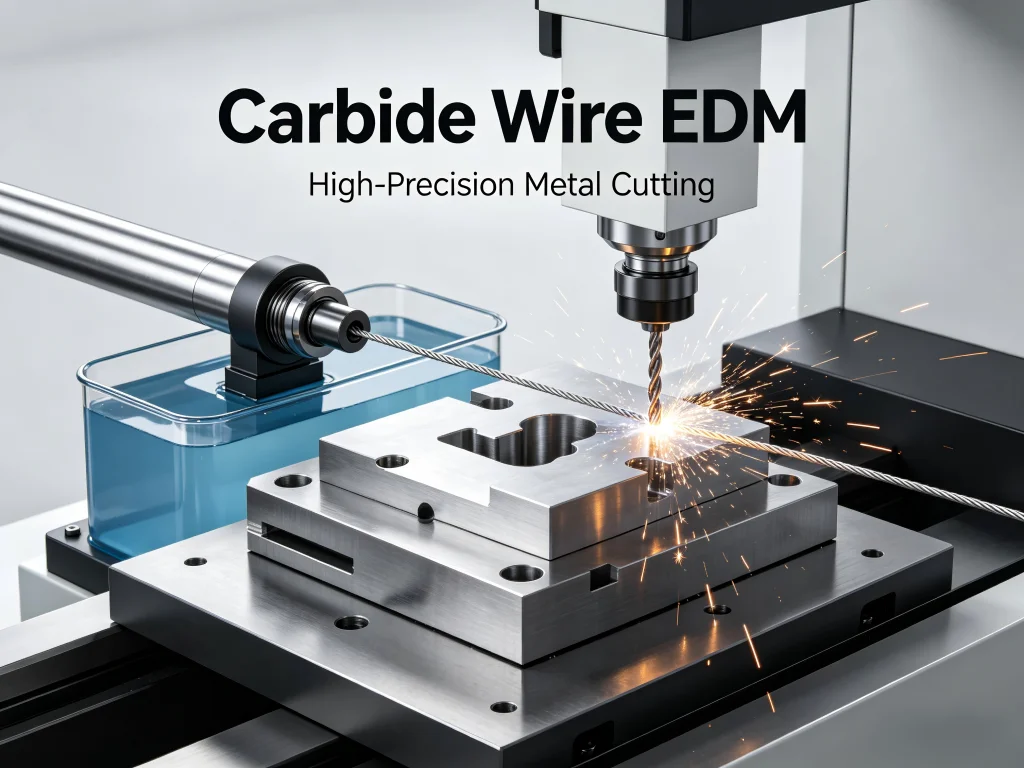
To truly grasp the value of this technology, one must first ask: can you edm carbide effectively? The answer lies in the physics of Electrical Discharge Machining (EDM). Unlike a mill or a lathe, a cnc edm wirecut machine uses a thin traveling wire, typically made of brass or coated copper, to act as an electrode. This wire never actually touches the workpiece. Instead, a high-frequency electrical current creates a series of sparks between the wire and the material, submerged in a dielectric fluid—usually deionized water.
When performing a carbide wire cut , the spark erodes the material by melting and vaporizing small particles. For tungsten carbide, this process is particularly nuanced. Tungsten carbide is a composite material consisting of hard carbide particles held together by a metallic binder, usually cobalt. A common concern in the industry is cobalt leaching. If the electrical parameters are not perfectly tuned, the dielectric fluid can chemically react with the binder, weakening the structural integrity of the finished part. Professional setups, such as those utilized by Jucheng, employ AC (Alternating Current) power supplies or “anti-electrolysis” circuits to prevent this degradation, ensuring that tungsten carbide wire edm results in a surface that is both smooth and structurally sound.
The edm wire cut wire itself is a critical component. It must possess high tensile strength to maintain stability under tension and high conductivity to deliver the necessary energy. As the wire moves through the guide system, it provides a fresh cutting surface constantly, which is why wire edm carbide can achieve such tight tolerances—often within 0.002mm. This level of repeatability is virtually impossible to achieve through manual grinding or traditional CNC milling on such hard substrates.
Module 2: Core Application Scenarios Across Industries
The versatility of carbide wire edm makes it indispensable in sectors where failure is not an option. Because it can cut complex geometries through thick sections of hardened material, its applications are vast and varied. Many professionals on platforms like Reddit and specialized machining forums often discuss the transition from traditional tool steels to carbide components for high-volume production, noting that the initial cost is offset by the longevity of the parts.
- Progressive Die and Mold Making: In the hardware and stamping industry, dies must withstand millions of cycles. Edm carbide components are used to create the punching and forming elements of these dies. The ability to create sharp internal corners and intricate profiles allows for the production of complex electronic connectors and automotive clips.
- Aerospace and Defense: Components that operate in high-temperature or high-stress environments often utilize tungsten carbide. Cnc edm wirecut technology is used to manufacture fuel injection nozzles and turbine blade components where precision is measured in microns.
- Medical Device Manufacturing: Surgical instruments and implants require biocompatible materials that are often incredibly hard. The non-contact nature of wire edm carbide ensures that no mechanical stress is introduced into these delicate parts during the shaping process.
- Precision Tooling: Custom end mills, inserts, and wear parts are frequently shaped using carbide wire cut methods. This ensures that the cutting edge is perfectly formed before final polishing.
One might also wonder: can you wire edm graphite for similar applications? While graphite is often used as an electrode material in Sinker EDM, in the context of wire EDM, it is less common for structural parts. However, the ability to cut conductive materials regardless of their hardness remains the primary draw of the carbide wire edm process. Jucheng’s facility handles these diverse applications by matching the specific grade of carbide to the most efficient machining strategy, ensuring optimal performance for every client.
Module 3: Critical Selection Factors for Procurement and Design
Choosing a partner for carbide wire edm or selecting the right equipment involves more than just looking at a price tag. Several technical and logistical factors determine the success of a project. When evaluating a service provider or a machine, consider the following parameters in this detailed comparison table:
| Feature | Standard Wire EDM | High-Precision Carbide Wire EDM | Impact on Quality |
|---|---|---|---|
| Power Supply | DC (Direct Current) | AC / Anti-Electrolysis | Prevents cobalt leaching and surface micro-cracking. |
| Surface Finish (Ra) | 0.8 – 1.2 µm | 0.1 – 0.2 µm | Reduces the need for secondary polishing and improves wear life. |
| Positional Accuracy | +/- 0.005 mm | +/- 0.002 mm | Ensures perfect fit in multi-component assemblies. |
| Wire Type | Standard Brass | Zinc-Coated / High-Tensile | Faster cutting speeds and better corner geometry. |
Beyond the hardware, one must ask: how fast does wire edm cut ? This is a vital factor in lead times. Generally, wire EDM is a slower process than milling, with speeds ranging from 100mm² to 300mm² per minute depending on the material thickness and desired finish. However, when you factor in that tungsten carbide wire edm eliminates the need for post-heat treatment (as the material is machined in its hardened state), the overall production cycle may actually be shorter. At Jucheng, we optimize these speeds by utilizing multi-pass cutting strategies—a roughing cut followed by several skim cuts to achieve the ultimate surface integrity.
Reliability and certification are also paramount. A provider should ideally hold ISO 9001 certifications and have a robust quality control department equipped with CMM (Coordinate Measuring Machines) and optical comparators. This ensures that the edm carbide parts delivered match the digital CAD files exactly. Jucheng’s commitment to quality involves rigorous inspection at every stage, from material sourcing to final packaging.
Module 4: Installation, Setup, and Maintenance Brief
For those integrating cnc edm wirecut capabilities into their own facilities, maintenance is the cornerstone of consistency. Unlike a mill that needs its oil changed and tools sharpened, an EDM machine’s health is determined by its fluid and electrical components. The dielectric system is the “blood” of the machine. It must be kept at a consistent temperature; even a one-degree fluctuation can cause thermal expansion in the workpiece, ruining a high-precision carbide wire edm job.
- Filter Management: The eroded carbide particles are microscopic. If the filters are saturated, these particles can cause “arcing,” which damages both the wire and the workpiece. Regular filter changes are mandatory.
- Resin Deionization: The water must be non-conductive to act as an insulator until the spark is triggered. Monitoring the conductivity levels and replacing the deionizing resin is critical for wire edm carbide precision.
- Power Feed Contacts: These components transfer electricity to the moving wire. Over time, the wire wears a groove into the contact. Rotating or replacing these contacts ensures a stable electrical discharge.
- Wire Alignment: The verticality of the wire must be calibrated using a square or an automated alignment tool. In tungsten carbide wire edm , even a slight tilt can lead to parts that do not fit their intended housings.
Proper maintenance ensures that when you ask how fast does wire edm cut , the machine performs at its peak rated speed without wire breaks. Jucheng maintains a strict preventative maintenance schedule for all our equipment, ensuring that our clients’ projects are never delayed by avoidable mechanical failures.
Module 5: FAQ – Addressing Common Concerns in Carbide Machining
1. Can you EDM carbide without it cracking?
Yes, provided you use a machine with an anti-electrolysis circuit. Traditional EDM could cause “heat-affected zones” (HAZ) and micro-cracking due to the thermal shock. Modern carbide wire edm settings use extremely short pulse durations to minimize the HAZ, preserving the material’s toughness.
2. Is tungsten carbide wire edm more expensive than machining tool steel?
Generally, yes. Carbide is more expensive as a raw material, and the cutting speed is often slower than that for steel. However, the resulting tool life is significantly longer, making it more cost-effective for high-volume production or high-wear applications.
3. How does the wire thickness affect the process?
Thinner wires (down to 0.05mm) allow for smaller internal radii but are more prone to breaking and cut slower. Most cnc edm wirecut operations use 0.20mm or 0.25mm wire for an optimal balance of speed and precision.
4. Can you wire edm graphite electrodes?
While can you wire edm graphite is a common question, the answer is yes. Graphite is conductive and cuts very easily. However, it is messy and requires specialized filtration to prevent the fine carbon dust from contaminating the machine’s dielectric system.
5. What kind of surface finish can I expect?
With multiple skim passes, carbide wire cut parts can achieve a mirror-like finish with an Ra of 0.1 µm. This is often smooth enough to eliminate the need for manual lapping.
6. Does the process affect the magnetism of the carbide?
Standard wire EDM does not significantly alter the magnetic properties, but the presence of cobalt in the binder means some grades may be slightly magnetic regardless. The electrical process itself does not “magnetize” the part permanently.
7. How thick can a piece of carbide be for wire EDM?
Modern machines can cut through material several hundred millimeters thick. However, maintaining vertical accuracy becomes more challenging as the thickness increases due to wire “bowing.”
8. Why is deionized water used instead of oil?
While some Sinker EDM machines use oil, most wire edm carbide machines use deionized water because it cools the wire more effectively and allows for faster flushing of debris from the narrow kerf.
Module 6: Why Jucheng is Your Premier Partner for Carbide Wire EDM
When searching for a manufacturing partner, expertise in difficult-to-machine materials is the ultimate differentiator. Jucheng has spent years refining the carbide wire edm process, moving beyond simple cutting to become a true research and application leader. Our facility is equipped with state-of-the-art cnc edm wirecut technology that is specifically calibrated for the unique challenges of tungsten carbide.
What sets Jucheng apart is our holistic approach. We don’t just take a drawing and run a machine; we analyze the application. Our engineers may suggest a specific grade of edm carbide that better suits your wear requirements or recommend a design tweak that makes the wire edm carbide process more efficient and cost-effective. We understand the nuances of cobalt leaching and have implemented strict water chemistry controls to ensure that every part leaving our floor maintains its metallurgical integrity.
Our commitment to the “Jucheng Standard” means transparency in lead times, uncompromising quality control, and a customer-centric communication style. Whether you are dealing with a complex aerospace component or a simple but high-precision wear part, our team treats every micron with the respect it deserves. By choosing Jucheng, you are not just getting a part; you are getting a precision-engineered solution backed by a decade of expertise in carbide wire cut technology.
The landscape of manufacturing is constantly evolving, but the need for hardness and precision remains constant. Carbide wire edm stands at the intersection of these needs. By leveraging the latest in electrical discharge technology, Jucheng continues to push the boundaries of what is possible, turning the “unmachinable” into reality. If your next project demands the extreme durability of tungsten carbide and the absolute precision of wire EDM, look no further than the experts who understand the science behind the spark.
Ready to Elevate Your Precision Machining?
Contact Jucheng today for a detailed consultation on your next carbide wire edm project. Our technical experts are ready to provide the accuracy and reliability your industry demands.
Email: info@jccncmachining.com
Visit us: www.jccncmachining.com