
In the high-stakes world of precision engineering, manufacturers often encounter a recurring wall: how to finish workpieces that have already been heat-treated to hardness levels exceeding 45 HRC. For decades, the industry standard was cylindrical grinding, a process known for its accuracy but equally notorious for its slow cycle times, high setup costs, and environmental challenges regarding coolant disposal. However, as global supply chains tighten and the demand for “faster-to-market” components grows, many engineers are turning to hard turning services as a more agile, cost-effective, and precise alternative. This transition is not merely a change in tooling; it represents a fundamental shift in how we approach the manufacturing of hardened steel components.
At Jucheng, we have observed a significant uptick in inquiries from sectors like automotive transmission and aerospace, where the need for turning advance engineering has become paramount. Users on platforms like Reddit’s r/Machining and various Facebook engineering groups often debate the feasibility of turning versus grinding. The consensus is shifting: if you have the right machine rigidity and specialized inserts, hard turning services could potentially reduce your production costs by up to 30% while maintaining the tight tolerances required for critical assemblies.
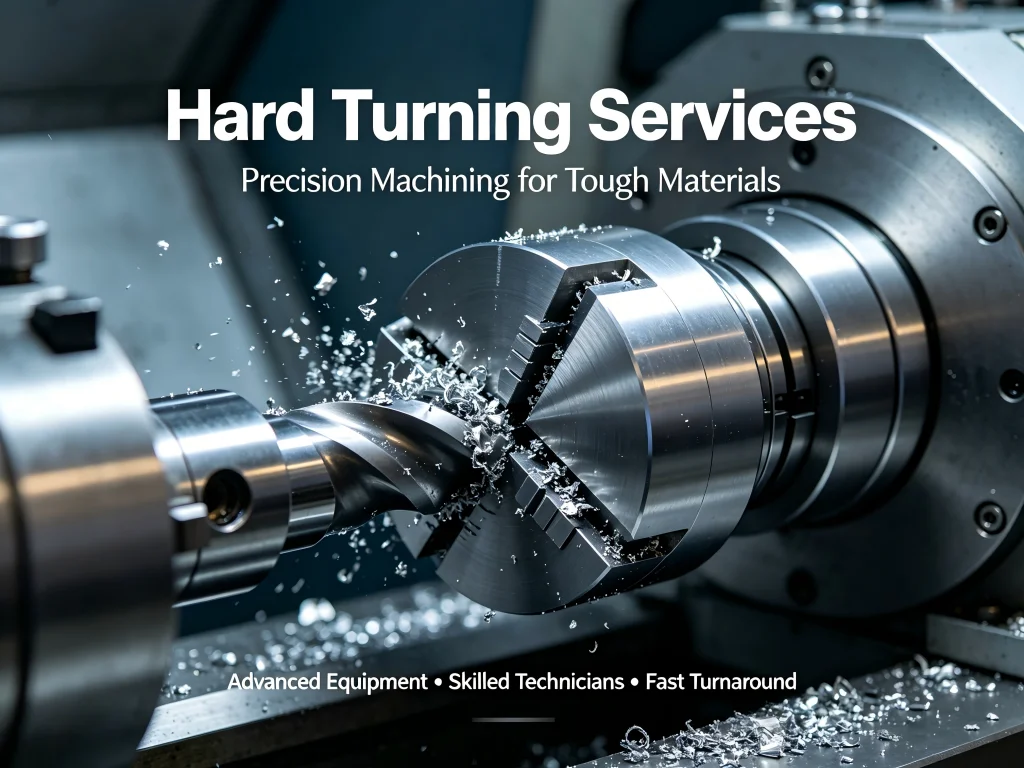
The Dilemma: The Hidden Costs of Conventional Grinding
The primary problem facing modern workshops is the “bottleneck effect” created by grinding stations. Grinding requires specialized machines that are often slower to set up and require expensive abrasive wheels that must be dressed frequently. Furthermore, grinding is generally a multi-setup process. You turn the part in its soft state, heat treat it, and then move it to a different machine for grinding. This movement between workstations introduces opportunities for dimensional errors and increases lead times. In regions like turning penang, where the semiconductor and medical device industries demand rapid prototyping, these delays may be unacceptable for maintaining a competitive edge.
Moreover, the environmental impact of grinding sludge is a growing concern. The mixture of metal chips and abrasive particles creates a waste stream that is difficult and expensive to recycle. By contrast, hard turning services produce dry chips that are easily reclaimed. This shift aligns with the broader industry trend toward “green machining,” where reducing the reliance on heavy coolants is a priority for sustainability and maintenance hard protocols.
Module 1: Defining Hard Turning and Its Core Principles
What exactly defines hard turning services? Technically, it is the process of single-point turning of parts with a hardness higher than 45 HRC, typically ranging up to 65 or 70 HRC. While traditional turning uses carbide tools to cut relatively soft materials, hard turning utilizes advanced cutting tool materials—most notably Polycrystalline Cubic Boron Nitride (PCBN) and ceramics.
The Mechanics of the Cut
Unlike soft turning, where the tool shears the metal, hard turning relies heavily on the generation of heat in the cutting zone to soften the material locally. This might sound counterintuitive, but the high pressure and temperature (which can reach over 700°C) actually allow the PCBN tool to slice through the hardened surface. The majority of this heat is carried away by the chips, leaving the workpiece thermally stable. This is why turning advance engineering requires machines with exceptional damping properties and thermal compensation to ensure that the microscopic expansion of the tool or spindle does not compromise the final dimensions.
Key Tooling Materials
- PCBN (Polycrystalline Cubic Boron Nitride): The gold standard for hard turning services. It maintains its hardness at extremely high temperatures and offers incredible wear resistance.
- Ceramics (Al2O3 and Si3N4): Often used for roughing operations or specific alloys where chemical stability is required at high speeds.
- Cermets: Occasionally used for finishing cuts on the lower end of the “hard” spectrum (45-50 HRC).
Module 2: Core Application Scenarios Across Key Industries
The versatility of hard turning services allows it to span multiple high-growth sectors. By integrating these services, Jucheng helps clients bridge the gap between design complexity and manufacturing reality.
1. Automotive Industry
In automotive manufacturing, hard turning services are indispensable for components such as gear shafts, fuel injection needles, and CV joints. These parts require a high surface finish to minimize friction and wear. Using a CNC lathe for these components allows for complex geometries, such as contours and grooves, to be machined in a single setup—something that would require multiple grinding wheels in a traditional setup.
2. Bearing and Tooling Manufacture
The bearing industry relies on turning penang facilities to produce inner and outer races with high roundness accuracy. Hard turning allows for the creation of “super-finished” surfaces that can often bypass the need for subsequent honing or polishing, depending on the application’s noise and vibration requirements.
3. Aerospace and Defense
Aerospace components often use hardened alloys that must withstand extreme stress. Here, turning advance engineering is used to manufacture landing gear components and turbine shafts. The ability to maintain traceability and consistency in a CNC environment is a significant advantage for hard building services in the aerospace sector.
Table 1: Hard Turning vs. Cylindrical Grinding Comparison
| Feature | Hard Turning Services | Cylindrical Grinding |
|---|---|---|
| Surface Finish (Ra) | 0.2 to 0.8 μm | 0.1 to 0.4 μm |
| Setup Time | Low (Uses standard CNC tooling) | High (Wheel dressing and balancing) |
| Geometry Flexibility | High (Single-point tool follows path) | Low (Limited by wheel shape) |
| Environmental Impact | Eco-friendly (Dry chips) | High (Grinding sludge/coolant) |
| Capital Investment | Moderate (Standard high-end CNC) | High (Dedicated grinding machines) |
Module 3: Critical Buying Factors for Hard Turning Services
When selecting a partner for your machining needs, not all hard turning services are created equal. It is vital to evaluate several technical and operational factors to ensure the final product meets your specifications.
1. Machine Rigidity and Damping
Hard turning exerts significant tool pressure. If the machine tool lacks rigidity, vibration will occur, leading to poor surface finish and premature tool failure. Look for providers like Jucheng who utilize heavy-duty machine bases and high-precision spindles. A machine designed for turning advance engineering must be able to withstand these forces without deflection.
2. Tooling Expertise
The choice of PCBN grade is a science in itself. Different grades are optimized for continuous cutting versus interrupted cutting (like turning a gear with teeth). A sophisticated provider will have a deep understanding of tool geometry, such as the use of wiper inserts to achieve grinding-like finishes at higher feed rates.
3. Quality Assurance and Certification
Does the facility have ISO 9001 or AS9100 certifications? For international clients, understanding the administrative side is also important. For instance, in some regions, hardware maintenance subject to sst (Sales and Service Tax) can impact the total cost of ownership. Transparency in billing and compliance with local tax laws, especially in manufacturing hubs like Malaysia, ensures a smooth procurement process.
Module 4: Installation and Maintenance Guidelines for Precision Hardware
Even the most perfectly machined part can fail if the surrounding hard building services and maintenance protocols are ignored. Maintenance hard components require a specific approach to ensure longevity.
Installation Best Practices
- Thermal Stability: Ensure that parts are allowed to reach room temperature before final measurement and installation. The heat generated during hard turning, while mostly removed by chips, can still cause slight expansion.
- Cleanliness: Hard-turned surfaces are often highly polished. Any abrasive particles left from the workshop environment can act as a grinding paste, destroying the surface finish during initial startup.
Ongoing Hardware Maintenance
For the machinery itself, hardware maintenance subject to sst in countries like Malaysia involves regular calibration of CNC axes. Because hard turning relies on micron-level precision, the maintenance hard schedule must include checks on spindle runout and ballscrew backlash every 500 operating hours. Neglecting this leads to a gradual “drift” in part quality that can be difficult to diagnose.
Module 5: FAQ – Addressing Common Concerns in Hard Turning
Q1: Can hard turning truly achieve the same finish as grinding?
In many cases, yes. With the use of wiper technology and optimized PCBN inserts, hard turning services can achieve a surface finish (Ra) of 0.2 to 0.4 microns, which is sufficient for most automotive and industrial applications. However, for “mirror finishes” below 0.1 Ra, grinding or lapping may still be required.
Q2: Is hard turning more expensive due to the cost of PCBN tools?
While a single PCBN insert costs significantly more than a carbide one, the overall cost per part is often lower. This is because hard turning reduces cycle times, eliminates the need for multiple machines, and reduces waste disposal costs. When you factor in the total turning advance engineering workflow, it is usually the more economical choice.
Q3: What materials are suitable for hard turning?
Most hardened steels, including high-speed steel, die steel (like D2 or H13), bearing steel (like 52100), and various case-hardened alloys, are excellent candidates for hard turning services. The material should ideally be above 45 HRC for the process to be most effective.
Q4: Why is my tool life so short when turning hardened steel?
This is a common discussion point on Facebook machining groups. Short tool life is usually caused by insufficient machine rigidity, incorrect cutting speeds, or the wrong grade of PCBN. It may also be due to using coolant; in hard turning, dry machining is often preferred to prevent “thermal shock” to the ceramic or PCBN insert.
Q5: Are there limitations to the shapes that can be hard turned?
The main limitation is the aspect ratio of the part. Because hard turning involves higher cutting forces than grinding, long, thin parts may deflect. In these cases, specialized steady rests or hard building services in terms of custom work-holding are necessary.
Q6: How does Jucheng handle the turning penang market requirements?
We provide localized support and rapid turnaround times for the turning penang industrial corridor, ensuring that our high-precision components meet the strict lead times of the electronics and medical sectors located there.
Module 6: Why Choose Jucheng for Your Hard Turning Services?
Choosing Jucheng means partnering with a leader in turning advance engineering. We don’t just “cut metal”; we provide a comprehensive manufacturing solution tailored to your specific pain points. Our facility is equipped with state-of-the-art CNC lathes that offer the extreme rigidity necessary for consistent hard turning.
Our competitive advantage lies in our experience. We have spent years refining our PCBN tool paths to maximize tool life and minimize surface roughness. Furthermore, our understanding of the logistics and administrative landscapes—including hardware maintenance subject to sst and international shipping protocols—makes us a reliable partner for global OEMs. We pride ourselves on our hard building services, which include custom jig and fixture design to ensure that even the most complex hardened parts are held securely and machined accurately.
Whether you are struggling with the slow speeds of grinding or looking to optimize your maintenance hard schedules, Jucheng provides the technical expertise and machine capacity to elevate your production quality. We offer a level of precision that “budget” shops simply cannot match, backed by a rigorous quality control process that includes CMM verification for every batch.
The Jucheng Commitment to Quality
Every project we undertake for hard turning services is subjected to a “Design for Manufacturability” (DFM) review. We may suggest slight modifications to your part’s geometry that could significantly reduce machining time without compromising function. This consultative approach is what defines turning advance engineering at Jucheng.
For more information on our capabilities, you can explore our CNC Machining Overview or visit the Modern Machine Shop for a deep dive into the technical standards of the industry.
Ready to Optimize Your Production?
Stop letting grinding bottlenecks slow down your growth. Discover how Jucheng’s hard turning services can deliver precision components with shorter lead times and lower costs. Contact our engineering team today for a technical consultation or a quote on your next project.
Email: info@jccncmachining.com | Website: www.jccncmachining.com