
This guide does not rank the processes. It classifies the part architecture, shows how tolerances accumulate differently, and explains when a hybrid chassis with machined interfaces is better than either route alone.
The Architecture Test: Shell or Precision Structure?
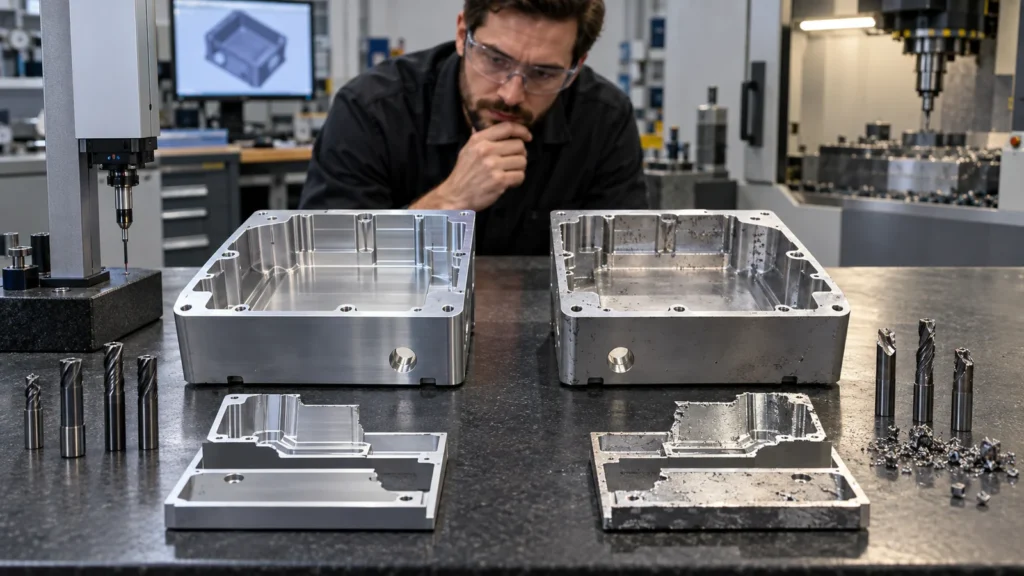 A shell encloses, shields, guides airflow, carries labels, or supports light hardware across a relatively large surface area. Its strength comes from folds, flanges, beads, hems, and assembled panels. Sheet metal fabrication creates this architecture efficiently from flat stock through cutting, punching, bending, hardware insertion, welding, and finishing.
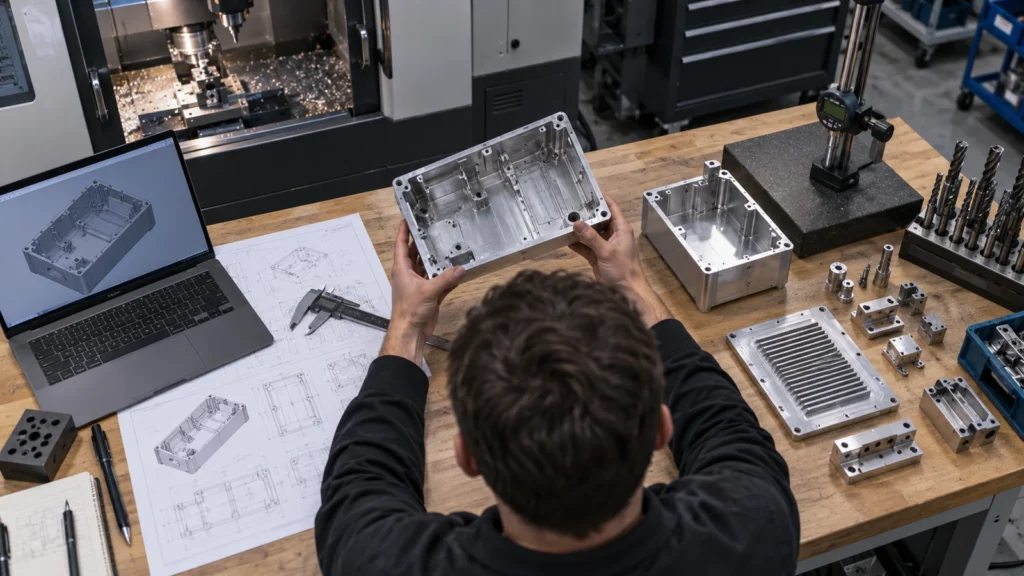
A precision structure locates components through machined relationships. It may combine bearing seats, dowel holes, gasket grooves, thick local bosses, rails, heat-transfer faces, or complex internal clearances in one body. CNC machining creates those features directly from stock and can keep related geometry within a controlled setup strategy.
Many products contain both. The design task is to decide which volume acts as a shell and which interfaces act as precision structure. Once that split is clear, process selection becomes much less subjective.
A shell encloses, shields, guides airflow, carries labels, or supports light hardware across a relatively large surface area. Its strength comes from folds, flanges, beads, hems, and assembled panels. Sheet metal fabrication creates this architecture efficiently from flat stock through cutting, punching, bending, hardware insertion, welding, and finishing.
A precision structure locates components through machined relationships. It may combine bearing seats, dowel holes, gasket grooves, thick local bosses, rails, heat-transfer faces, or complex internal clearances in one body. CNC machining creates those features directly from stock and can keep related geometry within a controlled setup strategy.
Many products contain both. The design task is to decide which volume acts as a shell and which interfaces act as precision structure. Once that split is clear, process selection becomes much less subjective.
Two Processes, Two Error Stacks
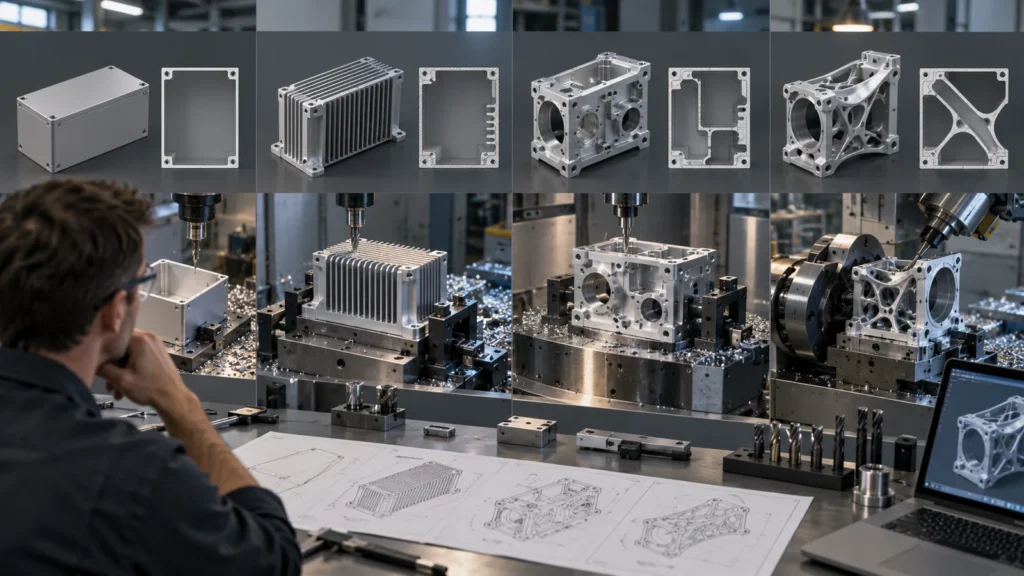 A machined part accumulates variation through stock condition, workholding, tool deflection, setup transfer, material movement, and measurement. A sheet metal assembly accumulates variation through cut blank dimensions, bend angle and radius, material thickness, grain direction, springback, tooling, hardware insertion, weld distortion, and assembly sequence. Applying a machined tolerance philosophy to a chain of bends can make an otherwise functional enclosure unnecessarily expensive.
Dimension sheet metal from functional datums and avoid long chained dimensions across multiple bends. Decide whether a hole is cut before bending, created after bending, or placed in a secondary machining operation. On CNC parts, group critical relationships into setups that preserve datum continuity. In both routes, the drawing should control function rather than every visible edge equally.
A machined part accumulates variation through stock condition, workholding, tool deflection, setup transfer, material movement, and measurement. A sheet metal assembly accumulates variation through cut blank dimensions, bend angle and radius, material thickness, grain direction, springback, tooling, hardware insertion, weld distortion, and assembly sequence. Applying a machined tolerance philosophy to a chain of bends can make an otherwise functional enclosure unnecessarily expensive.
Dimension sheet metal from functional datums and avoid long chained dimensions across multiple bends. Decide whether a hole is cut before bending, created after bending, or placed in a secondary machining operation. On CNC parts, group critical relationships into setups that preserve datum continuity. In both routes, the drawing should control function rather than every visible edge equally.
Four Enclosure Archetypes Point to Different Routes
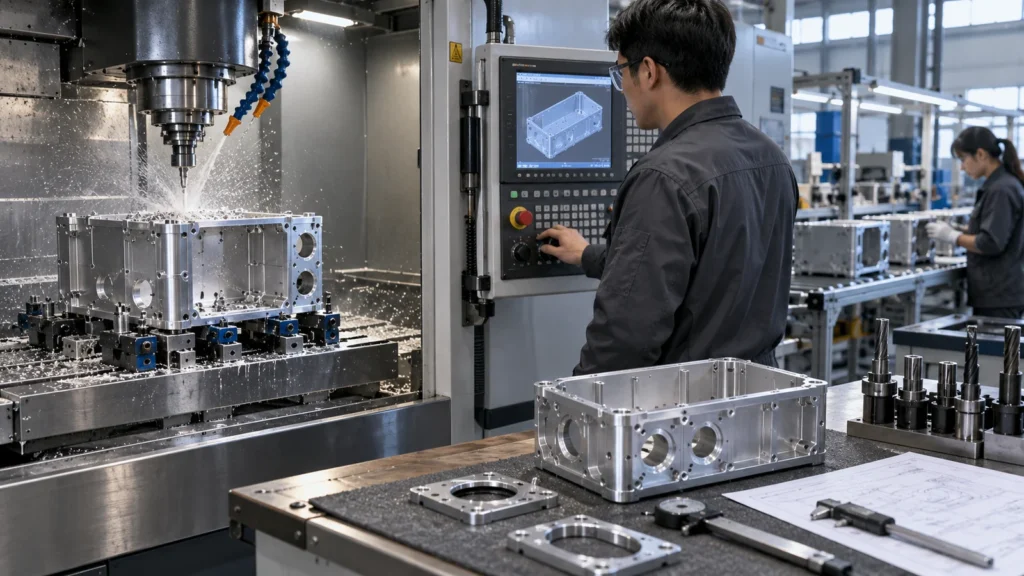
When the main job is protection, ventilation, electromagnetic shielding, and access, a bent cover with inserted hardware is usually more economical than a deeply pocketed billet. The design should respect bend relief, minimum flange needs, tool access, and finish coverage.
Sealed instrument housing
A gasket groove, controlled sealing land, threaded ports, connector locations, and internal component datums can favor a machined body. A separate sheet metal cover may still close the assembly, creating a practical mixed architecture.
Machine guard or large cabinet
Large surface area and moderate interface precision strongly favor sheet metal panels, frames, and welded or fastened assemblies. Machined blocks should be reserved for hinges, latches, rails, or alignment points that justify them.
Thermal or structural base
When the enclosure base also spreads heat, locates optics, supports motion components, or resists local loads, a machined plate or housing may be necessary. The remaining noncritical walls can stay fabricated.
Protect the Interfaces First
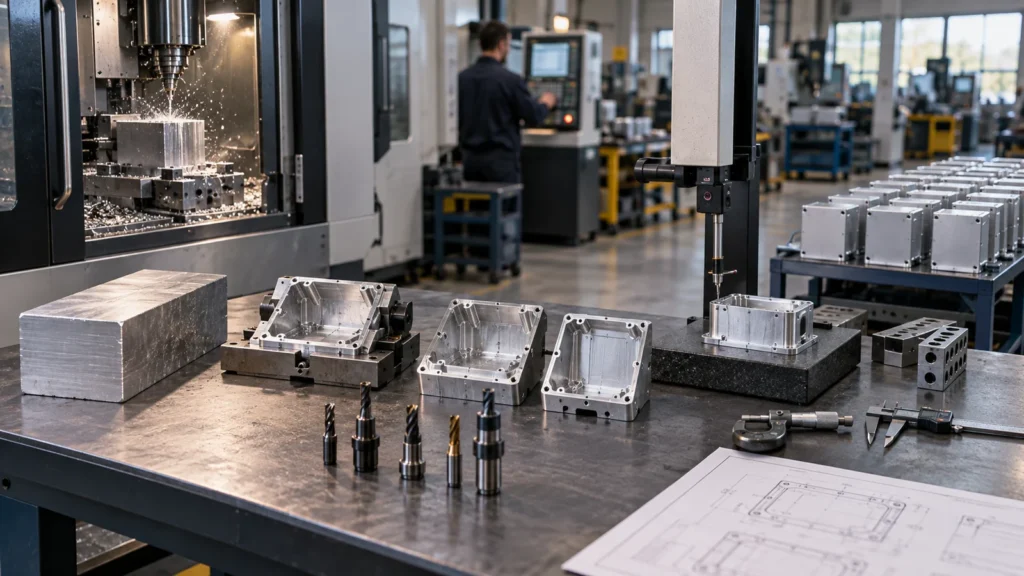 List every feature that controls assembly or performance: rail seats, PCB standoffs, connector cutouts, hinge axes, gasket lands, fan openings, grounding contacts, display windows, motor mounts, or datum holes. Then classify each as formed, cut, welded, inserted, or machined. This feature map exposes where a nominally cheaper fabrication route accumulates secondary operations.
Welding can introduce distortion around critical faces; coating can change grounding and fit; inserted hardware can rotate or pull out; bend variation can move hole patterns. Machining can avoid some of those risks but may create thin-wall distortion, inaccessible corners, and long cycle time. The process plan should assign inspection at the stage where a feature becomes final.
For assemblies with demanding relationships, use the principles in CNC tolerance planning only on the interfaces that need them. Do not apply precision-machined limits to the entire fabricated envelope.
List every feature that controls assembly or performance: rail seats, PCB standoffs, connector cutouts, hinge axes, gasket lands, fan openings, grounding contacts, display windows, motor mounts, or datum holes. Then classify each as formed, cut, welded, inserted, or machined. This feature map exposes where a nominally cheaper fabrication route accumulates secondary operations.
Welding can introduce distortion around critical faces; coating can change grounding and fit; inserted hardware can rotate or pull out; bend variation can move hole patterns. Machining can avoid some of those risks but may create thin-wall distortion, inaccessible corners, and long cycle time. The process plan should assign inspection at the stage where a feature becomes final.
For assemblies with demanding relationships, use the principles in CNC tolerance planning only on the interfaces that need them. Do not apply precision-machined limits to the entire fabricated envelope.
Cost Follows Operations—and Engineering Change
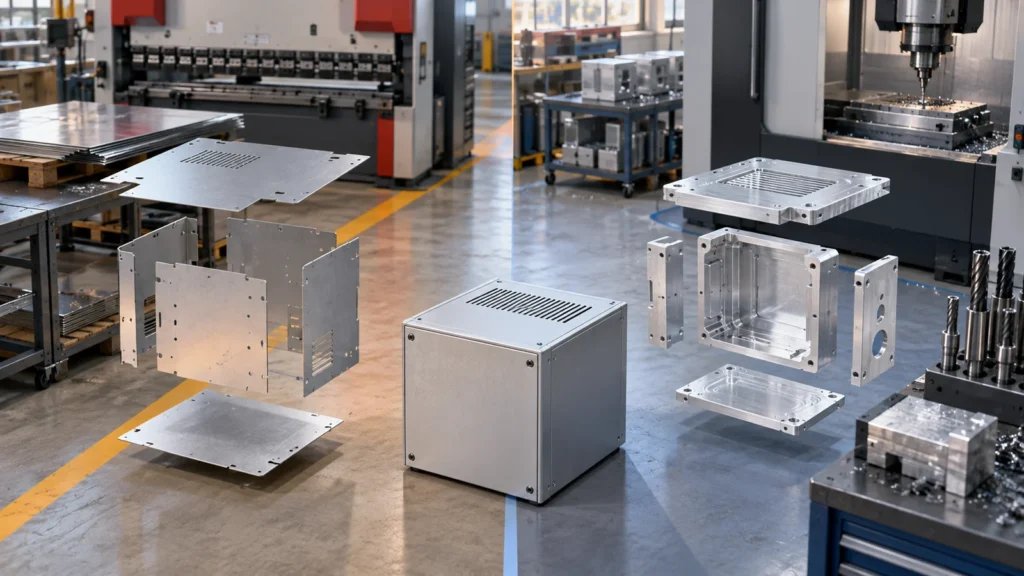 Sheet metal cost is not only material and laser time. Count programming, nesting, punching, bending setups, special tooling, hardware, welding, grinding, cleaning, finishing, assembly, and inspection. CNC cost includes stock, programming, setups, material removal, tools, deburring, finish, and inspection. A low-cost blank can become an expensive assembly after repeated handling.
Change sensitivity differs by route. Moving a cutout may be simple before dedicated punches or forming tools are committed. Changing a machined pocket may be straightforward until it affects workholding or tool access. A fair quote comparison includes the current revision maturity and likely change path, not just the first batch.
Sheet metal cost is not only material and laser time. Count programming, nesting, punching, bending setups, special tooling, hardware, welding, grinding, cleaning, finishing, assembly, and inspection. CNC cost includes stock, programming, setups, material removal, tools, deburring, finish, and inspection. A low-cost blank can become an expensive assembly after repeated handling.
Change sensitivity differs by route. Moving a cutout may be simple before dedicated punches or forming tools are committed. Changing a machined pocket may be straightforward until it affects workholding or tool access. A fair quote comparison includes the current revision maturity and likely change path, not just the first batch.
Materials and Finishes Do Not Transfer Directly
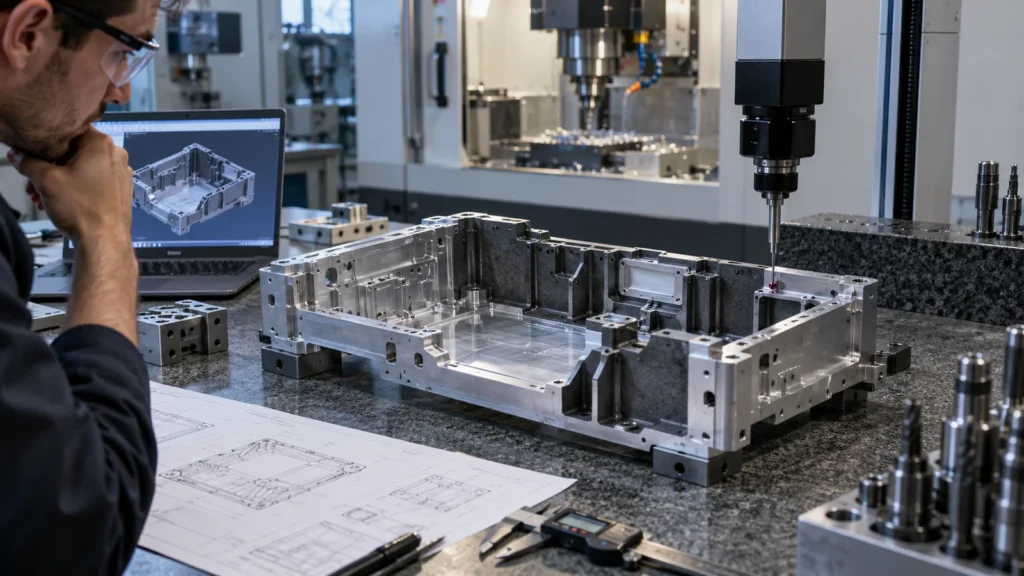 Sheet metal needs formable grades and thicknesses compatible with the bend route. CNC machining offers broader stock forms and allows local thickness, but the material must still be stable and machinable. A grade chosen for a machined prototype may not be the best bendable alternative, and a thin sheet alloy may not be available as a thick billet in the same condition.
Finishing affects both architecture and tolerances. Powder coating can bridge seams and protect broad panels but adds thickness around holes and mating edges. Anodizing depends on alloy, surface preparation, electrical contact, and masking. Brushing direction, weld blending, bead blasting, and cosmetic acceptance need zones. Review the surface finish options together with the fabrication sequence.
Sheet metal needs formable grades and thicknesses compatible with the bend route. CNC machining offers broader stock forms and allows local thickness, but the material must still be stable and machinable. A grade chosen for a machined prototype may not be the best bendable alternative, and a thin sheet alloy may not be available as a thick billet in the same condition.
Finishing affects both architecture and tolerances. Powder coating can bridge seams and protect broad panels but adds thickness around holes and mating edges. Anodizing depends on alloy, surface preparation, electrical contact, and masking. Brushing direction, weld blending, bead blasting, and cosmetic acceptance need zones. Review the surface finish options together with the fabrication sequence.
Designing a Hybrid Chassis
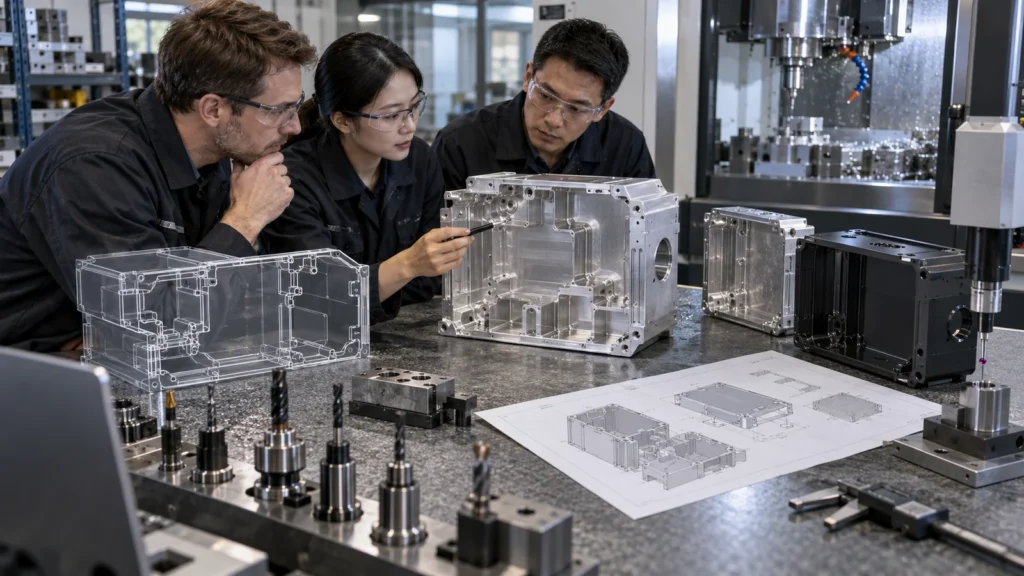 A hybrid design uses fabricated panels for area and machined parts for precision. Typical combinations include a bent chassis with machined rail blocks, a welded frame with post-machined mounting pads, a sheet metal cover on a machined thermal base, or a formed enclosure with machined connector plates.
Success depends on datum transfer. Decide how the machined element locates to the fabricated body, how tolerance accumulates at fasteners, whether adjustment is needed, and which component carries the master datum. Avoid using fasteners to force a distorted panel onto a precision base. Slots, floating nuts, shims, locating pins, or controlled interfaces can separate alignment from clamping.
The hybrid route should reduce total risk, not merely add parts. Compare assembly labor, supply coordination, leak or shielding seams, finish matching, and serviceability before splitting the design.
Thermal behavior can change the answer. A machined base can provide a continuous heat path and controlled contact face, while thin fabricated panels dissipate heat over area and support airflow. If the enclosure carries power electronics, identify where heat enters, which joints interrupt conduction, how coating affects contact, and whether fastener preload remains stable after cycling.
Electromagnetic compatibility introduces another system-level requirement. Sheet seams, ventilation openings, coatings, and grounding hardware influence shielding. A one-piece machined body can reduce seams but still needs conductive interfaces at covers and connectors. Review the manufacturing architecture with electrical and thermal requirements, not only mechanical CAD.
A hybrid design uses fabricated panels for area and machined parts for precision. Typical combinations include a bent chassis with machined rail blocks, a welded frame with post-machined mounting pads, a sheet metal cover on a machined thermal base, or a formed enclosure with machined connector plates.
Success depends on datum transfer. Decide how the machined element locates to the fabricated body, how tolerance accumulates at fasteners, whether adjustment is needed, and which component carries the master datum. Avoid using fasteners to force a distorted panel onto a precision base. Slots, floating nuts, shims, locating pins, or controlled interfaces can separate alignment from clamping.
The hybrid route should reduce total risk, not merely add parts. Compare assembly labor, supply coordination, leak or shielding seams, finish matching, and serviceability before splitting the design.
Thermal behavior can change the answer. A machined base can provide a continuous heat path and controlled contact face, while thin fabricated panels dissipate heat over area and support airflow. If the enclosure carries power electronics, identify where heat enters, which joints interrupt conduction, how coating affects contact, and whether fastener preload remains stable after cycling.
Electromagnetic compatibility introduces another system-level requirement. Sheet seams, ventilation openings, coatings, and grounding hardware influence shielding. A one-piece machined body can reduce seams but still needs conductive interfaces at covers and connectors. Review the manufacturing architecture with electrical and thermal requirements, not only mechanical CAD.
RFQ Checklist for a Fair Comparison
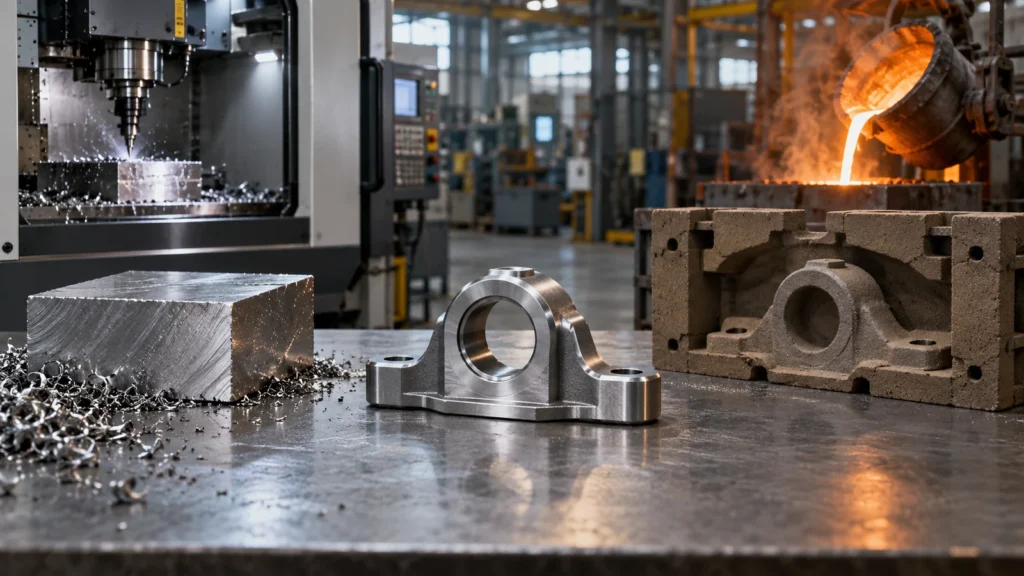
Ask suppliers to propose alternate architecture when the current design fights the process. The goal is to compare accepted assemblies, not force both routes to imitate each other. This feature-level approach also gives a more useful view of the advantages and disadvantages of CNC machining.
For larger assemblies, provide a datum-flow sketch showing how the enclosure locates to the product and how internal components locate to the enclosure. This helps distinguish cosmetic envelope from alignment structure and reveals whether adjustability, shims, slots, or post-assembly machining are more economical than demanding tighter fabrication variation.
Buyer FAQs
It can hold appropriate requirements, but hole location after bending depends on the datum scheme, bend variation, tooling, and whether the hole is created before or after forming. Critical patterns may need secondary machining or adjustment features.
Is a one-piece machined enclosure always stronger?
No. Strength depends on geometry, material, joints, loads, and boundary conditions. Folds and formed sections can be very stiff for their mass, while a machined body can integrate local load paths and avoid seams. Evaluate the actual load case.
When should a welded frame be machined?
Post-weld machining is useful when welding distortion would otherwise move rail seats, mounting pads, bore relationships, or other interfaces. The frame needs machining allowance and a stress-aware sequence.
Can the same drawing be quoted both ways?
The functional requirements can remain common, but each process benefits from a different manufacturing design. Invite controlled alternatives and require suppliers to identify every proposed geometry or tolerance change.