
CNC machining is often presented as a universal answer for precision parts, but the best manufacturing choice depends on geometry, material, quantity, performance, schedule, and total cost. CNC can offer accurate repeatable components without dedicated molding tooling, yet it also has limits: tools need physical access, material is removed rather than formed, complex setups can be expensive, and high-volume products may eventually need a different process. This balanced guide helps engineers and buyers decide where CNC creates value and where it introduces trade-offs.
Start with the Job, Not the Technology
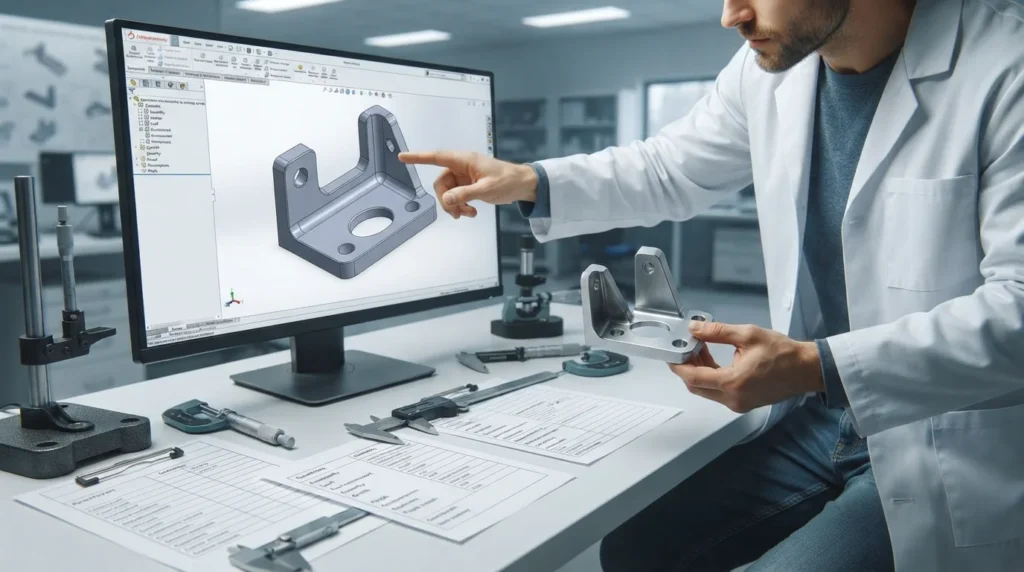
| Project need | Why CNC may fit | What still needs review |
|---|---|---|
| Functional prototype | No dedicated mold is normally needed and the part can represent the selected material | Geometry access, prototype cost, and whether the final process will behave differently |
| Low or medium volume | Digital programming and fixtures can support changing designs and moderate batches | Setup allocation, cycle time, and whether a forming process becomes economical later |
| Tight functional interfaces | Controlled toolpaths and planned inspection can support precision features | Datums, material behavior, thermal stability, and measurement method |
| Frequent revisions | Digital programs can be revised without rebuilding a dedicated forming tool | Revision control, reprogramming, fixture changes, and first-part verification |
For the process itself, see the site’s CNC machining process guide. The benefits and limitations below should be read against the specific product decision.
Where CNC Machining Creates Value
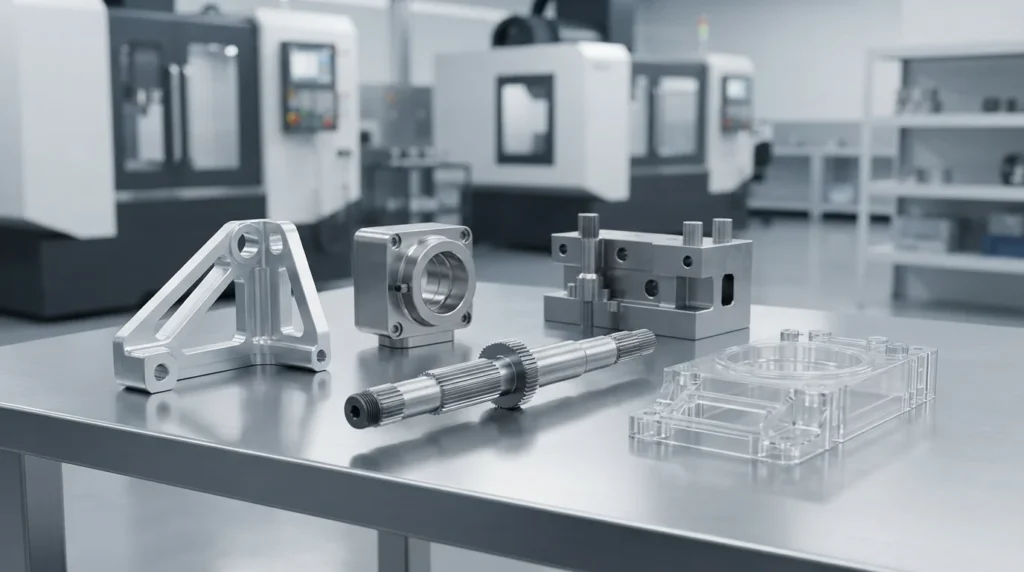
CNC machining can produce parts from many metal and engineering-plastic families, allowing the design team to select material behavior for load, weight, wear, heat, corrosion, electrical function, or appearance. The process can also accommodate a wide range of prismatic, rotational, and contoured geometries as long as tools and fixtures can reach the features.
2. Repeatable digital instructions
Once a process is reviewed and controlled, digital programs and documented setups can support repeatable production. Repeatability is valuable for assemblies, replacement parts, engineering builds, and products whose dimensions must remain consistent across a batch.
3. Low dedicated-tooling commitment
Unlike processes that require a dedicated mold or die before the first part, CNC often starts from stock material, tooling, workholding, and a programmed route. This can make it attractive for prototypes, custom components, and early production when the design is still changing.
4. Useful engineering feedback
A CNC supplier can identify tool access problems, deep pockets, thin walls, difficult datums, tolerance conflicts, and finishing risks before production. That feedback can improve the design while changes are still less expensive.
Where CNC Machining Reaches Its Limits
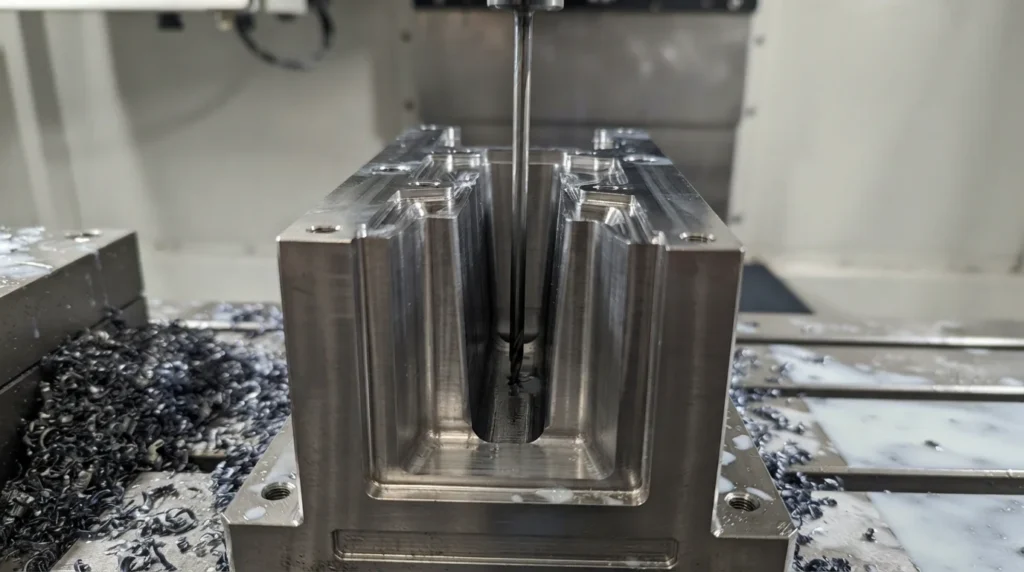
- Tool access: enclosed cavities, severe undercuts, deep narrow pockets, and sharp internal corners may need special tooling, multiple setups, or a different process.
- Material waste: a part cut from a large billet may require significant stock removal, creating time, chips, and yield cost.
- Setup burden: features spread across many faces can require repositioning, datum transfer, probing, and additional verification.
- Flexible features: thin walls, ribs, and plastic sections can deflect during cutting or measurement and may need careful support.
- High-volume economics: programming and setup may be less competitive than a forming process when demand is stable and volume is high enough to amortize tooling.
- Process dependence: tight tolerances, special finishes, difficult materials, and detailed reports can add time and cost even when the geometry is technically possible.
A limitation does not automatically mean “cannot make.” It may mean “requires a different route, a revised feature, a larger budget, or a more explicit acceptance plan.”
Volume, Tooling, and the Break-Even Question
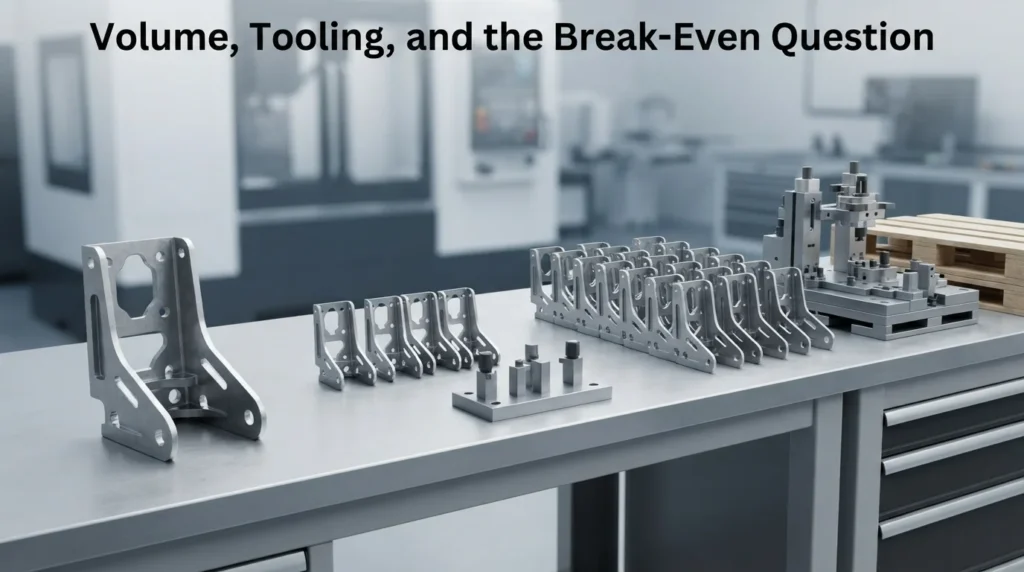
| Question | CNC advantage | Potential trade-off |
|---|---|---|
| Will the design change? | Program and fixture changes may be more flexible than new dedicated tooling | Each revision still needs engineering review and first-part verification |
| Is the quantity uncertain? | Avoids committing early to a large fixed tooling investment | Unit cost may remain higher than a mature high-volume route |
| Are parts highly customized? | Digital manufacturing supports part-to-part variation | Programming, setup, and inspection can be repeated for each variant |
Geometry and Material Trade-Offs
CNC design decisions are connected. A material chosen for heat or wear may require different tools and cutting strategies. A compact aesthetic shape may create deep pockets or poor access. A thin lightweight structure may need more support and a different inspection sequence.
Design for accessible cutting
Consider standard tool diameters, internal radii, pocket depth-to-width ratio, wall thickness, clamping surfaces, and the number of orientations. These changes can preserve function while reducing setup and toolpath complexity.
Choose material for service, not just machining
A free-cutting material may be easy to machine but unsuitable for load, temperature, wear, chemicals, or dimensional stability. Conversely, a more difficult material may be justified by its service performance. Compare the full life-cycle risk, not only the cutting rate. The CNC materials selection guide provides a requirement-first framework.
Precision Is a Process, Not a Promise
CNC’s accuracy and repeatability are valuable, but they are not automatic outcomes of the word “CNC.” Machine condition, thermal state, tool wear, workholding, material behavior, finishing, datums, and inspection all influence the result. A responsible evaluation connects the drawing requirement to a process and a measurement method.
For tight interfaces, define what is critical, which datum reference frame applies, whether dimensions are measured before or after finishing, and what inspection evidence is needed. Use the site’s quality information as a starting point for the quality discussion, while keeping the specific acceptance criteria in the controlled drawing and RFQ.
When Another Manufacturing Route May Fit Better
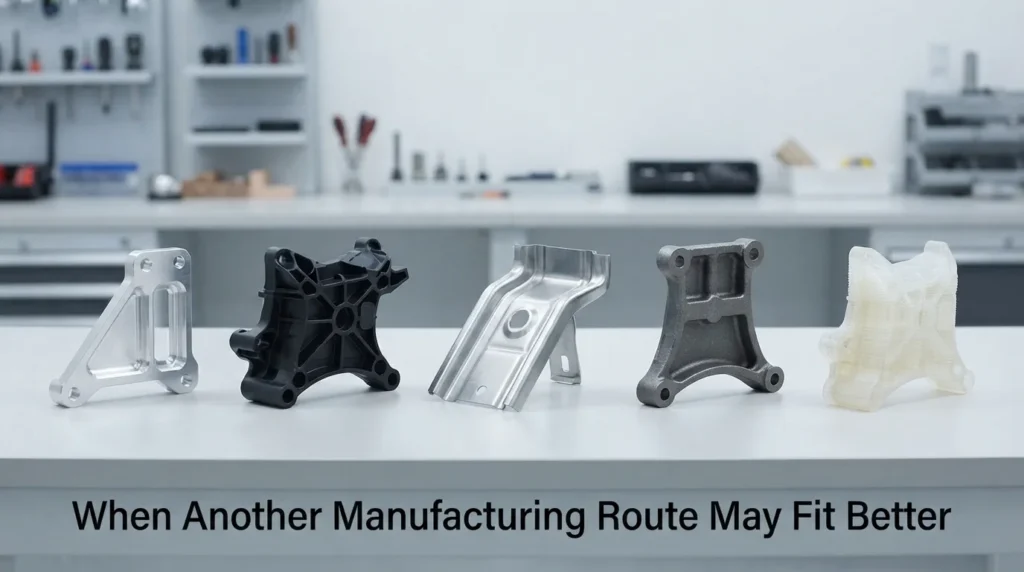
The comparison should include total tooling, design freedom, material properties, surface finish, tolerance, lead time, inspection, part price, revision cost, and supply risk. No alternative wins on one metric alone.
A Practical Selection Checklist
- Define the part’s function, environment, load, temperature, wear, and appearance.
- Record material, quantity, revision frequency, target schedule, and required evidence.
- Check tool access, internal radii, wall thickness, deep features, workholding, and setup count.
- Separate general dimensions from critical fits, datums, surfaces, and inspection features.
- Estimate the total route: programming, setup, stock, cutting, finishing, inspection, packaging, and logistics.
- Compare CNC with alternatives using the same functional and commercial assumptions.
- Ask a supplier for DFM feedback before locking the design or selecting a process.
If the project’s geometry, material, quantity, and quality requirements are ready, submit them through the CNC machining quote workflow for a route-specific review.
CNC Machining Pros and Cons FAQs
What are the main advantages of CNC machining?
CNC can provide digital repeatability, material flexibility, accurate functional features, low dedicated-tooling commitment, and useful support for prototypes, custom parts, and low-to-medium production. The actual benefit depends on geometry, material, quantity, and process control.
What are the main disadvantages of CNC machining?
Common trade-offs include material waste, tool-access limits, setup and programming cost, sensitivity to thin or flexible features, and reduced competitiveness for some very high-volume products. Tight finishing and inspection requirements can add more time and cost.
Is CNC machining good for prototypes?
It can be a strong option when the prototype needs the selected production material, functional interfaces, realistic strength, or a quick design revision cycle. The team should still check whether the eventual production process will introduce different shrinkage, texture, or material behavior.
Is CNC machining economical for high-volume production?
It can be, especially for complex or customized parts, but the answer depends on cycle time, setup, material yield, quantity, and alternatives. As volume becomes stable and high, compare CNC with processes whose tooling cost can be spread across the forecast demand.
How do I decide whether CNC is right for my part?
Compare function, geometry, material, tolerance, finish, quantity, schedule, inspection, tooling, and total cost. Ask a supplier to review tool access, setups, material behavior, and quality risks before committing to the route.