
“Break all sharp edges” sounds precise until a supplier has to decide how much material to remove from a bearing shoulder, how to treat a cross-hole burr, or whether a visible corner should be a radius or a chamfer. The note identifies an intention—remove dangerous or unwanted sharpness—but often leaves the acceptable geometry and inspection condition open to interpretation.
Separate edge break, chamfer, and radius
These terms are related but not interchangeable. An edge break generally means removing the sharp intersection without necessarily defining a specific geometric form. A chamfer specifies a beveled face, usually with a size and sometimes an angle. A radius defines a curved transition. A deburr instruction addresses unwanted raised material left by machining; it does not by itself define the final edge size.
| Drawing language | What it communicates | What may still be unclear |
|---|---|---|
| Break sharp edges | Remove sharpness generally | Maximum or minimum edge removal; treatment of critical edges |
| Chamfer with size and angle | Defined bevel geometry | Measurement tolerance and whether all edges are included |
| Radius with size | Defined rounded geometry | Transition limits, edge accessibility, and inspection method |
| Remove burrs | Eliminate raised material from cutting | Permitted edge condition after removal and burr direction control |
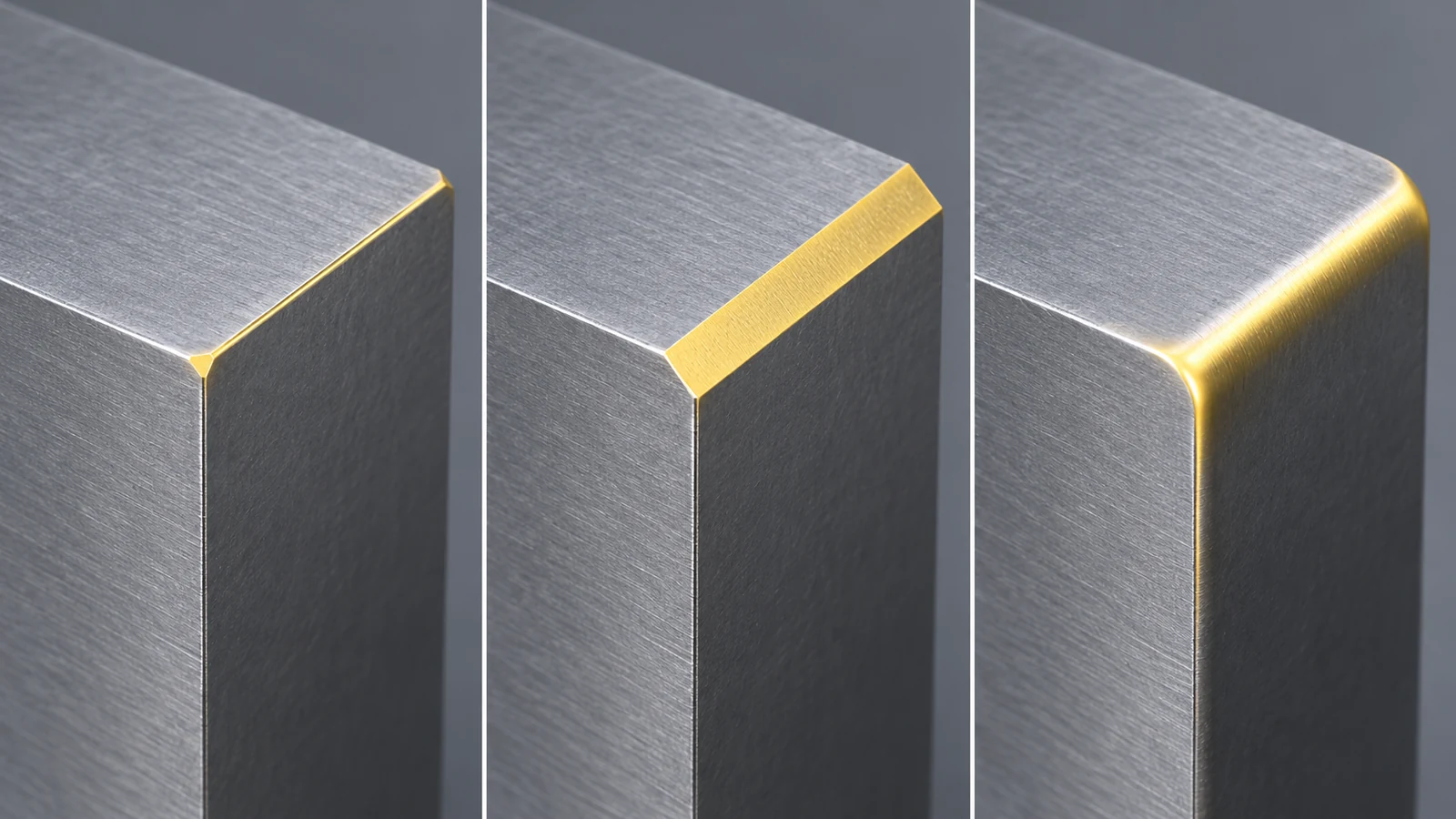
For machined parts, edge preparation is connected to the cutting sequence and the final surface condition. The site’s CNC milling capability and surface-finish information are relevant process context; the drawing remains the authority for acceptance.
Where a broad note creates risk
A uniform edge break may be harmless on an external handling edge yet change the effective length of a locating shoulder. A countersunk fastener seat, sealing land, press fit, thin wall, or intersecting hole may need a distinct requirement. Internal edges can be difficult to reach, and a tool path that removes a burr in one direction can leave a different condition on the opposite side.
Broad notes also create inspection disagreements. One inspector may reject a visible burr, while another may accept it because the drawing does not define a measurable limit. If a part is cleaned, coated, or assembled after machining, the order of operations can affect whether the edge remains accessible and what “acceptable” looks like at receipt.
Turn the note into an actionable requirement
Use a general note only for edges whose function is genuinely noncritical. Identify exceptions with local dimensions or a detail view. Where the edge condition affects fit, safety, sealing, flow, or handling, state the geometry or a clear acceptance boundary and indicate whether it applies before or after finishing.
- Mark critical edges individually instead of assuming a general note covers their function.
- Specify chamfer or radius size when the geometry matters to assembly or contact.
- Call out both sides of a through-hole when burr direction or removal matters.
- Clarify whether the requirement is visual, dimensional, or both.
- Define exceptions for sharp functional edges, datum boundaries, or protected surfaces.
During design review, trace the note against the part’s mating surfaces and inspection plan. A concise drawing can still be unambiguous when the general instruction is paired with clearly identified exceptions.
Treat burr direction as part of the design
For intersecting features, the burr often forms where a cutting edge exits the material. Whether that location is acceptable depends on fluid path, assembly contact, appearance, and access for removal. A note that says “deburr” may not explain which side is protected or whether a small edge condition is allowed near a critical wall.
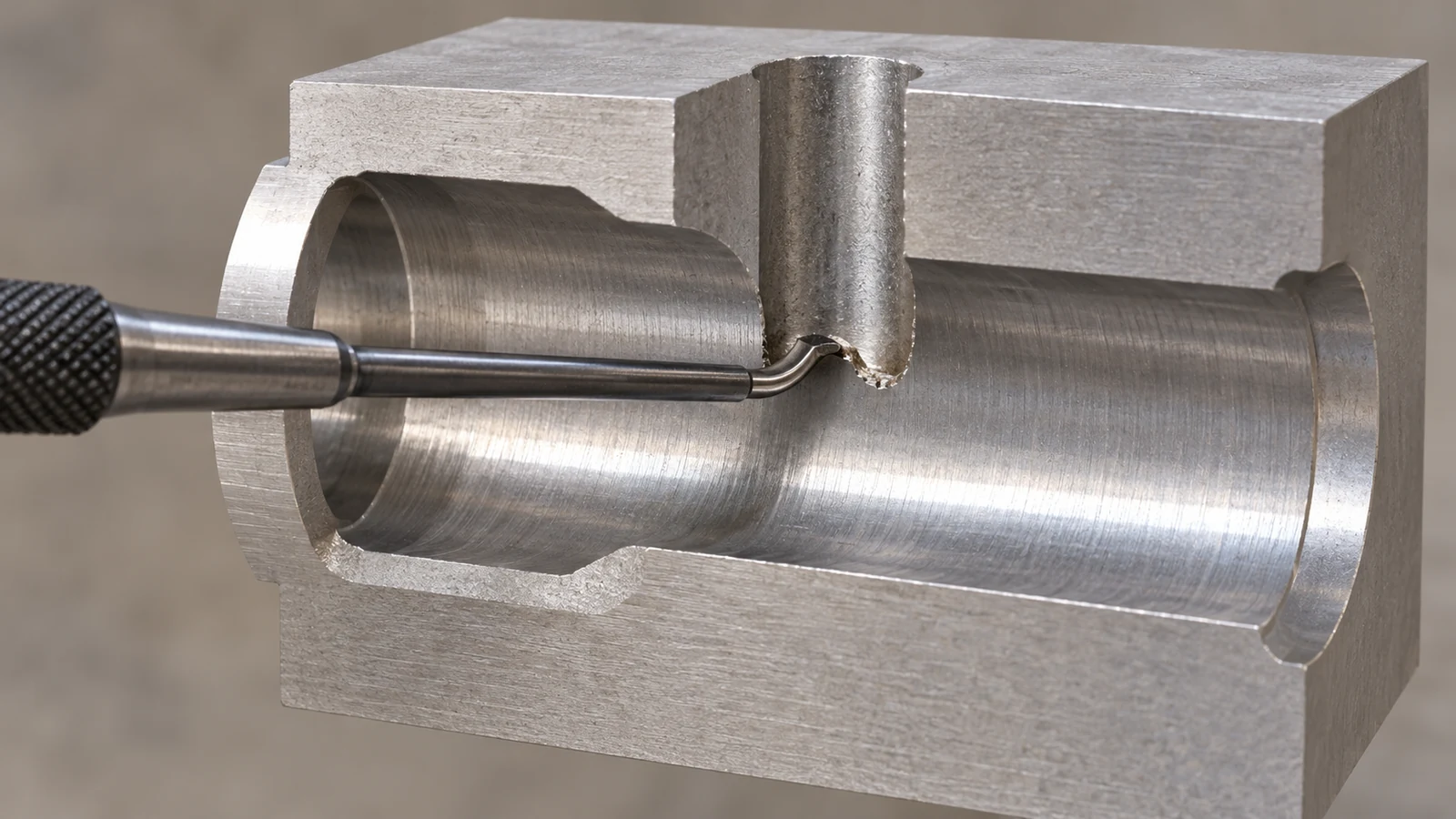
Use a section view or callout where direction matters. If a bore, cross-hole, slot, or thin web has a critical edge, identify the zone and describe the required condition. Buyers can then review the drawing with the machinist before production instead of relying on an interpretation made at final inspection. The broader CNC machining process guide provides parent-level context for how drawing requirements flow into machining and inspection.
Questions about CNC edge callouts
Is “deburr” the same as “break edges”?
No. Deburring focuses on removing raised material; breaking an edge describes removing sharpness. A drawing may need both instructions, especially where the acceptable final geometry matters.
Should every edge have a specified chamfer?
No. Specify geometry where function or inspection depends on it. A general edge note can be suitable for noncritical edges if its limits and exceptions are clear.
How should internal-hole burrs be controlled?
Identify the intersecting feature and the side or zone that matters, then state the acceptable condition. A general note may not communicate access or direction well enough.