
When your project demands the highest possible electrical conductivity and thermal performance, C10100 copper machining becomes both an opportunity and a challenge. This oxygen-free electronic (OFE) copper grade delivers 101% IACS conductivity and 99.99% purity—but its soft, gummy nature makes it one of the most difficult materials to machine effectively. Engineers and procurement professionals frequently ask: is copper hard to machine? The short answer is yes—but the right manufacturing partner transforms this difficulty into precision-engineered success.
This guide explores everything you need to know about C10100 copper machinability, from material properties and processing challenges to selection criteria and why experienced manufacturers like Jucheng Precision deliver consistent, high-quality results. Whether you are researching copper machining near me or evaluating tips for machining copper, this comprehensive resource addresses the questions that matter most.
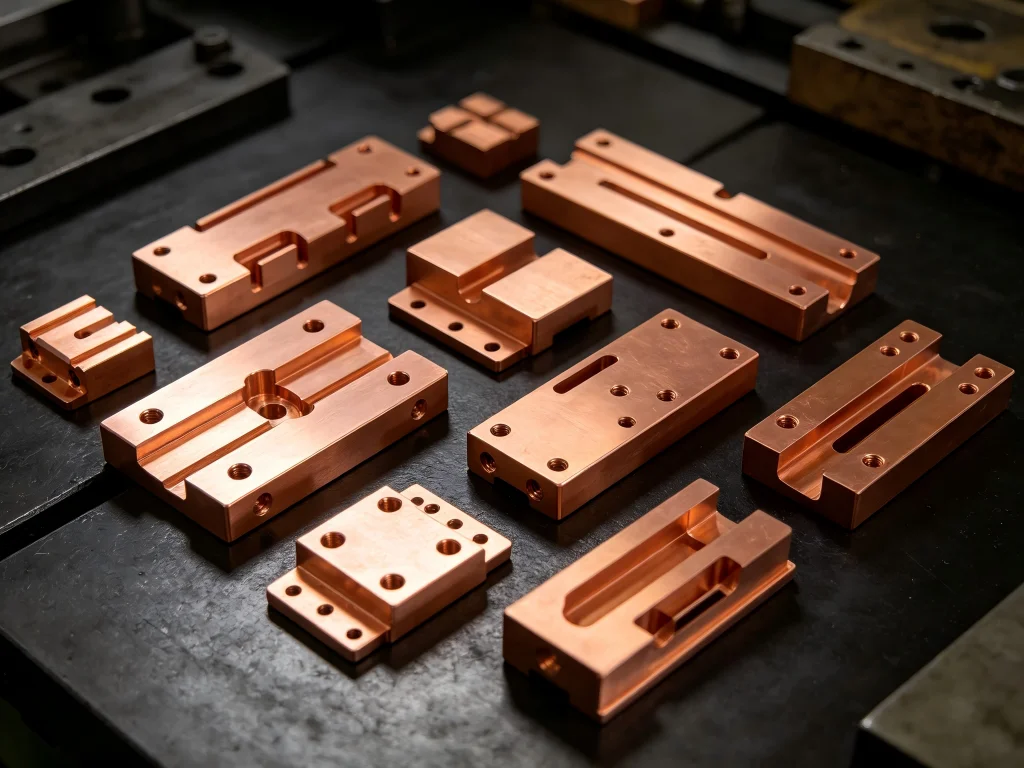
The Problem: Why C10100 Copper Challenges Even Experienced Machine Shops
Pure copper presents a paradox. Its exceptional ductility—the very property that makes it invaluable for electrical and thermal applications—creates significant machining difficulties. C10100 copper, with its 99.99% copper content and oxygen-free composition, exhibits what machinists describe as a “dead soft” character. The material tends to smear rather than shear cleanly when cut, generating long, stringy chips that wrap around cutting tools and create built-up edge (BUE).
On machining forums like Practical Machinist, experienced operators share their frustrations: “I’m having a bit of an issue getting the chips to break turning down some C10100”. Another notes that while they approach it similarly to aluminum for cutting conditions, the material’s behavior during machining requires constant adjustment. These real-world accounts reflect what the technical data confirms—C10100 has a machinability rating of just 20% compared to free-cutting brass (C36000 at 100%).
The core challenges include:
- Material adhesion: Copper’s ductility causes it to stick to cutting tools, leading to built-up edge that degrades surface finish and dimensional accuracy
- Thermal expansion: High thermal conductivity (391 W/m·K) means heat dissipates quickly, but the material also expands during cutting and shrinks upon cooling—often resulting in undersized parts
- Workholding deformation: Soft copper distorts under standard clamping forces, making it difficult to maintain tight tolerances without specialized fixturing
- Burr formation: The material’s gummy nature creates tenacious burrs that are difficult to remove without secondary operations
These challenges explain why many shops avoid C10100 copper machining altogether, preferring easier-to-machine alloys like brass or tellurium copper. Yet for applications requiring maximum conductivity and purity, there is no substitute.
The Solution: C10100 Copper—Defining the Material and Its Value
C10100 copper, also known as Oxygen-Free Electronic (OFE) copper, represents the highest purity copper grade commercially available. Its composition—99.99% minimum copper with oxygen content below 5 parts per million—delivers properties that make it indispensable for critical applications.
Key Material Properties
| Property | C10100 Specification | Significance for Applications |
|---|---|---|
| Purity | 99.99% minimum | Highest conductivity, minimal impurities |
| Electrical Conductivity | 101% IACS | Superior to standard copper grades |
| Thermal Conductivity | 391-397 W/(m·K) | Efficient heat dissipation |
| Oxygen Content | <5 ppm | Resistant to hydrogen embrittlement |
| Machinability Rating | 20% | Requires specialized techniques |
| Density | 8.9 g/cm³ | Standard copper density |
The oxygen-free manufacturing process distinguishes C10100 from more common grades like C11000 (electrolytic tough pitch copper). By eliminating oxygen from the refining environment, C10100 avoids the hydrogen embrittlement that can occur when ETP copper is exposed to reducing atmospheres at elevated temperatures. This makes C10100 the preferred choice for:
- High-vacuum electronics where outgassing cannot be tolerated
- Cryogenic components requiring stable properties at extreme temperatures
- Microwave tubes and waveguides demanding consistent conductivity
- Superconductor applications where purity directly impacts performance
In the words of one Reddit discussion on copper machining, “C10100 is one of the highest purity grades of copper. The parts I’ve made of C10100 were used in semi-conductor manufacturing”. This real-world perspective underscores the material’s role in advanced technology sectors.
Understanding C10100 Copper Machinability: Why Specialized Expertise Matters
The question is copper hard to machine frequently arises in engineering forums and procurement discussions. The answer depends entirely on context. Copper alloys like C14500 (tellurium copper) machine readily with an 85% machinability rating. But C10100 copper machinability sits at just 20%—comparable to some stainless steels—making it significantly more challenging.
What makes C10100 particularly difficult? Several interrelated factors:
The “Gummy” Cutting Dynamic
Pure copper’s high ductility means it behaves more like chewing gum than metal under the cutter. Instead of shearing cleanly, the material tends to flow and smear, creating a built-up edge on the cutting tool. This BUE alters the effective cutting geometry, leading to poor surface finish, dimensional inaccuracy, and accelerated tool wear. One machining guide notes that “for soft grades like C10100 OFHC, 150–300 m/min is typical with carbide tools”—but even with optimized parameters, chip control remains challenging.
Workholding and Deformation Risks
The softness of C10100 creates what machinists call a “clamping deformation” problem. Standard 3-jaw chucks applied with forces appropriate for aluminum will distort thin-walled copper components. This requires specialized low-stress workholding techniques, including custom-machined soft jaws that wrap 360 degrees around the part to distribute clamping forces evenly.
Thermal Management During Cutting
Copper’s exceptional thermal conductivity works against the machining process. Heat generated at the cutting interface dissipates rapidly into the workpiece rather than being carried away with the chip. This can lead to work hardening of the surface layer, making subsequent passes even more difficult. The material also expands significantly during cutting and contracts upon cooling—a phenomenon that can push precision-machined parts out of tolerance if not carefully managed.
Chip Evacuation and Surface Finish
Long, stringy chips are characteristic of C10100 copper machining. These chips can wrap around the cutting tool, interfere with the cutting process, and mar the finished surface. Effective chip breaking requires specific tool geometries and cutting parameters that many general-purpose machine shops do not possess.
These challenges explain why sourcing copper machining near me often yields disappointing results. Local machine shops may have the equipment but lack the specialized knowledge required for consistent C10100 copper machining. The material demands more than standard CNC capabilities—it requires a manufacturing partner who understands the nuances of soft metal processing.
Application Deep-Dive: Where C10100 Copper Machining Delivers Exceptional Value
The superior properties of C10100 copper make it the material of choice for demanding applications where performance cannot be compromised. Understanding these applications helps engineers and procurement professionals make informed decisions about when to specify this premium grade.
Electrical Power Distribution and Busbars
Electrical busbars represent one of the most common applications for C10100 copper machining. The material’s 101% IACS conductivity ensures minimal energy loss in high-current applications, from industrial power distribution to electric vehicle battery connections. Machined busbars require precise tolerances for reliable connections, clean edges to prevent arcing, and consistent surface finish for optimal contact resistance.
Jucheng Precision transforms raw copper bars and plates into precision busbars using 5-axis CNC machining centers capable of producing complex geometries with tight tolerances. The company’s expertise in soft metal machining ensures burr-free edges and excellent surface finish—critical factors for electrical performance.
Heat Sinks and Thermal Management Systems
Copper’s thermal conductivity (roughly double that of aluminum) makes it the gold standard for heat sinks and thermal management components. C10100’s exceptional purity ensures consistent thermal performance across the entire component, while its ductility allows for intricate fin geometries that maximize surface area for heat dissipation.
Machining copper heat sinks presents particular challenges. Thin fins are prone to deformation during cutting, and the material’s softness makes it difficult to maintain sharp edges without secondary operations. Advanced manufacturers like Jucheng employ specialized tool paths and cutting strategies to produce clean, distortion-free fins.
High-Vacuum and Cryogenic Components
The oxygen-free composition of C10100 makes it the only choice for high-vacuum applications where outgassing would compromise performance. In cryogenic systems, the material maintains its conductivity and ductility at extremely low temperatures, making it indispensable for superconducting magnet systems and particle accelerators.
Semiconductor Manufacturing Equipment
As noted in machining forums, C10100 components find their way into semiconductor manufacturing equipment. The material’s purity ensures that no contaminants are introduced into sensitive semiconductor processes, while its conductivity supports the high-power requirements of modern chip fabrication.
Medical and Antimicrobial Applications
Copper’s natural antimicrobial properties—it kills bacteria and viruses on contact—make it increasingly valuable for medical equipment and high-touch surfaces. C10100’s purity ensures these properties are fully realized without compromising biocompatibility.
Key Selection Factors: Choosing the Right Partner for C10100 Copper Machining
When evaluating potential suppliers for C10100 copper machining, several critical factors determine success. The following considerations help procurement professionals and engineers make informed decisions.
Technical Expertise and Experience
Not all CNC machine shops possess the specialized knowledge required for effective C10100 copper machining. Look for manufacturers who demonstrate understanding of:
- Tool selection: Sharp carbide tools with polished flutes and appropriate geometries for soft metals
- Cutting parameters: Optimized speeds and feeds that balance productivity with surface quality
- Chip control: Strategies for breaking and evacuating stringy copper chips
- Workholding: Low-stress clamping techniques that prevent deformation
- Thermal management: Approaches for controlling heat generation and managing thermal expansion
Jucheng Precision brings over a decade of specialized experience to C10100 copper machining. The company’s team of 190+ professionals includes 30+ senior engineers with 13+ years of experience each. This depth of expertise translates directly into consistent quality for challenging materials.
Equipment Capabilities
The right equipment makes the difference between acceptable and exceptional results. Evaluate potential suppliers on:
- Machine types: 3, 4, and 5-axis CNC machining centers provide the flexibility for complex geometries
- Precision capabilities: Look for documented tolerance capabilities—Jucheng achieves machining accuracy up to 0.002mm
- Production capacity: The ability to scale from prototypes to production volumes
- Quality control: In-process inspection and final verification systems
Jucheng operates a state-of-the-art 8,000-square-meter facility housing 150+ CNC machining centers, including 25+ high-precision 5-axis Haas and Mazak workstations. This scale ensures both capability and capacity for projects of any size.
Quality Certifications and Standards
Industry certifications provide objective evidence of a manufacturer’s commitment to quality. Jucheng holds IATF 16949 (automotive) and ISO 13485 (medical device) certifications, demonstrating compliance with the most stringent quality management standards. For C10100 copper components used in critical applications, these certifications offer essential assurance.
Material Sourcing and Traceability
For C10100 copper machining, material provenance matters. Jucheng stocks electrolytic tough pitch (ETP) and oxygen-free (OFE) copper grades to meet different conductivity requirements. Full material traceability ensures that every component meets specifications.
Post-Processing and Surface Finish Options
Many C10100 copper components require post-processing to achieve their final form and function. Consider suppliers who offer:
- Polishing for enhanced surface finish and conductivity
- Passivation (anti-tarnish) to prevent oxidation during storage and use
- Nickel or tin plating for corrosion resistance and solderability
Jucheng provides comprehensive post-processing services, ensuring components arrive ready for installation.
Lead Times and Project Management
For many projects, speed to market is as important as quality. Evaluate suppliers on their ability to deliver on schedule. Jucheng’s extensive equipment fleet and experienced team support rapid turnaround from prototyping to production.
Why Jucheng Precision Excels at C10100 Copper Machining
Jucheng Precision has established itself as a leader in C10100 copper machining through a combination of technical expertise, advanced equipment, and unwavering commitment to quality. Several factors distinguish the company in this challenging field.
Specialized Soft Metal Machining Protocols
Understanding that “machining soft copper requires specific expertise to prevent deformation and ensure surface quality”, Jucheng has developed proprietary protocols for C10100 copper machining. These include:
- Deformation control: Specialized clamping and low-stress machining techniques that hold tight tolerances without bending the part
- Optimized tool paths: Cutting strategies designed specifically for copper’s gummy behavior, ensuring burr-free parts with excellent surface finishes
- Tool selection: Sharp, high-quality carbide tools appropriate for soft metal cutting
Advanced Equipment Fleet
Jucheng’s 150+ CNC machines include 25+ 5-axis centers capable of machining intricate cooling fins and complex geometries found in advanced thermal management devices. This equipment diversity allows the company to handle everything from simple turned parts to complex milled components requiring multiple setups.
Comprehensive Quality Systems
IATF 16949 and ISO 13485 certifications demonstrate Jucheng’s commitment to quality management. These systems ensure consistent results across every production run, with documented processes and traceability from raw material to finished component.
Material Expertise Across Copper Grades
Beyond C10100, Jucheng machines the full spectrum of copper grades, including C11000 (ETP), C10200 (OF), C17200 (beryllium copper), C12200 (DHP), and C14500 (tellurium copper). This breadth of experience informs the company’s approach to each material, ensuring optimal parameters for every project.
Proven Track Record
Jucheng has successfully delivered C10100 copper components for applications ranging from semiconductor manufacturing to high-power electrical distribution. This real-world experience translates into predictable, reliable results for new projects.
Responsive Customer Service
Engineering projects often require iteration and refinement. Jucheng’s team works closely with clients throughout the development process, providing technical guidance and rapid adjustments as needed. This collaborative approach ensures that final components meet or exceed expectations.
Tips for Machining Copper: What the Experts Recommend
For engineers and machinists seeking practical tips for machining copper, the following guidelines represent industry best practices for C10100 and similar grades.
Tool Selection and Maintenance
- Use sharp carbide tools with polished flutes to minimize friction and prevent built-up edge
- Consider diamond-coated tools for extended tool life in production runs
- Maintain sharp cutting edges—dull tools push rather than shear the material, generating excessive heat
- Select tools with appropriate geometry for copper’s ductile behavior
Cutting Parameters
- For turning C10100, maintain high cutting speeds with continuous feed to prevent work hardening
- For milling, use carbide tools with high helix angles to minimize tool wear and improve chip evacuation
- Apply slower feed rates to prevent work hardening and ensure smooth surface finish
- Consider recommended speed ranges: 150–300 m/min with carbide tools for soft grades
Workholding Strategies
- Use low-stress clamping to prevent deformation of soft copper components
- Machine custom soft jaws that wrap around the part for uniform force distribution
- Avoid over-tightening workholding devices
- Consider vacuum fixturing for thin or delicate parts
Chip Control
- Apply effective chip-breaking strategies to prevent long, stringy chips from wrapping around tools
- Use appropriate coolant flow to flush chips away from the cutting zone
- Consider high-pressure coolant for improved chip evacuation
Surface Finish Optimization
- Minimize vibration through rigid setups and shortest possible tool extensions
- Avoid deep, narrow slots where chips are difficult to clear
- Consider finishing passes with light cuts for optimal surface quality
Frequently Asked Questions About C10100 Copper Machining
Is copper hard to machine?
Pure copper like C10100 is challenging to machine due to its high ductility and plasticity. The material tends to smear rather than shear cleanly, creating built-up edge on cutting tools and generating long, stringy chips. However, with proper techniques and experienced operators, copper can be machined to tight tolerances with excellent surface finish. The question is copper hard to machine depends on the grade—alloyed coppers like C14500 machine much more readily than pure grades.
What is the machinability rating of C10100 copper?
C10100 copper machinability is rated at 20% compared to free-cutting brass (C36000 at 100%). This low rating reflects the material’s tendency to smear, generate built-up edge, and produce difficult-to-control chips. Despite this low rating, experienced manufacturers achieve excellent results through optimized tooling and cutting parameters.
What are the main applications for C10100 copper components?
C10100 copper components find use in high-vacuum electronics, cryogenic systems, microwave tubes, superconductor applications, electrical busbars, heat sinks, and semiconductor manufacturing equipment. The material’s exceptional purity and conductivity make it essential where performance cannot be compromised.
How does C10100 compare to C11000 copper?
C10100 (oxygen-free electronic copper) offers higher purity (99.99% vs. 99.9%) and superior conductivity (101% IACS vs. approximately 100% IACS) compared to C11000 (electrolytic tough pitch copper). C10100 is also resistant to hydrogen embrittlement, making it suitable for applications involving elevated temperatures in reducing atmospheres. However, C10100 commands a premium price and presents greater machining challenges.
What should I look for in a C10100 copper machining partner?
Key selection factors include demonstrated experience with soft metals, appropriate equipment (3/4/5-axis CNC capability), quality certifications (IATF 16949, ISO 13485), material traceability, post-processing capabilities, and proven track record with similar projects. The question of copper machining near me should prioritize capability over proximity—the right partner may be worth the shipping distance.
Can C10100 copper be welded or brazed?
C10100 copper offers excellent solderability and good brazing characteristics. Gas shielded arc welding is rated as fair, while oxyacetylene welding is not recommended. The material’s oxygen-free composition makes it suitable for brazing in hydrogen or vacuum environments without risk of embrittlement.
What surface finishes are available for C10100 copper components?
Common surface finishes include polishing (for enhanced conductivity and appearance), passivation (anti-tarnish treatment), and nickel or tin plating (for corrosion resistance and solderability). The appropriate finish depends on the application environment and performance requirements.
What is the typical lead time for C10100 copper machining projects?
Lead times vary based on complexity, quantity, and current production schedules. Experienced manufacturers like Jucheng offer rapid prototyping services and scalable production capabilities to meet project timelines. Discuss specific requirements with potential suppliers to understand realistic delivery expectations.
Making the Right Decision for Your C10100 Copper Project
C10100 copper machining demands expertise that goes beyond standard CNC capabilities. The material’s exceptional properties—101% IACS conductivity, 99.99% purity, and resistance to hydrogen embrittlement—make it indispensable for critical applications. Yet its soft, gummy nature requires specialized techniques that many machine shops cannot provide.
When evaluating potential manufacturing partners, prioritize demonstrated experience with C10100 and similar copper grades. Look for facilities equipped with advanced 5-axis machining centers, quality certifications like IATF 16949 and ISO 13485, and a track record of successful projects in your industry.
Jucheng Precision brings over a decade of specialized experience to every C10100 copper machining project. The company’s 150+ CNC machines, 190+ skilled professionals, and comprehensive quality systems deliver consistent, high-quality results. From prototyping to production, Jucheng provides the technical expertise and manufacturing capability that C10100 copper demands.
Whether you are developing heat sinks for advanced electronics, busbars for electric vehicles, or components for semiconductor manufacturing equipment, choosing the right machining partner determines project success. With its proven capabilities and commitment to quality, Jucheng Precision stands ready to transform your C10100 copper requirements into precision-engineered reality.
Contact Jucheng Precision today to discuss your C10100 copper machining project. Our engineering team will provide technical guidance, design-for-manufacturability feedback, and a competitive quote tailored to your specifications.