
Choose among CNC machining, laser cutting, and waterjet cutting by starting with the finished geometry, not the machine label. Laser and waterjet are usually considered for profiles cut from sheet or plate; CNC machining is the stronger fit when the part needs pockets, bores, threads, accurate faces, or features on multiple sides. A cut blank followed by CNC finishing is often the practical route when one process cannot deliver both an economical outline and functional interfaces.
The trade is not simply speed versus accuracy. Heat input, edge condition, material, thickness, nesting, stock use, workholding, and the number of later operations all affect the accepted-part cost. Define which edges and faces locate, seal, join, or carry load before comparing quotations.
Start with the geometry that must be finished
Classify each feature by how it is made and what it does. A flat outline may be cut quickly, while a bearing bore, threaded hole, seal face, counterbore, or three-dimensional pocket may need machining afterward. The key question is whether the cut edge itself is functional or only defines the blank.
If a part is essentially a two-dimensional profile, cutting processes can reduce material removal compared with milling the full outline from solid stock. If the part has several machined planes, precise spacing between faces, or features that reference a common datum, CNC may simplify the route by creating those relationships in controlled setups. A flat profile with a few critical features can combine both approaches.
What each route is built to do
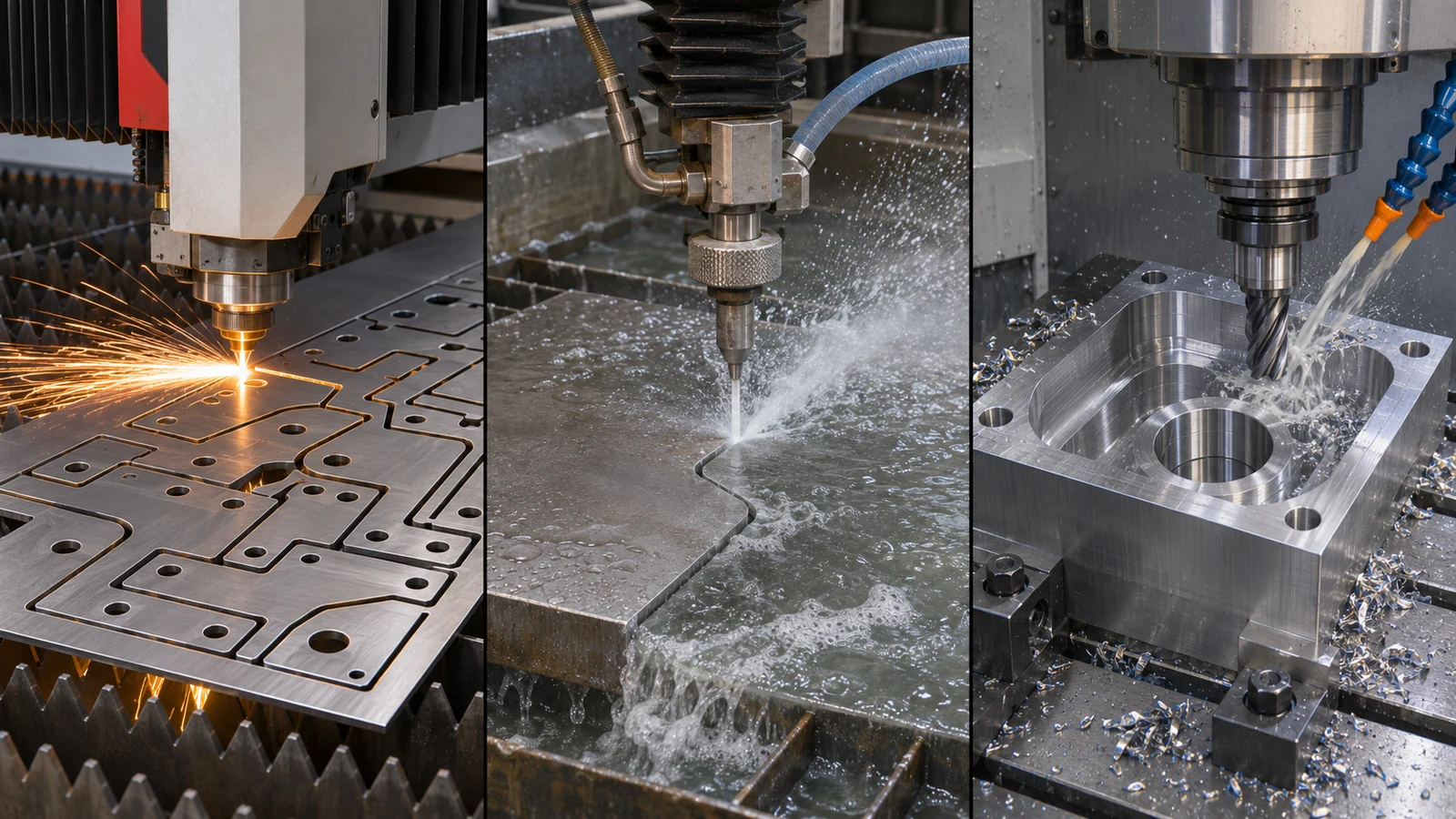
Laser cutting directs a concentrated thermal beam through material. It can be efficient for nested sheet profiles, but the usable result depends on alloy, thickness, reflectivity, assist gas, cut parameters, edge requirement, and the equipment. Heat-affected material or distortion may matter near a weld, sealing surface, fatigue-critical edge, or later machined feature. Do not assume that a laser-cut edge is a finished datum.
Abrasive waterjet cutting removes material with a high-pressure abrasive stream. It avoids the thermal heat-affected zone associated with laser cutting, which can be useful for heat-sensitive materials or designs where thermal alteration is unacceptable. The cut can still have taper, striations, edge variation, and a finish grade that depends on the process settings. Waterjet should not be treated as a substitute for a machined fit surface just because the process is cold.
CNC machining removes material with a cutting tool and can create planar and three-dimensional geometry, holes, threads, pockets, and controlled interfaces. Its economics depend on stock form, material removal, tool access, setup count, workholding, and inspection. Milling from plate or billet can waste material on a thin profile, while it may be appropriate when the finished part needs substantial three-dimensional detail. See the site’s CNC milling capability for process context.
Compare the process around the part
| Decision factor | Laser cutting | Abrasive waterjet | CNC machining |
|---|---|---|---|
| Typical starting geometry | Sheet or plate profile | Sheet or plate profile | Plate, bar, billet, extrusion, or near-net blank |
| Feature strength | Fast profile cutting; later machining may be needed for bores, threads, and datum faces | Cold profile cutting; finishing may still be needed for functional edges and interfaces | Strong for 3D features, machined faces, holes, pockets, and threaded details |
| Thermal consideration | Thermal process; review heat input and edge condition for the material and application | No thermal HAZ from the cutting stream; inspect edge profile and finish | Mechanical cutting; review cutting force, workholding, burrs, and distortion |
| Main cost drivers | Nesting, thickness, material response, edge requirement, and volume | Cut time, abrasive use, thickness, edge quality, and volume | Setup, stock, removal time, tool access, inspection, and finishing |
| Best next question | Is the edge acceptable as cut? | Is the cut profile accurate enough for the following operation? | Can the required features share datums and accessible setups? |
This is a route-screening table, not a universal tolerance or thickness chart. Actual capability varies with the machine, material, geometry, cutting parameters, and acceptance method. Ask vendors for evidence on the specific part rather than applying generic numbers.
Edge condition can change the route
Laser-cut edges may need deburring or machining if dross, edge taper, thermal effects, or local surface condition could affect fit, fatigue, coating, or joining. Waterjet edges avoid laser heat input, but cut direction, abrasive stream behavior, and quality settings can leave taper or striation. Both processes can produce a useful blank while leaving the functional interface to a later operation.
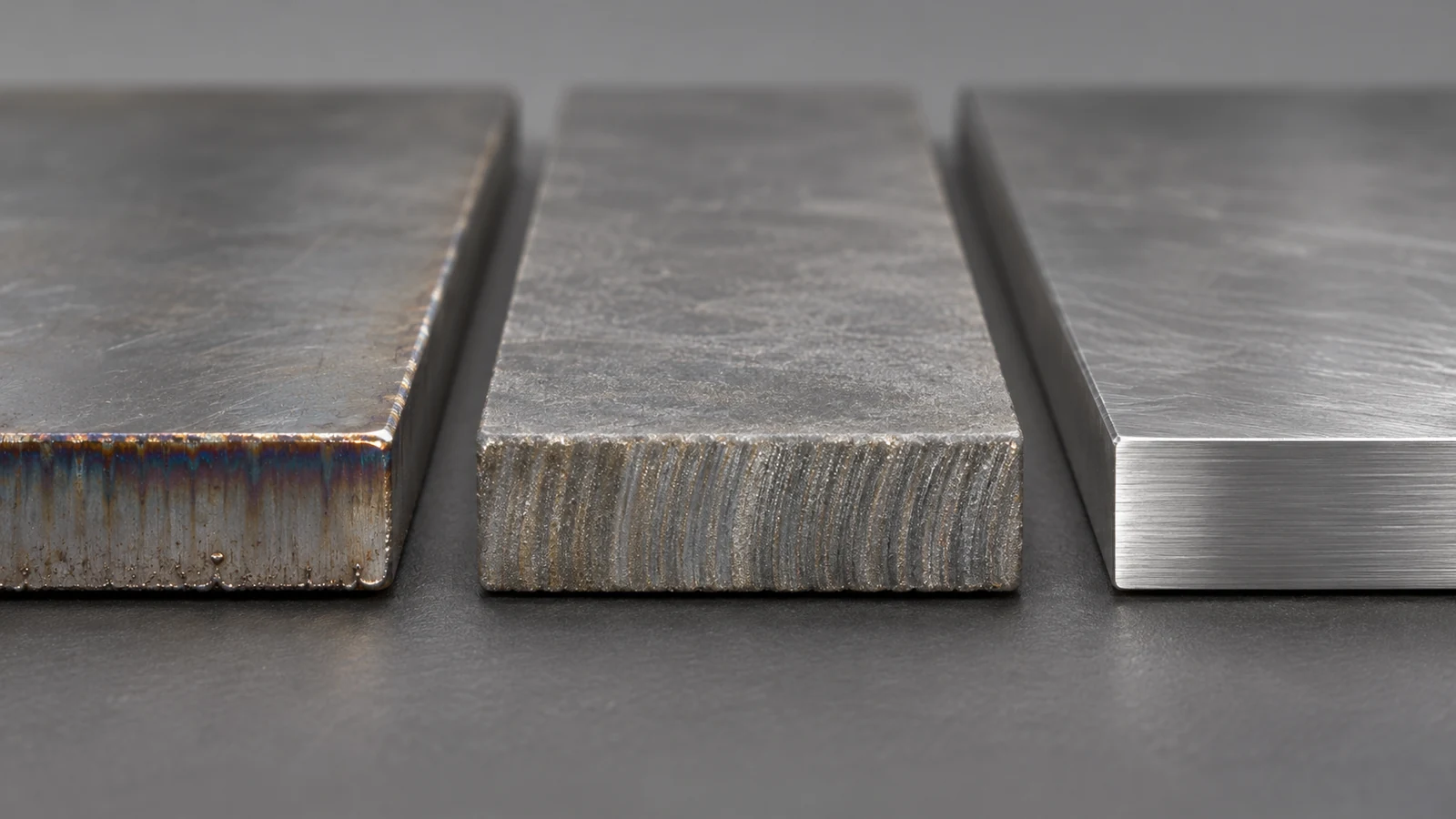
For CNC, the corresponding risk is not an HAZ but the interaction of cutting forces, material removal, tool reach, clamping, and residual stress. Thin parts can move when released; a machined edge can burr; a long reach can deflect. The route should define which features are rough-cut, which are finished, how the part is located, and when it is inspected.
Use a hybrid route when the blank is simple
A laser or waterjet blank followed by CNC machining can make sense when the perimeter is a low-cost two-dimensional cut but the part also needs accurate bores, sealing faces, threaded holes, or milled pockets. The cut profile may serve as a rough envelope while machined datums establish the final relationship between functional features.
That hybrid route only works when the blank has enough stock for finishing and can be located repeatably. Define the allowance on the drawing or process plan, identify the datum surfaces created first, and establish whether the cut edge may be used as a locator. If the edge is not controlled for that purpose, use a machined reference instead. A CNC machining supplier should receive the blank condition, cut direction if relevant, allowance, quantity, and the final acceptance features.
Make the RFQ compare like with like
Send the same model and drawing revision to each supplier. Mark critical surfaces, fit dimensions, hole and thread requirements, edge breaks, finish, material and condition, quantity, and inspection documents. Ask whether the quote includes the finished part or only the cut blank, and whether deburring, secondary machining, finishing, inspection, packaging, and material certification are included.
Compare total cost and risk per accepted part. A low profile-cutting price can rise if the edge requires extensive cleanup or if an extra operation is needed to locate the part. A CNC-only quote can be unnecessarily high if much of the stock is removed merely to create a flat outline. State what must be functionally controlled and let the route proposal explain how the supplier will produce and verify it.
Frequently asked questions
Is waterjet always better than laser for thick metal?
No universal rule applies. Compare the actual alloy, thickness, edge requirement, distortion risk, cut quality, throughput, and the next operation. A thick heat-sensitive part may favor waterjet, while another geometry may be better served by a different route.
Can laser or waterjet make a finished precision part?
They can make finished parts when the geometry and acceptance requirements fit the process capability. If the part needs controlled bores, threads, multiple datum faces, or three-dimensional features, plan for machining or another finishing step.
When should cutting and CNC machining be combined?
Combine them when a cut blank reduces waste or cutting time and CNC creates the features that control fit, sealing, alignment, or assembly. The blank must include suitable allowance and a repeatable locating strategy.