
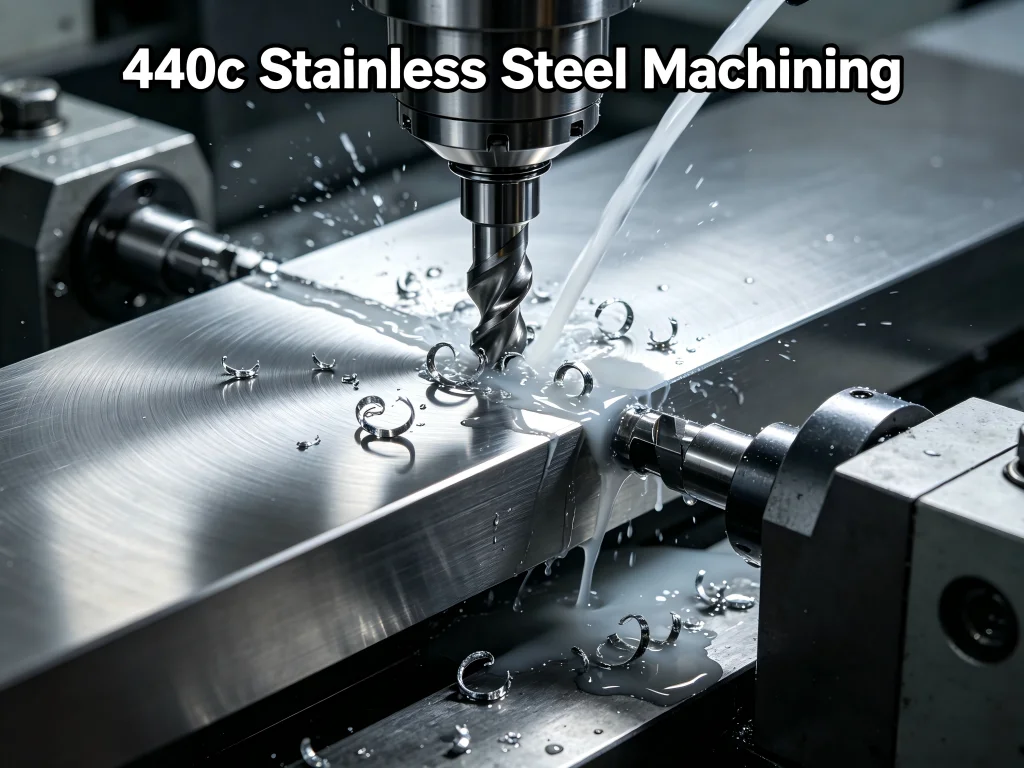
Why 440C Stainless Steel Demands Specialized Machining
Understanding the material is the first step toward mastering its machining. 440C is a high-carbon martensitic stainless steel, UNS S44004, containing approximately 0.95 to 1.20% carbon and 16.00 to 18.00% chromium. This chemistry delivers the highest attainable hardness of any stainless steel grade—about Rockwell C 60 after proper heat treatment. The alloy was originally developed for bearing applications, including balls and races, and remains the material of choice for components requiring maximum wear resistance combined with moderate corrosion protection.
The challenge? That same hardness translates directly into poor machinability. In machining forums, professionals consistently describe 440C as “difficult to machine” and “hard on tool life”. The material exhibits a pronounced work-hardening tendency during cutting operations. When the tool engages the workpiece, localized deformation rapidly increases surface hardness at the cutting zone. This accelerates flank wear, generates excessive heat, and can lead to premature tool failure if parameters are not precisely controlled.
One Practical Machinist forum member working on tiny bushings (1/8″ diameter) at 50 HRC asked a question many have faced: “Am I going to have a nightmare turning and drilling these 50HRC rods?” The consensus response highlighted the importance of machining in the annealed condition followed by post-hardening, a strategy that minimizes tool wear and distortion. This practical insight underscores a fundamental rule: successful 440C stainless steel machining requires not just the right equipment, but the right approach to material state and process sequencing.
What Makes 440C Stainless Steel Unique?
Before diving into machining strategies, it is worth addressing a common question: how hard is 440C stainless steel? The answer depends on heat treatment. In the annealed condition, the material is machinable with standard tooling. After hardening and tempering, it reaches approximately 60 HRC, making it the hardest stainless steel available. This exceptional hardness delivers outstanding wear resistance but also means that machining in the hardened state typically requires specialized techniques such as grinding or electrical discharge machining (EDM).
Another frequent inquiry: does 440C stainless steel rust? The alloy provides good corrosion resistance under atmospheric conditions and in freshwater. It also performs adequately in mild acidic environments and most alkalis. However, its corrosion resistance is lower than that of austenitic grades like 304 or 316. Optimal corrosion resistance is achieved when the alloy is hardened and tempered, with tempering temperatures kept below approximately 800°F (427°C). This limitation means 440C is not recommended for elevated-temperature applications where corrosion resistance might be compromised.
For those evaluating material options, 440C material equivalent designations include 1.4125 (European standard) and X105CrMo17. The 440C material hardness in the hardened condition typically ranges from 58 to 62 HRC, depending on the specific tempering temperature used.
When comparing alloys, the question 440C vs DC53 frequently arises in tooling and knife-making applications. DC53 offers higher toughness and impact resistance, making it suitable for heavy-duty模具 applications that experience significant冲击 loads. However, 440C provides superior corrosion resistance and remains the preferred choice when stainless properties are essential. The decision ultimately depends on whether corrosion resistance or toughness is the higher priority for your specific application.
The Jucheng Approach: Solving 440C Machining Challenges
So is 440C stainless steel good for your project? The answer is yes—provided you work with a machining partner who understands the material’s unique demands. Jucheng Precision has developed systematic methodologies for 440C stainless steel machining that address the three primary obstacles: work hardening, heat generation, and tool wear.
Work Hardening Prevention
The work-hardening phenomenon in 440C occurs when cutting parameters are improperly selected. Dull tools, incorrect speeds, or insufficient feed rates can cause the material to harden at the surface, making subsequent passes even more difficult. Jucheng addresses this through:
- Sharp, positive-rake geometries that shear material cleanly rather than pushing it
- Optimized feed rates that maintain continuous chip formation and prevent the tool from rubbing against the workpiece
- Strategic toolpath planning that avoids repeated passes over work-hardened surfaces
Thermal Management
Heat is the enemy of both tool life and part quality in 440C machining. The material’s low thermal conductivity concentrates heat at the cutting edge, accelerating wear and potentially causing metallurgical alterations in the finished part. Research has shown that cryogenic cooling with liquid nitrogen can significantly reduce flank wear and improve surface integrity when machining AISI 440C. Jucheng employs high-pressure through-spindle coolant delivery systems that direct coolant precisely to the cutting zone, evacuating heat efficiently and suppressing the work-hardening effect.
Tool Selection Strategy
Cutting tool selection makes the difference between success and failure. For 440C stainless steel machining, Jucheng deploys specialized carbide and ceramic tooling with advanced coatings such as AlTiN or multi-layer variants designed to withstand extreme temperatures and abrasion. Cubic Boron Nitride (CBN) tools have demonstrated effectiveness in turning hard martensitic stainless steel, producing low surface roughness at cutting speeds of 225 m/min with a feed rate of 0.125 mm/rev and 0.50 mm depth of cut. For practical production environments, moderate cutting speeds of 175 m/min under the same feed and depth conditions represent an ideal balance between productivity and tool life.
Research on the effect of parameter settings on surface roughness during turning of 440C grade stainless steel indicates that feed rate is the most significant factor influencing surface finish, followed closely by cutting speed and cutting depth. Tool wear, however, is primarily influenced by cutting depth. These findings guide Jucheng’s parameter selection process, ensuring that each operation is optimized for both surface quality and tool longevity.
Critical Parameters for 440C Stainless Steel Cutting Speed
One of the most common technical questions is about 440C stainless steel cutting speed. The optimal parameters depend on several variables, including tool material, workpiece hardness, coolant type, and machine rigidity. However, the following table provides a useful reference point for common operations:
| Operation | Tool Material | Cutting Speed (m/min) | Feed Rate (mm/rev) | Depth of Cut (mm) | Notes |
|---|---|---|---|---|---|
| Turning (Annealed) | Carbide | 150–200 | 0.10–0.20 | 0.50–1.50 | Use sharp inserts; apply coolant |
| Turning (Hardened) | CBN / Ceramic | 80–120 | 0.05–0.12 | 0.20–0.50 | Light cuts; rigid setup required |
| Milling (Annealed) | Carbide (AlTiN coated) | 100–150 | 0.05–0.10 per tooth | 0.50–1.00 | Climb milling preferred |
| Drilling (Annealed) | Carbide | 40–60 | 0.05–0.08 | — | Peck drilling; high-pressure coolant |
These values should be considered starting points. When using carbide tools, surface speeds can be increased two to three times over suggested values, and feeds can be increased between 50% and 100%. However, adjustments should be made in small increments while monitoring tool wear and surface finish.
Applications Across Industries
440C stainless steel finds use across diverse sectors due to its unique combination of hardness, wear resistance, and corrosion protection. Understanding these applications helps clarify why 440C stainless steel machining expertise is so valuable.
Aerospace and Defense
The alloy’s high strength-to-weight ratio and resistance to wear make it suitable for bearing assemblies, valve components, and precision instrument parts. High-strength stainless steel alloys like 440C deliver exceptional yield strength often exceeding 1000 MPa while maintaining essential corrosion resistance. In hardened condition, yield strength can exceed 1800 MPa.
Medical Devices
Surgical instruments, dental tools, and orthopaedic implants benefit from 440C’s hardness and biocompatibility. The material’s ability to hold a sharp edge and resist corrosion in bodily fluids makes it a preferred choice for cutting instruments.
Industrial Equipment
Pump components, valve seats, ball studs, bushings, and wear-resistant textile components all leverage the alloy’s durability. Needle valves and ball check valves represent classic applications where both hardness and corrosion resistance are essential.
Consumer Products
High-end cutlery and knife blades frequently use 440C for its edge retention and stainless properties. While some consumers debate whether “440C is good” compared to newer powder metallurgy steels, the alloy remains a reliable choice for quality knives.
Selecting the Right 440C Machining Partner
When evaluating CNC machining services for 440C components, several factors should guide your decision. These considerations help ensure that your parts meet specifications without costly delays or quality issues.
Machine Capability
Rigidity is non-negotiable. 440C’s high cutting forces require machines with robust construction, high-torque spindles, and minimal vibration. Jucheng operates state-of-the-art CNC equipment, including multi-axis platforms capable of maintaining tolerances as tight as ±0.01mm. High-rigidity spindles and thermal compensation systems manage the challenges associated with machining high-strength stainless steel.
Tooling Expertise
The right tooling strategy separates successful 440C machining from costly failures. Look for partners who demonstrate deep knowledge of insert geometries, coating technologies, and toolpath optimization. Jucheng maintains material-specific parameter libraries continuously refined through in-process metrology and failure analysis.
Quality Systems
Certifications matter. Jucheng’s quality management systems ensure consistent production of complex geometries with tight tolerances and superior surface finishes. Rigorous first-article inspection protocols using CMMs and surface profilers validate dimensional conformity against critical specifications.
Value-Added Services
Beyond machining, consider partners who offer complementary services. Jucheng provides cleaning, deburring, press-fit assembly, thread locking, adhesive bonding, and passivation for stainless steel components. These services streamline the supply chain and reduce the need for multiple suppliers.
Installation and Maintenance Considerations
Proper installation and maintenance of 440C components extend service life and prevent premature failure. A few key points worth noting:
- Surface preparation: For optimum corrosion resistance, surfaces must be free of scale, lubricants, and foreign particles. After fabrication, cleaning and passivation should be considered.
- Avoid over-tempering: Tempering above approximately 800°F (427°C) reduces corrosion resistance. For maximum corrosion protection, tempering should remain below this threshold.
- Temperature limitations: The useful operating temperature range is limited due to loss of ductility at temperatures below zero and loss of strength due to over-tempering at elevated temperatures.
- Handling precautions: 440C should be handled like high-speed tool steel during hot working operations. Preheat to 1400–1500°F (760–816°C), then heat slowly and uniformly to 1900–2100°F (1038–1149°C).
Frequently Asked Questions About 440C Stainless Steel Machining
Is 440C stainless steel difficult to machine?
Yes, 440C is considered difficult to machine due to its high hardness, work-hardening tendency, and abrasive nature. However, with proper tooling, optimized parameters, and rigid machine setups, successful machining is achievable. Jucheng’s specialized approach demonstrates that the material can be processed efficiently when the right methodologies are applied.
What is the best cutting tool for 440C stainless steel?
Carbide tools with advanced coatings like AlTiN or multi-layer variants perform well for most operations. For turning hardened 440C, Cubic Boron Nitride (CBN) or ceramic tools are recommended. Tool selection should consider the specific operation, material hardness, and production volume.
Can 440C stainless steel be machined in the hardened condition?
Machining fully hardened 440C (58–62 HRC) is extremely challenging and generally not recommended for conventional operations. The preferred approach is to machine in the annealed condition and then heat treat to final hardness. Grinding or EDM may be required for post-hardening operations.
How does 440C compare to 304 stainless steel for machining?
304 stainless steel is significantly easier to machine than 440C. While 304 work-hardens, it does not reach the extreme hardness levels of 440C. The cutting forces, tool wear rates, and heat generation are all substantially higher when machining 440C.
What coolant should be used for 440C machining?
High-pressure through-spindle coolant is recommended to evacuate heat from the cutting zone and suppress work hardening. Emulsifiable cutting fluids applied with continuous flow are effective. Cryogenic cooling with liquid nitrogen has shown benefits for reducing tool wear and improving surface finish.
What surface finish can be expected when machining 440C?
Surface finishes below Ra 0.8 µm are achievable with optimized parameters and proper tooling. Research has demonstrated low surface roughness at cutting speeds of 225 m/min with feed rate of 0.125 mm/rev. Feed rate is the most significant factor influencing surface roughness.
Is 440C stainless steel magnetic?
Yes, 440C is martensitic stainless steel and is magnetic in both annealed and hardened conditions. This distinguishes it from austenitic grades like 304 and 316, which are non-magnetic.
What are the alternatives to 440C for high-wear applications?
Alternatives include DC53 for applications requiring higher toughness, powder metallurgy steels for improved wear resistance, and other martensitic grades like 420 or 440A for slightly lower hardness but improved machinability. The choice depends on the specific balance of hardness, toughness, and corrosion resistance required.
Why Jucheng for Your 440C Stainless Steel Machining Needs
Jucheng Precision has established itself as a leader in high-quality CNC machining services, offering comprehensive solutions for industries requiring precision parts. The company’s approach to 440C stainless steel machining reflects deep material science understanding integrated with precise process engineering.
Jucheng’s facility is equipped with state-of-the-art CNC machinery capable of manufacturing high-quality components with intricate designs and tight tolerances. The company’s rigid CNC setups, high-torque spindles, and specialized tooling strategies deliver precision components without thermal distortion or surface defects. Multi-axis CNC platforms equipped with high-rigidity spindles, thermal compensation systems, and real-time tool monitoring manage the challenges associated with machining high-strength stainless steel.
Beyond technical capability, Jucheng offers value-added services that simplify the supply chain: cleaning, deburring, press-fit assembly, thread locking, adhesive bonding, and passivation for stainless steel components. This comprehensive approach ensures that parts arrive ready for installation, reducing lead times and eliminating the need for secondary processing.
Jucheng’s global reach and certified quality systems provide confidence for customers worldwide. Whether you need rapid prototypes, low-volume production, or high-volume manufacturing, Jucheng’s expertise in 440C stainless steel machining ensures your components meet the most demanding specifications.
Ready to discuss your 440C stainless steel project? Contact Jucheng Precision today to leverage their 5-axis expertise and secure high-quality, reliable part production.