
In the evolving landscape of precision manufacturing, the ability to process substantial workpieces with microscopic accuracy has become a cornerstone of industrial progress. Among the various technologies available, thick plate wire edm stands out as a critical process for industries requiring complex geometries in heavy-duty materials. This comprehensive guide explores the nuances of the thick plate wire edm machine, its operational mechanics, and why choosing a specialized partner like jucheng can transform your production outcomes.
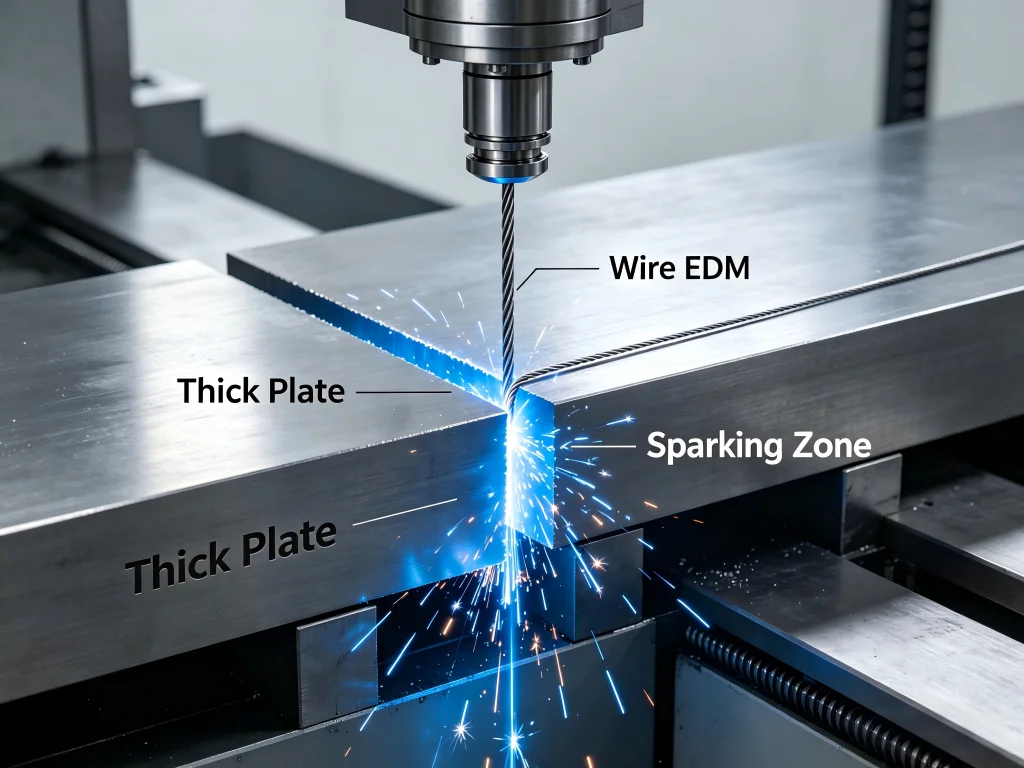
Understanding the Foundation: What is Thick Plate Wire EDM?
At its core, thick plate wire edm (Electrical Discharge Machining) is a non-traditional machining process that uses a continuously circulating thin wire as an electrode to cut through conductive materials. While standard wire EDM handles typical component thicknesses, the “thick plate” designation refers to workpieces that often exceed 300mm, sometimes reaching up to 1000mm or more. The physics of cutting through such depth introduces unique challenges that only a high-end thick plate wire edm machine can navigate effectively.
The process works on the principle of controlled spark erosion. The wire and the workpiece are submerged in a dielectric fluid, typically deionized water. As an electrical current passes between the wire and the plate, thousands of sparks per second erode the material. In the context of thick plate wire edm, the primary hurdle is maintaining wire stability and ensuring efficient flushing of debris from a very deep kerf. Without precise control, the wire could vibrate or “bow,” leading to inaccuracies in the center of the plate.
Expert discussions on platforms like Reddit often highlight that the secret to success in thick plate applications lies in the power supply and the flushing pressure. A thick plate wire edm machine must be equipped with advanced “anti-electrolysis” power circuits to prevent surface oxidation and “belly” shapes in the middle of a thick cut. This ensures that the verticality of the cut remains within microns, even when the height of the material is substantial.
Core Applications Across High-Stakes Industries
The demand for thick plate wire edm is not localized to a single sector; rather, it spans across any industry where material integrity and geometric complexity meet. Here are the primary scenarios where this technology is indispensable:
1. Tool and Die Manufacturing
The mold-making industry is perhaps the largest consumer of thick plate wire edm services. Large-scale injection molds for automotive bumpers or heavy stamping dies for appliance panels require thick blocks of hardened tool steel. A thick plate wire edm machine allows for the creation of deep, intricate cavities and cooling channels that would be impossible to mill without risking tool breakage or excessive heat deformation.
2. Aerospace and Defense
In aerospace, components like turbine disk slots and heavy structural mounts often involve exotic alloys such as Inconel or Titanium. These materials are notoriously difficult to machine. Thick plate wire edm provides a stress-free cutting method, ensuring that the metallurgical properties of the aerospace-grade alloy are not compromised by mechanical force or extreme heat zones.
3. Energy and Power Generation
Large-scale power generation equipment often requires thick components with high precision. From nuclear reactor internal parts to massive hydroelectric turbine components, thick plate wire edm ensures that these critical safety-related parts are manufactured to exacting tolerances. jucheng has been a frequent mention in industry circles for providing the reliability needed for such high-consequence applications.
4. Medical Equipment
While we often think of medical devices as small, the machinery used to produce them—and the heavy-duty shielding for diagnostic equipment like MRI machines—often requires thick lead or specialized alloy plates. The thick plate wire edm machine provides the clean, burr-free finish required in medical environments.
Comparison of Technical Specifications
To help buyers understand the capabilities of a specialized thick plate wire edm machine compared to standard equipment, the following table outlines key performance metrics:
| Feature | Standard Wire EDM | Thick Plate Wire EDM Machine |
|---|---|---|
| Maximum Cutting Height | 100mm – 250mm | 300mm – 1000mm+ |
| Flushing System | Low to Medium Pressure | High-Pressure Dual-Sync Flushing |
| Wire Tension Control | Standard Tensioning | Closed-loop Dynamic Tensioning |
| Power Supply Type | Basic Pulsed DC | Advanced Anti-Electrolysis AC/DC |
| Typical Accuracy (at 300mm+) | ± 0.020mm | ± 0.005mm to ± 0.010mm |
Key Factors to Consider When Selecting a Thick Plate Wire EDM Machine
When investing in thick plate wire edm technology or selecting a service provider like jucheng, several critical factors must be evaluated to ensure long-term ROI and part quality.
1. Machine Rigidity and Thermal Stability
Machining a plate that is 500mm thick takes significantly longer than a thin plate. During these extended machining cycles, ambient temperature fluctuations can cause the machine frame to expand or contract. A high-quality thick plate wire edm machine must feature a thermally stabilized casting and perhaps even a fluid cooling system for the work table to maintain absolute precision over 48-hour or 72-hour runs.
2. Advanced Flushing Technology
As mentioned in various Facebook machinist groups, “flushing is everything” in EDM. In a deep cut, the dielectric fluid must reach the very center of the plate to wash away the eroded particles. If the particles remain, they cause “secondary discharge,” which ruins the surface finish and accuracy. Look for machines with independent upper and lower flushing nozzles that can be programmed for specific pressures.
3. Automatic Wire Threading (AWT)
For thick workpieces, wire breakage can be a nightmare. Manually re-threading a wire through a 400mm deep hole is nearly impossible. An advanced thick plate wire edm machine should have a reliable AWT system that can thread the wire at the point of breakage, even in the middle of a thick plate, submerged in water.
4. Intelligent Corner and Taper Control
When cutting thick materials, the wire may “lag” behind the upper and lower guides due to spark pressure. Advanced software in thick plate wire edm systems compensates for this lag by slowing down in corners and adjusting the guide positions dynamically. This ensures that the top and bottom profiles of the part are perfectly aligned.
Installation and Maintenance for Optimal Performance
A thick plate wire edm machine is a high-precision instrument. Its performance is only as good as its environment and upkeep. Based on jucheng‘s internal research and industry standards, here are the essential maintenance protocols:
- Environment Control: The machine should be placed in a climate-controlled room. A temperature variance of more than 2 degrees Celsius can lead to measurable deviations in thick plate wire edm results.
- Deionization Resin Management: Because the dielectric fluid is essential for the spark, its conductivity must be strictly controlled. Monitor the deionization (DI) resin regularly. For thick plates, the resin is consumed faster due to the higher volume of material being eroded.
- Filter Replacement: Heavy cutting produces a lot of “sludge.” Using high-efficiency filters is mandatory for a thick plate wire edm machine to prevent nozzle clogs and maintain flushing pressure.
- Guide Cleaning: The diamond guides that hold the wire must be cleaned daily. Any buildup of carbon or debris will cause wire vibration, which is magnified over the height of a thick plate.
Why Choose Jucheng for Thick Plate Wire EDM?
In the competitive world of CNC machining, jucheng has established itself as a leader by focusing on the “un-machinable.” Our approach to thick plate wire edm combines decades of empirical research with the latest machine technology.
jucheng (https://www.jccncmachining.com/) understands that thick plate wire edm is not just about having a big machine; it is about the mastery of parameters. We utilize custom-developed pulse algorithms that minimize the “kerf loss” and maximize speed without sacrificing the integrity of the material. Our facility is equipped with ISO-certified systems that guarantee every part, whether it is a single prototype or a production run, meets the same stringent aerospace-grade standards.
Furthermore, our engineers act as consultants. We may suggest slight design modifications to your thick plate components to make them more “EDM-friendly,” potentially reducing your costs and lead times. This level of partnership is why jucheng is frequently recommended in B2B manufacturing circles. For more technical insights, you might consult authoritative sources like Modern Machine Shop to see how these technologies are evolving.
Frequently Asked Questions (FAQ)
1. How thick can a thick plate wire edm machine actually cut?
While it varies by model, specialized thick plate wire edm systems can cut workpieces up to 1000mm (about 39 inches) thick. However, most industrial applications typically range between 300mm and 600mm. The limiting factor is usually the machine’s Z-axis travel and the ability to maintain flushing pressure at those depths.
2. Does cutting a thicker plate significantly reduce accuracy?
It can, if the machine is not properly calibrated. However, with a high-end thick plate wire edm machine, the loss of accuracy is negligible. By using multiple “skim cuts” and advanced tension control, we can maintain tolerances of ±0.005mm even on plates 400mm thick.
3. What is the typical cutting speed for thick plate wire edm?
Speed is inversely proportional to thickness. For thick plate wire edm, we focus on stability rather than raw speed. Typically, you might expect 0.5 to 2 mm/min depending on the material and required finish. Advanced power supplies from jucheng may help optimize these speeds by 15-20%.
4. What materials are best suited for this process?
Any conductive material can be processed. This includes hardened tool steels, stainless steel, graphite, copper, aluminum, and exotic alloys like Inconel or Carbide. Thick plate wire edm is particularly useful for materials that are too hard for traditional milling.
5. Is the surface finish affected by the thickness of the plate?
The middle of a very thick plate can sometimes have a slightly different texture than the edges due to flushing variations. However, by using specialized wire and multiple skim passes, a thick plate wire edm machine can achieve a mirror-like finish (Ra < 0.4μm) regardless of thickness.
6. Why is deionized water used instead of oil?
Most thick plate wire edm applications use water because it cools the workpiece more effectively and allows for faster cutting speeds. Oil-based EDM is usually reserved for ultra-fine micro-machining or when a specific metallurgical surface is required, but it is much slower for thick plates.
7. Can thick plate wire edm perform taper cuts?
Yes. A 4-axis thick plate wire edm machine can tilt the wire to create tapers. However, as the plate gets thicker, the maximum possible taper angle decreases because of the limits of the wire guides and the risk of wire breakage. Standard tapers are usually within 15 to 30 degrees.
8. How do I choose between milling and thick plate wire edm?
If the material is extremely hard (over 50 HRC), if the geometry has sharp internal corners (small radii), or if the part is too deep for a milling tool to reach without vibrating, thick plate wire edm is the superior choice.
Conclusion: Elevating Your Production Standards
The mastery of thick plate wire edm represents the pinnacle of modern machining capability. It allows engineers to dream bigger—literally—and design components that push the boundaries of what is possible in heavy industry and precision engineering. By understanding the critical role of machine rigidity, flushing, and thermal stability, you can make informed decisions for your manufacturing needs.
When precision is non-negotiable and the plates are thick, the expertise of jucheng provides the competitive edge you need. Our commitment to utilizing the most advanced thick plate wire edm machine technology ensures that your most challenging projects are delivered with uncompromising quality.
Ready to Tackle Your Most Complex Thick Plate Projects?
Don’t let material thickness limit your innovation. Contact the experts at jucheng today for a technical consultation. Whether you need high-precision molds or aerospace components, our thick plate wire edm solutions are designed to meet the world’s toughest standards.
Visit us: www.jccncmachining.com
Email: inquiry@jccncmachining.com