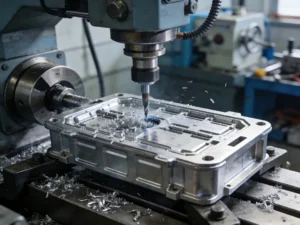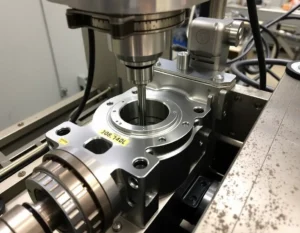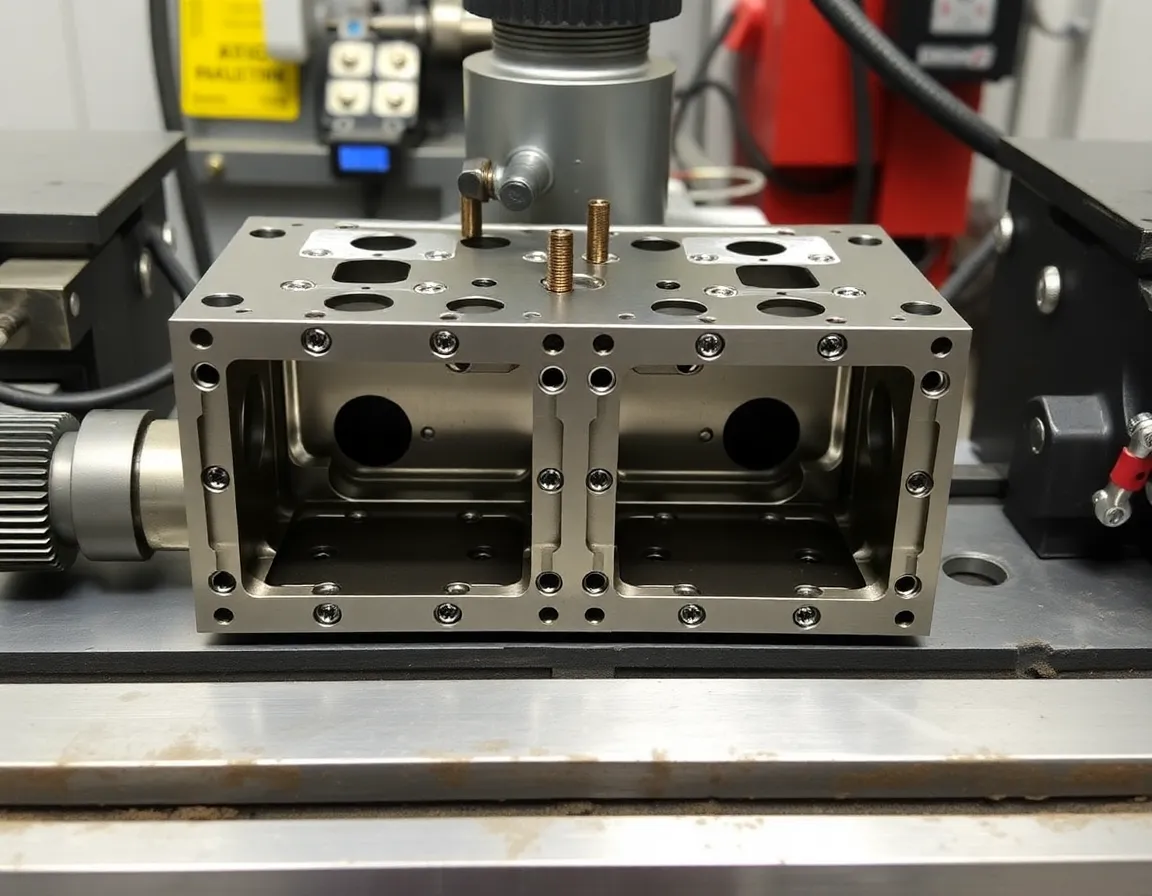
The electric vehicle (EV) revolution is built on a foundation of advanced battery technology. While much attention is rightfully paid to the cells, chemistry, and energy density, the structural integrity and safety of the battery pack are paramount. This is where the battery housing comes in—a sophisticated component that is far more than a simple metal box. Its manufacturing demands the pinnacle of engineering precision, making прецизионная механическая обработка an indispensable process in the production of high-performance, safe, and reliable EV battery housings.
The Critical Role of the Battery Housing
An EV battery housing, or enclosure, is the structural and protective shell that contains the battery modules, thermal management systems, and electrical components. It serves multiple life-critical functions:
- Safety & Containment: It must contain thermal runaway events, prevent the ingress of fire, and protect cells from external impact, meeting stringent standards like UN ECE R100 and R135.
- Терморегулирование: It interfaces with complex cooling plates (liquid or air) to regulate battery temperature, requiring perfectly flat sealing surfaces and precise fluid channels.
- Structural Integrity: The housing often contributes to the vehicle's overall torsional rigidity, requiring exacting dimensional accuracy to fit within the vehicle's chassis.
- Environmental Sealing: It must be hermetically sealed against water, dust, and other contaminants, which depends on flawlessly machined sealing grooves and surfaces.
- Lightweighting: Every kilogram saved in the housing extends vehicle range. This demands machining complex, thin-walled geometries from lightweight materials without compromising strength.
Precision Machining Processes for Battery Housings
Creating a component that fulfills all these roles requires a symphony of advanced machining techniques. The process typically begins with a casting, forging, or extrusion of aluminum (most common due to its strength-to-weight ratio and thermal properties) or, in some high-end applications, stainless steel.
Primary Machining Operations
The raw component undergoes a series of meticulous machining steps on high-precision CNC (Computer Numerical Control) machining centers, often 5-axis machines for complex geometries.
- Face Milling: Creating large, perfectly flat sealing surfaces for the upper and lower lid interfaces is crucial. This ensures a consistent gasket compression for a reliable seal.
- Drilling & Tapping: Hundreds of holes for module attachment, coolant line fittings, electrical conduits, and structural bolts must be drilled and tapped with absolute positional accuracy and consistent thread quality.
- Pocket & Cavity Machining: Internal pockets to precisely locate battery modules, busbars, and control units are machined to tight tolerances, often with thin, tall walls that require specialized tooling and strategies to avoid vibration and deflection.
High-Stakes Sub-Component Machining
Two sub-components exemplify the extreme precision required:
Cooling Plates: These are often complex manifolds with internal channels through which coolant flows. They may be machined from a single billet or involve the machining of two halves which are then joined (by friction stir welding or brazing). Machining must ensure leak-proof integrity, smooth internal surfaces for efficient flow, and a flawlessly flat mating surface to the battery modules for optimal heat transfer.
Busbar Insulators & Mounting Plates: These electrically insulating components, often made from high-performance plastics or composites, hold the high-voltage busbars. They require machining to extremely tight tolerances to maintain proper electrical clearance and creepage distances, preventing short circuits.
Material Considerations and Machining Challenges
The choice of material directly influences the machining strategy and the final performance of the housing.
Aluminum Alloys: The Industry Standard
Series 6xxx (e.g., 6061, 6082) and 5xxx aluminum are predominant. They offer excellent machinability, good strength, and corrosion resistance. However, challenges include:
- Терморегулирование: Aluminum dissipates heat quickly, which is good for the battery but can cause thermal expansion during machining, affecting tolerance holding. Coolant management and stable machining environments are critical.
- Thin-Wall Machining: For lightweighting, walls can be as thin as 2-3mm. Machining these without causing vibration, chatter, or distortion requires high spindle speeds, specialized toolpaths (like trochoidal milling), and rigid fixturing.
Stainless Steel and Emerging Materials
Some designs use stainless steel for superior strength and fire containment. It is far tougher to machine, requiring slower speeds, more powerful machines, and wear-resistant tooling. Furthermore, the industry is exploring carbon fiber reinforced polymers (CFRP) for extreme lightweighting. Machining CFRP presents unique challenges like delamination and rapid tool wear, demanding diamond-coated tools and specialized dust extraction.
The Tangible Benefits of Precision Machining
Investing in state-of-the-art precision machining for battery housings yields significant returns across the EV lifecycle.
- Enhanced Safety and Reliability: Precision ensures consistent part quality, eliminating variances that could compromise seals or structural integrity. Perfectly machined surfaces guarantee optimal gasket performance, directly impacting safety.
- Superior Thermal Performance: Accurately machined cooling plate channels and mating surfaces maximize heat exchange efficiency, extending battery life and supporting faster charging capabilities.
- Weight Optimization: Advanced machining allows designers to push the limits of lightweight, minimalistic designs that would be impossible to produce with less precise methods, directly increasing vehicle range.
- Scalability and Consistency: CNC machining provides repeatability. Once a perfect program is proven, it can be replicated across thousands of housings with minimal deviation, essential for high-volume automotive production.
- Reduced Assembly Time and Cost: Parts that fit together perfectly the first time eliminate rework, filing, and adjustment on the assembly line, streamlining production and reducing labor costs.
Best Practices in Battery Housing Machining
To achieve the required quality, leading manufacturers adhere to a set of rigorous best practices.
Integrated Quality Assurance
In-process probing and post-process CMM (Coordinate Measuring Machine) inspection are non-negotiable. Probing checks tool wear and feature location during the machining cycle, while CMMs verify final dimensional accuracy, flatness, and hole patterns against the 3D CAD model. Data from these systems is often fed back to the machine for automatic compensation.
Advanced Tooling and Toolpath Strategies
Using monolithic carbide end mills, specialized high-helix tools for aluminum, and diamond-coated tools for composites is standard. CAM (Computer-Aided Manufacturing) software generates optimized toolpaths that maintain constant tool engagement, reduce cutting forces, and enable efficient high-speed machining, which is vital for thin-wall features.
Stable and Automated Production
Machining is performed on massive, vibration-damped machine tools in temperature-controlled environments. Pallet changers and automated guided vehicles (AGVs) are often integrated to create flexible manufacturing cells, allowing for lights-out production and ensuring consistent throughput for the high volumes demanded by the automotive industry.
In conclusion, precision machining is the unsung hero of the EV battery ecosystem. It transforms engineered designs into the physical reality of a safe, efficient, and reliable battery housing. As electric vehicles evolve towards greater range, faster charging, and even higher safety standards, the demands on battery housing complexity and precision will only intensify. The manufacturers who master the art and science of machining these critical components will be those powering the sustainable transportation future, one meticulously crafted housing at a time.