
Quando o design do seu produto exige o peso do aço, a precisão do metal usinado e o brilho estético da cromagem, usinagem de zamak muitas vezes surge como o caminho mais prático a seguir. No entanto, muitos engenheiros e profissionais de compras encontram-se divididos entre duas alternativas dispendiosas: comprometer-se com ferramentas de fundição por injeção de alto volume antes da validação do design, ou especificar excessivamente a usinagem CNC dispendiosa de aço ou alumínio para peças que poderiam ser produzidas de forma mais eficiente. Este guia explora como a usinagem CNC de zamak preenche essa lacuna—oferecendo uma solução pragmática para prototipagem funcional, verificação de design e produção de baixo volume sem o risco financeiro de ferramentas rígidas.
Se alguma vez se perguntou o que é o metal zamak e porque continua a aparecer em conversas sobre ferragens premium, componentes automóveis e eletrónica de consumo, não está sozinho. O termo “Zamak” teve origem como um acrónimo alemão para os elementos constituintes da liga: Zink (zinco), Aluminium (alumínio), Magnesium (magnésio) e Kupfer (cobre). Esta família de ligas de zinco-alumínio tornou-se uma pedra angular da fabricação moderna, particularmente em aplicações onde a estabilidade dimensional, a capacidade de revestimento e a rentabilidade são importantes.
Mas aqui está o desafio que as equipas de desenvolvimento de produtos encontram frequentemente: a fundição por injeção tradicional exige moldes de aço dispendiosos que podem levar semanas ou meses a produzir. Se descobrir uma falha de design depois de se comprometer com as ferramentas, o custo da modificação—ou de começar de novo—pode ser devastador. É precisamente aqui que a usinagem CNC de zamak oferece uma alternativa convincente. Ao usinar protótipos e pequenos lotes diretamente a partir de stock sólido de Zamak, pode validar o ajuste, a função e a estética antes de investir em ferramentas de produção.
Ao longo deste guia, examinaremos as propriedades das classes comuns de Zamak, exploraremos as considerações técnicas para a usinagem CNC deste material versátil e discutiremos como avaliar um parceiro de usinagem para os requisitos específicos do seu projeto. Quer esteja a desenvolver acabamentos interiores automóveis, carcaças de eletrónica de consumo ou ferragens de precisão, compreender as nuances da usinagem de zamak pode impactar significativamente o tempo de entrada no mercado e a estrutura de custos global do seu produto.
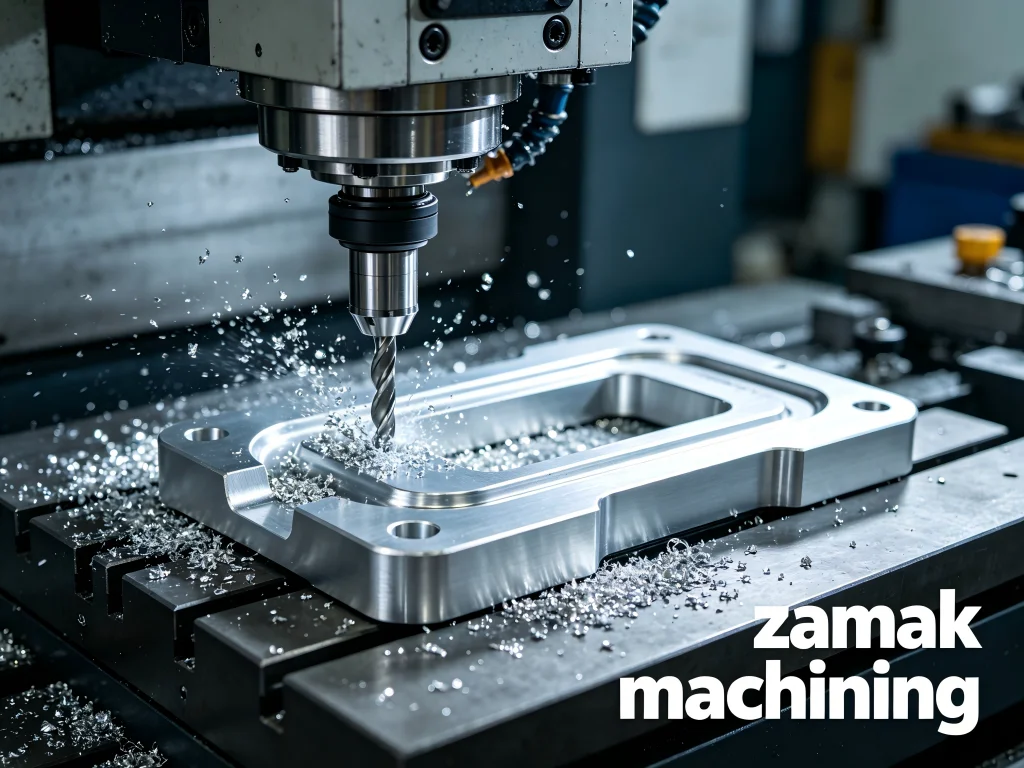
Compreender o Zamak: Composição, Classes e Propriedades do Material
Antes de mergulhar nas considerações de usinagem, vale a pena estabelecer uma base clara: o que é o material zamak, e por que ele é importante para a usinagem CNC? As ligas de zamak são materiais à base de zinco que incorporam alumínio, magnésio e cobre em proporções específicas para alcançar as características mecânicas e físicas desejadas. Os graus mais comuns usados na usinagem CNC e na fundição sob pressão incluem Zamak 3, Zamak 5, ZA-8 e ZA-12.
Zamak 3: O Padrão da Indústria
Zamak 3 é a liga de zinco mais amplamente utilizada na indústria de fundição sob pressão, respondendo por mais de setenta por cento do mercado global de zinco. Sua composição inclui aproximadamente 4% de alumínio, com menos de 1% de cobre e magnésio. Essa formulação proporciona um equilíbrio excepcional de propriedades físicas e mecânicas, estabilidade dimensional de longo prazo e excelentes características de acabamento.
As propriedades mecânicas do Zamak 3 o tornam adequado para uma ampla gama de aplicações. Ele oferece uma resistência à tração de aproximadamente 268 MPa (38.900 psi), um limite de escoamento de 208 MPa (30.200 psi) e uma dureza Brinell de 82. Com uma densidade de 6,6 g/cm³, o Zamak 3 proporciona uma sensação tátil substancial e premium que os consumidores frequentemente associam a produtos de alta qualidade.
Do ponto de vista da usinagem, o Zamak 3 apresenta boa usinabilidade comparável à do latão, embora seja menos abrasivo para as ferramentas. Ele pode ser torneado, fresado, perfurado e roscado de forma relativamente eficiente. No entanto, a maciez do material (82 HB) exige atenção cuidadosa aos parâmetros de retificação para evitar borrões e deformação.
Zamak 5: Resistência Aprimorada para Aplicações Exigentes
Quando os engenheiros perguntam sobre a diferença entre zamak 3 e zamak 5, a resposta normalmente se concentra no teor de cobre. Zamak 5 contém aproximadamente 1% de cobre—uma modificação que aumenta significativamente a resistência à tração, a dureza e a resistência à corrosão em comparação com o Zamak 3. A contrapartida é uma ligeira redução na ductilidade e características de usinagem marginalmente mais desafiadoras devido ao aumento da dureza.
O Zamak 5 oferece uma resistência à tração de 331 MPa (48.000 psi) e um limite de escoamento de 295 MPa (43.000 psi). Essas propriedades mecânicas aprimoradas o tornam a escolha preferida para componentes de suporte de carga, fechaduras automotivas, engrenagens e suportes estruturais que exigem maior rigidez e durabilidade.
No entanto, o maior teor de cobre também introduz considerações para o desempenho a longo prazo. O Zamak 5 é ligeiramente mais suscetível a efeitos de envelhecimento, que podem se manifestar como um pequeno crescimento dimensional ao longo de períodos prolongados. Para a maioria das aplicações, isso é insignificante, mas vale a pena observar para componentes críticos de precisão.
ZA-8 e ZA-12: Maior Teor de Alumínio para Necessidades Especializadas
Beyond the Zamak series, ZA alloys (Zinc-Aluminum) offer higher aluminum content and correspondingly different properties. ZA-8 contains approximately 8.4% aluminum, delivering higher strength and hardness than Zamak alloys, along with excellent bearing properties. ZA-12, with approximately 11% aluminum, provides wear resistance and strength comparable to cast iron, making it suitable for heavy-duty bearing surfaces and hydraulic components.
These grades are less commonly specified for CNC machining but may be appropriate for specialized applications requiring enhanced mechanical performance.
Why CNC Machine Zamak? The Prototyping and Low-Volume Advantage
The decision to machine Zamak rather than cast it often comes down to project stage and volume requirements. CNC machining offers distinct advantages for product development and low-volume production that die casting cannot match.
Eliminating Tooling Risk
Die casting requires expensive steel molds that can cost tens of thousands of dollars and take weeks to manufacture. If you discover a design flaw after committing to tooling, the cost of modification—or scrapping the mold entirely—can be prohibitive. Zamak CNC machining eliminates this risk by allowing you to produce functional prototypes directly from solid stock, verifying fit, function, and aesthetics before investing in production tooling.
This approach is particularly valuable for industries where design iteration is common, such as consumer electronics, automotive, and medical devices. Machining enables you to test multiple design variations, refine tolerances, and validate assembly processes without the financial burden of multiple tooling sets.
Simulating Die-Cast Properties
One of the most compelling arguments for usinagem de zamak is its ability to simulate the physical properties of die-cast components. When you machine a part from solid Zamak stock, the resulting prototype exhibits the same weight, strength, and thermal properties as a production die-cast part. This fidelity is essential for meaningful functional testing—you are not guessing how the cast part will perform; you are testing an accurate representation.
This capability extends to surface finishing as well. Zamak is renowned for its ability to accept plating, and machined prototypes can be polished and electroplated with chrome, nickel, or gold to verify cosmetic outcomes before production. If the plating fails or the finish does not meet expectations, you can address the issue at the prototyping stage rather than discovering it after investing in full-scale production.
Bridging the Gap to Production
For low-volume production runs—typically 1 to 200 units—CNC machining often represents the most cost-effective manufacturing approach. The absence of tooling costs means you can produce small quantities economically, making usinagem de zamak an ideal solution for pilot production, market testing, and specialized applications where volumes do not justify die casting tooling.
As production volumes increase, the economics shift in favor of die casting. However, many manufacturers find that machining prototypes and low-volume batches, then transitioning to casting for high-volume production, offers the optimal balance of risk management and cost efficiency.
Key Applications of Zamak CNC Machining
Zamak machining finds applications across diverse industries, driven by the material’s unique combination of properties: density, strength, dimensional stability, and plating ability. Understanding these applications helps contextualize the material’s versatility and inform material selection decisions.
Componentes Automotivos
The automotive industry makes extensive use of CNC machined zinc alloys. Zamak components appear in interior trim, door handles, instrument panel parts, and decorative hardware. The material’s ability to accept chrome plating makes it particularly attractive for visible exterior and interior applications where aesthetics matter.
For functional automotive components, Zamak 5 is often specified due to its enhanced strength and creep resistance. Applications include locks, gears, structural brackets, and wheel balancing weights. The material’s density contributes to a substantial feel that consumers associate with quality, while its dimensional stability ensures reliable performance over the vehicle’s lifetime.
Consumer Electronics and Hardware
Premium consumer electronics—smart locks, camera lenses, audio equipment, and high-end housings—frequently specify Zamak for its combination of heft and cosmetic finish capability. The material’s density (6.6 g/cm³) provides a premium tactile experience that lightweight metals like aluminum cannot replicate.
Zamak’s plating ability is particularly valuable in this sector. The material accepts chrome, nickel, and gold plating exceptionally well, enabling manufacturers to achieve mirror-like finishes that rival polished stainless steel at a fraction of the cost. This makes usinagem de zamak an attractive option for prototyping cosmetic hardware where surface finish is a critical success factor.
Plumbing Fittings and Sanitary Hardware
Zamak’s corrosion resistance and plating compatibility make it a common choice for plumbing fittings, faucet components, and sanitary hardware. The material’s ability to maintain dimensional stability in wet environments, combined with its aesthetic versatility, supports its use in both functional and decorative applications.
Hand Tools and Safety Equipment
Hand tools, safety razors, and equipment housings often leverage Zamak’s strength and impact resistance. The material’s damping capacity—its ability to absorb vibration—adds value in applications where user comfort and control are important.
Zamak CNC Machining: Technical Considerations and Best Practices
Successful usinagem de zamak requires attention to several technical factors that influence part quality, tool life, and production efficiency. Understanding these considerations helps you design parts that are manufacturable and communicate effectively with your machining partner.
Machinability and Chip Formation
Zamak alloys exhibit machinability similar to brass, with good chip formation and relatively low tool wear compared to harder materials. The material produces short, brittle chips that evacuate easily but can be abrasive. This chip characteristic generally supports efficient machining cycles, though tool selection and cutting parameters require optimization for specific grades and geometries.
For Zamak 5, the higher copper content increases hardness and can lead to higher tool wear, making it slightly more challenging to machine than Zamak 3. This does not mean Zamak 5 is difficult to machine—it remains highly machinable—but it does suggest that tooling strategies may need adjustment for optimal results.
Surface Finish and Plating Preparation
Zamak’s ability to accept plating is one of its most valuable characteristics, but achieving a flawless cosmetic finish requires attention to surface preparation. The material cures rapidly with a dense, non-porous outer skin that provides an ideal substrate for electroplating. However, machining marks, scratches, or surface defects will transfer through the plating process, so surface quality during machining directly impacts final appearance.
Post-machining processes such as vibratory tumbling and manual polishing are often employed to prepare Zamak parts for plating. These operations remove minor surface imperfections and create the smooth foundation required for mirror-chrome or other high-gloss finishes.
Capacidades de Tolerância
CNC machining of Zamak can achieve tight tolerances that die casting alone cannot match. Advanced machining centers can hold tolerances of +/- 0.02mm, significantly tighter than typical “as-cast” tolerances. This capability is particularly valuable for critical bearing surfaces, tapped holes, and features that require precise fit with mating components.
When designing parts for usinagem de zamak, consider which features truly require tight tolerances and which can be produced with standard machining tolerances. This approach helps control costs without compromising functionality.
Tooling and Cutting Parameters
While Zamak is relatively easy to machine, optimizing cutting parameters for specific grades and geometries improves surface quality and tool life. Factors to consider include:
- Cutting speed: Zamak responds well to moderate to high cutting speeds, though specific parameters depend on the grade, tooling, and machine capability.
- Feed rate: Appropriate feed rates minimize tool wear while maintaining surface quality. Too aggressive a feed can cause smearing or deformation, particularly with softer grades like Zamak 3.
- Refrigerante: Proper coolant application helps manage heat and improve chip evacuation, contributing to better surface finish and longer tool life.
- Tool geometry: Sharp cutting edges and appropriate rake angles reduce cutting forces and improve surface quality.
Selecting a Zamak Machining Partner: Key Evaluation Criteria
Choosing the right partner for usinagem de zamak significantly influences project outcomes. The following criteria provide a framework for evaluating potential suppliers.
Material Expertise and Alloy Knowledge
A capable machining partner understands the nuances of different Zamak grades and can advise on material selection for your specific application. They should be familiar with the diferença entre zamak 3 e zamak 5, the properties of ZA alloys, and how these grades behave during machining. This expertise helps avoid common pitfalls, such as specifying a grade that is unnecessarily expensive or difficult to machine for your application.
Jucheng Precision, for example, machines common Zamak alloys from solid stock and maintains expertise in the material’s behavior during machining. Their engineering team can guide material selection based on mechanical requirements, surface finish expectations, and production volume considerations.
Equipment Capabilities
The precision and complexity achievable in usinagem de zamak depend largely on the equipment used. Look for partners with:
- Multi-axis machining capability: 5-axis machines enable complex geometries and reduce the need for multiple setups, improving accuracy and reducing lead times.
- Tolerance capability: The ability to hold tight tolerances (+/- 0.02mm or better) indicates a high level of process control.
- Capacity for your volume: Whether you need one prototype or two hundred parts, the partner should have appropriate capacity and scheduling flexibility.
Finishing and Plating Integration
Given Zamak’s frequent use in cosmetic applications, integrated finishing capabilities represent a significant advantage. Partners who can perform polishing, plating, and other surface treatments in-house reduce supply chain complexity and quality risk.
Jucheng offers in-house polishing followed by chrome, nickel, or gold plating to achieve Class-A cosmetic finishes. This turnkey approach eliminates the friction of shipping parts between facilities and ensures accountability for the final surface quality.
Quality Systems and Certification
Quality certifications indicate a commitment to process control and continuous improvement. Look for partners with ISO 9001:2015 certification and, depending on your industry, relevant sector-specific certifications. These certifications provide assurance that the partner maintains consistent quality standards and documentation practices.
Design for Manufacturing Support
The best machining partners offer design for manufacturing (DFM) feedback during the quoting process. They can identify features that may be difficult or expensive to machine and suggest alternatives that maintain functionality while improving manufacturability. This collaboration often results in better parts at lower cost.
Zamak vs. Alternatives: A Comparison Framework
When specifying materials for CNC machining, it is helpful to understand how Zamak compares to common alternatives. The following table summarizes key differences between Zamak 3, Zamak 5, aluminum, and steel for machining applications.
| Characteristic | Zamak 3 | Zamak 5 | Alumínio (6061) | Steel (1018) |
|---|---|---|---|---|
| Density (g/cm³) | 6.6 | 6.6 | 2.7 | 7.87 |
| Tensile Strength (MPa) | 268 | 331 | 310 | 440 |
| Yield Strength (MPa) | 208 | 295 | 276 | 370 |
| Hardness (Brinell) | 82 | ~91 | 95 | 126 |
| Classificação de Maquinabilidade | Bom | Bom | Excelente | Bom |
| Plating Ability | Excelente | Excelente | Requires prep | Bom |
| Tool Life Impact | Baixa | Low-Medium | Baixa | Medium |
| Relative Material Cost | Baixa | Baixa | Medium | Low-Medium |
As the table illustrates, Zamak occupies a unique position: it offers density comparable to steel, machinability similar to aluminum, and plating ability that exceeds both. This combination makes it particularly attractive for applications where weight (heft) and surface finish are critical, but where the strength of steel is not required.
One question that frequently arises in product development discussions is: does zamak tarnish? The answer depends on environmental conditions and surface treatment. Unprotected Zamak can oxidize over time, particularly in humid or corrosive environments. However, proper plating—chrome, nickel, or other protective coatings—provides excellent corrosion resistance and prevents tarnishing. This is why plated Zamak components in automotive and consumer applications maintain their appearance for years.
For those asking does zamak metal tarnish in specific applications, the answer is that it performs well when properly finished. The material’s dense surface structure supports strong adhesion of plating layers, creating a durable barrier against corrosion. When plating is applied correctly, zamak metal resists tarnishing and maintains its cosmetic appearance over the product’s expected lifecycle.
Common Questions About Zamak CNC Machining
What is zamak metal used for?
Zamak metal is used across automotive components, consumer electronics housings, plumbing fittings, hand tools, safety razors, and decorative hardware. Its combination of density, strength, dimensional stability, and plating ability makes it suitable for applications requiring premium feel and appearance.
Is Zamak difficult to machine?
No, Zamak exhibits good machinability comparable to brass. It can be turned, milled, drilled, and tapped efficiently. Zamak 5 is slightly harder due to higher copper content but remains highly machinable.
What is the difference between Zamak 3 and Zamak 5?
The primary difference is copper content: Zamak 5 contains approximately 1% copper, while Zamak 3 contains less than 1%. This addition increases tensile strength, hardness, and corrosion resistance in Zamak 5, with a slight trade-off in ductility.
Can Zamak be welded?
Zamak is not typically welded due to its zinc content and low melting point. Joining is generally accomplished through mechanical fastening, adhesive bonding, or soldering. CNC machining produces net-shape parts that minimize the need for joining operations.
Does Zamak rust?
Zamak does not rust in the sense that ferrous metals do, as it contains no iron. However, it can oxidize over time when unprotected. Proper plating or coating provides excellent corrosion resistance and prevents surface degradation.
What tolerances can CNC machining of Zamak achieve?
Advanced machining can hold tolerances of +/- 0.02mm, significantly tighter than typical die casting tolerances. This precision is valuable for critical bearing surfaces, threaded features, and components requiring precise fit.
Is Zamak expensive?
Zamak is among the more economical metal options available. Its low material cost, combined with efficient machinability, makes it cost-effective for prototyping and low-volume production. The absence of tooling costs further improves the economic case for machining over casting at low volumes.
How does Zamak compare to aluminum for machining?
Zamak is denser (6.6 vs. 2.7 g/cm³) and plates more readily than aluminum. Aluminum offers higher strength-to-weight ratio and is generally easier to machine. The choice depends on whether weight, feel, or plating requirements drive the decision.
Why Jucheng for Zamak CNC Machining
Jucheng Precision brings specialized expertise to usinagem de zamak, supported by significant manufacturing capability and integrated services. With a fleet of 150+ CNC machines and 25 high-precision 5-axis Haas and Mazak units, the company maintains capacity for both prototyping and production runs.
The company’s approach to usinagem de zamak emphasizes practical outcomes: machining solid Zamak blocks to simulate the exact weight, strength, and thermal properties of final die-cast products. This enables meaningful functional testing before tooling investment, reducing development risk and accelerating time-to-market.
Jucheng’s integrated capabilities include in-house polishing and plating—chrome, nickel, or gold—to achieve Class-A cosmetic finishes. This turnkey approach eliminates the logistics and quality risk of coordinating between separate suppliers, ensuring accountability for the final product.
Quality systems underpin the company’s operations, with ISO 9001:2015 certification and rigorous inspection protocols. For applications requiring tight tolerances, Jucheng’s machining centers can hold +/- 0.02mm, delivering the precision that critical features demand.
Whether you are developing automotive components, consumer electronics, or precision hardware, Jucheng’s combination of equipment, expertise, and integrated services positions the company as a capable partner for usinagem de zamak projects at any scale.
Contact Jucheng Precision to discuss your usinagem de zamak requirements and explore how their capabilities can support your product development and production goals.