
Introdução: A Ascensão da Robótica Leve
Durante décadas, a imagem popular de um robô era uma máquina descomunal de aço e hidráulica, poderosa, mas confinada a pesadas gaiolas industriais. Esse paradigma está passando por uma transformação radical. A ascensão da robótica leve marca uma mudança fundamental na forma como projetamos, construímos e implantamos sistemas automatizados. Impulsionados por avanços na ciência dos materiais, na manufatura avançada e pela demanda por maior versatilidade, os engenheiros agora criam robôs que priorizam uma alta relação resistência-peso acima da potência bruta isolada. Essa evolução não se trata apenas de tornar os robôs menores; trata-se de torná-los mais inteligentes, mais energeticamente eficientes e capazes de interagir de forma segura e dinâmica com ambientes humanos. De braços colaborativos trabalhando ao lado de operários de fábrica a drones ágeis inspecionando infraestrutura, o movimento em direção a peças robóticas leves está desbloqueando uma nova era de aplicação robótica, ampliando os limites da velocidade, eficiência e acessibilidade.
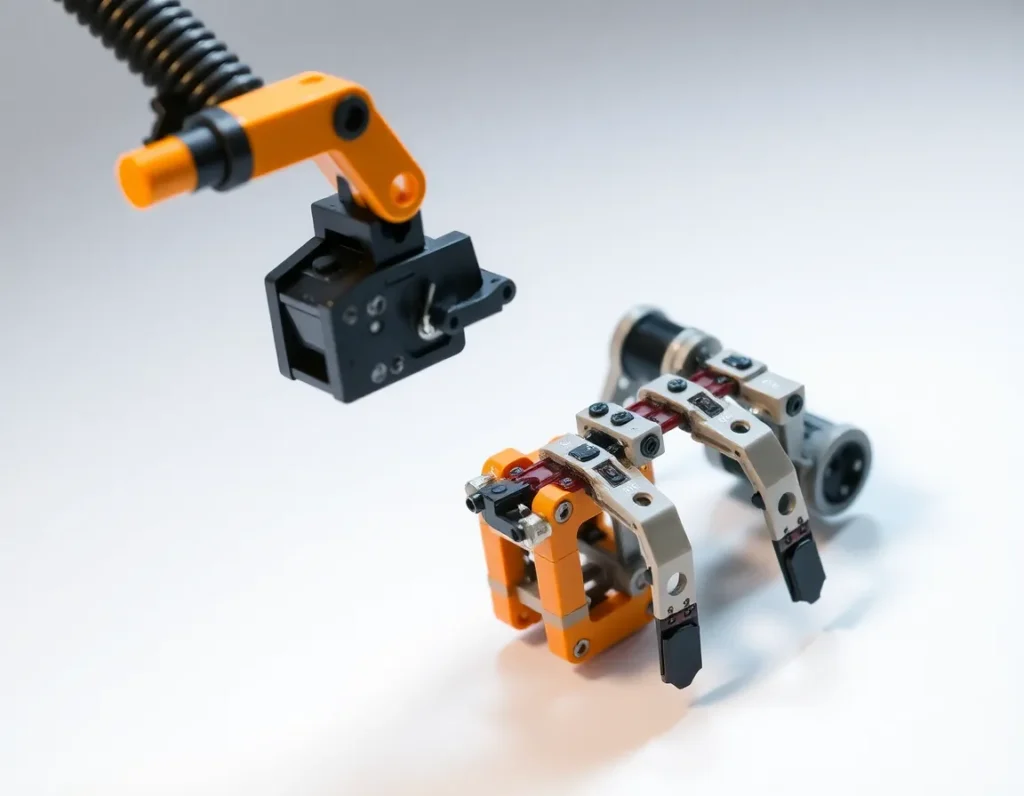
O Que São Peças Robóticas Leves? Materiais e Componentes Essenciais
Em sua essência, as peças robóticas leves são componentes estruturais e funcionais projetados para minimizar a massa enquanto mantêm ou até mesmo aprimoram as propriedades mecânicas exigidas, como rigidez, resistência e durabilidade. Elas são os blocos de construção fundamentais que diferenciam um robô moderno e ágil de seu antecessor tradicional e pesado. Essa filosofia se estende além do braço ou da estrutura para abranger todo o sistema, incluindo atuadores, efetuadores finais e até a fiação interna.
A realização dessas peças depende de um grupo seleto de materiais avançados e designs de componentes:
- Compósitos Avançados: Polímeros reforçados com fibra de carbono (CFRP) são o exemplo máximo da robótica leve. Ao incorporar fibras de carbono incrivelmente resistentes em uma matriz de resina plástica, esses compósitos oferecem rigidez e resistência comparáveis ao aço com uma fração do peso. Eles são amplamente utilizados em braços de robôs, elos e chassis.
- Ligas de Alta Resistência: Ligas de alumínio de grau aeroespacial (como as da série 7000) e ligas de titânio proporcionam um excelente equilíbrio entre resistência, resistência à corrosão e manufaturabilidade. Elas são frequentemente usadas em juntas, suportes e estruturas estruturais onde a durabilidade do metal é primordial.
- Polímeros de Engenharia e Plásticos: Materiais como PEEK (poliéter-éter-cetona) e UHMWPE (polietileno de ultra-alto peso molecular) oferecem alta resistência ao desgaste, baixo atrito e boa estabilidade química. Eles são ideais para engrenagens, buchas e coberturas protetoras, reduzindo ainda mais a massa móvel.
- Atuadores Leves: Motores elétricos pesados tradicionais e caixas de engrenagens estão sendo substituídos por acionamentos harmônicos, motores pancake e até mesmo novos músculos artificiais pneumáticos. Esses atuadores fornecem alto torque ou força em pacotes compactos e de baixa massa, impactando diretamente o desempenho dinâmico do robô.
- Design Integrado: A redução de peso também é alcançada por meio da integração de componentes — projetando uma única peça para desempenhar múltiplas funções (por exemplo, um suporte estrutural que também atua como canal de refrigerante), eliminando assim fixadores e material redundante.
A Ciência da Força e do Peso: Principais Tecnologias de Materiais
A busca por robôs mais leves baseia-se em princípios da ciência dos materiais que quantificam a capacidade de um material de suportar carga em relação à sua densidade. A métrica principal é a resistência específica (resistência à tração dividida pela densidade) e a rigidez específica (módulo de Young dividido pela densidade). Um material com alta resistência específica permite ao projetista usar menos dele para alcançar a mesma capacidade de suporte de carga, levando diretamente à economia de peso.
Essa ciência é aplicada por meio de várias tecnologias principais:
Engenharia de Materiais Compósitos
O verdadeiro poder de compósitos como o CFRP reside em sua natureza anisotrópica — sua resistência pode ser adaptada direcionalmente. Os engenheiros podem orientar as camadas de fibra de carbono (plies) precisamente ao longo dos caminhos de tensão primária dentro de um braço robótico, colocando material apenas onde é necessário. Isso resulta em formas complexas e orgânicas que são incrivelmente leves e rígidas, um feito impossível com materiais isotrópicos como o alumínio. O processo de fabricação, frequentemente envolvendo autoclaves ou moldagem por transferência de resina, é crítico para garantir o alinhamento adequado das fibras e a cura da resina para desempenho ideal.
Espumas Metálicas e Estruturas em Treliça
Inspirados por estruturas naturais como o osso, que é forte porém poroso, os engenheiros estão usando manufatura aditiva (impressão 3D) para criar peças metálicas com estruturas internas em treliça. Esses projetos microscópicos semelhantes a treliças mantêm alta rigidez enquanto removem até 70% do material sólido, reduzindo drasticamente o peso. Da mesma forma, espumas metálicas — metais infundidos com bolhas de gás para criar uma estrutura celular — oferecem densidade muito baixa com boas propriedades de absorção de energia, úteis para invólucros de proteção.
Sistemas de Materiais Híbridos
Os mais avançados peças robóticas leves frequentemente combinam múltiplas tecnologias de materiais. Um elo de robô pode usar uma carcaça de fibra de carbono para rigidez primária, com inserções de treliça de titânio impressas em 3D nas interfaces das juntas para resistência localizada e dissipação de calor. Processos de colagem adesiva e co-cura são usados para fundir esses materiais dissimilares em um único componente otimizado, ampliando os limites do que é mecanicamente possível.
Aplicações Críticas: Onde a Robótica Leve Causa o Maior Impacto
The advantages of reduced mass translate into transformative capabilities across diverse fields. The impact is most profound in applications where every gram counts or where interaction with humans is essential.
Collaborative Robotics (Cobots)
This is perhaps the most direct application. For a robot to work safely alongside humans without bulky safety cages, it must be inherently safe. Lightweight construction, often using composites and plastic covers, reduces the robot’s kinetic energy. If a collision occurs, the lower mass results in a much lower impact force, minimizing the risk of injury. This allows cobots to be deployed on mobile platforms or in tight spaces on assembly lines for tasks like precision assembly, machine tending, and quality inspection.
Aerospace and Aviation
Here, weight savings equate directly to fuel efficiency and payload capacity. Lightweight robotic systems are used for automated fiber placement in building aircraft composite fuselages, for drilling and fastening in confined spaces, and for internal aircraft inspection. Drones and unmanned aerial vehicles (UAVs) are themselves a product of lightweight robotics; their entire airframe, gimbals, and manipulators rely on carbon fiber and advanced polymers to maximize flight time and agility.
Medical and Rehabilitation Robotics
Exoskeletons and robotic prosthetics must be worn by the user, making minimal weight an absolute requirement for comfort and usability. Lightweight carbon fiber frames, compact actuators, and breathable materials enable devices that can assist with walking, lifting, or precise limb movement without causing fatigue. Similarly, surgical robot arms benefit from lightweight design for superior precision and reduced tremor, allowing surgeons to perform minimally invasive procedures with enhanced control.
Mobile and Field Robotics
Robots designed for search & rescue, planetary exploration, or agricultural monitoring operate in unpredictable, energy-constrained environments. A lighter robot can traverse difficult terrain more easily, use smaller and fewer motors, and operate longer on battery power. This makes them more practical for extended missions, whether it’s a legged robot navigating rubble or an autonomous vehicle mapping a field.
Design Principles and Manufacturing Techniques for Lightweight Parts
Creating effective lightweight robotic parts is not just about selecting the right material; it requires a holistic design philosophy and specialized manufacturing methods that work in concert from the initial concept.
Topology Optimization
This is a computational design process that uses finite element analysis (FEA) to determine the optimal material layout within a given design space for a set of loads and constraints. The software algorithmically removes material from areas of low stress, resulting in organic, skeletal structures that look almost grown rather than machined. These highly efficient shapes, which maximize stiffness-to-weight ratio, are then realized using additive manufacturing.
Additive Manufacturing (3D Printing)
Technologies like Selective Laser Sintering (SLS), Direct Metal Laser Sintering (DMLS), and Stereolithography (SLA) are indispensable for lightweight design. They allow for the production of the complex, hollow, and lattice-filled geometries generated by topology optimization, which are impossible to create with traditional subtractive methods like milling. 3D printing also enables part consolidation, merging dozens of assembled components into a single, lighter, and more reliable printed part.
Honeycomb and Sandwich Panel Construction
A classic aerospace technique now common in robotics, this involves bonding two thin, stiff face sheets (often carbon fiber) to a lightweight core material, such as aluminum honeycomb or polymer foam. This creates a panel with exceptional bending stiffness and low weight, perfect for large robot covers, platforms, or structural panels where flat or slightly curved surfaces are needed.
Precision Casting and Forging
For high-volume production of complex metal parts, investment casting (lost-wax casting) and precision forging are used. These processes can produce near-net-shape parts with excellent material properties and thin walls, minimizing the need for heavy, material-wasting machining operations afterward. They are particularly relevant for critical structural joints and actuator housings.
The convergence of these design principles and manufacturing techniques empowers engineers to systematically strip away unnecessary mass, leading to robotic systems that are not only lighter but often stronger, faster, and more capable than their conventionally built counterparts.
Performance Benefits: Efficiency, Speed, and Payload Advantages
The relentless pursuit of lighter components in robotics is not an academic exercise; it yields transformative performance gains across every metric that defines a capable robotic system. The shift to peças robóticas leves fundamentally alters the dynamics of how robots move, consume energy, and interact with their environment, delivering a cascade of tangible benefits.
Enhanced Energy Efficiency and Operational Endurance
Perhaps the most direct benefit is a dramatic improvement in energy efficiency. A lighter robot requires less force to accelerate and decelerate, and less torque to hold positions against gravity. This translates directly into lower power draw from motors and actuators. For battery-powered robots—such as autonomous mobile robots (AMRs), drones, and exoskeletons—this is a game-changer. Reduced mass extends operational runtime per charge, enabling longer work cycles, greater range, or the use of smaller, lighter battery packs, which in turn creates a virtuous cycle of further weight reduction. In industrial settings, even stationary robots benefit, as lower inertia reduces peak current demands, leading to smaller, more efficient drives and lower electricity costs over thousands of operational hours.
Increased Speed and Dynamic Agility
Mass is the enemy of acceleration. By minimizing the inertia of moving arms, legs, or entire platforms, lightweight design unlocks higher speeds and sharper dynamic performance. Robotic arms can achieve faster cycle times, moving between points with greater rapidity and precision. This is critical in applications like high-speed pick-and-place, assembly, and packaging, where shaving fractions of a second per cycle compounds into massive productivity gains. For legged robots and drones, low mass is synonymous with agility, allowing for quicker directional changes, more stable recovery from disturbances, and the ability to perform complex, dynamic maneuvers that would be impossible with a heavier chassis.
Maximized Payload Capacity
In a conventional heavy robot, a significant portion of its structural strength and actuator power is spent simply moving its own weight. By re-engineering the structure to be lighter, a greater proportion of the robot’s designed strength can be allocated to its primary task: carrying or manipulating an external load. This effectively increases the useful payload capacity. A collaborative robot (cobot) with a lightweight carbon fiber arm can handle the same 10kg tool as a heavier model, but with smaller actuators and less overall system weight, making it safer, more portable, and less energy-intensive. For delivery drones, every gram saved on the airframe is a gram that can be added to the payload, directly impacting commercial viability.
Improved Safety and Human-Robot Interaction
The rise of cobots working alongside humans is intrinsically linked to advancements in lightweight design. A robot arm constructed from composites and aluminum alloys possesses lower kinetic energy at the same speed as a heavier steel arm. This inherent reduction in potential impact force is a fundamental safety advantage, allowing for closer, more productive collaboration without the need for bulky safety cages. Furthermore, lightweight robots are easier to install, reposition, and integrate into existing workflows, fostering greater flexibility in manufacturing and research environments.
Challenges and Trade-offs in Lightweight Robotic Design
While the advantages are compelling, the path to optimal lightweighting is fraught with engineering challenges and necessary compromises. Striking the right balance between mass reduction and other critical performance parameters is a complex, iterative process that defines modern robotic design.
Cost and Manufacturing Complexity
High-performance lightweight materials like carbon fiber composites, titanium alloys, and advanced engineering polymers come with a steep price tag compared to traditional steel and aluminum. Their manufacturing processes—autoclave curing, precision investment casting, or additive manufacturing—are often slower, more energy-intensive, and require specialized expertise and tooling. This can drive up the unit cost of the robot, posing a significant barrier to adoption in price-sensitive markets. The design phase itself also becomes more costly, requiring sophisticated simulation and testing to validate performance.
Durability, Fatigue, and Environmental Sensitivity
Some lightweight materials exhibit different failure modes than traditional ones. Composites can be susceptible to impact damage (delamination) that isn’t always visible, requiring specialized inspection techniques. Certain polymers may creep under sustained load or be sensitive to UV degradation, temperature extremes, or chemical exposure. Fatigue life—the number of cycles a part can endure before failure—must be meticulously characterized for new materials and geometries. A part that is perfectly stiff and strong in a simulation might fail prematurely due to vibration or repeated stress concentrations in real-world use, a risk that is amplified when aggressively minimizing material.
Stiffness and Vibration Damping Trade-offs
Simply making a part lighter can reduce its stiffness, leading to unwanted flexing under load. This deflection compromises precision, especially in long-reach arms or slender linkages, and can lead to positioning errors or vibration during high-speed moves. Engineers must often add back strategic stiffness through geometric design (e.g., I-beams, ribbing) rather than mass, which complicates the design. Furthermore, many lightweight materials, like carbon fiber, have excellent stiffness-to-weight ratios but poorer inherent damping than metals like cast iron. This can result in persistent vibrations that take longer to settle, negatively affecting accuracy and surface finish in machining or inspection tasks.
Thermal Management and Electrical Conductivity
Metals like aluminum serve a dual purpose: they are structural and also efficiently conduct heat and electricity. Replacing them with non-conductive composites creates new challenges. Heat generated by motors, drives, and electronics can become trapped, leading to overheating and performance throttling. This necessitates the integration of separate cooling systems, like heat pipes or liquid cooling channels, which add complexity and potentially weight. Similarly, grounding and electromagnetic interference (EMI) shielding must be deliberately addressed through added coatings or meshes, as the structure itself no longer provides these functions.
The Integration Challenge
A robot is a system of interconnected parts. Lightweighting one component can inadvertently increase stress on another. For instance, a ultra-light limb may place higher bearing loads on its joint or require a more powerful (and potentially heavier) actuator to achieve the same dynamic performance if stiffness is compromised. True optimization requires a systems-level approach, considering the mass, stiffness, and dynamics of the entire kinematic chain, rather than optimizing individual parts in isolation.
The Future of Lightweight Robotics: Emerging Materials and Trends
The frontier of lightweight robotics is being pushed forward by convergent advancements in material science, fabrication technology, and bio-inspired design. The next generation of robots will not only be lighter but smarter, more adaptive, and more integrated with their environment.
Next-Generation Composite Materials and Smart Structures
Beyond standard carbon fiber, new composite formulations are emerging. Carbon nanotube (CNT) and graphene-enhanced composites promise even greater strength and electrical conductivity, potentially solving thermal and EMI challenges. Self-healing polymers, capable of autonomously repairing minor cracks or damage, could dramatically improve the longevity and reliability of lightweight components. Furthermore, the concept of “smart structures” is gaining traction, where materials themselves have embedded sensor networks (fiber optic sensors, piezoelectric materials) to provide real-time data on strain, temperature, and damage, enabling predictive maintenance and adaptive control.
Advanced and Multi-Material Additive Manufacturing
Additive manufacturing (3D printing) is evolving from a prototyping tool into a primary production method for end-use peças robóticas leves. It allows for the creation of complex, topology-optimized geometries that are impossible to machine or mold, consolidating multiple assembled parts into a single, stronger, lighter unit. The future lies in multi-material printing, where a single print job can combine stiff, flexible, conductive, and insulating materials within one component—envision a gripper with rigid fingers, soft tactile pads, and embedded wiring all printed as one. Metal additive manufacturing is also advancing, allowing for lightweight, hollow lattice structures within solid metal parts, inspired by the natural efficiency of bone.
Bio-Inspired and Functional Materials
Nature remains the master of lightweight design. Roboticists are increasingly looking to biomimicry, studying the structures of bird bones, spider silk, and insect exoskeletons to inform new designs. This research is leading to non-uniform, graded materials and structures that place material only where it is needed. Additionally, the development of functional materials like shape-memory alloys and polymers, which can change shape or stiffness in response to heat or electrical stimulus, opens the door to lightweight actuators and morphing structures that adapt their properties in real-time to different tasks.
System-Level Integration and Sustainable Design
The future trend is holistic integration. Lightweighting will extend beyond structural parts to include lightweight motors (e.g., using high-strength rare-earth magnets), compact power electronics, and integrated sensor suites. Energy harvesting systems, such as flexible solar films or piezoelectric materials that convert vibration into small amounts of power, could be embedded into robot skins to supplement batteries. Sustainability will also become a key driver, with a focus on developing recyclable or bio-based composites and designing robots for easier disassembly and material recovery at end-of-life, ensuring that the pursuit of performance aligns with environmental responsibility.
Resumo dos Pontos Principais
The evolution toward lightweight robotics represents a fundamental shift in engineering philosophy, prioritizing intelligent material use and strategic design over brute force. The core takeaway is that reducing mass is not merely about making a robot easier to carry; it is a leveraged strategy that amplifies performance across the board. By employing advanced materials like composites, high-strength alloys, and polymers, and leveraging manufacturing techniques such as additive manufacturing and topology optimization, engineers can create parts that are both strong and light.
The performance benefits are profound: significantly improved energy efficiency leading to longer operation, heightened speed and agility for faster task completion, and an increased ratio of payload capacity to robot weight, enhancing utility. These advantages are particularly critical in emerging fields like collaborative robotics, mobile automation, and aerial drones.
However, this path requires navigating important trade-offs. Challenges include higher material and manufacturing costs, potential compromises in durability and vibration damping, and the complexities of thermal management and electrical integration in non-metallic structures. Successful design demands a systems-level view to avoid sub-optimization.
Looking ahead, the future is bright with innovations in smart composites, multi-material 3D printing, and bio-inspired structures. These advancements promise to create robots that are not only exceptionally lightweight and efficient but also adaptive, self-monitoring, and more sustainable. The ongoing development of lightweight robotic parts is, therefore, a central enabler for the next wave of robotic applications, from delicate human assistance to robust planetary exploration.
Frequently Asked Questions (FAQ)
What are the most common materials used for lightweight robotic parts?
The most common materials fall into several categories: Composites, particularly carbon fiber reinforced polymer (CFRP), are top choices for high-stiffness, low-weight structures. Metais Leves like aluminum alloys (e.g., 6061, 7075) and titanium alloys offer an excellent balance of strength, machinability, and conductivity. Advanced Polymers and engineering plastics, such as PEEK and UHMWPE, are used for wear-resistant, low-friction components. The choice depends on the specific requirements for strength, stiffness, fatigue resistance, and environmental exposure.
Does “lightweight” always mean “less durable”?
Not necessarily. While improper lightweighting can lead to durability issues, a well-engineered lightweight part is often more durable for its intended function. Advanced materials like composites can have superior fatigue resistance and corrosion resistance compared to steel in many applications. The key is designing for the specific stress profiles and lifetime cycles, not simply removing material. Durability challenges usually arise from unfamiliarity with a material’s failure modes or from pushing the optimization too far without adequate safety factors.
Why are lightweight robots considered safer for collaboration with humans?
Safety in human-robot collaboration is heavily influenced by a robot’s kinetic energy, which is a function of both its mass and speed. A lightweight robot inherently possesses lower kinetic energy at any given speed. In the event of an unexpected contact, the potential for injury is significantly reduced. This inherent safety characteristic allows lightweight cobots to operate in closer proximity to people without the need for extensive safety fencing, as mandated by international standards like ISO/TS 15066.
Can I retrofit my existing industrial robot with lightweight parts to improve its performance?
Generally, no. Retrofitting structural components is highly complex and not recommended. A robot’s dynamics, including its control algorithms, vibration characteristics, and load ratings, are meticulously calibrated for its original mass and stiffness distribution. Swapping a major arm segment for a lighter one would unbalance the system, potentially causing instability, inaccurate positioning, and excessive wear on gears and bearings. Performance gains are best achieved through a ground-up design that considers the entire system.
What role does software play in lightweight robotics?
Software is absolutely critical. It enables the design (through Finite Element Analysis and topology optimization software), controls the manufacturing (in additive and composite layup systems), and ultimately governs the robot’s motion. Advanced control algorithms can compensate for some of the dynamic challenges of lightweight structures, such as low-frequency vibrations, using input shaping or adaptive filtering techniques. The synergy between the physical lightweight design and intelligent, responsive software is what unlocks the full potential of these advanced robotic systems.