서론: 성능 플라스틱의 정점
항공우주, 의료 기기, 반도체 제조, 고성능 자동차 엔지니어링과 같은 까다로운 분야에서 재료 선택은 성공을 결정짓는 중요한 요소입니다. 폴리에테르에테르케톤(PEEK)은 뛰어난 열 안정성, 내화학성, 기계적 강도로 오랫동안 고성능 열가소성 수지로 존경받아 왔습니다. 그러나 타협 없는 강성, 치수 안정성, 전도성이 요구될 때 표준 PEEK는 종종 강화된 대응 제품인 카본 충전 PEEK로 대체됩니다. 일반적으로 탄소 섬유나 흑연을 함침한 이 첨단 복합재는 폴리머로 가능한 것의 한계를 뛰어넘습니다. 그러나 뛰어난 특성에는 중요한 단점이 따릅니다. 바로 전문화되고 세심한 가공 접근 방식이 필요하다는 점입니다. 카본 충전 PEEK 가공의 기술과 과학을 숙달하는 것은 잠재력을 최대한 발휘하고 값비싼 실패를 피하는 데 필수적입니다.
카본 충전 PEEK 이해: 재료 구성 및 특성
카본 충전 PEEK는 단일 재료가 아니라 복합재군입니다. 기본 PEEK 폴리머는 탄소 첨가제로 강화되어 특성을 근본적으로 변화시킵니다. 가장 일반적인 두 가지 유형은 탄소 섬유 강화 PEEK(일반적으로 중량 기준 30%)와 흑연 충전 PEEK입니다. 각 변형은 특정 응용 분야에 맞춘 뚜렷한 프로파일을 제공합니다.
탄소 충전제의 유형과 그 영향
탄소 섬유 강화 PEEK: 이 복합재는 단섬유 또는 연속 탄소 섬유를 포함합니다. 섬유는 인장 강도, 굴곡 탄성률, 크리프 저항을 극적으로 증가시킵니다. 재료는 더 단단하고 견고해지지만, 더 연마성이고 이방성(섬유 방향에 따라 특성이 다름)이 됩니다.
Graphite-Filled PEEK: Here, powdered graphite is used as the filler. This formulation significantly enhances the material's lubricity, reducing friction and wear. It also improves thermal conductivity and electrical dissipation more uniformly than fibers. Graphite-filled PEEK is often chosen for sealing applications, bearings, and components where low friction is paramount.
Key Material Properties Machinists Must Respect
- High Abrasiveness: The carbon fibers are exceptionally hard and will rapidly wear down cutting tools not designed for abrasion resistance.
- Anisotropic Behavior: In fiber-reinforced grades, strength and thermal expansion differ along and across the fiber direction, affecting dimensional stability during machining.
- 열 민감성: Despite its high melting point (~343°C / 650°F), PEEK can soften and gum if excessive localized heat is generated during cutting.
- Hygroscopic Nature: PEEK can absorb small amounts of moisture from the air, which may cause minor dimensional changes if the stock is not properly conditioned before machining.
Best Practices for Machining Carbon-Filled PEEK
Successfully machining carbon-filled PEEK requires a holistic strategy encompassing tool selection, machine parameters, workholding, and cooling. Deviation from these best practices leads to poor surface finish, dimensional inaccuracy, delamination, and premature tool failure.
Tooling: The First Line of Defense
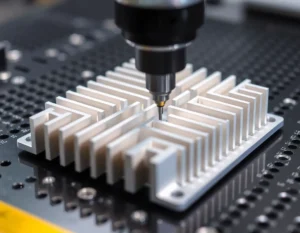
Tool material and geometry are non-negotiable. Polycrystalline diamond (PCD) tooling is the unequivocal gold standard for carbon fiber-reinforced PEEK. The extreme hardness of PCD provides outstanding wear resistance against the abrasive fibers, ensuring consistent cuts and long tool life. For lower-volume jobs or graphite-filled grades, fine-grained micro-grain carbide tools with specialized coatings (like TiAlN) can be acceptable. Tool geometry should feature sharp, polished cutting edges, positive rake angles, and ample flute space for efficient chip evacuation. Dull tools must be avoided at all costs, as they generate heat and increase cutting forces.
Machining Parameters: Speed, Feed, and Depth of Cut
The goal is to achieve a high cutting speed with a moderate to high feed rate to generate thin, clean chips that carry heat away. A conservative depth of cut is recommended.
- Speed (SFM): High spindle speeds (600-1000 SFM for PCD, 300-600 SFM for carbide) are effective. This minimizes contact time and prevents rubbing.
- Feed Rate (IPR): Maintain a consistent and positive feed. Too slow a feed allows the tool to dwell, generating heat and work-hardening the material; too fast can cause chipping. A feed of 0.002-0.010 inches per revolution is a common starting point.
- Depth of Cut: Use light to moderate depths (0.010" - 0.100") to control cutting forces and heat generation.
Coolant and Chip Management
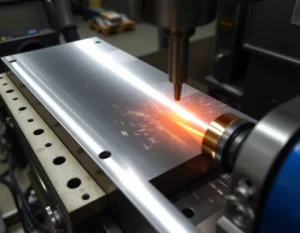
While carbon-filled PEEK can be machined dry, using a coolant is highly beneficial. It suppresses dust (a health and cleanliness concern), reduces heat, and improves chip evacuation. Compressed air or a mist coolant system is often ideal, as it prevents the material from absorbing liquid. If using a flood coolant, ensure it is compatible with PEEK and does not cause stress cracking. Efficient chip removal is critical, as recut chips can mar the surface finish and increase tool load.
Workholding and Part Support
Due to its stiffness, carbon-filled PEEK can be held securely, but care must be taken to avoid distorting thin-walled features. Use soft jaws, evenly distributed clamping force, and proper support to prevent vibration (chatter) and part movement. The anisotropic nature means residual stresses may be released during machining, so a final light finishing pass is often necessary to achieve perfect dimensions after the part stabilizes.
Applications and Benefits of Machined Carbon-Filled PEEK Components
The rigorous effort required to machine carbon-filled PEEK is justified by the unparalleled performance of the finished components. These parts operate in environments where metals fail and other plastics falter.
Primary Industry Applications
- Aerospace: Brackets, bushings, seals, and ducting in engines and airframes. The combination of high strength-to-weight ratio, flame retardancy, and low outgassing is critical.
- Medical & Surgical: Permanent implants, surgical instrument handles, and components for sterilization trays. Its biocompatibility (in implant-grade forms), radiolucency, and ability to withstand repeated autoclaving cycles are vital.
- Semiconductor Manufacturing: Wafer carriers (boats), probe tips, and seals. The material's purity, chemical resistance to aggressive etchants, and dimensional stability in vacuum and high-temperature processes are essential.
- Oil & Gas: Seals, valve seats, and bearing components for downhole tools. It resists sour gas (H2S), high pressures, and extreme temperatures.
- High-Performance Automotive & Robotics: Lightweight structural components, bearing cages, and gears where reduced inertia, wear resistance, and noise dampening are beneficial.
Tangible Benefits Realized
By mastering the machining of this material, manufacturers deliver parts that offer:
- Significant Weight Reduction: Replacing metals with carbon-filled PEEK can cut weight by 70% or more, crucial for fuel efficiency and dynamic performance.
- Corrosion and Chemical Immunity: It outperforms stainless steel in many corrosive environments, eliminating rust and degradation.
- Reduced Maintenance and Lubrication: Its inherent lubricity, especially in graphite-filled grades, allows for dry-running parts and extended service intervals.
- Design Freedom: Machining from stock shapes (rods, plates, tubes) allows for rapid prototyping and production of complex geometries that might be infeasible with molding for low volumes.
Conclusion: Precision as a Prerequisite
Carbon-filled PEEK stands at the apex of engineering thermoplastics, offering a property set that bridges the gap between polymers and metals. However, its transformation from a rugged stock shape into a precision component is not a routine machining operation. It is a disciplined process that demands respect for the material's abrasive and anisotropic nature. Success hinges on the unwavering application of best practices: investing in PCD tooling, optimizing machining parameters for a clean shear cut, managing heat and chips effectively, and understanding the material's post-machining behavior. For those who master these techniques, carbon-filled PEEK becomes not a machining challenge to be feared, but a powerful enabling material that allows engineers to push the limits of innovation in the world's most demanding applications. The mastery of machining carbon-filled PEEK is, therefore, a specialized skill that turns a premium material into a pinnacle of performance.