
Nickel plating machining serves as a critical finishing process for precision CNC components, enhancing corrosion resistance, surface hardness, and wear performance. Yet when engineers search for “nickel plating machine price” or browse discussions about “nickel plated machine screws” on forums, they often face a fundamental question: which nickel plating method—electrolytic or electroless—delivers the right balance of cost, uniformity, and performance for their specific application? This buyer’s guide offers a structured comparison to help you make an informed decision.
Before diving into specifications and pricing, it helps to step back and consider what plating actually does for a CNC-machined part. The finishing layer does not merely alter the appearance; it transforms the surface chemistry to resist corrosion, withstand repeated friction, and maintain dimensional integrity over time. Whether your project involves high-volume automotive fasteners or tight-tolerance aerospace housings, the choice between electrolytic and electroless nickel plating will influence everything from production cost to long-term reliability. This guide walks through the key decision factors, compares both methods side by side, and highlights what to look for when evaluating service providers.
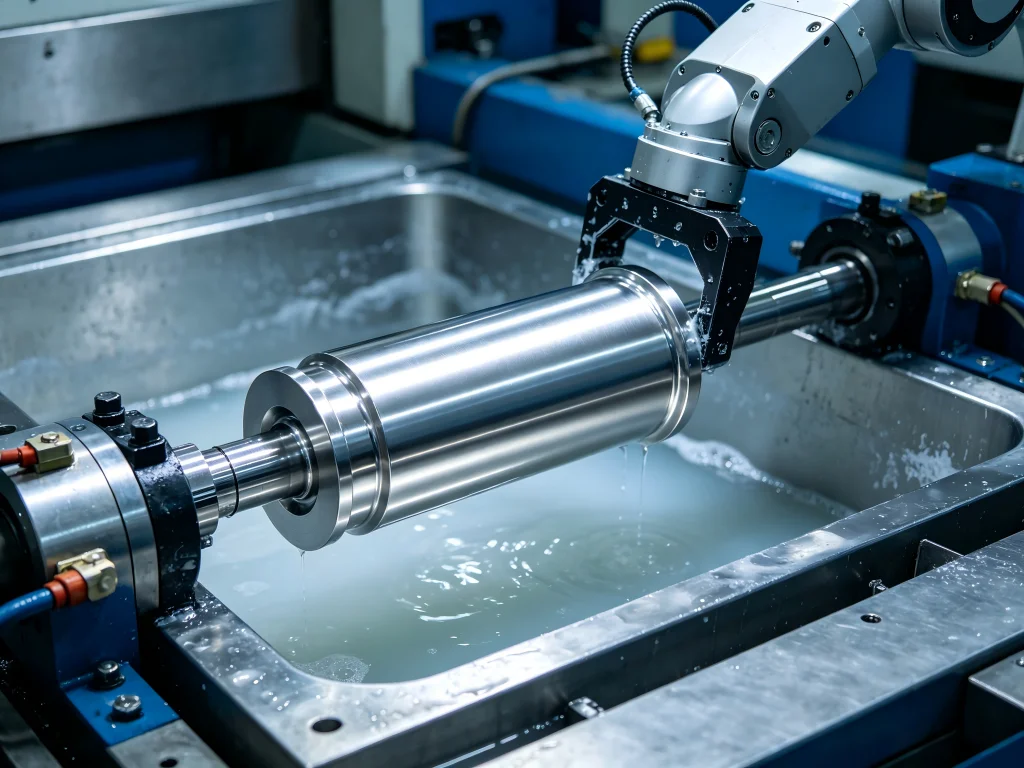
Understanding the Two Core Methods of Nickel Plating Machining
The term nickel plating machining actually refers to two distinct processes: electrolytic nickel plating (also known as electroplating) and electroless nickel plating. Each method deposits a layer of nickel onto a CNC-machined substrate, but the underlying mechanisms differ significantly, and those differences translate directly into performance trade-offs.
Electrolytic Nickel Plating
Electrolytic nickel plating relies on an external electrical current to drive the deposition of nickel ions from a solution onto the workpiece, which acts as the cathode. The setup typically involves a rectifier, an electrolyte bath containing nickel salts, and anodes that supply nickel ions as they dissolve. When current flows, positively charged nickel ions migrate toward the negatively charged part and reduce to metallic nickel on its surface.
This process tends to be faster and more cost-effective for high-volume production runs. However, it comes with a well-documented limitation: because current density varies across the part geometry—higher on edges and corners, lower in recesses—the coating thickness becomes uneven. Sharp features may receive excessive buildup while internal passages or blind holes receive little to no coverage. In online forums, hobbyists and professionals alike note that with electrolytic plating, “if you plate too much, things can get squirrely, and the plating can begin to peel”, highlighting the importance of precise process control.
Electroless Nickel Plating
Electroless nickel plating, by contrast, requires no external electricity. The process uses a chemical reducing agent—typically sodium hypophosphite—in an autocatalytic reaction that deposits a nickel-phosphorus alloy uniformly onto the part surface. As long as the bath can flow over a feature, deposition occurs at a consistent rate, resulting in exceptional thickness uniformity even on complex geometries with threads, deep holes, and internal cavities.
A Reddit user exploring DIY electroless nickel plating noted that “it can be a bit tricky to perfect but as long as the piece is perfectly clean … it’s come out looking like it’s done in a factory”. For industrial applications, electroless nickel offers superior corrosion resistance, especially in high-phosphorus formulations (above 10% P), and can be heat-treated to reach hardness levels exceeding 850 HV. The trade-off? Higher chemical costs and slower deposition rates compared to electrolytic plating.
Side-by-Side Comparison: Key Parameters for Decision-Making
When evaluating “nickel plating machine price” or comparing quotes from service providers, it helps to look beyond the unit cost and examine the technical parameters that truly matter for your application. The table below summarizes the critical differences:
| Parameter | Electrolytic Nickel Plating | Electroless Nickel Plating |
|---|---|---|
| Deposition mechanism | Electric current-driven | Autocatalytic chemical reaction |
| Coating composition | Pure nickel (99%+) | Nickel-phosphorus alloy (2–14% P) |
| Thickness uniformity | Uneven (thicker on edges/corners; thinner in recesses) | Highly uniform (±0.0001 inch tolerance achievable) |
| Substrate requirements | Must be electrically conductive | Works on conductive and non-conductive substrates |
| As-plated hardness | 150–500 HV | 500–600 HV |
| Post-heat-treatment hardness | Limited increase | Up to 850–1100 HV |
| Corrosion resistance | Moderate | Excellent (especially high-phosphorus) |
| Typical cost per part | Lower | Higher (20–40% premium) |
| Production throughput | Faster (suited for high-volume) | Slower (suited for precision/small batch) |
One nuance often overlooked: the phosphorus content in electroless nickel coatings creates an amorphous structure that eliminates grain boundaries, making it highly resistant to chloride-induced corrosion. However, because it forms an alloy rather than pure nickel, electrical conductivity suffers compared to electrolytic coatings. If your component requires both plating and electrical conductivity—such as a connector housing or grounding path—electrolytic nickel may be the better choice despite its uniformity limitations.
Key Selection Criteria for Nickel Plating Machining
Choosing between these methods involves evaluating several interrelated factors. Rather than treating each factor in isolation, consider how they interact for your specific use case.
1. Part Geometry and Complexity
For components with simple external surfaces—shafts, bushings, flat plates—both methods can work, though electrolytic plating may offer a lower-cost path. However, for parts with internal threads, deep blind holes, cross-drilled passages, or sharp internal corners, electroless nickel plating is strongly preferred. The uniform deposition characteristic ensures that functional surfaces maintain their dimensional specifications and that threads do not require post-plating re-tapping. JUCHENG Precision utilizes specialized fluid-agitation systems during electroless nickel processing to ensure fresh chemistry reaches the deepest internal ports, a critical detail for complex manifolds and valve bodies.
2. Tolerance and Dimensional Control
When a part features tolerances of ±0.01 mm or tighter, the plating process itself must not introduce unacceptable variation. Electroless nickel grows predictably—typically 15 to 25 microns per hour—allowing machinists to compensate for the added thickness during the initial CNC programming. In contrast, electrolytic plating tends to build up faster on edges, potentially altering critical dimensions in ways that cannot be accurately predicted. This explains why industries such as aerospace, medical devices, and precision hydraulics heavily favor electroless nickel for their nickel plating machining needs.
One forum contributor discussing nickel plating on rifle components observed that “nickel plating adds a layer to the thickness of parts, sometimes the screws will not go back in the holes”. This practical observation underscores why dimensional planning matters so much, regardless of which method you choose.
3. Environmental and Chemical Exposure
High-phosphorus electroless nickel (typically 10–14% P) delivers excellent resistance to salt spray, acidic environments, and high-humidity conditions. It can pass 500-hour or even 1,000-hour salt spray tests, making it the default choice for marine equipment, chemical processing components, and outdoor electronic housings. Electrolytic nickel, while offering decent corrosion protection as a barrier layer, does not match this level of resilience. If your application involves exposure to chlorides, industrial chemicals, or persistent moisture, the premium for electroless nickel is well justified.
4. Production Volume and Cost Structure
Cost remains a practical constraint for many buyers. The “nickel plating machine price” for industrial electroplating lines can range from $60,000 for smaller setups to over $400,000 for fully automatic systems, while electroless plating equipment carries different capital and chemical cost profiles. More relevant for most buyers is the per-part cost from a service provider. Electrolytic nickel plating generally runs 20–40 percent less expensive per part than electroless, particularly for high-volume orders of geometrically simple components. For low-volume, high-precision, or geometrically complex parts, the uniformity and performance benefits of electroless often outweigh the higher unit cost.
5. Lead Time and Availability
When you search for “nickel plating machine price in india” or “nickel plating in malaysia,” lead time becomes as important as cost. In Southeast Asia’s rapidly growing manufacturing sector—where the Malaysia nickel plating market is projected to grow steadily due to expanding electronics and automotive industries—availability can vary significantly by region. Electrolytic plating lines typically offer faster turnaround because the process is simpler and bath chemistry maintenance is less demanding. Electroless nickel requires more precise chemical control and longer dwell times, so plan for additional lead days when specifying this finish.
Industry Applications and What They Tell Us About Process Choice
Observing how different industries use nickel plating machining can guide your own selection. The pattern is instructive rather than prescriptive, but it reveals consistent logic.
- Aerospace components: Hydraulic actuators, landing gear parts, and fuel system fittings almost always receive electroless nickel plating. The combination of uniform thickness on complex internal geometries and high corrosion resistance justifies the higher cost. JUCHENG Precision serves this sector with ASTM/ISO-certified electroless nickel finishes that meet stringent aerospace standards.
- Automotive parts: Here you see both methods. High-volume fasteners and brackets may use electrolytic nickel for cost efficiency. But precision transmission components, fuel injector bodies, and sensor housings—where dimensional consistency matters—increasingly specify electroless nickel.
- Electronics and connectors: For components requiring surface conductivity, electrolytic nickel is often preferred because it deposits pure nickel rather than a phosphorus alloy. A pure nickel layer also serves as an excellent underlayer for gold or silver plating in high-reliability connectors.
- Medical devices: Surgical instruments and implantable device components typically use electroless nickel due to its uniform coverage, biocompatibility when properly sealed, and resistance to sterilization cycles. However, engineers must carefully consider whether the application requires non-magnetic properties (high-phosphorus electroless nickel is non-magnetic, while low-phosphorus and electrolytic nickel retain magnetic characteristics).
- Nickel plated machine screws: These widely available fasteners demonstrate the practical benefits of nickel plating at the component level. The plating prevents tarnishing, provides a hardened surface, and makes the screws suitable for applications requiring multiple reassemblies without galling. For such fasteners, electrolytic nickel often suffices, though electroless nickel becomes preferable when the screws mate with delicate threads or operate in corrosive environments.
A quick note on the nickel plating process itself, regardless of which method you choose: surface preparation determines success or failure. Contaminants such as oil, grease, oxides, or residual machining coolants can prevent proper adhesion. A standard workflow includes degreasing, rinsing with deionized water, surface activation (etching), plating, post-plating rinse, and drying, followed by inspection. In many plating failures, the root cause traces back to inadequate cleaning rather than the plating chemistry itself. One experienced voice in the hobbyist community put it bluntly: “if there’s oil, dirt, or rust on your parts, nickel can’t bond properly,” leading to peeling, blistering, or uneven spots. This principle holds equally for industrial-scale production.
Why JUCHENG Stands Out for Nickel Plating Machining
When evaluating service providers, you want more than a competitive “nickel plating machine price.” You need a partner who understands that plating does not exist in isolation—it integrates with the CNC machining workflow, and the best outcomes come from coordinated process planning.
JUCHENG Precision operates from a manufacturing hub in Shenzhen, equipped with multi-axis Haas and Mazak CNC centers alongside integrated surface finishing capabilities. Rather than treating nickel plating as an afterthought, JUCHENG’s engineers design the machining strategy with plating allowances built in. This means your parts arrive from the CNC process with dimensions that anticipate the plating thickness, eliminating the costly rework that occurs when parts are machined first and plated later without coordination.
The company offers both electrolytic and electroless nickel plating options, along with comprehensive finishing services including zinc plating, chrome plating, anodizing, and passivation. JUCHENG’s electroless nickel process meets ASTM and ISO standards and complies with RoHS/REACH environmental regulations. For complex geometries requiring electroless nickel, JUCHENG’s fluid-agitation systems ensure fresh chemistry reaches every internal feature, a detail that distinguishes true precision finishing from commodity plating. Furthermore, their quality control protocols include systematic thickness verification and adhesion testing, giving you documented traceability for each batch.
What does this mean for your purchasing decision? It means you can work with a single vendor for both machining and finishing, reducing supply chain complexity and eliminating the risks that arise when different shops handle separate process steps. One point highlighted in JUCHENG’s technical documentation is that their integrated approach allows for flexible scaling—from low-volume prototypes to production runs—while maintaining consistent plating quality across the transition.
Frequently Asked Questions About Nickel Plating Machining
Making Your Final Choice: A Practical Decision Framework
When you sit down to specify nickel plating machining for your next CNC project, work through this sequence of questions:
- What is the part geometry like? If you see internal threads, blind holes, sharp corners, or complex internal passages on the drawing, lean toward electroless nickel. Simple external surfaces make electrolytic nickel a viable option.
- What tolerances must the part hold? For tolerances tighter than ±0.01 mm, electroless nickel’s uniform deposition is a significant advantage. Electrolytic nickel can work if you plan for post-plating grinding, but this adds steps and cost.
- What environment will the part see? Marine, chemical, outdoor, or humid conditions call for electroless nickel’s superior corrosion protection. Controlled indoor environments may not justify the premium.
- What is your production volume? For high-volume, geometrically simple parts, electrolytic nickel’s lower per-part cost adds up quickly. For low-volume, high-complexity parts, the uniformity of electroless nickel typically proves more valuable than the cost difference.
- Does the part require conductivity or specific magnetic properties? Electrolytic nickel (pure nickel) offers conductivity and magnetic behavior. High-phosphorus electroless nickel offers non-magnetic properties but lower conductivity. Align your choice with electrical and magnetic specifications.
By answering these questions systematically, you can avoid over-specifying (and over-paying) for capability you do not need, while also avoiding under-specifying and ending up with field failures. And when you partner with a provider who understands both CNC machining and nickel plating finishing—a provider like JUCHENG—you gain the benefit of an integrated perspective that catches potential issues before they reach production.
Ready to discuss your nickel plating machining requirements?
Whether you need high-volume electrolytic nickel plating or precision electroless finishing for complex geometries, JUCHENG’s engineering team can guide you toward the right solution.
For more technical resources, consult industry standards available from ASTM International and ISO. JUCHENG Precision maintains certification to applicable ASTM/ISO standard