
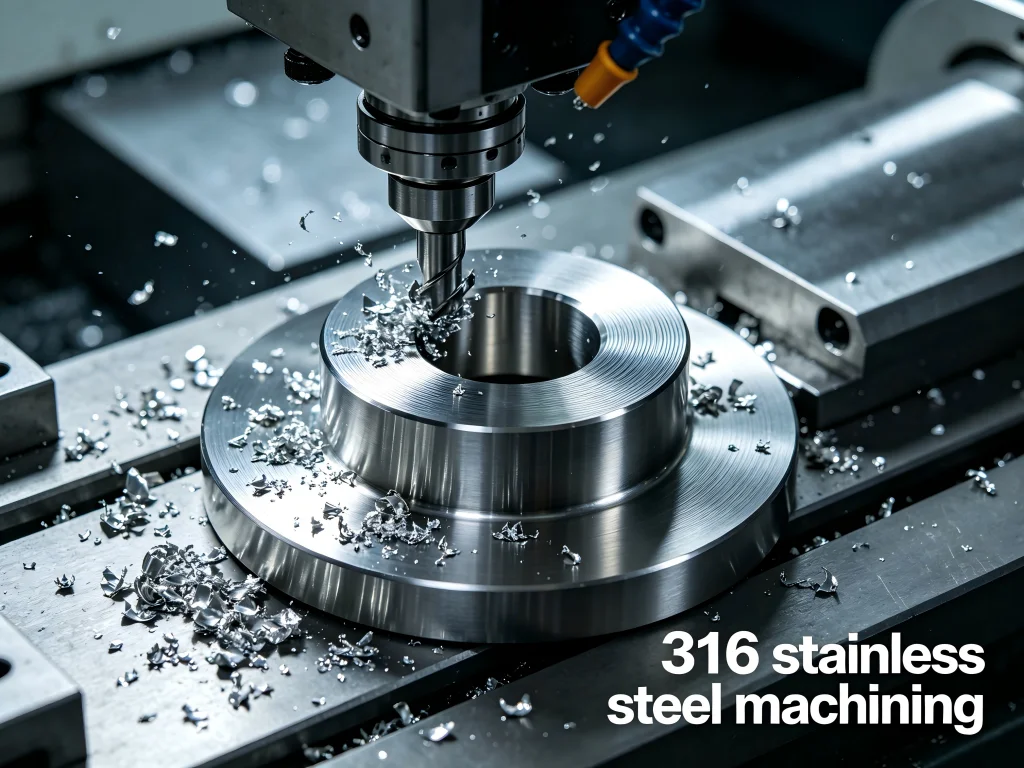
If you have ever worked with 316 stainless steel machining, you already know it is not like cutting aluminum or even standard carbon steel. This austenitic alloy earns its reputation as a challenging material—one that demands respect, preparation, and a solid understanding of how it behaves under the cutting tool. Whether you are a CNC programmer, a shop owner, or an engineer specifying parts for marine or medical applications, mastering 316 stainless steel machining could mean the difference between profitable production and a nightmare of broken tools and scrapped parts.
This guide draws on machining data, metallurgical research, and real-world shop floor experience to give you a comprehensive look at everything involved in 316 stainless steel machining. From cutting speeds and tool selection to work hardening and coolant strategies, we will cover the essential knowledge you need to machine this material successfully and consistently.
What Is 316 Stainless Steel?
Before diving into the machining specifics, it helps to understand what makes 316 stainless steel unique. Grade 316 is an austenitic chromium-nickel stainless steel that contains molybdenum—typically 2 to 3 percent. This molybdenum addition is what sets 316 apart from the more common 304 grade. It significantly enhances the alloy’s resistance to pitting and crevice corrosion, particularly in chloride-rich environments like saltwater or chemical processing plants.
The presence of molybdenum also influences the material’s mechanical properties. Type 316 stainless steel has a higher yield strength than 304—around 60 ksi compared to roughly 42 ksi for 304. This higher strength, combined with a work hardening rate that is approximately 15 percent higher than 304, makes 316 stainless steel machining more demanding from the outset.
The material is available in two primary variants: standard 316 and 316L. The “L” stands for low carbon—maximum 0.03 percent—which prevents carbide precipitation during welding and reduces the risk of intergranular corrosion. For 316 stainless steel machining applications that involve subsequent welding, 316L is often the preferred choice.
Key Properties That Affect Machining
Several inherent characteristics of 316 stainless steel directly impact how it should be machined:
- Work hardening tendency: 316 work-hardens rapidly under the cutting tool. If the tool dwells or rubs instead of cutting, the surface hardens instantly, which could lead to immediate tool failure.
- Poor thermal conductivity: Heat generated during cutting does not dissipate quickly through the material. Instead, it concentrates at the cutting edge, accelerating tool wear.
- High toughness and ductility: The material is “gummy” and prone to built-up edge formation, which degrades surface finish and increases cutting forces.
- Moderate machinability rating: 316 has a machinability rating of approximately 36 to 45 percent relative to B1112 free-machining steel.
Understanding these properties is the first step toward developing a successful 316 stainless steel machining strategy. The remainder of this guide will show you how to work with—not against—these material characteristics.
316 Stainless Steel Machinability Rating and What It Means
The machinability rating of 316 stainless steel is typically cited as 36 to 45 percent. But what does that number actually mean for your shop floor? In practical terms, a 45 percent machinability rating indicates that 316 stainless steel machining requires roughly twice the cutting time and consumes significantly more tooling compared to a free-machining steel rated at 100 percent.
For context, here is how 316 compares to other common stainless grades:
| Stainless Steel Grade | Machinability Rating | Approximate SFM | Key Characteristics |
|---|---|---|---|
| 303 | 70% | 150 | Free-machining, excellent for automatic lathes |
| 304 | 45% | 70 | Good corrosion resistance, moderate machinability |
| 316/316L | 45% | 60 | Superior corrosion resistance, tougher to machine |
| 321 | 38% | 60 | Stabilized grade, similar machinability to 316 |
| 410 | 60% | 95 | Martensitic, better machinability than austenitic grades |
Data sourced from thyssenkrupp Materials machining data
Notice that while 304 and 316 share the same machinability rating, 316 stainless steel machining is generally considered more difficult. This is because 316’s higher yield strength and greater work hardening rate mean it puts more stress on the tool and requires more careful parameter control.
One Reddit machinist put it this way: “304 is annoying, but 316 is a different beast. You blink and the tool is gone. You have to stay ahead of the work hardening or it will eat your end mills for breakfast.” This sentiment echoes across machining forums—316 stainless steel machining is not impossible, but it demands discipline.
Optimal Cutting Speeds and Feeds for 316 Stainless Steel
Getting the speeds and feeds right is arguably the most critical factor in successful 316 stainless steel machining. The material’s poor thermal conductivity and work hardening tendency mean that incorrect parameters could lead to rapid tool failure, poor surface finish, or both.
Recommended Cutting Speeds
For 316 stainless steel machining, the recommended cutting speed (Vc) typically falls between 60 and 150 meters per minute, depending on the operation and tooling. Here are more specific guidelines:
- Turning with carbide inserts: 100 to 150 m/min for roughing; 120 to 150 m/min for finishing
- Milling with carbide tools: 60 to 120 m/min, with 100 m/min being a common starting point for many operations
- Slot milling: 75 to 150 m/min, with 150 m/min identified as optimal for general-purpose slot milling in one study
- High-speed steel (HSS) tools: Significantly lower—around 15 to 25 m/min—due to HSS’s lower red hardness
A research study on turning AISI 316 stainless steel found that the optimal combination for minimizing cutting force, surface roughness, and power consumption while maximizing tool life was a cutting speed of 122.37 m/min, feed of 0.13176 mm/rev, and depth of cut of 0.213 mm. These values provide a solid reference point for 316 stainless steel machining operations.
Recommended Feed Rates
Feed rate is another critical parameter. For 316 stainless steel machining, the general principle is to use a heavier feed than you would for mild steel. This helps the tool get beneath the work-hardened layer that forms on the surface.
Typical feed ranges include:
- Turning (mm/rev): 0.10 to 0.20 mm/rev, with 0.13 to 0.15 mm/rev being a sweet spot for many operations
- Milling (mm/tooth): 0.02 to 0.20 mm/tooth, depending on tool diameter and machine rigidity
- Slot milling: 0.15 mm/tooth was identified as optimal in one study for general-purpose slot milling
The feed rate has been identified as the most influential factor affecting flank wear in 316 stainless steel machining, followed by cutting speed and depth of cut. This means that getting the feed right is your first priority when troubleshooting machining issues.
Depth of Cut Considerations
Depth of cut for 316 stainless steel machining typically ranges from 0.2 to 0.8 mm. A key principle is to take a deep enough cut to get under the work-hardened surface layer. Light cuts with insufficient depth could cause the tool to rub against a hardened surface, accelerating wear and potentially leading to catastrophic tool failure.
One experienced machinist on Facebook noted: “With 316, you have to commit to the cut. If you baby it, the material will work-harden right in front of the tool and you will be replacing end mills every five minutes. Take a real cut, keep the feed up, and get out.”
Tool Selection for 316 Stainless Steel Machining
Choosing the right tooling is essential for cost-effective 316 stainless steel machining. The material’s toughness and abrasiveness demand tools that can withstand high cutting forces and temperatures.
Carbide Tools
Cemented carbide is the workhorse for 316 stainless steel machining. Carbide tools offer the hardness and wear resistance needed to handle this challenging material. Key considerations include:
- Coatings: TiAlN (Titanium Aluminum Nitride) and AlTiN coatings are particularly effective for 316 stainless steel machining because they provide excellent heat resistance and reduce friction
- Geometry: Sharp cutting edges with positive rake angles help reduce cutting forces and prevent work hardening
- Grade: Use tougher carbide grades for interrupted cuts and more wear-resistant grades for continuous cutting
High-Speed Steel Tools
While carbide is preferred for most 316 stainless steel machining operations, HSS tools still have their place—particularly for low-speed operations, complex tool shapes, or situations where carbide’s brittleness is a concern. M42 cobalt HSS is a popular choice for milling cutters, offering a good combination of hardness and strength at lower cutting speeds.
Tool Holding and Rigidity
Tool rigidity is non-negotiable in 316 stainless steel machining. The high cutting forces generated when machining this material require a rigid setup to prevent vibration, chatter, and tool deflection. Key points include:
- Use the shortest possible tool overhang
- Ensure the machine itself is “substantial” and not prone to vibration
- For milling, use stout arbors with supports as close to the cutter as possible
As one forum contributor observed: “You cannot machine 316 on a hobby mill. It will chatter, the tool will break, and you will be frustrated. You need a rigid machine with real horsepower.”
The Work Hardening Challenge in 316 Stainless Steel Machining
Work hardening is perhaps the single greatest challenge in 316 stainless steel machining. Austenitic stainless steels like 316 have a pronounced tendency to harden under deformation. When the cutting tool contacts the material, the surface layer work-hardens, becoming harder and more resistant to cutting.
This creates a self-reinforcing problem: the work-hardened surface is harder to cut, which generates more heat and friction, which causes more work hardening, which wears the tool faster. Breaking this cycle requires a deliberate machining strategy.
Strategies to Manage Work Hardening
Here are proven approaches for managing work hardening during 316 stainless steel machining:
-
- Maintain constant feed: Never let the tool dwell or rub against the material. A constant, aggressive feed keeps the cutting edge ahead of the work-hardening front
- Take adequate depth of cut: Cut deep enough to get beneath the work-hardened layer. Light cuts could cause the tool to rub against a hardened surface
- Use sharp tools: Dull tools generate more friction and heat, accelerating work hardening
- Apply adequate coolant: Flood coolant helps control temperature and prevent the surface from hardening excessively
A study on dry down-milling of 316 stainless steel found that feed rate was the most influential factor affecting flank wear, followed by cutting speed and depth of cut. The optimal parameters identified were 0.2 mm/tooth feed rate, 100 m/min cutting speed, and 0.8 mm depth of cut. These values underscore the importance of a relatively aggressive feed.
Coolant and Lubrication Strategies
Effective cooling is essential for successful 316 stainless steel machining. The material’s poor thermal conductivity means heat concentrates at the cutting edge, leading to rapid tool wear and potential workpiece damage.
Flood Coolant
Heavy flood coolant is the standard approach for 316 stainless steel machining. It serves multiple purposes: removing heat from the cutting zone, flushing chips away from the tool, and providing lubrication. For 316, coolant flow may need to be increased by as much as 20 percent compared to machining 304.
Minimum Quantity Lubrication (MQL)
MQL is an alternative that uses a fine mist of lubricant instead of flood coolant. Research on MQL turning of SS-316 found that it could provide better results than dry turning. Another study identified optimal MQL parameters for 316 stainless steel machining as a cutting speed of 130 m/min and feed rate of 0.16 mm/rev.
MQL offers environmental and cost benefits but may not provide sufficient cooling for all 316 stainless steel machining operations, particularly heavy roughing cuts.
High-Pressure Through-Spindle Coolant
For deep hole drilling and other demanding operations, high-pressure through-spindle coolant is highly effective. The high pressure helps evacuate chips from the cutting zone and delivers coolant directly to the cutting edge.
Common Applications of 316 Stainless Steel
Understanding where 316 stainless steel is used helps explain why 316 stainless steel machining is such an important capability. The material’s exceptional corrosion resistance makes it the go-to choice for demanding environments.
Marine and Offshore Applications
316 stainless steel is the standard material for marine hardware. Boat fittings, propeller shafts, rigging screws, and desalination plant components all rely on 316 stainless steel machining for their corrosion resistance in saltwater environments. Subsea robot frames, connectors, and thruster housings are increasingly specified in 316L for multi-year service in the ocean.
Medical and Pharmaceutical Equipment
316L stainless steel is the standard material for surgical instruments, orthopedic implants (temporary), and pharmaceutical equipment. Its biocompatibility and resistance to body fluids and sterilization processes make it indispensable in healthcare manufacturing. The material’s cleanability is also critical for pharmaceutical and semiconductor manufacturing environments.
Chemical and Food Processing
Chemical processing equipment, heat exchangers, and food processing machinery frequently use 316 stainless steel. The molybdenum content provides resistance to the corrosive chemicals used in producing inks, photographic chemicals, paper, and textiles. In food processing, 316 is preferred for acidic or high-salt scenarios, such as juice filling equipment.
High-Temperature Applications
316 stainless steel maintains a yield strength of 150 MPa at 800°C—approximately 20 percent higher than 304. This makes it suitable for jet engine parts, exhaust manifolds, and furnace components.
304 vs 316: Which One to Choose?
A common question in 316 stainless steel machining discussions is whether to use 304 or 316. The choice depends on the application requirements and cost considerations.
Corrosion Resistance Comparison
The primary advantage of 316 over 304 is its superior corrosion resistance, thanks to the molybdenum addition. In a 3.5 percent sodium chloride solution, 316 corrodes at only 0.001 mm/year, compared to 0.01 mm/year for 304. For marine, chemical, and medical applications, 316 is typically the better choice despite its higher cost.
Machinability Comparison
While both 304 and 316 share a 45 percent machinability rating, 316 is more challenging to machine in practice. Its higher yield strength and greater work hardening rate mean it requires more careful parameter control and generally results in shorter tool life. For 316 stainless steel machining, cutting speeds typically need to be reduced to 80-120 m/min compared to 120-150 m/min for 304.
Cost Considerations
316 is 30 to 50 percent more expensive than 304 due to the molybdenum content. However, the total life cycle cost may favor 316 in corrosive environments. One case study found that a desalination equipment manufacturer who chose 316 saw a 40 percent initial cost increase but extended service life to 15 years compared to 5 years for 304, reducing maintenance costs by 60 percent.
Why Choose Jucheng for 316 Stainless Steel Machining
When you need reliable, high-quality 316 stainless steel machining, the choice of manufacturing partner matters. Jucheng Precision has established itself as a trusted provider of CNC machining services for challenging materials like 316 stainless steel.
Rigid Machining Infrastructure
Jucheng uses high-rigidity CNC centers specifically designed to handle the higher cutting forces required for 316 stainless steel machining without vibration. This ensures dimensional accuracy and surface integrity even on complex parts. With over 150 CNC machines in their facility, they have the capacity to handle projects of any scale.
Surface Integrity and Post-Processing
Jucheng carefully controls cutting heat to prevent surface discoloration and maintain the passive oxide layer that gives stainless steel its corrosion resistance. They offer electropolishing to further enhance corrosion resistance for medical and semiconductor applications. Passivation—using nitric or citric acid—is highly recommended after 316 stainless steel machining to remove free iron and maximize the chrome-oxide passive layer.
Deep Hole Drilling Capabilities
Jucheng specializes in drilling deep, straight bores in 316L for fluid manifolds and other demanding applications. They use high-pressure through-spindle coolant to evacuate chips effectively, maintaining consistent hole quality even in deep-hole operations.
Material Certification and Traceability
Jucheng provides full traceability with Mill Certificates confirming the molybdenum content and other material properties. This is essential for compliant medical, marine, and aerospace products where material provenance must be documented.
Expertise in Work Hardening Management
Jucheng’s machining philosophy explicitly addresses the work hardening challenge that defines 316 stainless steel machining. They enforce a “Heavy-Chip” machining approach—using sharp, coated carbide tools with constant feed rates to stay ahead of the work-hardening front. As their team puts it, “dwelling or rubbing the tool causes the surface to harden instantly, causing tool failure”.
Fast Turnaround
For time-sensitive projects, Jucheng’s expedited 5-axis CNC workflow can deliver fully finished 316L components in as fast as 10 to 14 business days. This combination of speed and quality makes them a valuable partner for both prototyping and production runs.
Frequently Asked Questions About 316 Stainless Steel Machining
What is the machinability rating of 316 stainless steel?
The machinability rating of 316 stainless steel is approximately 36 to 45 percent relative to B1112 free-machining steel. This means it requires more careful parameter control and generally results in shorter tool life compared to free-machining grades.
What cutting speed should I use for 316 stainless steel?
For 316 stainless steel machining with carbide tools, recommended cutting speeds range from 60 to 150 m/min depending on the operation. A good starting point is 100 to 120 m/min for turning and 60 to 100 m/min for milling. Research has identified 122.37 m/min as optimal for balancing cutting force, surface roughness, power consumption, and tool life in turning operations.
Why is 316 stainless steel so difficult to machine?
316 is difficult to machine due to several factors: its high work hardening rate, poor thermal conductivity, high toughness, and tendency to form built-up edge. The combination of these properties means heat concentrates at the cutting edge, tools wear rapidly, and the material hardens ahead of the cut, creating a challenging machining environment.
What type of tooling is best for machining 316 stainless steel?
Coated carbide tools—particularly those with TiAlN or AlTiN coatings—are the preferred choice for 316 stainless steel machining. Sharp cutting edges with positive rake angles help reduce cutting forces and prevent work hardening. For some applications, M42 cobalt HSS may be used at lower cutting speeds.
How do I prevent work hardening when machining 316?
To prevent work hardening during 316 stainless steel machining, maintain a constant, aggressive feed rate; take adequate depth of cut to get beneath the hardened layer; use sharp tools; and apply adequate coolant. Never let the tool dwell or rub against the material—this is a guaranteed way to work-harden the surface and break the tool.
What coolant should I use for 316 stainless steel machining?
Heavy flood coolant is the standard approach for 316 stainless steel machining, with flow rates potentially needing to be increased by 20 percent compared to machining 304. High-pressure through-spindle coolant is effective for deep hole drilling. MQL can be effective for some operations but may not provide sufficient cooling for heavy roughing.
Is 304 or 316 easier to machine?
While both 304 and 316 have similar machinability ratings, 304 is generally somewhat easier to machine in practice. 316 has higher yield strength and a greater work hardening rate, making it more demanding on tooling and requiring more precise parameter control. Cutting speeds for 316 typically need to be reduced compared to 304.
What industries commonly use 316 stainless steel machining?
316 stainless steel machining is essential in marine and offshore applications, medical device manufacturing, pharmaceutical equipment, chemical processing, food processing, and aerospace. The material’s corrosion resistance and biocompatibility make it the standard choice for these demanding industries.
Conclusion
316 stainless steel machining is a challenging but highly valuable manufacturing capability. The material’s exceptional corrosion resistance, biocompatibility, and high-temperature strength make it indispensable in critical applications ranging from marine hardware to medical implants. However, its work hardening tendency, poor thermal conductivity, and toughness demand a deliberate, disciplined approach to machining.
Success with 316 stainless steel machining comes down to getting the fundamentals right: appropriate cutting speeds and feeds, sharp coated carbide tooling, adequate coolant, and rigid machine setups. The feed rate, in particular, has been identified as the most influential parameter affecting tool life. A strategy of taking aggressive cuts with constant feed—rather than light passes that risk work hardening—is the key to productive and cost-effective machining.
Whether you are machining 316 in your own shop or sourcing parts from a partner like Jucheng Precision, understanding these principles will help you achieve better results. Jucheng’s expertise in rigid machining, work hardening management, and post-processing—combined with their material certification and fast turnaround capabilities—makes them a strong choice for demanding 316 stainless steel machining projects.
For more information about 316 stainless steel machining services or to discuss your specific project requirements, visit Jucheng’s website or contact their technical team directly.