
You have a high-volume production run of brass components coming up. The drawings call for tight tolerances—±0.01 mm on critical bore diameters—and your customer expects flawless surface finishes. You specify C36000 brass machining because you have heard it is the “free-machining” standard. But when the first batch comes off the line, the dimensions are drifting. Parts that should be identical are coming out slightly different. Scrap rates are climbing. And you are left wondering: if C36000 free machining brass is supposed to be the easiest material to cut, why is your project turning into a precision nightmare?
This is the precision paradox of C36000 brass. The very properties that make it the industry benchmark for machinability—its lead content, its chip-breaking characteristics, its high thermal conductivity—also introduce subtle challenges that can derail high-precision projects if not properly managed. The good news? These challenges are entirely solvable. This article walks through the real-world problems engineers and procurement professionals face with C36000 free machining brass, and more importantly, how to solve them—whether you are machining in-house or sourcing from a CNC partner like Jucheng Precision.
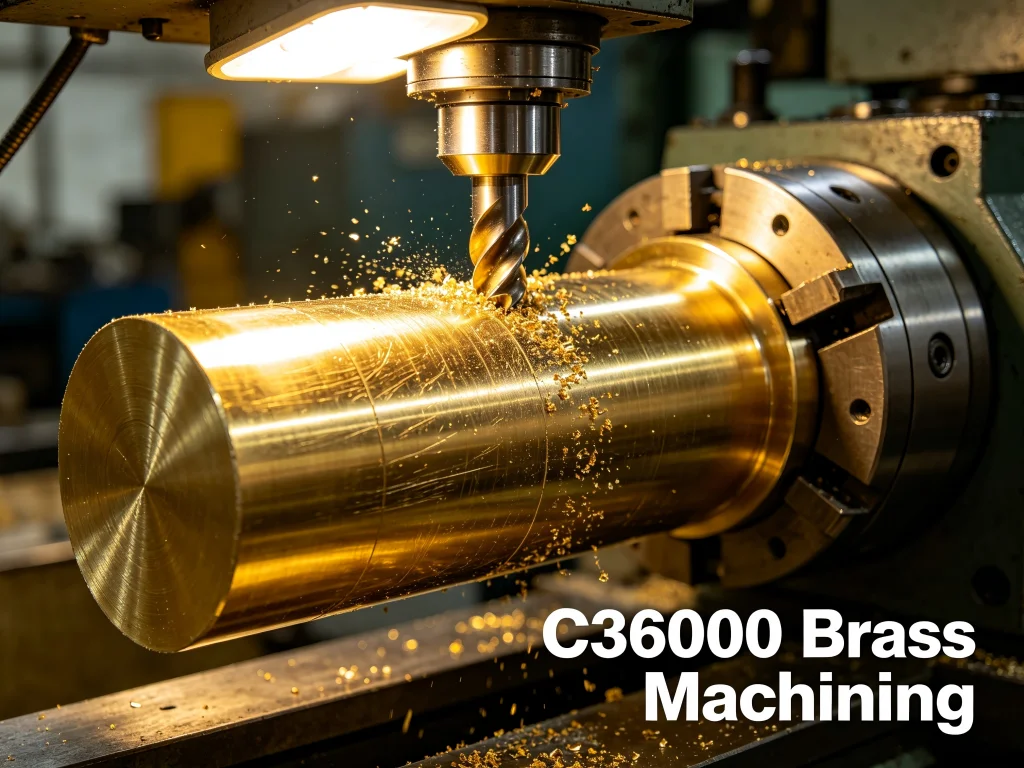
Understanding the Material: What Makes C36000 Free Machining Brass the Industry Standard
Before we can solve the problems, we need to understand the material. C36000 free machining brass, also known as Alloy 360 or free-cutting brass, is a copper-zinc alloy containing approximately 60–63% copper, with the balance primarily zinc and about 2.5–3.7% lead. That small percentage of lead is the secret ingredient. The lead does not dissolve into the copper-zinc matrix; instead, it remains as microscopic, finely dispersed particles. When a cutting tool engages the material, these lead particles act as internal chip breakers and solid lubricants. The chips fracture into tiny, well-controlled pieces that fall away cleanly rather than tangling around the tool or workpiece.
This is why C36000 holds a machinability rating of 100%—the benchmark against which all other copper alloys are judged. The material allows for dramatically higher spindle speeds and feed rates than almost any other metal. Cutting tools glide through with minimal resistance, extending tool life significantly. But this ease of cutting creates a false sense of security. As one machining specialist with two decades of experience put it: “Many assume brass is a ‘forgiving’ material in CNC machining due to its excellent machinability. But brass’s quirks—especially thermal expansion and subtle tool wear—can derail high-precision projects”.
C36000 Brass Mechanical Properties at a Glance
The mechanical properties of C36000 brass vary depending on temper and processing condition. In its annealed state, tensile strength ranges from 340–420 MPa with yield strength of 125–200 MPa and elongation of 25–50%. Cold-worked (H02 temper) material exhibits significantly higher strength: tensile strength of 450–550 MPa with yield strength reaching 350–450 MPa. Hardness ranges from 70–100 HV in the annealed condition up to 160+ HV in the hard (H04) temper. The density is approximately 8.50 g/cm³ with a melting point range of 885–900°C.
These properties make C36000 free machining brass suitable for an extraordinary range of applications: automotive sensor bodies, threaded inserts, fluid connectors, and thermostat parts; plumbing fittings, faucet stems, and valve components; industrial gears, pinions, bushings, and fasteners; and even consumer goods like decorative hardware and lock bodies. The material offers good corrosion resistance, excellent solderability and brazability, and that warm golden aesthetic that makes it a favorite for visible components.
The Real Problems: What Actually Goes Wrong in C36000 Brass Machining
If C36000 brass machines so easily, where do the problems come from? The answer lies in the interplay between material properties, machining parameters, and the specific demands of high-precision production. Let us break down the most common challenges engineers encounter.
Thermal Expansion: The Silent Dimensional Drift
Here is the irony: C36000 brass has excellent thermal conductivity—approximately 115 W/(m·K) at 20°C. This means heat generated during cutting dissipates rapidly into the tool and workpiece. While this is generally beneficial (it prevents heat from concentrating at the cutting edge), it creates a specific problem: the workpiece expands during machining. One specialist documented temperature spikes of 80°C during heavy milling on C36000 components—enough to expand a 50 mm diameter by 0.05 mm. By the time the part cooled, it was out of spec.
In a real-world case, a manufacturer needed 500 custom brass valve bodies with tolerances of ±0.01 mm. Early batches showed inconsistent bore diameters. The culprit was thermal expansion during machining altering dimensions by up to 0.03 mm, leading to a 15% scrap rate. The material was not the problem; the failure to account for its thermal behavior during process planning was.
Tool Wear: Not What You Expect
Because C36000 free machining brass has low hardness (approximately 80 HB), cutting forces are significantly lower than for steel—30–50% less, by some estimates. This typically translates to extended tool life. A 10 mm HSS drill in C36000 brass maintains sharpness two to three times longer than in 1018 steel.
But tool wear still occurs, and it manifests subtly. Flank wear on cutting tools, if not monitored, leads to increased friction, which generates more heat, which exacerbates thermal expansion issues. In one high-volume project for a medical device manufacturer, initial runs using standard carbide tools showed rapid wear after just 200 parts, leading to poor surface quality and an 18% scrap rate. The wear was not catastrophic tool failure—it was gradual degradation that compromised surface finish and dimensional accuracy before anyone noticed.
Burr Formation: The Unwanted Edge
Despite its free-cutting nature, C36000 brass can still produce burrs, particularly on exit edges of holes and pockets. Brass’s ductility leads to ragged edges in low-speed operations. The primary cause is using dull tools. While tool life may be long, checking for flank wear and resharpening or replacing tools before they become dull is key to preventing burrs and maintaining surface finish quality.
C36000 vs C3604: The Confusion Factor
Adding to the complexity, many engineers encounter both C36000 and C3604 specifications. C3604 is the Japanese Industrial Standard (JIS) designation for what is essentially the same free-machining brass alloy. The UNS C36000 standard is American, while C3604 is Japanese—both describe a leaded brass with excellent machinability. Some sources describe C3604 as “also known as C36000”. The key difference lies in the standard’s origin and slight compositional variations: C36000 typically contains 60.0–63.0% copper and 2.5–3.7% lead, while C3604 contains 57.0–61.0% copper and 1.8–3.7% lead. For most machining applications, the performance is comparable, but understanding which standard your customer requires matters for compliance and certification.
Solving the Problems: Practical Strategies for Precision C36000 Brass Machining
Now that we have identified what goes wrong, let us talk about what goes right. The solutions are not complicated, but they require intentional planning. Here is how to approach C36000 brass machining for high-precision, high-volume success.
Strategy 1: Control Thermal Expansion Through Smart Cooling
Instead of flooding the workpiece with coolant (which can cause thermal shock), targeted mist cooling directed at the cutting edge reduces heat while maintaining stable temperatures. High-efficiency cooling systems can lower average machining temperatures by 25°C. Combined with trochoidal toolpaths that distribute cuts evenly and reduce heat buildup, manufacturers have slashed dimensional variance by 40%.
For critical components, pre-heating the C36000 brass stock to approximately 50°C in a controlled environment simulates machining conditions and minimizes post-machining distortion. One aerospace project using this “stress relief” step cut rejection rates from 12% to 3%.
Strategy 2: Optimize Feed and Speed for the Specific Alloy
C36000 brass requires a delicate balance: too aggressive, and you generate excess heat; too conservative, and tool wear accelerates. Through rigorous testing, specialists have developed feed and speed matrices for common brass alloys. For C36000 brass, optimal parameters include a feed rate of approximately 0.1 mm/tooth at 300 m/min cutting speed. These parameters should be validated under actual production conditions—every brass alloy is unique.
Strategy 3: Use the Right Tool Geometry
Tools with positive rake angles (5–10°) and polished flutes reduce friction and minimize burr formation. Sharp tools with proper geometry shear material cleanly, producing superior surface finishes and reducing the need for secondary deburring operations.
Strategy 4: Leverage Automation for Consistency
Here is where C36000 free machining brass truly shines. Its predictable chip formation and low cutting forces make it ideal for “lights-out” manufacturing—automated production that runs continuously with minimal human intervention. Automatic bar feeders enable continuous, uninterrupted production of brass pins, shafts, and spacers. The well-behaved chips simply fall away and are washed out by coolant, eliminating the tangling problems that plague steel and aluminum machining.
This is not just a convenience—it is a cost advantage. Parts machined from C36000 brass can cost significantly less than equivalent steel parts. One analysis found that a fitting machined from C36000 brass cost approximately 26–44% less than the same part machined from 12L14 leaded steel. The reasons are straightforward: faster cycle times, longer tool life, and reduced scrap rates all contribute to lower per-part costs.
How to Choose the Right Partner for C36000 Brass Machining
If you are not machining C36000 brass in-house, choosing the right CNC partner is critical. Here is what to look for, and how Jucheng Precision addresses each consideration.
Equipment and Capability
Not all CNC machines are created equal. For high-volume C36000 brass machining, you need equipment designed for speed and precision. Jucheng Precision operates Swiss-style lathes and automated turning centers equipped with automatic bar feeders for continuous, lights-out manufacturing. Their multi-axis CNC machines handle intricate brass parts with exceptional accuracy, reducing waste and increasing production efficiency.
Quality Assurance and Tolerances
Precision requirements for C36000 brass components often call for tolerances as tight as ±0.005 mm to ±0.01 mm. Jucheng’s ISO-certified facility ensures tight tolerances and mirror-like surface finishes directly off the machine. Real-time machine monitoring and advanced CAD/CAM software enable optimal performance at every production stage.
Material Certification and Compliance
Depending on your industry, material certifications may be non-negotiable. Jucheng provides material certifications, including RoHS-compliant lead-free brass options for applications with environmental restrictions. It is worth noting that standard C36000 brass contains lead and is not RoHS-compliant nor approved for potable water applications under NSF/ANSI 61—critical considerations for plumbing and medical applications.
Surface Finishing Capabilities
The aesthetic appeal of C36000 brass is one of its key advantages. Jucheng offers a full range of finishes including as-machined, polished (high gloss), brushed, and nickel or chrome plating. Their polishing process brings out the natural golden luster of the alloy.
Cost-Effectiveness at Scale
High-volume production of C36000 brass components demands economies of scale. Jucheng’s investment in automation—including lights-out manufacturing capabilities—allows them to offer competitive pricing while maintaining quality. The low cutting forces and extended tool life of C36000 brass translate directly to lower operating costs and faster turnaround times.
Applications: Where C36000 Free Machining Brass Excels
The versatility of C36000 brass means it appears in products across nearly every industry. Understanding where and how the material is used helps inform both design decisions and supplier selection.
Automotive Applications
C36000 brass components are found throughout modern vehicles: sensor bodies, threaded inserts for plastic components, fluid connectors, thermostat parts, and fuel injector components. The material’s corrosion resistance and machinability make it ideal for under-hood applications where reliability is paramount.
Plumbing and Fluid Systems
Plumbers’ brass goods, faucet stems, faucet seats, valve bodies, and pipe fittings are all commonly manufactured from C36000 free machining brass. The material’s resistance to water corrosion and its ability to hold precise threads make it the go-to choice for fluid handling components.
Electronics and Electrical
Connectors, terminals, and shielding parts frequently specify C36000 brass. While its electrical conductivity (approximately 26% IACS annealed) is lower than pure copper, it is significantly better than steel, and the machinability advantage often outweighs the conductivity trade-off for complex connector geometries.
Industrial and General Hardware
Gears, pinions, bushings, fasteners, lock bodies, and automatic screw machine parts represent the largest volume applications for C36000 brass. The combination of machinability, strength, and corrosion resistance makes it the default choice for high-volume precision components.
Frequently Asked Questions About C36000 Brass Machining
Q1: Is C36000 the same as C3604 brass?
They are similar but not identical. C36000 is the UNS (American) designation, while C3604 is the JIS (Japanese) designation. Both are leaded free-machining brasses with comparable properties. C36000 typically contains 60.0–63.0% copper and 2.5–3.7% lead, while C3604 contains 57.0–61.0% copper and 1.8–3.7% lead. For most machining applications, the performance is similar, but checking the specific standard required for your project is important.
Q2: Is C36000 brass RoHS compliant?
No. Standard C36000 brass contains approximately 2.5–3.7% lead, which exceeds RoHS limits for lead content. Lead-free brass alternatives are available for applications requiring RoHS compliance, though they typically have lower machinability ratings.
Q3: Can C36000 brass be welded?
Welding is not recommended for C36000 brass due to lead vaporization during the welding process. Mechanical fastening or brazing/soldering are the preferred joining methods. The material has excellent solderability and good brazability.
Q4: What is the machinability rating of C36000 brass?
C36000 free machining brass has a machinability rating of 100%—it is the industry standard against which all other copper alloys are measured. This means it offers the best possible combination of cutting speed, tool life, and surface finish among copper alloys.
Q5: What tolerances can be achieved with C36000 CNC machining?
With proper process control, C36000 brass components can achieve tolerances as tight as ±0.005 mm to ±0.01 mm. Jucheng Precision routinely achieves tolerances of ±0.005″ (±0.125 mm) or better, with capabilities for micron-level precision on critical features.
Q6: How does C36000 compare to other brass alloys for machining?
C36000 brass offers the highest machinability rating (100%) among brass alloys. Cartridge brass (C26000, 70/30) has lower machinability because the chips are “gummier” and more prone to tangling. Naval brass (C46400) offers superior corrosion resistance for marine applications but is harder to machine. For high-volume CNC production, C36000 is typically the most cost-effective choice.
Q7: Does C36000 brass work harden during machining?
Standard C36000 free machining brass has good cold workability and does not work harden significantly during machining. However, lead-free brass alternatives can work harden, requiring different machining strategies. This is one reason C36000 remains the preferred choice for high-volume automated production.
Q8: What is the difference between aged brass and polished brass?
Aged brass refers to a patinated or oxidized finish achieved through chemical or natural aging processes, creating a darker, more antique appearance. Polished brass is buffed to a high-gloss, mirror-like finish that showcases the natural golden color of C36000 brass. The choice between aged and polished finishes is purely aesthetic and depends on the desired visual effect for the final product.
Why Jucheng Precision for Your C36000 Brass Machining Needs
When the precision of your C36000 brass components matters, the choice of manufacturing partner makes the difference between production that runs smoothly and production that runs into costly delays. Jucheng Precision brings several distinct advantages to C36000 brass machining projects.
Technical Expertise: Jucheng specializes in high-precision CNC machining of brass and other materials, with deep understanding of the material-specific considerations that affect C36000 free machining brass production. Their team understands the thermal expansion, tool wear, and chip formation characteristics that separate successful projects from problematic ones.
Advanced Equipment: Swiss-style lathes, automated turning centers, and multi-axis CNC machines enable Jucheng to handle complex brass geometries with exceptional accuracy. Automatic bar feeders support continuous, lights-out manufacturing for high-volume production runs.
Quality Systems: ISO-certified facilities with real-time machine monitoring and advanced CAD/CAM software ensure consistent quality across every production run. Material certifications and inspection reports provide full traceability.
Surface Finishing: In-house finishing capabilities—including polishing, brushing, and plating—mean Jucheng can deliver C36000 brass components ready for final assembly, eliminating the need for secondary finishing suppliers.
Cost-Effectiveness: By leveraging the natural machinability of C36000 free machining brass and combining it with automated production systems, Jucheng delivers competitive pricing without sacrificing quality. The result is exceptional value for high-volume precision components.
The precision paradox of C36000 brass machining is real—but it is solvable. With the right understanding of the material’s behavior, the right process controls, and the right manufacturing partner, you can achieve the speed and efficiency that C36000 promises without compromising on the quality your customers demand. Whether you are machining in-house or sourcing from a specialist, the strategies outlined here will help you turn the paradox into predictable, profitable production.
Ready to discuss your C36000 brass project? Contact Jucheng Precision to learn how their expertise in C36000 free machining brass can bring your components to life—on time, on spec, and on budget.