
Incoloy 925 machining can be carried out in the solution-annealed or aged condition, but the route must match the required final state. Special Metals recommends rough machining before age hardening and finishing afterward for best results. For a fitting with a bore, thread and locating face, the practical task is to decide which features remain unfinished and how they will be verified after aging.
Start by establishing the condition of the supplied stock and the component’s delivery requirements. A route that includes aging and a route that starts with already aged material carry different responsibilities. Neither should be selected from the alloy name alone.
Identify the state before planning the first cut
The Special Metals alloy 925 bulletin identifies it as an age-hardenable nickel-iron-chromium alloy, designated UNS N09925. Its machining guidance explicitly covers both solution-annealed and aged material. That distinction belongs in the order review, alongside the product form and applicable specification.
Record what the material certificate establishes and what additional evidence the order requires. Do not label a blank simply “annealed” if the specified processing state needs a more precise description. Similarly, do not assume that an aged condition proves every final component requirement has been met.
Keep alloy identity distinct from application qualification. Our Incoloy 825 machining guide concerns a different alloy. A similar family name does not authorize using 825 stock, processing instructions or acceptance evidence for a 925 component.
What can be prepared before aging?
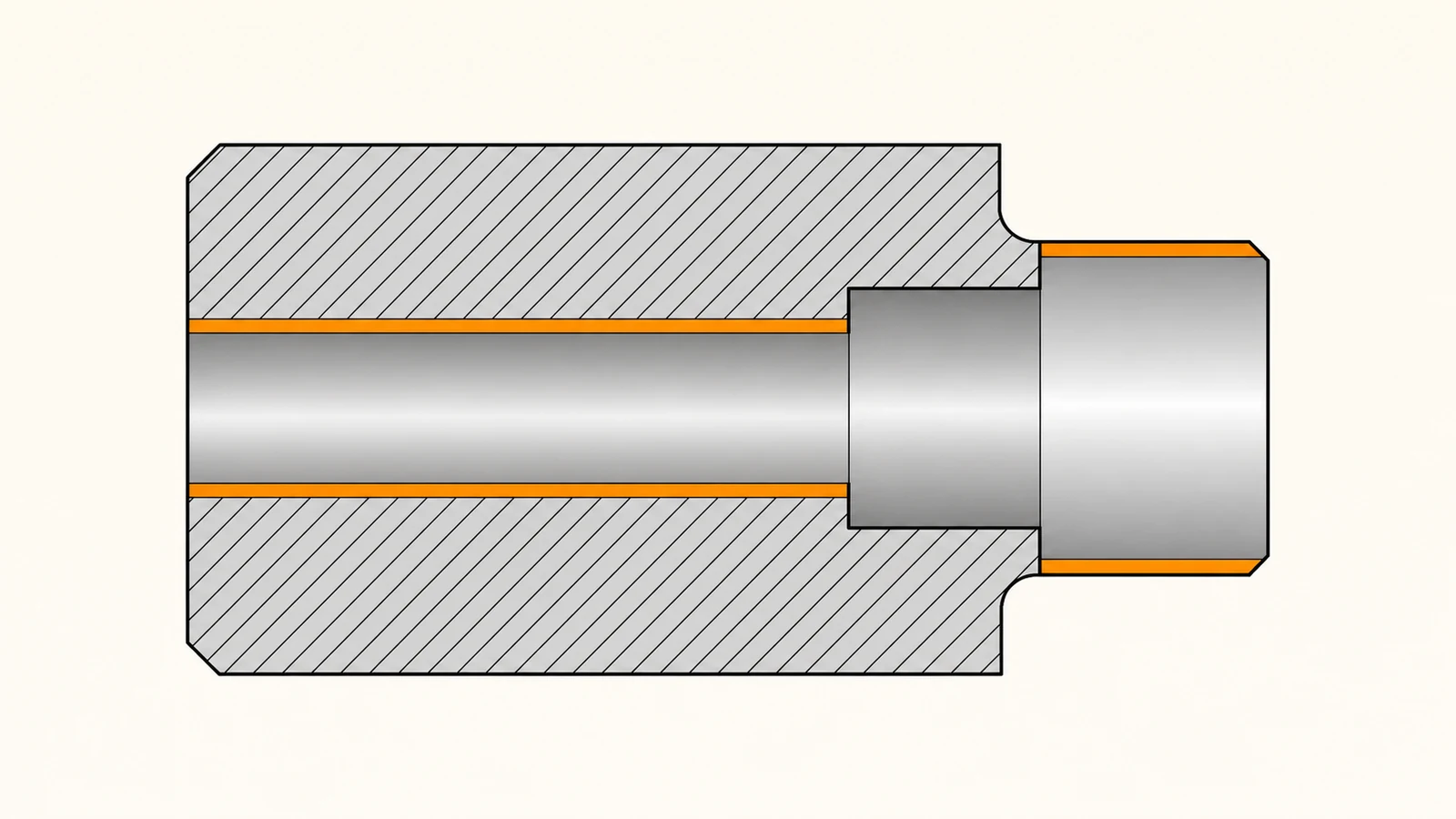
Use an annotated drawing to separate rough geometry from final functional surfaces. For a fitting, this might include the outer envelope, a prepared bore and features needed for handling or later location. The process planner should decide what can be produced early while preserving access and suitable material for subsequent finishing.
The allowance is a property of the proposed route, not a universal number attached to alloy 925. It must accommodate the actual geometry, intermediate condition and intended finishing process. Show where it is retained and how the next operation will find its reference. An unexplained note to “leave stock” is not a complete handoff.
Review the order in which material is removed from the inside and outside. A thick blank and a thin-walled fitting do not provide the same support. Once a bore or groove changes the section, the component presented to the next setup may behave differently from the original stock.
Special Metals emphasizes rigid tooling and methods that limit work hardening. Its published cutting tables are tied to particular states and tooling. Use them as source context for process development, not as universal settings for a modern cutter, a different feature or an unspecified machine arrangement.
Bore, thread and face need one coordinated route
A bore may establish a locating diameter, carry flow or provide clearance. Those functions require different acceptance detail. Mark the working length and the relationship to the thread or face, then identify which operation establishes each requirement in the final state.
For a connection thread, state the standard, usable engagement, runout region and relevant seating arrangement. A proposal to cut the thread before aging must include how it will be accepted afterward. A proposal to cut it afterward must address access and the confirmed material condition at that stage.
Consider the face that the mating part contacts. Its position relative to the thread can determine whether the assembly seats as intended. Producing a good thread and a good face in isolation is insufficient if their relationship is missing from the drawing or lost between setups.

During Incoloy 925 machining review, place these features on the same route sheet. Record their preparation, final operation and inspection reference together. This is more useful than assigning a generic finishing instruction to the whole component.
Compare two routes for a hypothetical fitting
Suppose a drawing specifies a fitting with an axial bore, an external thread and a locating shoulder in an agreed aged delivery condition. This is a hypothetical planning example, not a JUCHENG production case. The comparison below identifies questions to resolve; it does not qualify either route for a particular order.
| Planning point | Prepare before aging, finish afterward | Begin with already aged stock |
|---|---|---|
| Incoming evidence | Confirm the starting condition and responsibility for the specified aging process. | Confirm the supplied aged condition against the purchase requirements. |
| Feature allocation | Identify rough features and the surfaces retained for final finishing. | Review the complete removal and finishing task in the supplied state. |
| Location between operations | Preserve references usable after the intermediate process. | Establish references through the planned sequence of setups. |
| Final evidence | Verify the required final state and completed functional geometry. | Verify the supplied-state evidence and completed functional geometry. |
For the first Incoloy 925 machining route, a key review is whether the unfinished bore and outside surfaces leave a practical finishing task after aging. If a later operation has no suitable reference or insufficient material, the earlier preparation was incomplete even if its intermediate dimensions were acceptable.
For the second route, the discussion shifts to machining the supplied state and preserving the functional relationships through the removal sequence. Eliminating aging from the manufacturing order does not eliminate the need for traceability, support planning or final inspection.
Accept the component after the final relevant operation
Distinguish process measurements from final acceptance. An intermediate bore measurement can guide the next operation without proving the finished bore is acceptable. The inspection plan should say which checks are repeated and why, particularly when the route changes material condition or alters an important section.
Separate size, form, surface texture and thread requirements. Define the reference and assessment region for each. A convenient end-of-bore reading does not establish the condition throughout a functional length, and a thread inspection alone does not establish the location of a seating shoulder.
Review any surface treatment, cleaning or deburring that follows the final cut. Protect the defined contact surfaces and retain their required edge geometry. If a subsequent operation changes a relevant characteristic, place its acceptance check at the appropriate later stage.
Also define the response to an unexpected result. A nonconforming dimension may require disposition rather than another automatic pass. Before removing more material, confirm whether the proposed correction preserves all related requirements and whether the drawing owner must approve it.
Make the quotation scope explicit
Provide the drawing and model, specified stock and delivery states, critical relationships and required documentation. Identify who controls thermal processing and who supplies final acceptance evidence. This prevents two suppliers from pricing fundamentally different tasks under the same material description.
For a JUCHENG review, send the fitting drawing with its aging and inspection scope. Ask for confirmation of material sourcing, process feasibility and available verification. This guide does not establish stocked alloy 925, a qualified thermal-processing route or suitability for a specific pressure or corrosive-service application.
Questions about sequence and acceptance
Must every feature be finished after aging?
Not automatically. Assign each feature according to its function and the approved route. If a feature is completed earlier, define the evidence needed to confirm it still meets the final requirements. The manufacturer’s broad routing recommendation is not a substitute for this feature-level decision.
Can a published machining trial establish the allowance for this fitting?
No. Trial results apply to the reported stock, geometry, condition and setup. They can identify issues worth investigating, but they do not establish a universal dimensional change or a finishing allowance for a different component. Have the responsible process specialist assess the actual route.