
You have just finished a precision run of 6061 aluminum housings on your Haas VF-4. They look immaculate, dimensions are within ±0.0005 inches, and the chamfers are pristine. Your customer needs these delivered in seven days. Then your quality manager walks over with a quiet but urgent question: “Did we spec a chemical film coating on this order, or are we shipping them bare?”
In that moment, the difference between a satisfied customer and a costly rework order could come down to whether you specified the right conversion coating. Let us walk through the entire problem landscape that chemical film coating solves—and explore why machinists, engineers, and supply-chain professionals across North America are making it a non-negotiable final step for aluminum components.
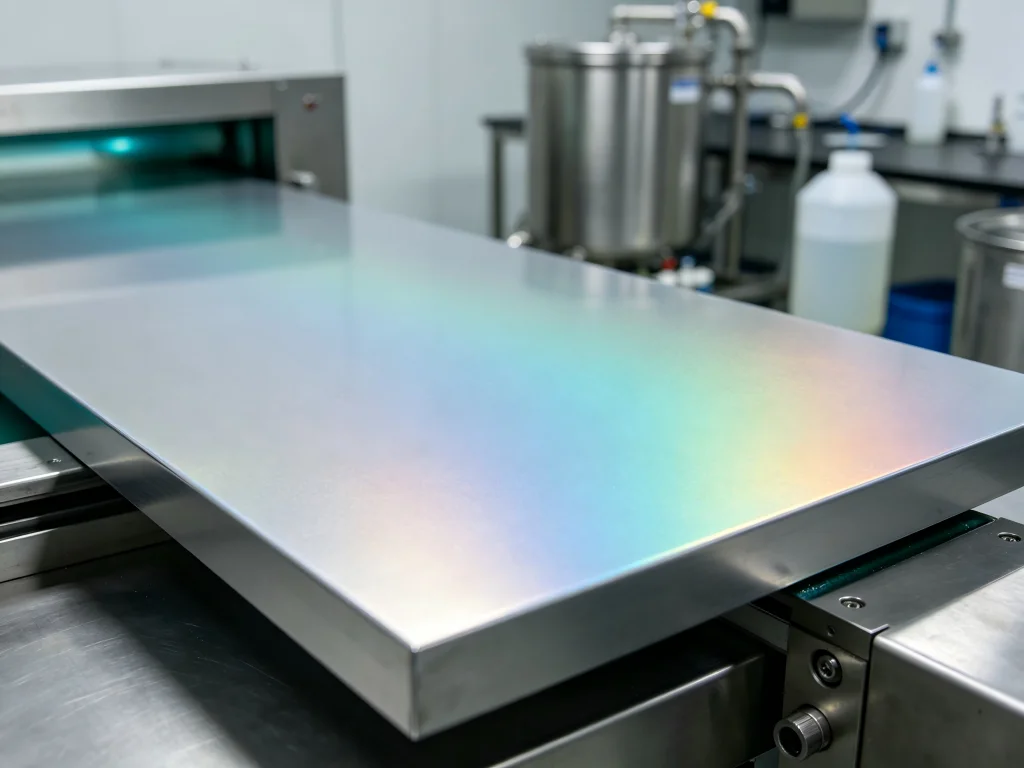
1. What Exactly Is Chemical Film Coating – And Why Does It Matter for Aluminum CNC Parts?
When clients ask “what is chemical coating” in a machining context, many assume it refers to something thick, heavy, and dimension-altering. The reality is far more elegant. Chemical film coating (often called chem film, chromate conversion coating, or by trade names such as Alodine and Iridite) is a non-electrolytic chemical conversion process applied specifically to aluminum and its alloys.
Rather than depositing a foreign layer onto the surface (as plating or paint would do), chemical film coating reacts with the aluminum surface itself. The aluminum undergoes a controlled oxidation passivation reaction that transforms the topmost layer into a durable, conductive, corrosion-resistant film that is typically only 0.00001 to 0.00004 inches (0.25–1.0 µm) thick.
Think of it this way: whereas anodizing creates a thick aluminum oxide layer by essentially growing the surface outward, chemical film coating creates a conversion layer by modifying the existing metal surface through a chromate or non-chromate chemical reaction. This distinction matters enormously for CNC-machined parts because the coating adds virtually no measurable thickness change, meaning tight-tolerance features stay exactly where you machined them.
On Reddit machining forums (r/Machinists, r/CNC), a frequently echoed concern from job shop owners goes something like this: “I just lost an aerospace contract because they required chem film, and I didn’t realize it until after I shipped bare aluminum parts.” Another common Reddit thread asks: “Which surface finish should I specify for 7075 brackets that need both corrosion protection and electrical grounding?” The answer emerging from those community discussions consistently points to chemical conversion coating as the preferred middle ground between bare aluminum (susceptible to filiform and galvanic corrosion) and heavy anodizing (which may compromise conductivity and dimensions).
From a regulatory standpoint, chemical film coating follows rigorous military and industry standards. The primary governing document is MIL-DTL-5541 (formerly MIL-C-5541), which defines both the chemical composition types and the protection classes. ASTM B449 also provides requirements for chromate conversion coatings intended for corrosion protection and as a base for organic films.
A technical understanding of the coating thickness is similarly important. Chemical film coating thickness is incredibly thin compared with alternatives like powder coating or Type II anodizing. Typical chem film coating thickness ranges from 0.2 to 1.2 microns. This minimal chemical film coating thickness ensures that press-fit holes, threaded inserts, and matingsurfaces remain within tolerance after treatment.
The process itself involves a precise series of steps. Any competent chem film provider follows a consistent sequence:
-
Cleaning and degreasing to remove all cutting oils and shop soils.
-
Deoxidizing/desmutting to eliminate naturally occurring oxides.
-
Immersion (or spray) in a chromate conversion chemistry bath at controlled temperature, pH, and concentration.
-
Thorough rinsing to halt the reaction.
-
Drying in ambient air or a low-temperature oven.
-
Final visual inspection and optional salt-spray or conductivity testing.
The beauty of the process is its speed: a full cycle often takes less than 30 minutes, whereas anodizing may require hours.
In the sections ahead, we will walk through the real-world application cases, selection criteria, and practical considerations that matter most for engineers, procurement specialists, and shop owners.
2. Where Chem Film Proves Essential: Real Applications Across Industries
If you search for “chem film coating near me” on Google or look up coating service directories, you will likely find providers serving a remarkably consistent set of industries. The demand for chemical film coating arises wherever aluminum parts need protection without losing metal-to-metal conductivity or without adding significant dimensional buildup.
2.1 Aerospace and Defense: The Original Chem Film Stronghold
The aerospace industry is arguably the single largest driver of chemical film coating demand. Look inside any commercial aircraft cabin, avionics bay, or wing structure, and you will find countless chem-filmed brackets, fittings, housings, and panels.
Aircraft engineers choose chemical conversion coating for several reasons:
-
Weight is critical; chem film adds virtually no mass.
-
Conductivity is required for lightning-strike protection and electrical bonding.
-
Paint adhesion must be excellent; chem film serves as an ideal primer layer.
-
Harsh environmental exposure demands reliable corrosion resistance without heavy coatings.
Military specifications codify this need. MIL-DTL-5541 Type 1 Class 1A provides maximum corrosion protection for unpainted or painted assemblies. The F/A-18 fuselage panels, Black Hawk helicopter instrument housings, and Predator drone electronics enclosures all rely on chem-filmed aluminum components to survive humidity, salt spray, and temperature cycles without pitting or exfoliation.
2.2 Electronics and Telecommunications: The Conductivity Imperative
Electronics manufacturers might initially wonder: Why not simply leave aluminum bare? The answer lies in galvanic corrosion and fretting oxidation. When bare aluminum contacts other metals (copper, steel, stainless) in a humid environment, galvanic cells form, and corrosion initiates at contact points. Over time, electrical resistance increases, signal integrity degrades, and intermittent failures become more likely.
Chemical film coating solves this problem by creating a thin, conductive conversion layer that interrupts galvanic corrosion pathways while preserving low contact resistance. For MIL-DTL-5541 Class 3 coatings, the specification requires contact resistance below 5,000 microhms per square inch in the as-coated state, a level that supports reliable grounding and EMI/RFI shielding.
From Reddit discussions among electronics hardware engineers, one sentiment recurs repeatedly: *“I learned the hard way that bare aluminum in a mixed-metal assembly corrodes within months. Now every chassis we design specifies chem film Type II Class 3.”*
Telecom enclosures, data center server rails, RF shielding housings, and satellite electronics all benefit from the unique combination of corrosion resistance and conductivity that chemical film coating provides—a combination that anodizing, with its insulating oxide layer, cannot match.
2.3 Automotive and Heavy Equipment: Balancing Cost and Performance
While aerospace tolerates premium pricing for surface finishing, the automotive sector demands cost-effectiveness at high volume. Chemical conversion coating fits thisneed well: it is one of the more affordable conversion coatings relative to anodizing or complex plating stacks.
Common automotive applications include:
-
Engine control module housings
-
Transmission valve body covers
-
Turbocharger compressor housings
-
Heat exchanger brackets
-
Under-hood sensor mounting plates
In heavy equipment, exposed aluminum components such as control panels, hydraulic valve blocks, and cab trim benefit from chem film applied as a paint pre-treatment or as a standalone protective finish.
A point echoed in machining forums: Ford, GM, and Tesla suppliers often require chem film on aluminum components that are subsequently painted, because the conversion coating prevents under-paint corrosion creep (filiform corrosion) without requiring costly primers.
2.4 Medical Devices: Cleanliness and Corrosion Resistance
Medical device manufacturers face unique challenges: devices must withstand repeated sterilization cycles (autoclaving, chemical sterilization), resist corrosion from bodily fluids or cleaning agents, and maintain biocompatibility. Aluminum is widely used in imaging equipment frames, surgical instrument handles, and diagnostic device chassis. A thin, clean, uniform conversion coating provides corrosion protection without introducing thick polymers or heavy metals that could raise regulatory concerns.
2.5 Industrial Machinery and Automation
For CNC machine builders themselves, chemical film coating appears on operator panels, control enclosures, sensor brackets, and material-handling components. Industrial environments expose aluminum to coolants, lubricants, humidity, and occasional chemical spills. Chem film provides a first line of defense without affecting part geometry—a major benefit for automation components with tight fit tolerances.
3. Key Selection Factors: Choosing the Right Chemical Film Specification
If you are sourcing chem film coating near me or reviewing a quotation from a finishing provider, the following selection factors will determine whether the finished parts meet your requirements.
3.1 Type I vs. Type II: The Hexavalent Chromium Decision
The single most consequential choice in chemical film coating is the Type selection:
-
Type I (Hexavalent Chromium) : Traditional formulation containing hexavalent chromium (Cr⁶⁺). Offers excellent corrosion resistance and has been used for decades across military and aerospace applications. However, Cr⁶⁺ is a known carcinogen subject to strict worker safety, waste disposal, and environmental regulations. RoHS (Restriction of Hazardous Substances) restricts Cr⁶⁺ in many commercial applications, which leads many customers to require Type II.
-
Type II (Trivalent Chromium or Chromium-Free) : Formulated without hexavalent chromium, typically using trivalent chromium (Cr³⁺) or other proprietary chemistries such as zirconium, titanium, or molybdenum-based compounds. Type II coatings are RoHS, REACH, ELV, and WEEE compliant, making them the default choice for European markets and for environmentally-conscious North American manufacturers. Modern Type II trivalent coatings have narrowed the corrosion-performance gap with Type I significantly. For many indoor or moderate-exposure environments, Type II offers fully adequate protection.
On the finishing.com forum (a long-running Q&A platform for metal finishing professionals), a frequently asked question is: “Can I substitute Type II for a Type I specification on an existing drawing?” The consensus answer: only with customer approval, because Type II coatings may appear visually different (clear/iridescent vs. yellow/gold) and may yield slightly different salt-spray hours. As one finishing expert notes: “When Type II is mentioned, the conversion coating shall not contain Hexavalent Chrome, hence, RoHS compliant. When Type I is mentioned, the conversion coating contains Hexavalent Chrome but it may not necessarily be yellow.”
3.2 Class 1A vs. Class 3: Protection vs. Conductivity
Within each Type, MIL-DTL-5541 defines two Classes:
-
Class 1A (Maximum Corrosion Protection) : This coating provides maximum corrosion resistance, painted or unpainted. It is a relatively thicker coating (within the same 0.25–1.2 micron range) and is intended for applications where corrosion protection is the highest priority and some increase in electrical contact resistance is acceptable. Typical uses include structural airframe components, exterior panels, and parts exposed to salt spray or humidity.
-
Class 3 (Low Electrical Resistance) : This coating provides corrosion protection with low contact resistance, meaning it is optimized for applications that require reliable electrical bonding, grounding paths, or EMI shielding. The coating is thinner than Class 1A and offers weight savings along with lower electrical impedance. Typical uses include electronics enclosures, grounding brackets, and RF housing assemblies.
Class 3 coatings are subject to Electrical Contact Resistance (ECR) testing per MIL-DTL-5541, typically performed monthly with coupons. The specification sets limits of no more than 5,000 microhms per square inch in the as-coated state, and 10,000 microhms after salt spray exposure.
3.3 Coating Thickness and Dimensional Impact
As previously noted, chemical film coating thickness typically ranges from 0.25 to 1.2 microns—far thinner than a human hair (which is approximately 70 microns thick). For most CNC-machined parts, chem film coating thickness is so minimal that no dimensional compensation is required. This distinguishes chem film from painting (which adds 25–100+ microns) or powder coating (50–150+ microns).
However, Class 1A coatings are generally toward the higher end of the thickness range compared with Class 3 coatings. In one supplier’s technical note: “Class 3 coatings are thinner, they are more susceptible to corrosion than class 1A coatings.” Thus, if your application requires maximum corrosion protection in a harsh environment, Class 1A is recommended even though it will be slightly thicker.
For parts with exceptionally tight tolerances (e.g., bearing journals, precision slide fits), chem film’s near-zero build remains a major advantage over paint, powder, or even some anodizing specifications.
3.4 Salt Spray Performance and Environmental Certification
Corrosion resistance is typically validated by ASTM B117 salt spray testing. Key benchmarks:
-
MIL-DTL-5541 Type I Class 1A: typically 168 hours (or more) of salt spray resistance before significant corrosion.
-
MIL-DTL-5541 Type II Class 1A: often 96–120 hours, depending on specific chemistry and alloy.
-
Type II Class 3: shorter duration, adequate for indoor or light-duty applications.
Beyond salt spray, regulatory certifications such as RoHS, REACH, ELV, and WEEE matter for global supply chains. In Reddit and Facebook manufacturing groups, importers frequently ask: “My European customer is requiring RoHS certification on aluminum enclosures—what surface finish do I need?” The nearly universal answer: specify MIL-DTL-5541 Type II conversion coating, and request a Certificate of Compliance from your finishing provider.
3.5 Alloy Compatibility
Not every aluminum alloy responds identically to chemical film coating. The conversion reaction rate and resulting coating quality vary by alloy composition:
-
Excellent response: 6061, 5052, 6063 (common extrusion and machining alloys).
-
Good response: 7075, 2024 (high-strength aerospace alloys), with proper bath control.
-
More challenging: High-silicon casting alloys (A356, A380) may require modified bath parameters or longer immersion times to achieve uniform coating.
-
Poor response: Pure aluminum (1100, 1350) tends to produce thinner, less protective coatings.
Most reputable finishing shops test each alloy combination periodically. If you are running a specialized alloy like 2195 or 7085, discuss bath parameters and qualification samples with your provider before committing to high-volume production.
3.6 Lead Times and Geographic Proximity
When you search chem film coating near me, lead time emerges as a critical factor, especially for CNC job shops with just-in-time delivery commitments. The chem film process itself is fast (typically 20–40 minutes for a batch), but queue times, inspection, packaging, and shipping create the overall turnaround. A local provider can often complete a batch within 2–3 business days after receiving clean, machined parts, whereas anodizing or plating may require 5–10 days.
For high-volume production or prototype runs, comparing three to five finishing vendors on turnaround, cost, and certification capabilities is standard practice.
<a id=”h4-process-and-handling”></a>
4. Process, Handling, and Quality Assurance: What Machinists Need to Know
Once you have chosen a specification, the actual chemical film coating application must be executed correctly. The following guidance helps CNC shops and procurement teams ensure quality outcomes.
4.1 Surface Preparation Is Everything
The single biggest cause of chem film failure is inadequate cleaning. Cutting oils, tapping fluids, fingerprints, and shop dust all inhibit the chemical conversion reaction, leading to uneven coating, visible “water breaks,” reduced corrosion resistance, and poor paint adhesion.
Before sending parts to finishing, consult with your provider about their cleaning protocol. Most reputable finishers follow a multi-step sequence:
-
Alkaline clean (heated, agitated).
-
Multiple rinse stages (counter-flow rinse for efficiency).
-
Acid deoxidizer/desmut (to remove natural oxides and embedded contamination).
-
Final rinse before immersion in the conversion chemistry.
Some providers also use ultrasonic cleaning for complex geometries or deep blind holes. If your parts have internal passages, threaded holes, or difficult-to-reach crevices, ask how the finisher ensures complete coverage and rinsing.
4.2 Racking and Part Orientation
Chem film is typically applied by immersing racks of parts in process tanks. Parts orientation and racking design matter:
-
Avoid “nesting” where parts touch each other, which creates shadow zones and incomplete coating.
-
Minimize small contact points between parts and racking; post-process touch-up may be necessary.
-
Ensure all surfaces face the solution flow (agitation helps).
On social media finishing groups, a common complaint involves “rack marks”—uncoated or discolored spots where parts contacted racks. Some rack marks are unavoidable, but a skilled finisher uses minimal-contact racking and may offer post-coating brush application for touch-up.
4.3 Inspection and Testing Requirements
Depending on your customer’s specification, your chemical film coating provider should perform or be able to certify the following tests:
-
Visual inspection: The coating should appear uniform, without bare spots, heavy streaks, or powdering. Type I coatings are typically yellow-gold to brown; Type II coatings range from clear to blueish iridescent.
-
Thickness measurement (optional, on test coupons): Confirm chemical film coating thickness within the required range (e.g., 0.3–1.2 µm) using X-ray fluorescence (XRF) or similar.
-
Salt spray testing (ASTM B117) : Typically performed monthly by the finisher on test panels, not on each part.
-
Adhesion testing (tape test, ASTM D3359) : Especially critical if parts will be painted after chem film.
-
Electrical contact resistance (ECR) testing: For Class 3 requirements, per MIL-DTL-5541.
Ensure your provider can supply Certificates of Conformance (CofCs) with traceable lot numbers. For NADCAP-certified aerospace work, monthly process control testing and documented results are mandatory.
4.4 Touching and Handling After Coating
Once parts receive chemical film coating, the coating is thin and relatively soft compared with anodized or plated surfaces. Abrasive contact, improper packing, or careless handling can scratch through the conversion layer, exposing bare aluminum and compromising corrosion protection.
Best practices for post-coating handling include:
-
Use clean, lint-free gloves during inspection and packaging.
-
Interleave parts with soft paper or foam to prevent metal-to-metal contact.
-
Avoid sliding parts across workbenches or steel surfaces.
-
Ship parts promptly; extended storage in humid conditions reduces coating effectiveness.
4.5 Paint and Powder Coating Over Chem Film
If your application requires topcoating with paint or powder, chemical conversion coating serves as an excellent primer. The microscopically roughened surface (created by the conversion reaction) promotes mechanical interlocking and chemical bonding with organic coatings.
When painting over chem film:
-
Most paint systems adhere well without additional primer.
-
Ensure the paint system is compatible with any residual chromium species (Type I) or trivalent chemistry (Type II).
-
Follow paint manufacturer recommendations for surface preparation after chem film (e.g., light abrading or cleaning).
-
Avoid painting over chem film if electrical conductivity is required through the surface—paint is an electrical insulator.
<a id=”h5-jucheng-advantage”></a>
5. Why Jucheng Stands Out for CNC Precision and Coating Integration
When you search for “chem film coating near me” or need a partner who truly understands the intersection of CNC machining and surface finishing, Jucheng offers a distinctive value proposition. The team at https://www.jccncmachining.com/ has built a reputation for integrating precision machining with a deep working knowledge of post-processing treatments like chemical film coating.
Instead of treating finishing as an afterthought or outsourcing to a third party without technical oversight, Jucheng approach is rooted in the principle that optimal part quality requires coordination from raw material through final coating.
5.1 Technical Expertise Across the Entire Manufacturing Chain
Jucheng engineers and machinists understand the subtle ways that cutting parameters, tool selection, and surface finish affect chemical conversion coating results. For example:
-
Excessively rough machined surfaces (high Ra values) can trap processing solutions and cause staining after chem film.
-
Burrs or sharp edges may flake or chip post-coating, creating failure points.
-
Certain coolants leave silicone-based residues that inhibit conversion reactions—even after standard cleaning.
By controlling the entire value stream, Jucheng ensures that CNC machining parameters are optimized for chem film, not just for speed or tool life.
5.2 Quality Systems and Certification
A trustworthy chemical film coating provider must operate under documented quality systems. Jucheng maintains ISO 9001:2015 certification, ensuring consistent processes, traceability, and continuous improvement. For customers requiring MIL-DTL-5541 compliance, Jucheng can produce parts meeting Type I or Type II requirements, with appropriate Class 1A or Class 3 designations.
Moreover, Jucheng supports customers seeking additional certifications such as RoHS, REACH, and conflict-minerals compliance—matters of growing importance in electronics and medical device supply chains.
5.3 Single-Source Responsibility and Faster Lead Times
Perhaps the greatest practical advantage of partnering with Jucheng is single-source responsibility. Rather than shipping raw machined parts to an external finisher (and praying they arrive safely and return on time), Jucheng coordinates coating in-house or through closely vetted partners. This approach:
-
Eliminates logistical delays and damage risks from multiple shipments.
-
Reduces communication overhead (one point of contact for both machining and finishing).
-
Simplifies quality audits (one supplier to audit, not two).
-
Enables tighter scheduling for just-in-time delivery.
In the world of contract manufacturing, every additional handoff adds risk. Jucheng minimizes that risk.
5.4 Material Selection Support
Choosing the right aluminum alloy for your chem-filmed part matters. Jucheng application specialists help customers navigate the trade-offs between machinability, strength, corrosion response, and coating compatibility. For components that require high strength and good chem film performance, 7075 is common. For excellent machinability and corrosion balance, 6061 is standard. For the highest strength-to-weight ratio, 2024 is a contender, though it requires careful bath management.
5.5 Prototype Through High-Volume Production
Whether you need five prototype brackets for an aerospace R&D project or 50,000 housings for a telecommunications rollout, Jucheng scales to meet demand. Quick-turn services (often 5–7 days for simple parts) support development cycles, while established process controls ensure repeatability for production runs.
On online forums, a question that surfaces repeatedly is: “Which CNC shop actually understands surface finishing instead of just shipping parts and saying ‘you figure out the coating’?” Jucheng positions itself squarely as the answer to that question: a technical partner who sees chemical film coating as integral to part performance.
6. Frequently Asked Questions About Chemical Film Coating
The following questions reflect actual search queries and forum discussions regarding chemical film coating, chem film conversion coating, and related topics.
Q1: What is the difference between chemical film vs anodizing?
This is perhaps the most common comparison question in metal finishing forums. Chemical film coating (conversion coating) creates a thin (0.25–1.2 µm), conductive, corrosion-resistant layer via chemical reaction with the aluminum surface. Anodizing (typically Type II or Type III) grows a thick (5–25 µm or more) aluminum oxide layer via electrolytic process, which is hard but electrically insulating.
Which one should you choose? If you need electrical conductivity (grounding, EMI shielding), chem film is your only option between the two. If you need maximum wear resistance, hardness, or dye-ability (colored finishes), anodizing is superior. If dimensional change is a concern, chem film adds far less thickness and is preferred for press-fit assemblies.
Q2: Is chemical film coating RoHS compliant?
It depends on the Type. MIL-DTL-5541 Type II (trivalent or chromium-free) coatings are RoHS compliant, REACH compliant, ELV compliant, and WEEE compliant. Type I (hexavalent chromium) coatings contain Cr⁶⁺ and do NOT meet RoHS requirements. For European markets or environmentally-conscious customers, always specify Type II.
Q3: How thick is chemical film coating on aluminum?
Typical chemical film coating thickness ranges from 0.25 to 1.2 microns (0.00001 to 0.000047 inches). To put this in perspective: a human hair is about 70 microns thick, so chem film is roughly 1/70th the thickness of a hair. This minimal build makes chem film ideal for precision-machined parts where tolerances must be preserved.
Q4: Can I apply chemical film coating over existing paint or anodizing?
No. Chem film requires direct contact with bare, clean aluminum to form the conversion layer. Existing coatings (paint, anodize, plating) must be completely stripped before applying chemical conversion coating. Stripping methods vary; chemical strippers or media blasting may be used, but the underlying aluminum must be verified as contamination-free.
Q5: What is chem film vs chemical conversion coating—are they the same?
Yes. These terms are used interchangeably. “Chem film” is industry shorthand for chemical conversion coating. Other names include chromate conversion coating, Alodine coating (a Henkel trade name), Iridite coating, and TCP coating. All refer to the same family of chemical treatments that convert the aluminum surface into a protective, conductive layer meeting MIL-DTL-5541 or ASTM B449 standards.
Q6: How long does chemical film coating last?
The service life of chemical film coating depends on environment and handling. Indoors, in clean, low-humidity conditions, chem-filmed parts can last decades without visible corrosion. In outdoor environments (humidity, salt spray, industrial pollution), the coating degrades over time; corrosion typically initiates at scratches or handling damage. For severe environments, chem film is often used as a primer under paint or powder coating rather than as a standalone finish.
Q7: Does chemical film coating change electrical conductivity?
No, it generally preserves or slightly improves electrical contact resistance compared with bare aluminum. Type II and Type I coatings both maintain low contact resistance when properly applied. In fact, one reason engineers choose chem film over anodizing is specifically to preserve grounding and bonding paths while still gaining corrosion protection.
Q8: Which aluminum alloys work best with chemical film coating?
Alloys in the 5xxx, 6xxx, and 7xxx series generally yield good results. Common examples:
-
6061 : Excellent overall results; most common alloy for chem film.
-
7075 : Good results; requires proper bath control.
-
5052 : Excellent results; good for marine and chemical-exposed parts.
-
2024 : Acceptable with careful process control; high copper content affects reaction.
-
A356 (casting) : Variable results; consult your finisher.
Avoid severely contaminated or heavily oxidized surfaces. Casting alloys with high silicon content may need modified processing.
Q9: Can I touch up damaged chem film after assembly?
Yes, in many cases. Touch-up solutions (brush-applied conversion coatings) are commercially available. For small scratches or rack marks, careful application of a compatible touch-up chemistry can restore corrosion protection. However, Class 3 conductivity requirements may not be fully restored by brush touch-up—verify with testing if conductivity is critical.
Q10: What is the difference between Type I and Type II chem film visually?
Type I (hexavalent chromium) typically appears yellow-gold to brownish, sometimes iridescent. Type II (trivalent/chromium-free) typically appears clear, colorless, or with a slight blueish iridescent tint. The color difference is useful for quick visual verification of coating type, though color alone is not definitive—some Type I formulations can be specified as “clear” or nearly colorless.
Q11: How do I find reliable chem film coating near me?
Searching for chem film coating near me yields local industrial finishers, but vetting is essential. Look for:
-
ISO 9001:2015 (or AS9100 for aerospace) certification.
-
Demonstrated experience with MIL-DTL-5541 requirements.
-
Monthly process control testing documentation (e.g., salt spray, ECR for Class 3).
-
Customer references in your industry.
-
Transparent quoting with clear coating specifications.
Alternatively, partner with a full-service CNC shop like Jucheng that manages finishing in-house or through audited partners, eliminating the need to coordinate multiple vendors.
Q12: Is chemical film coating expensive compared with anodizing?
Generally, chemical conversion coating costs less than Type II anodizing and significantly less than Type III hard anodizing. Chem film requires simpler equipment (no rectifiers, no refrigeration for hard anodize), shorter cycle times, and less energy consumption. For high-volume applications, chem film is often the most cost-effective conversion coating that meets both corrosion and conductivity requirements.
Costs vary by region, batch size, part geometry, and specification (Type II Class 3 typically lowest cost; Type I Class 1A with extensive testing may be higher). Request quotes from multiple finishers for your specific part mix.
7. From Machined Aluminum to Mission-Ready Component
Returning to the opening scenario—the machinist facing a customer requirement for chem film and a tight deadline—the path forward is now clear.
Chemical film coating transforms your precision-machined aluminum parts from raw, corrosion-vulnerable components into durable, conductive, ready-for-service assemblies. Whether you are building avionics enclosures that must survive extreme environments, automotive electronics requiring RoHS compliance, or industrial equipment needing a reliable paint base, chem film delivers a unique combination of attributes that no other surface treatment matches.
The key is selecting the right partner. The open-moat advantage lies with manufacturers like Jucheng, who understand not only the machining side but also the finishing requirements that turn raw metal into finished goods. By controlling the entire process—from material selection through CNC turning and milling to chemical conversion coating application—Jucheng eliminates the fragmentation that plagues traditional “machine then outsource finishing” models.
Ready to specify chemical film coating on your next aluminum project?
Whether you are prototyping a new design or ramping production volumes, the team at Jucheng is available to review your drawings, discuss material and coating options, and provide a competitive quote.
Visit Jucheng CNC Machining at: https://www.jccncmachining.com/
Submit your RFQ today. Tell our engineers your application, your required specification (MIL-DTL-5541 Type I or II, Class 1A or 3), and your lead time needs. From there, Jucheng will handle the rest—machining, finishing, inspection, and delivery.