
When your engineering team specifies 17-4 PH machining for a critical component, you are not just choosing a material—you are making a decision that affects lead times, part performance, and your overall production budget. This precipitation-hardening stainless steel offers an exceptional combination of high strength, corrosion resistance, and hardness that few other alloys can match. But here is the challenge that manufacturing professionals consistently discuss on forums like Reddit and Practical Machinist: 17-4 PH stainless steel machining requires specialized knowledge, the right tooling strategies, and a CNC partner who understands how to navigate its unique behavior under cutting tools. This guide helps you evaluate potential machining partners and make an informed decision for your next project involving 17-4 PH stainless steel.
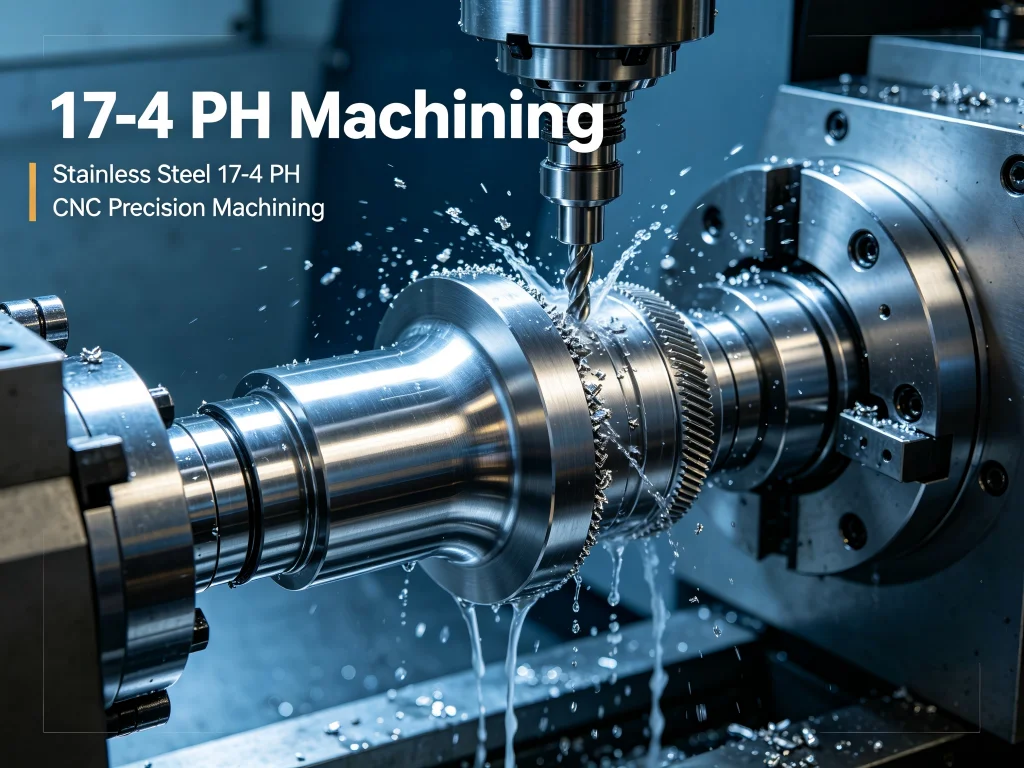
Understanding the Material: What Makes 17-4 PH Different?
Before we dive into the selection criteria, it is worth understanding what you are actually working with. 17-4 PH—the “PH” stands for precipitation hardening—is a martensitic stainless steel that contains approximately 17% chromium and 4% nickel, with significant copper additions that enable its unique strengthening mechanism. The material can be supplied in Condition A (solution annealed), which is the most machinable state, and then age-hardened through various heat treatment protocols designated as H900, H1025, H1075, H1100, H1150, and H1150D.
What does this mean for your machining project? In the annealed condition, 17-4 PH stainless steel offers a machinability rating of approximately 45 to 48%, with surface cutting speeds around 80 feet per minute. In the overaged H1150 condition, machinability improves to about 76% with speeds up to 125 feet per minute. However, the material presents real challenges: it is known for built-up edge formation on cutting tools and difficulty in chip control, which can compromise surface quality and increase tooling costs.
One experienced machinist on a popular forum put it this way: “17-4 can be a bit gummy when turning”. Another countered: “17-4 is pure bliss to machine, especially milling and drilling, compared to the miserable hell of 316”. The truth lies somewhere in between—17-4 PH machining is highly rewarding when done correctly but unforgiving when approached without the proper expertise.
The Core Decision Framework: 7 Factors to Evaluate When Choosing a 17-4 PH Machining Partner
Selecting the right CNC shop for your 17-4 PH stainless steel machining project requires evaluating multiple dimensions. Here is a framework that procurement professionals and engineers can use to compare potential partners.
1. Material Condition Expertise
Not all 17-4 PH is the same. Your components may require machining in Condition A followed by post-machining heat treatment, or you might need machining in a pre-hardened condition. A capable partner should demonstrate:
- Understanding of how different heat treatment conditions affect machinability
- Experience with both pre-hardened and annealed material machining
- Knowledge of dimensional changes that occur during post-machining heat treatment
- Ability to recommend the optimal condition based on your specific application
As Ryerson’s technical resources note, 17-4 can be precipitation hardened by holding the steel at 900°F for just one hour, “thereby minimizing scaling and distortion and allowing parts to be machined to close tolerances, prior to heat treatment”. This means a skilled machinist can leverage the material’s properties to achieve tight tolerances that might be impossible with other stainless grades.
2. Tooling and Cutting Parameter Optimization
The machining community consistently emphasizes that 17-4 PH stainless steel demands specific tooling strategies. Research has shown that tool orientation and surface curvature significantly affect tool wear during five-axis milling of 17-4PH. Studies also indicate that using a 0.4 mm cutting nose radius can reduce cutting force, temperature, and tool wear compared to a 0.8 mm radius.
When evaluating a potential CNC partner, ask about:
- Their preferred tooling materials (carbide inserts with appropriate coatings are standard)
- Experience with modulation-assisted machining strategies for chip breakage
- Approach to coolant and lubrication (MQL, wet, or cryogenic)
- Cutting parameters they typically employ (speeds of 120-180 SFM are common for milling)
3. Quality Management Systems and Certifications
For components used in aerospace, medical, automotive, or defense applications, quality certifications are non-negotiable. Jucheng Precision operates under the IATF 16949 quality management system, a standard that demonstrates rigorous process control and continuous improvement capabilities. When comparing shops, consider:
- ISO 9001:2015 certification (minimum standard)
- IATF 16949 for automotive applications
- AS9100D for aerospace and defense
- ISO 13485 for medical devices
- Internal inspection capabilities and measurement equipment
4. Equipment Capability and Capacity
The complexity of your 17-4 PH machining project will determine the equipment requirements. Jucheng Precision utilizes advanced CNC equipment including multi-axis machines and 5-axis CNC systems capable of producing complex geometries with maximum precision. Key questions to ask:
- What is the maximum part size they can accommodate?
- Do they have 3-axis, 4-axis, or 5-axis capabilities?
- What is their typical lead time for 17-4 PH projects?
- Do they offer both prototyping and production runs?
5. Secondary Operations and Finishing
17-4 PH stainless steel machining often requires secondary operations to achieve the final specifications. These may include heat treatment, surface finishing, passivation, or specialized coatings. A full-service provider can manage the entire workflow, reducing coordination overhead and quality risks.
6. Industry Experience and Application Knowledge
Different industries have different requirements for 17-4 PH components. Aerospace applications demand exceptional traceability and tight tolerances. Medical devices require biocompatibility and surface finish standards. Chemical processing equipment needs corrosion resistance in aggressive environments. Marine applications require caution regarding crevice corrosion in stagnant saltwater.
A partner with experience in your specific industry will understand these nuances without requiring extensive hand-holding.
7. Cost Structure and Value Proposition
While price is always a consideration, the lowest quote rarely delivers the best value for 17-4 PH stainless steel machining. The material’s challenges mean that cutting corners on tooling, inspection, or process control can result in scrap, rework, and delayed deliveries. Evaluate quotes based on:
- Transparency about what is included (material sourcing, heat treatment, inspection, packaging)
- Experience with similar projects and geometries
- Quality track record and rejection rates
- Lead time commitments and on-time delivery performance
Comparative Analysis: 17-4 PH vs. Alternative Materials
Understanding how 17-4 PH compares to other stainless steel grades can help you confirm that you have selected the right material before you even begin evaluating machining partners.
| Property | 17-4 PH (Condition A) | 17-4 PH (H900) | 15-5 PH | 316 Stainless |
|---|---|---|---|---|
| Tensile Strength (psi) | 150,000 | 200,000 | ~170,000 | ~80,000 |
| Yield Strength (psi) | 110,000 | 185,000 | ~155,000 | ~42,000 |
| Hardness (Rockwell C) | 34 | 44 | ~38 | ~22 |
| Machinability Rating | 45-48% | Lower | Lower than 17-4 | ~45% |
| Corrosion Resistance | Good | Good | Excellent | Superior |
| Magnetic Properties | Magnetic | Magnetic | Magnetic | Non-magnetic |
As the data shows, 17-4 PH outperforms 15-5 PH in machinability, requiring less specialized tooling and effort. However, 15-5 offers superior toughness, especially in larger sections, making it preferable for applications where impact resistance is critical. Compared to 316 stainless, 17-4 PH stainless steel delivers dramatically higher strength at the cost of some corrosion resistance and magnetic properties.
One forum contributor noted that “17-4PH when heat treated will produce a part that is somewhat hard (Rc44 max), and very tough. They make things like torque shafts and prop shafts with it”. This practical insight captures why many engineers choose 17-4 PH for demanding mechanical applications.
Applications That Demand 17-4 PH Machining Excellence
The decision to use 17-4 PH stainless steel typically arises from specific application requirements. Understanding these applications can help you articulate your needs more clearly to potential machining partners.
Aerospace and Defense
According to industry data, 17-4 PH is ideal for aircraft and missile fittings, fasteners, gears, turbine blades, and pump shafts. The material maintains high strength at temperatures up to 600°F (316°C), making it suitable for engine-adjacent components.
Oil, Gas, and Chemical Processing
The combination of corrosion resistance and high strength makes 17-4 PH valuable for valves, pump components, and chemical processing equipment. The material can withstand chloride-induced stress corrosion cracking, offering performance comparable to 304 stainless.
Medical Devices
In the medical field, 17-4PH is used for orthopedic screws and bone plates. Its biocompatibility and strength make it a preferred choice for implantable devices and surgical instruments.
Automotive and Motorsports
High-performance automotive components, including transmission parts and suspension components, frequently specify 17-4 PH stainless steel for its strength-to-weight ratio and fatigue resistance.
Why Jucheng Precision Stands Out for 17-4 PH Machining
When your project requires 17-4 PH machining, Jucheng Precision offers capabilities that address the key evaluation factors discussed above. Here is what sets them apart:
Technical Expertise Across Material Conditions
Jucheng’s engineering team understands the nuances of machining 17-4 PH in various heat treatment conditions. Whether your components require machining in the annealed state followed by precipitation hardening, or you need to machine pre-hardened material, Jucheng has the experience to deliver consistent results.
Advanced Multi-Axis Capabilities
With 5-axis CNC machines and advanced long mill CNC systems, Jucheng Precision can produce complex geometries that would be challenging or impossible with conventional 3-axis equipment. This capability is particularly valuable for aerospace and medical components with intricate features.
IATF 16949 Quality Management
Operating under the IATF 16949 quality management system demonstrates Jucheng’s commitment to rigorous process control and continuous improvement. For automotive and other demanding applications, this certification provides assurance that quality is built into every step of the manufacturing process.
Comprehensive Service Offering
Jucheng provides a complete range of services beyond machining, including surface finishing options like polishing, brushing, sandblasting, anodizing, powder coating, plating, and passivation. This one-stop capability reduces coordination overhead and ensures consistent quality across all operations.
Prototyping and Production Flexibility
Whether you need rapid prototypes for validation or full production runs, Jucheng offers the flexibility to scale according to your project requirements. This versatility is especially valuable for companies transitioning from development to commercialization.
Frequently Asked Questions About 17-4 PH Machining
What does 17-4 PH stand for?
The “17” refers to approximately 17% chromium content, the “4” indicates approximately 4% nickel, and “PH” stands for precipitation hardening—the heat treatment process that gives this alloy its exceptional strength. It is also known as UNS S17400 or Grade 630 stainless steel.
Is 17-4 PH stainless steel magnetic?
Yes, 17-4 PH stainless steel exhibits magnetic properties due to its martensitic structure. The degree of magnetism can vary based on the heat treatment it has undergone. If only annealed, it retains ferrite and shows magnetic characteristics.
Can 17-4 PH be machined in the hardened condition?
Yes, 17-4 PH can be machined in both the solution annealed condition and the precipitation hardened condition. However, machining in the hardened state is more challenging and requires specialized tooling and cutting parameters. Most shops recommend machining in Condition A and then heat treating to the desired hardness.
What is the machinability rating of 17-4 PH?
In the annealed condition (Condition A), 17-4 PH stainless steel has a machinability rating of approximately 45-48%. In the overaged H1150 condition, the rating improves to about 76%. For comparison, 1212 free-machining steel is typically rated at 100%.
What tooling is recommended for 17-4 PH machining?
Carbide inserts with sharp edges and a positive rake angle are recommended for turning operations. For milling, coarse-tooth tools help reduce cutting heat. Coated tools, particularly those with TiAlN coatings, have shown good performance in research studies.
How does 17-4 PH compare to 316 stainless for machining?
While both materials have similar machinability ratings, experienced machinists often prefer 17-4 PH. One forum participant described 17-4 as “pure bliss to machine, especially milling and drilling, compared to the miserable hell of 316”. However, 316 offers superior corrosion resistance, particularly in marine environments, while 17-4 provides dramatically higher strength.
What are the common heat treatment conditions for 17-4 PH?
The common aging treatments are designated as H900, H925, H1025, H1075, H1100, H1150, and H1150D. Each condition offers different mechanical properties. For example, H900 provides maximum strength (190,000 psi tensile) with lower ductility, while H1150 offers lower strength (134,800 psi) but higher toughness and better machinability.
What industries commonly use 17-4 PH machined parts?
17-4 PH stainless steel is widely used in aerospace, defense, chemical processing, oil and gas, medical devices, automotive, and marine industries. Its combination of high strength, corrosion resistance, and hardness makes it suitable for demanding applications across these sectors.
Making Your Final Decision
Choosing the right partner for 17-4 PH machining is not just about finding the lowest price—it is about finding a shop that understands the material’s behavior, has the right equipment and tooling strategies, and can deliver consistent quality across your production runs. Jucheng Precision combines technical expertise, advanced multi-axis capabilities, and IATF 16949 quality management to provide a comprehensive solution for your 17-4 PH stainless steel machining needs.
When evaluating potential partners, use the framework outlined in this guide to ask the right questions and compare capabilities objectively. The material’s unique properties—its strength, hardness, and precipitation-hardening behavior—demand a partner who respects these characteristics and has the experience to navigate them successfully.
Whether you are prototyping a new medical device, scaling production for an aerospace component, or developing high-performance automotive parts, the right 17-4 PH machining partner can make the difference between project success and costly delays. Take the time to evaluate your options thoroughly, and do not hesitate to ask for references or case studies from similar projects.
Ready to discuss your 17-4 PH stainless steel machining project? Contact Jucheng Precision today to learn how their expertise can help you achieve your manufacturing goals with confidence and efficiency.