The Evolution of Precision: A New Contender Emerges
For decades, the final machining of hardened steel components (typically above 45 HRC) was the undisputed domain of grinding. This abrasive process was trusted to deliver the exceptional surface finishes and tight tolerances required for bearings, gears, and other critical parts. However, the late 20th century saw the rise of a formidable challenger: hard turning. Enabled by advances in machine tool rigidity, precision, and, most importantly, ultra-hard cutting tool materials like cubic boron nitride (CBN) and polycrystalline cubic boron nitride (PCBN), hard turning has evolved from a novelty to a mainstream hard turning service. This has left manufacturers with a critical question: which process is truly better? The answer, as is often the case in precision engineering, is not a simple one. It depends on a nuanced analysis of the application, production goals, and economic constraints.
Understanding the Processes: Fundamentals and Mechanics
To make an informed choice, one must first understand the fundamental differences between these two precision machining methods.
What is Hard Turning?
Hard turning is a single-point, cutting process performed on lathes or turning centers. It involves removing material from a workpiece that has been heat-treated to a high hardness, typically in the range of 58 to 68 HRC. The key to its success lies in the cutting tools:
- CBN (Cubic Boron Nitride): The second-hardest known material after diamond, CBN tools are exceptionally wear-resistant and can withstand the high temperatures generated at the cutting edge.
- PCBN (Polycrystalline CBN): These tools consist of CBN particles sintered together with a ceramic binder, offering a balance of toughness and hardness suitable for continuous and intermittent cuts.
- Ceramics and Advanced Carbides: Used for specific applications and lower hardness ranges.
The process itself is similar to conventional turning but requires a machine tool with high static and dynamic rigidity, precise thermal stability, and capable spindle speeds to achieve the necessary surface quality.
What is Grinding?
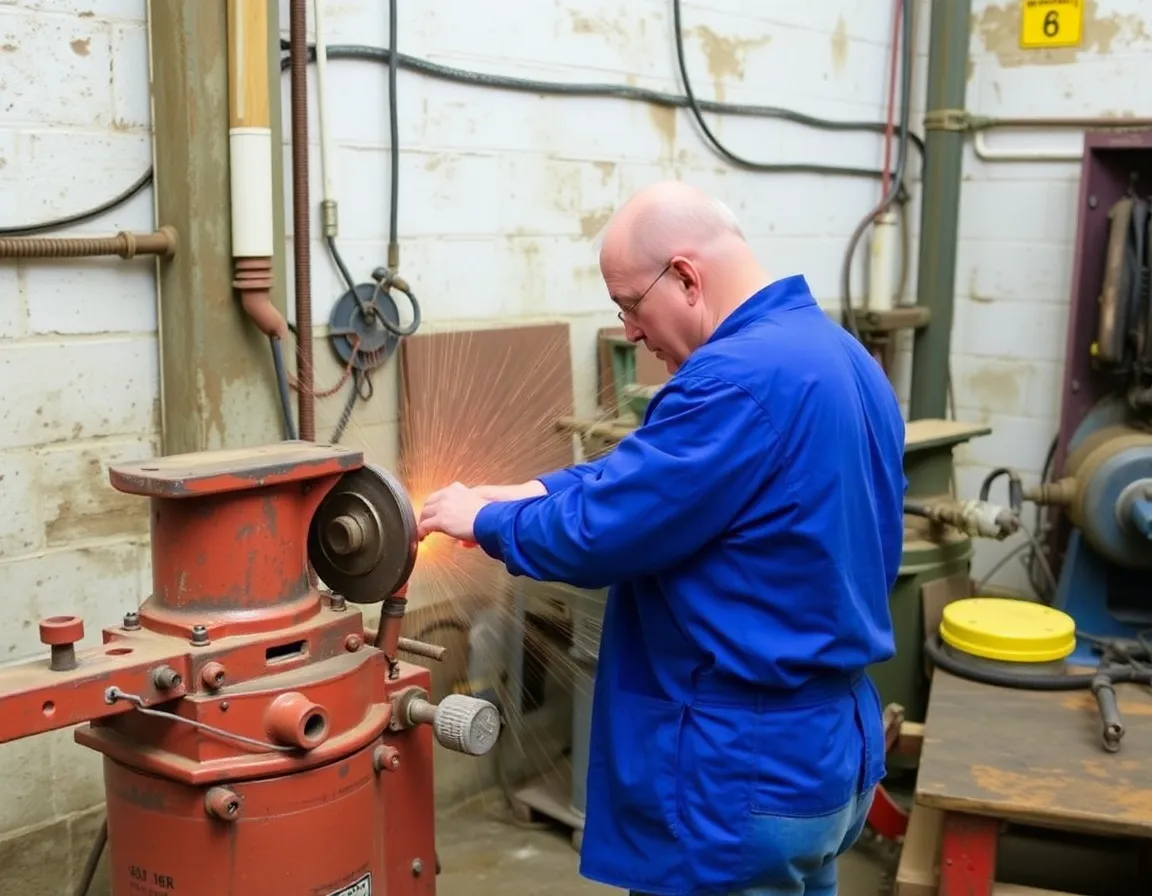
Grinding is an abrasive machining process that uses a rotating wheel composed of abrasive grains (like aluminum oxide or silicon carbide) held together by a bonding material. Material removal occurs via the shear and ploughing action of countless individual, microscopic cutting edges on the abrasive grains. It is a multi-point cutting process known for its ability to achieve:
- Extremely fine surface finishes (Ra values below 0.4 µm).
- Exceptional geometrical accuracy (roundness, cylindricity).
- Precise size control on very hard materials.
Grinding requires specialized machines (cylindrical, centerless, surface grinders) and often involves the use of cutting fluids for cooling and lubrication.
The Head-to-Head Comparison: Advantages and Limitations
Choosing between hard turning and grinding requires weighing their respective strengths and weaknesses against your specific project requirements.
Advantages of Hard Turning
Flexibility and Set-up Time: Hard turning is significantly more flexible. Changing a turning insert or modifying a CNC program is far quicker than dressing a grinding wheel or setting up a complex grinding fixture. This makes it ideal for smaller batch sizes and just-in-time production.
Process Consolidation: This is perhaps hard turning's greatest strength. Multiple operations (facing, turning, grooving, profiling, chamfering) can often be completed in a single setup on one machine. Grinding typically requires multiple setups or machines to achieve the same geometry.
Dry Machining Potential: Hard turning can frequently be performed dry or with minimal coolant (near-dry machining). This eliminates the cost and environmental impact of coolant purchase, maintenance, and disposal, aligning with green manufacturing initiatives.
Material Removal Rate (MRR): Hard turning generally offers a higher metal removal rate than grinding, leading to shorter cycle times for many parts, especially those with moderate stock allowances.
Capital and Operating Costs: A modern CNC lathe capable of hard turning is often a lower capital investment than a high-precision grinding machine. Floor space requirements and overall energy consumption can also be lower.
Advantages of Grinding
Surface Finish and Integrity: Grinding remains the undisputed champion for achieving the very finest surface finishes. It can consistently produce Ra values that are difficult or impossible to reach with hard turning, which is critical for applications like hydraulic rods or high-performance bearing races.
Geometrical Accuracy: For achieving the ultimate in roundness, straightness, or size control on hardened materials, precision grinding is often the more reliable and predictable process, especially for very long or thin components prone to deflection.
Versatilidade de Materiais: While hard turning is limited to ferrous materials (hardened steels, cast irons), grinding can efficiently process a vast array of materials, including hardened steels, ceramics, glass, and composites.
Process Stability on Thin Walls: The lower cutting forces in grinding make it the preferred choice for machining delicate, thin-walled hardened components where the pressure from a single-point tool might cause distortion.
Consistency in High-Volume Production: For extremely high-volume runs of a single, simple geometry (e.g., bearing rings), dedicated grinding machines can offer unbeatable consistency and throughput.
Strategic Application and Best Practices
The decision is rarely absolute. The most successful manufacturers leverage a deep understanding of both processes to select the optimal one—or even combine them.
When to Choose Hard Turning Services
- Geometrias Complexas: Parts with multiple diameters, contours, grooves, and forms in a single setup.
- Low to Medium Batch Sizes: Where setup time and flexibility are critical cost drivers.
- Near-Net-Shape Components: When stock allowance is minimal (typically 0.1mm to 0.5mm per side).
- Environmental & Coolant-Conscious Production: For shops aiming to reduce their coolant footprint.
- Consolidated Machining: When aiming to perform "done-in-one" machining to reduce part handling and throughput time.
Common Applications: Automotive transmission components (gears, shafts), hydraulic pistons, tool holders, die inserts, and bearing rings where the highest possible finish is not the sole criterion.
When to Choose Grinding
- Superior Surface Finish is Mandatory: Applications involving fluid dynamics, high-speed rotation, or extreme wear resistance.
- Ultimate Dimensional Precision: For gauge masters, fuel injection components, or aerospace bearings requiring sub-micron tolerances.
- Hard, Non-Ferrous Materials: Machining hardened tool steels with high vanadium content, ceramics, or carbides.
- High-Volume, Simple Geometry: Mass production of pins, shafts, or rollers.
- Thin-Walled or Delicate Parts: Where cutting force must be absolutely minimized.
The Hybrid Approach: The Best of Both Worlds
A sophisticated and increasingly common strategy is to use hard turning and grinding in tandem. Hard turning serves as the primary stock removal process, quickly and efficiently machining the component to near-final dimensions and geometry. This is followed by a light finishing grind—often with minimal stock removal—to achieve the final, impeccable surface finish and nanometer-level accuracy. This hybrid approach maximizes productivity by leveraging the speed of turning and the finishing capability of grinding, often resulting in the lowest total cost per part for high-precision applications.
The Verdict: It's About Optimal Value, Not a Winner
Asking whether hard turning is "better" than grinding is like asking if a hammer is better than a screwdriver. The tool must match the task. Hard turning has irrevocably changed the landscape of precision machining by offering a faster, more flexible, and often more cost-effective solution for a wide range of hardened components. It has democratized precision turning, allowing job shops and large manufacturers alike to produce complex hardened parts efficiently.
However, grinding maintains its sovereign territory where the absolute pinnacle of surface quality, geometrical perfection, or specific material challenges are concerned. The evolution of serviços de torneamento duro has not rendered grinding obsolete; rather, it has provided the manufacturing world with a powerful complementary technology.
The most informed decision comes from a detailed analysis of the part print (tolerances, finish, geometry), production volume, available equipment, and total cost considerations. Partnering with an experienced hard turning service provider who also understands the capabilities of grinding can be invaluable. They can conduct feasibility studies, recommend the optimal process route, and deliver components that meet not just the specification, but do so in the most economically and technically efficient manner possible. In the modern manufacturing arena, the real victory lies in knowing when to use each of these exceptional processes to its fullest potential.