Beyond the Flatlands: Introducing 4th Axis CNC Milling
In the realm of precision manufacturing, the quest to create more complex, intricate, and functional parts in a single setup is relentless. While 3-axis CNC milling machines are the undisputed workhorses of the industry, they have a fundamental limitation: they primarily work on three orthogonal planes (X, Y, and Z). To machine features on multiple sides of a part, an operator must stop the machine, manually re-fixture the workpiece, and re-establish zero points—a process prone to errors and time consumption. Enter the 4th axis CNC milling machine , a transformative technology that adds a rotational axis, unlocking the ability to create sophisticated geometries with remarkable efficiency and precision. This article delves into how 4-axis CNC makes complex parts simple.
What is 4-Axis CNC Milling? The Core Concept
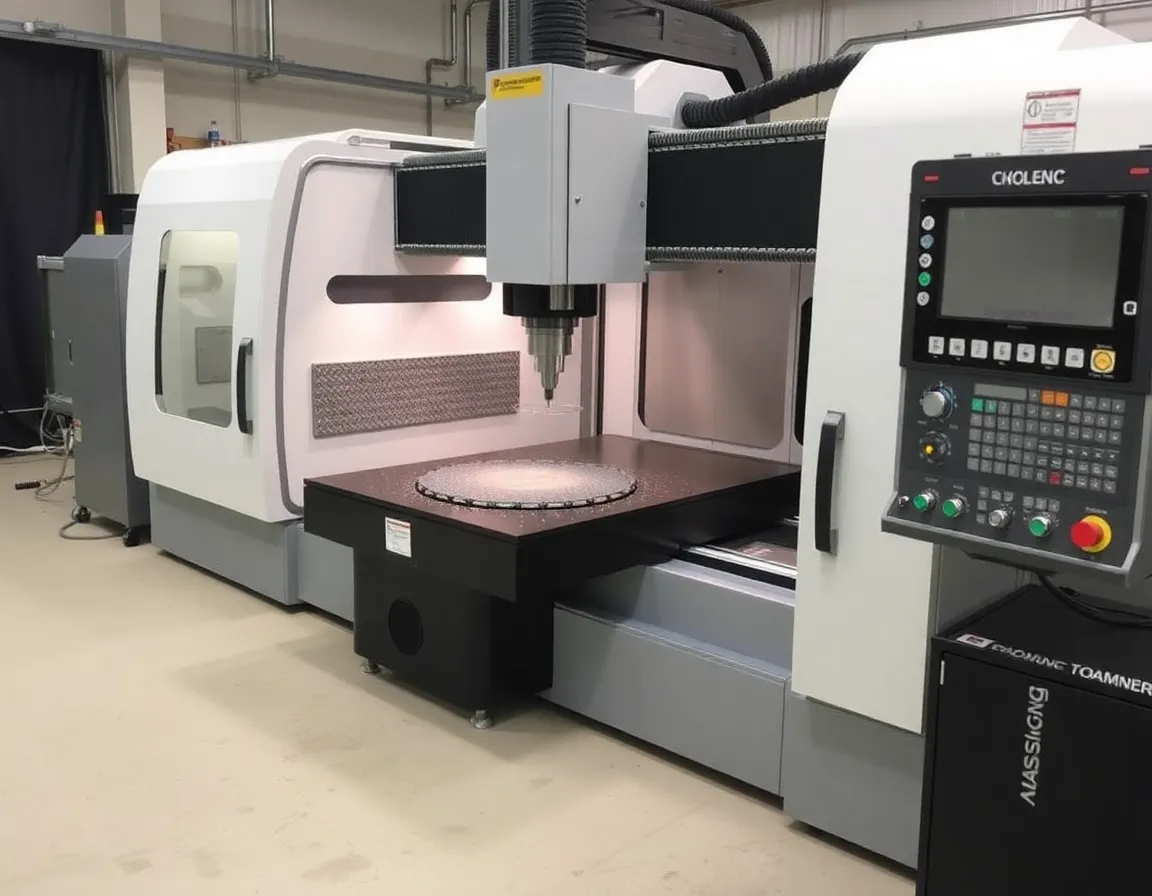
At its heart, a 4-axis CNC milling machine incorporates all the movements of a standard 3-axis machine (left-right, forward-back, up-down) and adds a fourth: rotation around a linear axis, typically the X-axis. This rotary axis is commonly referred to as the A-axis. The workpiece is mounted on a specialized rotary table or trunnion, which is integrated into the machine bed and controlled by the CNC program. This allows the spindle to access multiple sides of the part—or even its entire circumference—without manual intervention.
How the 4th Axis Works: The Rotary Table
The 4th axis is not just a simple turntable. It is a precision-engineered component with its own servo motor, capable of indexing (rotating to precise angles) and continuous rotation synchronized with the other three axes. This synchronization is key. In indexing mode, the machine rotates the part to a specific angle, locks it in place, and then performs 3-axis milling operations. This is perfect for machining features on different faces, like drilling holes on four sides of a block. Incontinuous 4-axis machining, the A-axis rotates simultaneously while the X, Y, and Z axes move, allowing the tool to cut complex contours, helixes, and cam profiles directly onto a cylindrical surface.
Types of 4th Axis Configurations
There are two primary configurations for adding a 4th axis:
- Rotary Table Mounted on the Machine Bed: This is a common add-on for existing 3-axis mills. The table sits on the machine's bed, and the workpiece is clamped to it. It's versatile but may have limitations in workpiece size and rigidity.
- Integrated Trunnion Table:Often found in more advanced machining centers, the trunnion is built into the machine. It typically provides superior rigidity, higher precision, and sometimes even a 5th axis (tilting) in a single unit, making it a powerhouse for complex work.
The Transformative Benefits: Why Move to 4 Axes?
Upgrading to or utilizing a 4-axis CNC machine offers a compelling array of advantages that directly translate to better parts, lower costs, and faster turnaround times.
Unmatched Efficiency & Reduced Setup Time
The most immediate benefit is the drastic reduction in setup changes. A single fixture on the rotary table can expose all sides of a part to the cutting tool. This eliminates the hours spent re-fixturing, re-indicating, and re-probing, slashing total job time and minimizing human error.
Enhanced Precision and Accuracy
Every time a part is moved and re-clamped, you introduce the potential for misalignment and cumulative error—known as tolerance stacking. By machining multiple features in one setup, you ensure that all geometries are machined relative to a single datum. This guarantees exceptional positional accuracy between features on different faces, which is critical for assemblies and high-tolerance components.
Capacidade de Usinar Geometrias Complexas
This is where 4-axis machining truly shines. It enables the creation of parts that are simply impossible or prohibitively expensive to make on a 3-axis machine. This includes:
- Continuous 3D Contours on Cylinders: Engraving, fluting, and machining organic shapes around a diameter.
- Helical Features:Like threads, worm gears, and long helical cooling channels in molds.
- Angled Features & Compound Angles:Drilling holes or machining pockets at precise angles without special fixtures.
- Camshafts and Eccentric Parts:Where the profile varies around a central axis.
Improved Surface Finish
Continuous 4-axis motion allows for smoother toolpaths over curved surfaces. Instead of a series of stepped, faceted cuts (as might be approximated on a 3-axis), the tool can maintain optimal engagement and follow the true contour, resulting in a superior surface finish that often requires less post-processing.
Real-World Applications: Where 4-Axis Excels
The versatility of 4-axis CNC milling makes it indispensable across numerous industries. Here are some prominent examples:
Aeroespacial e Defesa
From complex structural brackets with lightening pockets on multiple sides to engine components, housings, and missile guidance parts. The ability to machine intricate features from a solid block of aluminum or titanium in one setup is invaluable for these high-strength, low-weight components.
Automotive & Motorsports
Used for prototyping cylinder heads, machining intake manifolds, creating custom wheels, and producing high-performance parts like uprights and suspension components. The speed and precision are critical in both production and fast-paced racing development.
Fabricação de Dispositivos Médicos
The medical field demands extreme precision and complex biocompatible parts. 4-axis machines are perfect for producing orthopedic implants (bone plates, spinal devices), surgical instrument handles, and dental abutments with intricate biological contours.
Mold & Die Making
Creating complex injection molds or die-casting dies often requires texturing, cooling channels, and intricate core/cavity details on curved surfaces. 4-axis machining allows mold makers to create these features efficiently, reducing lead times for mold production.
General Engineering & Prototyping
Any shop dealing with enclosures, manifolds, gears, or artistic sculptures benefits from 4-axis capabilities. It dramatically expands the design freedom for engineers and designers, allowing them to prototype functional parts that closely match final production intent.
Best Practices for Successful 4-Axis Machining
Harnessing the full power of the 4th axis requires a shift in both programming and setup strategy.
Strategic CAM Programming
Effective 4-axis work is entirely dependent on advanced CAM (Computer-Aided Manufacturing) software. Programmers must be skilled in:
- Defining the Rotary Axis Correctly: Accurately setting the centerline of rotation in the software is paramount.
- Choosing the Right Toolpaths:Utilizing specialized 4-axis wrapping, indexing, and continuous contouring toolpaths.
- Managing Tool Orientation & Collision Avoidance:The software must simulate the full range of motion to prevent the tool, holder, or spindle from crashing into the part or rotary table.
Workholding is Paramount
The rotary table is only as good as the fixture holding the part. The setup must be exceptionally rigid to withstand cutting forces from multiple directions. Using dedicated tombstones, vises designed for rotary tables, and custom fixtures is common. Properly balancing the workpiece mass around the axis of rotation can also improve performance and accuracy.
Understanding Machine Kinematics & Post-Processing
The CAM program generates generic toolpaths, but a post-processortranslates this into the specific G-code your machine understands. The post-processor must be correctly configured for your machine's 4th axis configuration (e.g., whether it rotates in degrees per minute or is synchronized with linear axes). A mismatch here will lead to catastrophic failure.
Start with Indexing
For shops new to 4-axis work, beginning with 3+1 axis machining(indexing) is a wise approach. It offers most of the setup and accuracy benefits with a programming and simulation complexity closer to 3-axis work. As expertise grows, moving into full continuous 4-axis machining becomes a natural progression.
Conclusion: A Gateway to Advanced Manufacturing
The integration of a 4th axis is not merely an incremental upgrade; it represents a fundamental shift in machining capability. It bridges the gap between the ubiquitous 3-axis mill and the ultra-complex, five-axis world. By making it simple to produce parts with multi-sided features and wrapped contours in a single setup, 4-axis CNC milling delivers tangible, bottom-line results: reduced labor, faster throughput, superior accuracy, and expanded design possibilities. For any machine shop looking to tackle more complex work, increase competitiveness, and future-proof their operations, unlocking the potential of the 4th axis is not just an option—it's a strategic imperative. The complex part that once required multiple setups, specialized fixtures, and anxious quality checks can now be machined simply, elegantly, and autonomously.