
Quando seus componentes críticos exigem precisão em nível de mícron, serviços de retificação de precisão tornam-se a etapa final e mais decisiva do seu processo de fabricação. A escolha errada pode custar semanas de retrabalho, milhares em peças descartadas e, em última análise, prejudicar o relacionamento com seus clientes. Este guia ajuda você a navegar pelo processo de seleção—focando não na oficina mais próxima, mas no parceiro mais bem equipado para entregar qualidade consistente e certificável em escala.
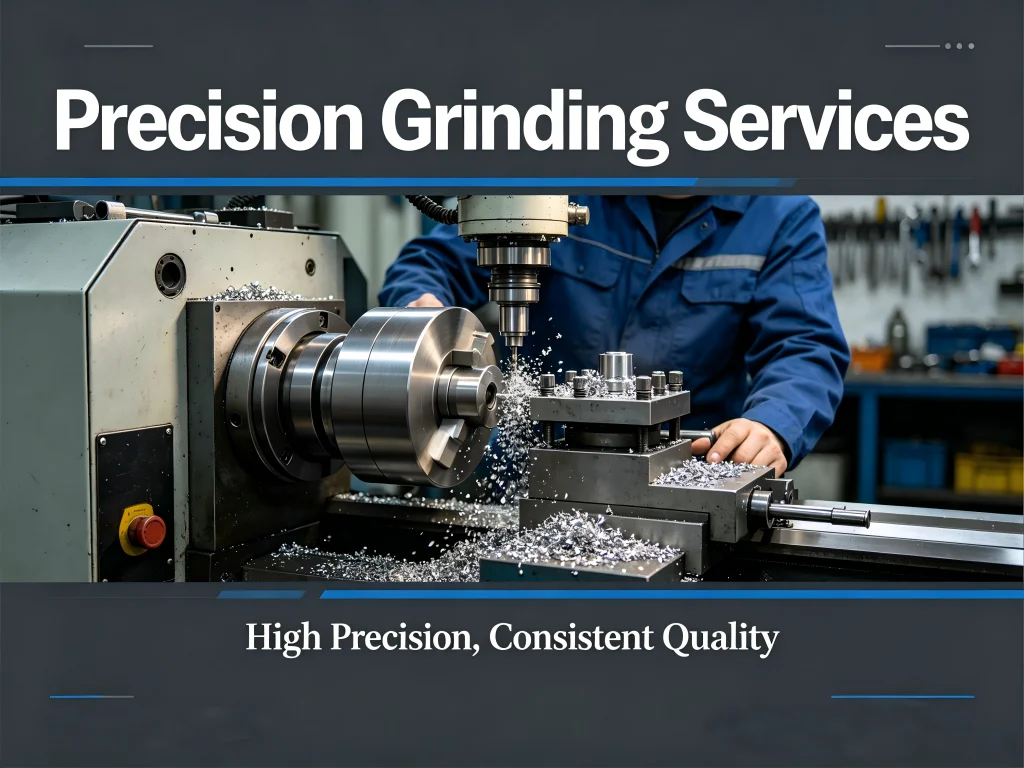
O Que Você Vai Aprender Neste Guia
- O que a retificação de precisão realmente significa
- As métricas que separam o bom do excelente
- 8 fatores críticos para escolher um parceiro de retificação
- Como os principais fornecedores se comparam (com dados)
- Por que a Jucheng oferece vantagens mensuráveis
- Respostas às perguntas que os compradores realmente fazem
O Que São Serviços de Retificação de Precisão? (E Por Que Precisão Não É Apenas Um Número)
Serviços de retificação de precisão utilizam máquinas de controle numérico computadorizado (CNC) com rebolos abrasivos rotativos para remover material com precisão excepcional—frequentemente alcançando tolerâncias dentro de mícrons (µm) ou décimos de milésimo de polegada (0,0001″). Diferentemente da retificação manual, a automação CNC possibilita geometrias complexas, repetibilidade perfeita em milhares de peças e integração perfeita com sistemas de carregamento automatizados para produção em alto volume.
Mas aqui está o que muitos compradores não percebem: precisão não é um único número. Como os especialistas do setor enfatizam, precisão é o efeito combinado da capacidade da máquina, comportamento do fuso, fixação da peça, ferramental, controle de processo, ambiente e medição. Você pode manter a dimensão perfeitamente e ainda falhar na cilindricidade. Você pode atingir a planicidade mas errar no acabamento superficial.
Para gerentes de engenharia e profissionais de compras em busca de serviços de retificação de precisão perto de mim, a verdadeira questão não deve ser sobre proximidade — deve ser sobre capacidade, consistência e certificação. Um fornecedor que consegue manter de forma confiável ±0,005 mm em aço endurecido, ao mesmo tempo que entrega 98%+ de rendimento na primeira passagem, irá atendê-lo melhor do que a oficina ao virar da esquina que tem dificuldades com estabilidade térmica.
Que Tipo de Retificação o Seu Projeto Requer?
Diferentes geometrias de peças exigem diferentes métodos de retificação. Compreender esta taxonomia ajuda-o a fazer as perguntas certas antes de solicitar orçamentos.
| Tipo de Retificação | Melhor Para | Tolerância Típica | Aplicações Comuns |
|---|---|---|---|
| Retificação Plana | Superfícies planas, faces paralelas, blocos quadrados | ±0,005 mm | Bases de máquinas-ferramenta, blocos-padrão, conjuntos de matrizes, dispositivos de precisão |
| Retificação Cilíndrica (OD/ID) | Superfícies externas ou internas redondas | ±0,002–0,01 mm | Eixos, pistas de rolamentos, buchas, componentes hidráulicos |
| Retificação Sem Centros | Peças cilíndricas de alto volume sem centros | ±0,005–0,01 mm | Barras, hastes de válvulas, pinos de pistão, fixadores |
| Retificação por coordenadas | Formas complexas, furos precisos, acabamento de moldes | ±0,002–0,005 mm | Machos de moldes, matrizes, furos de precisão com tolerâncias de localização rigorosas |
| Retificação interna | Furos e perfis internos | ±0,005–0,01 mm | Furos de cilindros hidráulicos, diâmetros internos de rolamentos, cavidades de implantes |
Muitas oficinas são especializadas em um ou dois métodos. Um parceiro verdadeiramente capacitado, no entanto, mantém experiência em todos os principais tipos de retificação — oferecendo a você uma fonte única para diversos requisitos de projeto.
As métricas que realmente importam: além das alegações de marketing
Qualquer fornecedor de retificação pode alegar “alta precisão”. Seu trabalho é verificar. Aqui estão os parâmetros quantificáveis que separam a capacidade legítima das promessas vazias.
Acabamento Superficial (Ra)
A fresagem ou torneamento padrão normalmente alcança 125–32 micropolegadas Ra. Serviços de retificação de superfície de precisão should reach 32 down to 4 microinches Ra—and top-tier providers can achieve Ra 0.05–0.4 µm (2–16 µin) for ultra-fine finishes that extend component lifespan. One medical device manufacturer reduced revision cycles by 40% after switching to a vendor that consistently held Ra 0.4 µm on titanium implants.
Tolerância Dimensional
Para precision grinding companies serving aerospace or medical industries, ±0.005 mm (5 microns) is the baseline. Leading firms hold ±0.002 mm on internal diameters and ±0.001 mm flatness on critical surfaces. Diamond Grinding Services Ltd, for instance, maintains ±0.005mm tolerances on hardened steel as a standard benchmark.
First-Pass Yield
This metric tells you how often parts meet specifications without rework. Regional competitors average around 86–87%. Top performers like Badger‘s Grinding Services achieve 98.7% first-pass yield, outperforming local alternatives by 12%. A 12% difference in scrap rate translates directly to your bottom line.
Geometric Consistency (Roundness, Cylindricity, Flatness)
Many shops focus solely on diameter tolerance. But form error matters just as much. When roundness or cylindricity must stay within 2–3 µm, grinding is the safer choice over hard turning, regardless of economics.
8 Critical Factors for Choosing Precision Grinding Services
Whether you are searching for precision grinding companies near me or considering global partners, these eight evaluation criteria will guide your decision.
1. Technical Capability Alignment
Start with your part print. What are the required tolerances? Surface finish? Material hardness? For surface grinding, ensure the vendor’s equipment delivers sub-0.002 mm accuracy with spindle power exceeding 1.5 kW. For tool re-sharpening applications, demand 4–5 axis CNC control with automatic tool detection. And always request documented test results showing surface roughness (Ra ≤0.8 μm) and thermal stability over extended cycles.
2. Production Scale and Capacity Redundancy
Local shops often lack the equipment redundancy to handle medium-to-large batch production or sudden demand spikes. Jucheng, by contrast, operates an 8,000 sq.ft. facility with over 150 CNC machines, ensuring uninterrupted production capacity even for high-demand projects. One aerospace client reduced lead time from 14 days to 4 days after switching to a partner with scalable infrastructure.
3. Quality Certifications
For B2B buyers, certification acts as a global quality stamp. ISO 9001:2015 establishes the foundation—consistent quality, documented procedures, risk management, and continuous improvement. For aerospace work, AS9100D is the gold standard, expanding on ISO 9001 to address the uniquely demanding nature of flight-critical components. Medical projects require ISO 13485. Automotive demands IATF 16949. Jucheng maintains ISO9001:2015, ISO 14001, ISO13485 (Medical), and IATF16949 (Automotive)—certifications many local shops simply cannot provide.
4. Inspection and Measurement Capabilities
“What gets measured gets managed.” Leading precision grinding companies use Coordinate Measuring Machines (CMM), optical projectors, surface roughness testers, and spectrometers for material verification. Jucheng maintains a 99.8% product qualification rate through advanced inspection equipment. Always ask: do they perform in-process measurement or only final inspection? In-process gauging catches errors before they become scrap.
5. Material Versatility and Stock Availability
If your vendor must order material after you place your order, you will wait. The best partners maintain extensive in-house material inventories. Jucheng stocks aluminum, stainless steel, mild steel, alloy steel, tool steel, and engineering plastics including PEEK, PTFE, and glass-filled nylon for immediate prototyping and production.
6. Lead Time and Delivery Reliability
On-time delivery rates above 90% reflect supply chain discipline. Response times under three hours indicate active customer management. Reddit discussions frequently highlight the trade-off between speed and accuracy. As one CNC machinist noted: “Their techs are wizards, but spell out your specs—assumptions cost us a week”. Clear communication upfront prevents schedule slippage.
7. Secondary and Finishing Capabilities
A partner who can handle grinding plus heat treating, anodizing, plating, or painting eliminates the need to ship parts between vendors. This saves time and guarantees finish quality. Jucheng provides in-house post-treatment including anodizing, electroplating, and painting, alongside complementary services like EDM, wire cutting, and sheet metal fabrication.
8. Cost Structure and Transparency
Low hourly rates often hide costs: rework fees, expediting charges, material markup. Request full transparency on pricing models. Some vendors offer tiered pricing for volumes above 500 units where economies of scale kick in sharply. Always request a pre-production sample run—the design for manufacturing (DFM) feedback alone often proves worth the cost.
How Leading Precision Grinding Vendors Compare
Based on industry data from QYResearch, the global precision surface grinding services market is projected to grow from $2.47 billion in 2024 to $4.35 billion by 2031, at a CAGR of 8.4%. Here is how key players stack up.
| Vendor Type | Tolerância Típica | Certificações | Capacity | Melhor Para |
|---|---|---|---|---|
| Local Job Shops | ±0.01–0.02 mm | Often limited or none | 1–10 machines | Small batches, prototypes, quick local turnaround |
| Regional Specialists | ±0,005–0,01 mm | ISO 9001 possibly | 10–30 machines | Mid-volume production, one grinding type |
| Global Leaders (UNITED GRINDING, Xometry) | ±0,002–0,005 mm | ISO 9001, AS9100 | 50–200+ machines | High-volume, multi-site, premium pricing |
| Jucheng Precision | ±0,002–0,005 mm | ISO 9001, 14001, 13485, IATF 16949 | 150+ máquinas CNC | High-volume, complex geometries, one-stop solution at competitive cost |
The key insight: Jucheng delivers global-leader capabilities (5-axis machining, full certifications, multi-material expertise) at cost structures that undercut Western competitors by 30–50%—without compromising quality or delivery reliability.
Why Jucheng Precision Should Be Your First Call for Precision Grinding Services
When engineering managers and procurement professionals search for precision grinding companies that combine scale, certification, and cost-effectiveness, Jucheng emerges as the clear choice.
Unmatched Production Capacity
With an 8,000 sq.ft. facility housing over 150 CNC machines—including 25 high-precision 5-axis Haas and Mazak systems—Jucheng handles projects that overwhelm smaller shops. This scale ensures redundancy, faster turnaround, and the ability to absorb demand spikes without schedule disruption. Jucheng has delivered highly complex parts in as fast as 4 days.
Comprehensive Grinding Capabilities
Beyond standard milling and turning, Jucheng offers full-spectrum grinding services: surface grinding, cylindrical grinding (OD/ID), centerless grinding, jig grinding, and contour grinding. This breadth means you never need to split a project across multiple vendors—a single point of accountability from prototype through production.
Globally Recognized Certifications
Jucheng adheres to ISO9001:2015, ISO 14001 (Environmental Management), ISO13485 (Medical Devices), and IATF16949 (Automotive). Advanced inspection equipment including CMM, spectrometers, and optical projectors maintains a verified 99.8% product qualification rate.
One-Stop Solution Under One Roof
Many precision grinding providers stop at grinding. Jucheng goes further: 3D printing, vacuum casting, sheet metal fabrication, EDM, wire cutting, and in-house finishing (anodizing, electroplating, painting). This integrated approach eliminates vendor coordination headaches and guarantees finish quality.
As one satisfied client noted: “Jucheng Precision offers superior CNC machining capabilities, global reach, and certified quality that local shops simply cannot match”.
Frequently Asked Questions About Precision Grinding Services
Q1: What is the typical lead time for precision grinding services?
For standard projects, most vendors quote 10–15 business days. However, shops with ample capacity and in-house material inventory can deliver in 4–7 days. Jucheng has completed complex parts in as little as 4 days when material is available. Always confirm lead times before placing orders, and factor in inspection and any secondary finishing steps.
Q2: How do I know if a precision grinding company is truly certified?
Ask for their certificate number and verify it on the registrar’s website (e.g., ISO.org). Genuine certifications are publicly verifiable. Red flags include vague claims like “we follow ISO standards” without actual certification, or reluctance to share audit reports. Jucheng provides full certification documentation upon request.
Q3: What is the difference between surface grinding and cylindrical grinding?
Surface grinding services produce flat, parallel surfaces on workpieces secured to a reciprocating or rotary table. Cylindrical grinding (OD/ID) machines external or internal surfaces of round parts, with the workpiece rotating against the grinding wheel. Choose surface grinding for blocks, plates, and gauge components. Choose cylindrical grinding for shafts, pins, bearings, and bushings.
Q4: Can precision grinding handle hardened steel above HRC 60?
Yes. Specialized grinding wheels (CBN or diamond abrasives) with proper coolant delivery effectively grind materials up to HRC 65. The key is controlling heat—excessive temperature causes thermal damage and micro-cracking. Jucheng uses cryogenic cooling and in-process gauging to maintain material integrity even on hardened tool steels and Inconel.
Q5: How much do precision grinding services typically cost?
Pricing varies by complexity, tolerance requirements, material, and volume. Simple surface grinding on aluminum might cost $50–100 per part in low volumes. Complex jig grinding on hardened steel with ±0.002 mm tolerance could exceed $500 per part. High-volume production reduces per-unit costs dramatically. Always request a detailed quote with line items for setup, machining, inspection, and finishing.
Q6: Do you offer precision grinding services for medical device components?
Yes. Jucheng holds ISO 13485 certification specifically for medical device manufacturing. We grind surgical instruments, implantable components, and prosthetic parts with ultra-fine surface finishes (Ra down to 0.1 μm) and complete traceability. All medical projects follow validated processes with documented quality records.
Q7: What is the minimum thickness or diameter you can grind?
For surface grinding, we handle parts as thin as 0.5 mm depending on material and geometry. For cylindrical grinding, minimum diameter is approximately 1 mm. Centerless grinding can process bar stock down to 0.5 mm diameter. Consult our engineering team for your specific application—we may recommend alternative processes for sub-millimeter work.
Q8: How do you ensure consistent quality across large production runs?
Through a combination of in-process measurement, statistical process control (SPC), and 100% inspection on critical dimensions. Jucheng‘s CMM and optical inspection systems verify every batch against your specifications. Our documented 99.8% product qualification rate provides confidence even for high-volume orders.
Make the Smart Choice for Your Next Precision Grinding Project
Selecionar o parceiro certo para serviços de retificação de precisão is not about finding the nearest shop. It is about finding the most capable partner—one with the scale, certification, technical expertise, and integrated capabilities to deliver consistent quality on time, every time.
Jucheng Precision combines the advantages of global manufacturing scale with localized service attention. Whether you need serviços de retificação de superfície for automotive components, cylindrical grinding for aerospace shafts, or complete one-stop manufacturing for medical devices, Jucheng has the equipment, certifications, and experience to exceed your expectations.
Ready to discuss your project? Contact Jucheng Precision today for a detailed quote and engineering consultation. Upload your CAD files, and our team will respond within 24 hours with feasibility feedback and pricing.
Visite nosso site: www.jccncmachining.com