
+86-188-7042-1176
project@jcproto.com
Mon-Fri: 8am-6pm (GMT+8)
EN
ISO 9001:2015 Certified
Glass Filled PTFE
Glass Filled PTFE (15% or 25%) incorporates high-quality glass fibers into the Teflon matrix to significantly improve its mechanical properties. This reinforced grade drastically reduces "cold flow" (creep) and increases compressive strength, making it much more reliable than virgin PTFE for high-load applications. Jucheng Precision specializes in the precision CNC machining of Glass Filled PTFE, utilizing diamond-coated tooling to overcome its abrasive nature. We deliver robust valve seats, gaskets, and industrial bearings that retain the exceptional chemical resistance of PTFE while providing the structural integrity required for high-pressure fluid systems and heavy machinery.
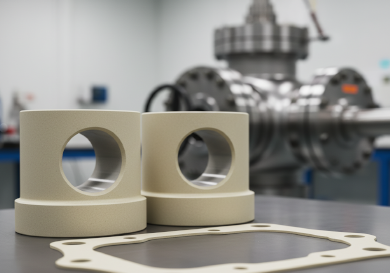
PTFE / Teflon Material Variants
| Grade | Common Name | Key Characteristics | Typical Applications |
|---|---|---|---|
| Glass Filled PTFE | Reinforced Teflon (15%/25%) | Significantly reduced “cold flow” (creep). Higher compressive strength and wear resistance. Off-white/Tan color. | Valve seats, gaskets, high-load bearings, bridge expansion plates. |
| Virgin PTFE | Pure Unfilled | Lowest friction and highest purity. Pure white. FDA compliant. | Medical components, chemical seals, electrical insulators. |
| Bronze Filled PTFE | Bearing Grade | Added bronze for maximum wear life and thermal conductivity. Best for heavy-duty sliding. | Hydraulic cylinder guides, piston rings. |
Glass Filled PTFE Machining Capabilities
| Capability | Technical Description | Jucheng Advantage |
|---|---|---|
| Abrasive-Resistant Turning | Glass fibers are abrasive to tools. We utilize specialized PCD (Diamond) or CVD-coated carbide inserts. | Ensures dimensional consistency over long production runs by preventing tool blunting and “size drift” on critical seal diameters. |
| Precision Valve Seat Milling | Milling complex sealing faces and spherical radii for industrial valve seats. | Our 5-axis machines achieve +/- 0.02mm accuracy, ensuring a perfect leak-proof seal against metal balls or butterfly gates. |
| Tight-Tolerance Boring | Boring internal diameters for high-load bushings with exceptional surface finish (Ra 0.8μm). | Jucheng’s rigid tool setups prevent the vibration-induced “chatter” marks often seen when machining reinforced polymers. |
| Custom Seal Profiling | CNC turning intricate lip profiles for reinforced gaskets that must operate under constant pressure. | Leveraging the stability of glass-filled stock, we produce sharp, crisp lip edges that outperform virgin PTFE in high-stress assemblies. |
Fabrication Guidelines for Glass Filled PTFE
Abrasiveness Management:
The 15% or 25% glass fiber content acts like a grinding wheel on standard tooling. Tip: We frequently inspect cutting edges under magnification to ensure the fibers are being sheared rather than torn, which ensures a smooth finish.
Creep Resistance Advantage:
Adding glass fiber reduces “cold flow” by up to 50% compared to virgin PTFE. Tip: This allows for tighter initial clearances in bearing designs, as the part will not deform as much under mechanical load.
Dimensional Stability:
Reinforced PTFE has a lower coefficient of thermal expansion than virgin material. Tip: This makes it easier to hold tight tolerances across varying workshop temperatures, though temperature control is still mandatory.
Non-Food Contact:
Unlike virgin PTFE, glass-filled grades are generally not used for direct food contact due to the fibers. Tip: We recommend this material strictly for industrial fluid handling and mechanical structural parts.
Primary Applications
Industrial Valves & Pumps
High-pressure valve seats, gaskets, and pump liners that must resist deformation and chemical attack.
Heavy Industry Bearings
Bushings and wear plates for bridge structures, heavy machinery, and industrial sliders where high compressive loads are present.
Hydraulics & Pneumatics
Reinforced backup rings and dynamic seals that prevent the extrusion of primary seals under high pressure.
Chemical Processing
Agitator bushings and pipe supports requiring a combination of low friction and structural rigidity in corrosive tanks.
Properties
| Density | 2.22 - 2.26 g/cm³ |
| Tensile Strength | 15 - 25 MPa |
| Coefficient of Friction | 0.10 - 0.20 |
| Hardness | 60 - 70 Shore D |
| Elongation at Break | 200 - 300% |
| Thermal Conductivity | 0.45 W/m-K |
| Continuous Service Temp | -200 to +260 °C |
| Water Absorption | < 0.02% |
| Creep Resistance | Superior |
| Machinability Rating | Moderate |
| Max Part Size | 2000 x 800 x 600 mm |