
+86-188-7042-1176
project@jcproto.com
Mon-Fri: 8am-6pm (GMT+8)
EN
ISO 9001:2015 Certified
Brass C46400
Brass C46400, widely known as "Naval Brass," is specifically engineered for exceptional durability in marine environments. By incorporating a small percentage of tin into the copper-zinc matrix, this alloy gains superior resistance to dezincification and saltwater corrosion. Jucheng Precision leverages advanced CNC machining to transform C46400 into robust marine shafts, fittings, and valve components. While tougher to process than standard free-cutting brass, our optimized tooling ensures high-strength parts with precision threads and smooth finishes, providing long-lasting performance in the most aggressive offshore and industrial applications.
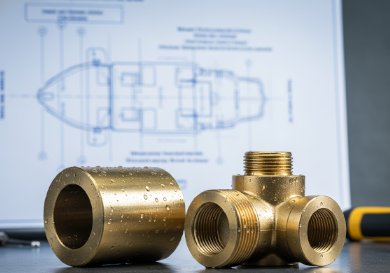
C46400 Machining Capabilities
| Capability | Technical Description | Jucheng Advantage |
|---|---|---|
| High-Torque Turning | C46400 is tougher than standard brass due to tin addition. We utilize high-rigidity CNC lathes to turn large marine shafts. | Ensures vibration-free machining of long propeller sleeves, maintaining perfect concentricity and diameter control. |
| Pressure-Tight Threading | Machining precise NPT and BSPP threads for marine valve bodies and pump components. | Jucheng guarantees leak-proof threads that withstand the high pressures found in underwater hydraulic systems. |
| Complex 4-Axis Milling | Milling slots, flats, and cross-holes in hexagonal or cylindrical naval brass billets. | Our 4-axis capability allows for the manufacturing of intricate marine fittings in fewer setups, reducing costs for our clients. |
| Fine Surface Finishing | Achieving smooth finishes (Ra 0.8μm) directly off the machine to minimize marine fouling. | Ensures that dynamic sealing surfaces in salt-water pumps perform reliably over long durations. |
Fabrication Guidelines for C46400 Naval Brass
Dezincification Resistance:
The defining feature of C46400 is the addition of Tin, which inhibits dezincification in saltwater. Tip: This makes it far superior to C360 for any submerged marine application.
Machinability Rating:
C46400 has a machinability rating of 30% compared to C36000. Tip: It is tougher and generates more heat. We use sharp carbide tools and high-flow coolant to manage temperatures.
Chip Breaking:
Unlike free-cutting brass, C46400 produces tougher, longer chips. Tip: We utilize specialized chip-breaking geometries to prevent chip wrapping on high-speed spindles.
Hot Formability:
Naval brass has excellent hot-working properties. Tip: It is ideal for parts that are hot-forged and then precision CNC machined to final dimensions.
Primary Applications
Marine Hardware
Propeller shafts, decorative boat trim, turnbuckles, and hull fittings exposed to harsh saltwater spray.
Fluid Control
Pump shafts, valve stems, and condenser plates for heat exchangers in power plants and desalination units.
Fastening Technology
Heavy-duty marine bolts, nuts, and rivets requiring high strength and resistance to marine environments.
Industrial Machinery
Bearings and bushings operating in wet or corrosive conditions where standard bronze might be too expensive.
Properties
| Density | 8.41 g/cm³ |
| Tensile Strength | 380 - 550 MPa |
| Yield Strength | 150 - 450 MPa |
| Hardness | 80 - 150 HB |
| Elongation at Break | 20 - 40% |
| Thermal Conductivity | 116 W/m-K |
| Electrical Conductivity | 26% IACS |
| Melting Point | 890 - 900 °C |
| Machinability Rating | 30% |
| Corrosion Resistance | Superior |
| Max Part Size | 2000 x 800 x 600 mm |