
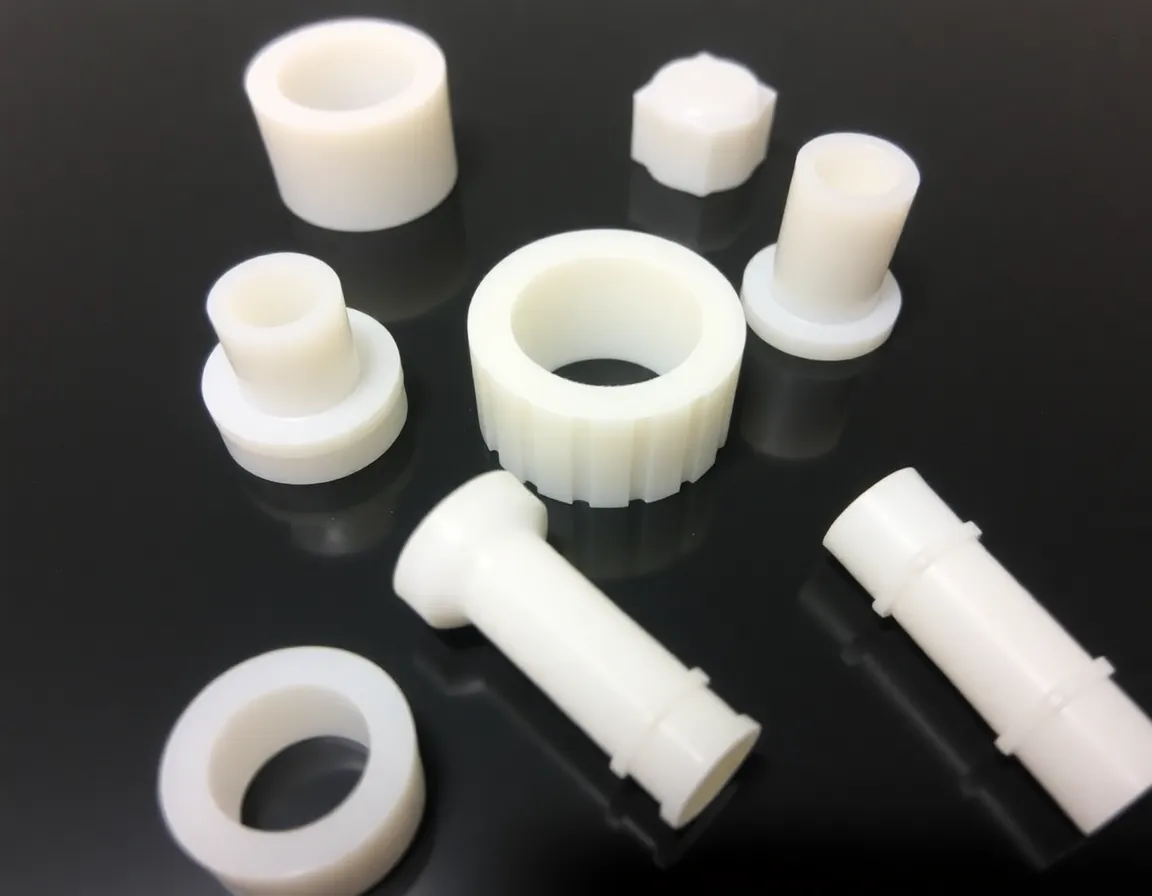
Introducción a los componentes plásticos mecanizados
En el panorama industrial moderno, la demanda de piezas de alto rendimiento, ligeras y resistentes a la corrosión ha impulsado un cambio significativo de los componentes metálicos tradicionales a las alternativas de plástico de ingeniería. Los componentes de plástico mecanizadosson piezas creadas mediante la eliminación de material de un bloque o barra de plástico sólido utilizando herramientas de corte de precisión, como fresadoras CNC, tornos y routers. A diferencia del moldeo por inyección o la impresión 3D, el mecanizado ofrece una precisión dimensional inigualable, un acabado superficial superior y la capacidad de producir geometrías complejas sin necesidad de utillaje costoso. Este proceso es esencial para industrias que abarcan desde la aeroespacial y los dispositivos médicos hasta el procesamiento de alimentos y la fabricación de semiconductores, donde la fiabilidad y la precisión no son negociables.
El mecanizado de plásticos aprovecha las propiedades únicas de los polímeros avanzados —como la resistencia química, el aislamiento eléctrico, la baja fricción y las altas relaciones resistencia-peso— para resolver desafíos de ingeniería que los metales no pueden abordar. Este artículo ofrece una exploración exhaustiva de los componentes plásticos mecanizados, abarcando los procesos fundamentales, la selección de materiales, los beneficios clave, las diversas aplicaciones y las mejores prácticas para lograr resultados óptimos.
Comprender el proceso de mecanizado de plásticos
El mecanizado de plásticos es una técnica de fabricación sustractiva que comienza con un bloque sólido de material termoplástico o termoestable. El proceso está altamente automatizado y a menudo utiliza maquinaria de Control Numérico por Computadora (CNC) para ejecutar movimientos precisos basados en un modelo digital 3D. Las etapas principales incluyen el diseño, la preparación del material, el corte y el acabado.
Fresado y torneado CNC
Fresado CNCutiliza herramientas de corte multicorte giratorias para eliminar material de una pieza de trabajo estacionaria. Esto es ideal para crear superficies planas, ranuras, bolsillos y contornos 3D intrincados. Para piezas cilíndricas,torneado CNC(utilizando un torno) gira la pieza de plástico mientras una herramienta de corte estacionaria le da forma, produciendo varillas, casquillos y componentes roscados. Ambos métodos dependen de una programación precisa de la trayectoria de la herramienta para evitar problemas comunes como fusión, astillado o deformación, que son específicos de los materiales plásticos.
Diferencias clave con el mecanizado de metales
Los plásticos se comportan de manera diferente a los metales bajo las fuerzas de corte. Tienen una conductividad térmica menor, lo que significa que el calor generado durante el corte no se disipa rápidamente, lo que provoca fusión localizada o engomado. Además, los plásticos son más elásticos y pueden deformarse bajo la presión de sujeción. Por lo tanto, los maquinistas deben usar:
- Herramientas de corte afiladas y pulidas para reducir la fricción y la acumulación de calor.
- Altas velocidades del husillo con velocidades de avance moderadaspara crear virutas limpias en lugar de embadurnar el material.
- Refrigerante o aire comprimidopara gestionar la temperatura y evacuar las virutas de manera efectiva.
- Fuerzas de sujeción ligeraspara evitar la distorsión de la pieza de trabajo.
Operaciones secundarias
Después del mecanizado primario, los componentes a menudo se someten a procesos secundarios como desbarbado (eliminación de bordes afilados), pulido (para claridad óptica) o roscado (para roscas internas). Algunas aplicaciones también requieren recocido, un ciclo controlado de calentamiento y enfriamiento, para aliviar las tensiones internas que pueden causar grietas o cambios dimensionales con el tiempo.
Selección de material: Elegir el plástico adecuado
The performance of a machined plastic component is heavily dependent on the base material. Engineers select polymers based on mechanical, thermal, chemical, and electrical requirements. Below are the most commonly used plastics for precision machining.
High-Performance Engineering Plastics
PEEK (poliéter éter cetona)is a premium thermoplastic known for exceptional strength, continuous service temperature up to 260°C, and resistance to harsh chemicals. It is used in aerospace brackets, medical implants, and semiconductor wafer handling equipment.PTFE (Polytetrafluoroethylene), or Teflon, offers the lowest coefficient of friction and outstanding chemical inertness, making it ideal for seals, gaskets, and non-stick surfaces.Acetal (POM)provides excellent dimensional stability, low moisture absorption, and high stiffness, commonly used for gears, bearings, and pump components.
Cost-Effective and General-Purpose Options
Nylon (PA6/PA66)is tough, wear-resistant, and easy to machine, though it absorbs moisture which can alter dimensions. It is widely used for bushings, rollers, and guide rails.Policarbonato (PC)offers high impact resistance and optical transparency, suitable for machine guards, lenses, and electrical enclosures.UHMWPE (Ultra-High Molecular Weight Polyethylene)is extremely abrasion-resistant and self-lubricating, perfect for conveyor components and food processing parts.
Specialty Materials for Unique Environments
For applications requiring flame retardancy, PVC (Policloruro de Vinilo)is a common choice.PVDF (Polyvinylidene Fluoride)excels in ultrapure water systems due to its low extractables.Torlon (PAI)maintains strength at very high temperatures and is used in automotive transmission components. The table of material properties is critical: machinists must consider not only the final use but also how the material responds to cutting, such as its tendency to string or chip.
Key Benefits of Machined Plastic Components
Choosing machined plastics over metals or other manufacturing methods offers distinct advantages that translate into better product performance and lower lifecycle costs.
Weight Reduction and Inertia Control
Plastics are significantly lighter than aluminum or steel—often 50% to 80% less dense. In applications like aerospace, robotics, and high-speed automation, reducing mass lowers energy consumption and reduces rotational inertia, allowing for faster acceleration and deceleration. This weight savings does not compromise strengthwhen using reinforced grades like glass-filled PEEK or carbon-filled Nylon.
Corrosion and Chemical Resistance
Unlike metals, plastics do not rust, oxidize, or corrode when exposed to moisture, acids, bases, or solvents. This makes them indispensable in chemical processing, marine environments, and medical sterilization equipment. PTFE and PVDFare particularly valued for their ability to withstand aggressive chemicals without degradation.
Electrical and Thermal Insulation
Most plastics are natural electrical insulators, preventing short circuits and signal interference in electronic assemblies. Materials like BakeliteyFR4 (glass epoxy)are machined into insulators, standoffs, and circuit board components. Additionally, plastics have low thermal conductivity, making them excellent for handles, knobs, and housings that must remain cool to the touch.
Design Flexibility and Rapid Prototyping
Machining allows for quick iteration without the lead time and cost of injection molding dies. Engineers can test multiple design variations in days, using the same material that will be used in production. Tight tolerances of +/- 0.001 inchesare achievable, and complex features like undercuts, thin walls, and sharp internal corners are possible without mold constraints.
Low Friction and Self-Lubrication
Many plastics, such as Acetal, Nylon, and UHMWPE, have inherent lubricity. This eliminates the need for external oils or greases in bearing and sliding applications, reducing maintenance and contamination risks. In food processing and cleanroom environments, this is a critical advantage.
Aplicaciones comunes en todas las industrias
Machined plastic components are found in virtually every sector where precision, durability, and material-specific properties are required.
Médico y sanitario
In the medical field, machined plastics are used for surgical instruments, prosthetics, and diagnostic equipment. PEEKis machined into spinal implants and dental abutments due to its biocompatibility and radiolucency (it does not interfere with X-rays).Ultem (PEI)is used for sterilization trays and surgical handles because it can withstand repeated autoclaving. The ability to produce custom, patient-specific parts with smooth surfaces that resist bacterial adhesion is invaluable.
Aeroespacial y Defensa
Aircraft interiors, satellite components, and drone parts benefit from the weight savings and flame resistance of machined plastics. Torlonis machined into bushings for landing gear and engine controls.PEEKreplaces metal in brackets and cable clamps, reducing fuel consumption. The materials also exhibit excellent fatigue resistance and dimensional stability across extreme temperature ranges.
Electrónica y semiconductores
In semiconductor fabrication, machined PTFEyPEEKcomponents are used for wafer handling, chemical delivery systems, and vacuum chamber parts. Their high purity and low outgassing prevent contamination of sensitive wafers.Static-dissipative plasticslike conductive Acetal are machined into test sockets and handling trays to protect electronic components from electrostatic discharge.
Food Processing and Packaging
FDA-approved materials like UHMWPEyAcetalare machined into conveyor chain guides, cutting boards, and scraper blades. These components are non-toxic, easy to clean, and resistant to food acids. Their self-lubricating nature eliminates the need for grease that could contaminate products.
Automotive and Industrial Machinery
Machined plastic gears, pulleys, and wear strips reduce noise and vibration compared to metal counterparts. Nailonis used for timing belt pulleys and cable guides, whileAcetalis machined into fuel system components and pump impellers. The low coefficient of friction extends the life of moving parts and reduces energy losses.
Best Practices for Designing and Machining Plastic Parts
To fully leverage the advantages of machined plastic components, engineers and machinists must adhere to specific design and process guidelines.
Design Considerations
- Avoid sharp internal corners: Plastics are notch-sensitive. Use generous radii (at least 0.02 inches) to reduce stress concentration and prevent cracking.
- Maintain uniform wall thickness:Variations in thickness can cause differential cooling and warping. If unavoidable, add gradual transitions.
- Incorporate draft angles:While not always necessary for machining, a slight taper (1-3 degrees) on deep pockets aids tool access and chip evacuation.
- Specify realistic tolerances:Plastics expand and contract with temperature and humidity. For critical dimensions, consider the material’s coefficient of thermal expansion and moisture absorption rate.
Machining Parameters
Successful plastic machining requires careful control of cutting variables. Use high spindle speeds (10,000-20,000 RPM)combined withlow feed ratesto produce fine chips. Employsingle-flute or two-flute end millswith a positive rake angle to shear material cleanly. For deep holes, use a peck drilling cycle to clear chips and prevent heat buildup.Always use coolant—either a water-miscible mist or compressed air—to keep the cutting zone below the material’s melting point.
Quality Assurance and Inspection
After machining, parts should be inspected for dimensional accuracy using coordinate measuring machines (CMM) or precision gauges. Visual inspection under magnification helps identify micro-cracks or burrs. For critical applications, non-destructive testinglike ultrasonic inspection can detect internal voids. It is also good practice to allow machined parts to “rest” for 24 hours at room temperature to stabilize before final measurement, especially for stress-relieved materials like Nylon.
Future Trends in Machined Plastic Components
The field of plastic machining is evolving with advances in material science and automation. Composite plasticsreinforced with carbon fiber, glass, or aramid are becoming more machinable, offering metal-like stiffness at a fraction of the weight.Hybrid manufacturingthat combines 3D printing of near-net shapes with final CNC machining is reducing waste and lead times. Additionally, the development ofbio-based and recyclable plasticsis enabling sustainable machining solutions for environmentally conscious industries. As CNC technology becomes more accessible, smaller businesses can now produce custom machined plastic components in-house, accelerating innovation from prototype to production.
In conclusion, machined plastic components represent a critical intersection of material science and precision engineering. Their ability to deliver high performance, customization, and cost efficiency makes them indispensable across a wide spectrum of modern industries. By understanding the nuances of material selection, machining processes, and design best practices, engineers can unlock the full potential of these versatile components, driving progress in technology, medicine, and manufacturing.