
This article follows contamination backward from the installed tool to material, design, machining, cleaning, inspection, and packaging. It avoids universal cleanliness or vacuum limits because acceptance must come from the equipment program and process environment.
Every Part Carries Two Specifications
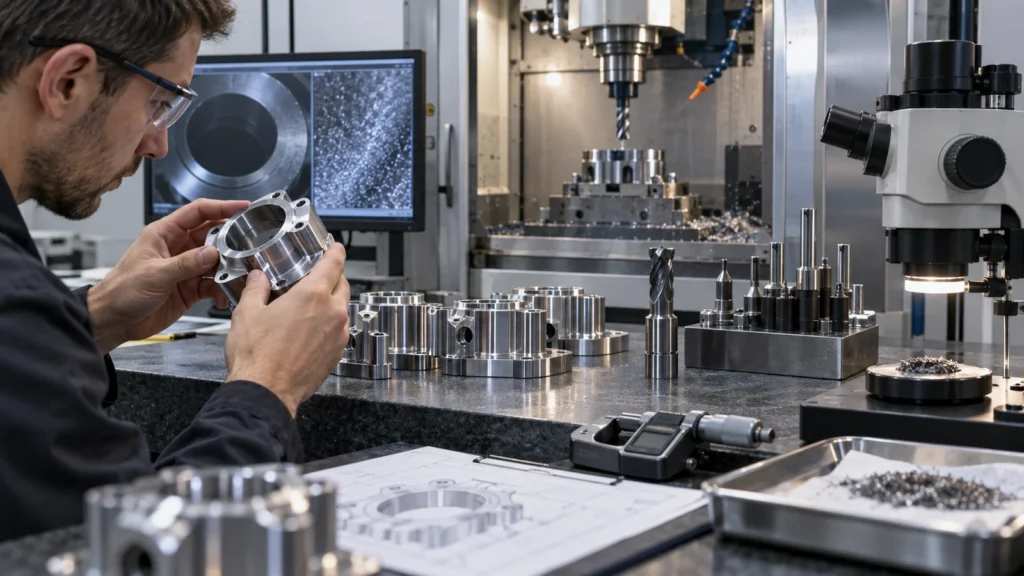 The geometry specification defines dimensions, datums, surface texture, threads, sealing interfaces, and fits. The product-condition specification defines material identity, surface chemistry, cleanliness, allowed residues, handling, packaging, and traceability. Both must be translated into supplier instructions.
A generic note such as “clean for semiconductor use” is not enough. Define the applicable customer standard, prohibited substances, cleaning validation, inspection method, packaging environment, and shelf or handling conditions. Requirements can differ between vacuum chamber, gas delivery, wet process, wafer handling, and external structural equipment.
The geometry specification defines dimensions, datums, surface texture, threads, sealing interfaces, and fits. The product-condition specification defines material identity, surface chemistry, cleanliness, allowed residues, handling, packaging, and traceability. Both must be translated into supplier instructions.
A generic note such as “clean for semiconductor use” is not enough. Define the applicable customer standard, prohibited substances, cleaning validation, inspection method, packaging environment, and shelf or handling conditions. Requirements can differ between vacuum chamber, gas delivery, wet process, wafer handling, and external structural equipment.
Build a Contamination Map Before Process Planning
List every stage that can add particles, films, ions, moisture, fibers, or cross-material residue: incoming stock, sawing, coolant, cutting tools, deburring, blasting, polishing, heat treatment, anodizing, passivation, inspection fixtures, washing, drying, gloves, bags, and transport.
| Source | Efecto potencial | Control question |
|---|---|---|
| Blind holes and threads | Trapped fluid or particles | Can they drain, flush, dry, and be inspected? |
| Shared media or tools | Cross-material contamination | Is segregation or dedicated media required? |
| Manual edge finishing | Loose burrs or embedded abrasive | What method and acceptance apply? |
| Packaging | Recontamination after release | Where and how is final bagging performed? |
Geometry Can Trap Process Residue and Gas
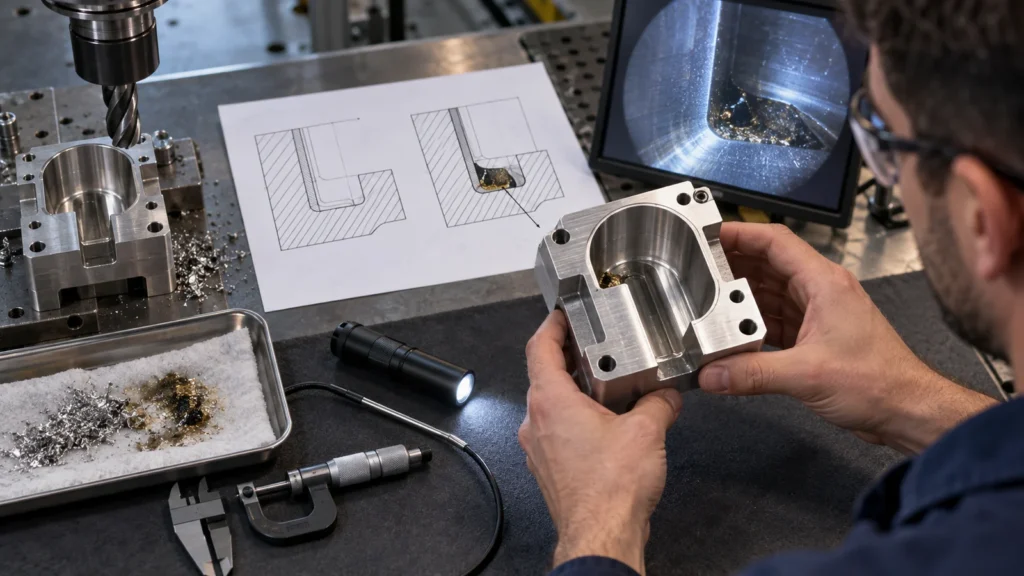 Blind tapped holes, overlapping passages, porous surface conditions, narrow crevices, and inaccessible cross-holes can be difficult to wash and dry. In vacuum duty, trapped volume or residue may appear as a leak-like load. Design review should consider venting, drain orientation, thread form, seals, welds, and cleanability.
Sealing faces need suitable flatness, texture, edge condition, and protection. A dimensionally correct scratch across a seal path can be functionally unacceptable. Identify sealing zones on the drawing and preserve them through finishing, inspection, and packaging.
Blind tapped holes, overlapping passages, porous surface conditions, narrow crevices, and inaccessible cross-holes can be difficult to wash and dry. In vacuum duty, trapped volume or residue may appear as a leak-like load. Design review should consider venting, drain orientation, thread form, seals, welds, and cleanability.
Sealing faces need suitable flatness, texture, edge condition, and protection. A dimensionally correct scratch across a seal path can be functionally unacceptable. Identify sealing zones on the drawing and preserve them through finishing, inspection, and packaging.
Material and Finish Compatibility Belong to the Process Environment
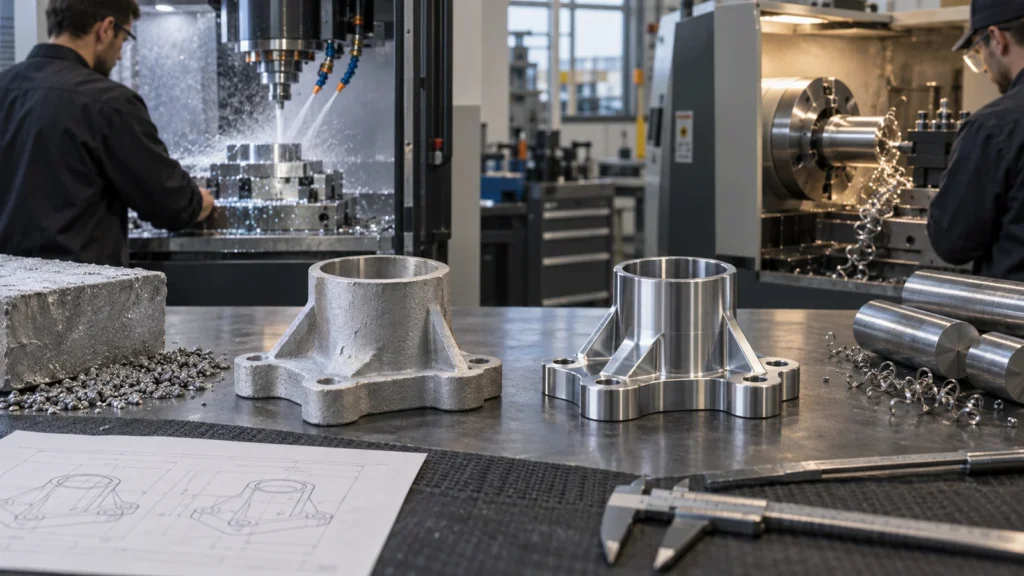 Aluminum, stainless steels, engineering plastics, copper alloys, and specialty materials may all appear in semiconductor equipment, but suitability depends on vacuum, plasma, chemical exposure, temperature, wear, and contamination limits. Specify grade, condition, certification, and any restricted substitutions.
Anodizing, electropolishing, passivation, plating, polishing, or specialty coatings can change corrosion, particle behavior, reflectivity, conductivity, and cleanability. Masking and contact marks must be controlled. Review finish thickness against fits and seal geometry through the CNC surface-finish .
Aluminum, stainless steels, engineering plastics, copper alloys, and specialty materials may all appear in semiconductor equipment, but suitability depends on vacuum, plasma, chemical exposure, temperature, wear, and contamination limits. Specify grade, condition, certification, and any restricted substitutions.
Anodizing, electropolishing, passivation, plating, polishing, or specialty coatings can change corrosion, particle behavior, reflectivity, conductivity, and cleanability. Masking and contact marks must be controlled. Review finish thickness against fits and seal geometry through the CNC surface-finish .
Machining Controls Begin Before the Wash
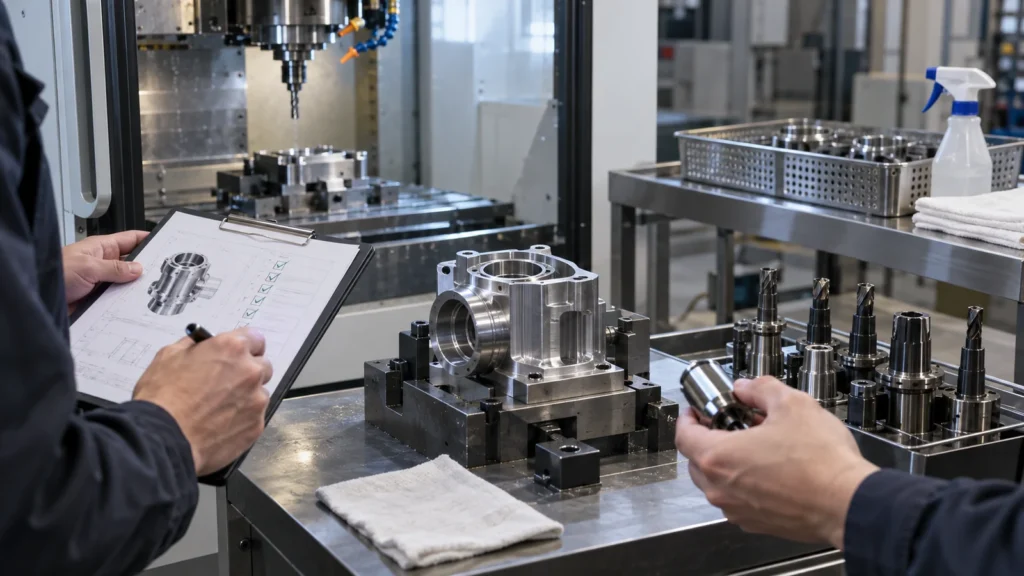 Cleaning cannot reliably repair every upstream problem. Prevent smeared burrs, embedded chips, damaged threads, inaccessible residue, and mixed-material debris during machining. Control tool condition, coolant quality, chip evacuation, handling surfaces, and deburring methods.
Large plates, chamber components, and thin vacuum parts may move with residual stress or clamping. Sequence roughing, relaxation, and finishing around functional datums. Protect finished sealing faces and avoid marker, adhesive, or handling materials prohibited by the program.
The applicable quality-control workflow should include product condition, not only final dimensions.
Cleaning cannot reliably repair every upstream problem. Prevent smeared burrs, embedded chips, damaged threads, inaccessible residue, and mixed-material debris during machining. Control tool condition, coolant quality, chip evacuation, handling surfaces, and deburring methods.
Large plates, chamber components, and thin vacuum parts may move with residual stress or clamping. Sequence roughing, relaxation, and finishing around functional datums. Protect finished sealing faces and avoid marker, adhesive, or handling materials prohibited by the program.
The applicable quality-control workflow should include product condition, not only final dimensions.
Clean, Inspect, and Pack as One Route
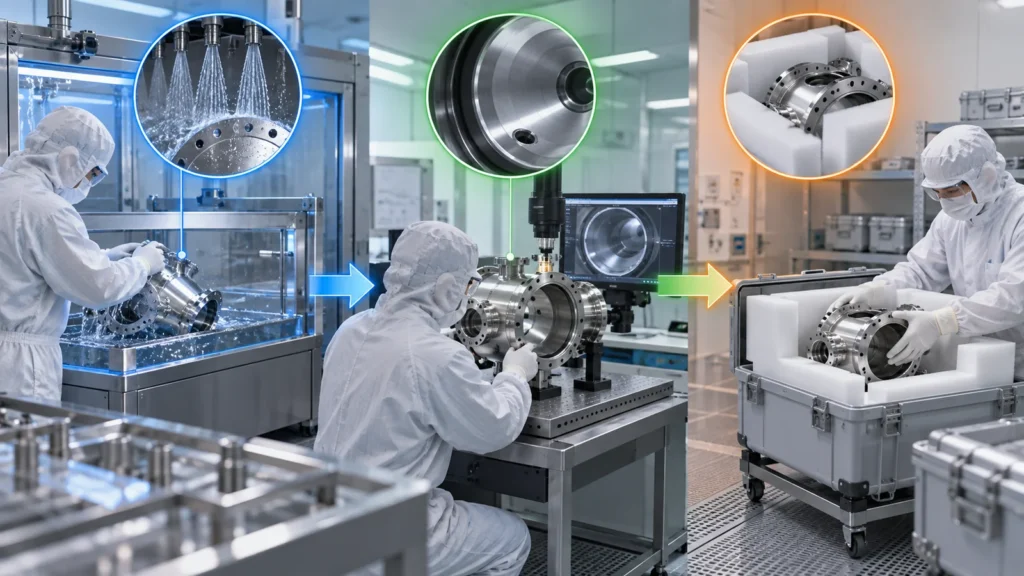 Define pre-clean preparation, chemistry, water quality if applicable, agitation or ultrasonic restrictions, rinse, drying, inspection, environmental controls, and packaging. Process order matters: some inspections can contaminate a cleaned surface, while some cleaning steps can alter markings or finishes.
Visual inspection needs agreed lighting, magnification, and defect criteria. Particle, residue, leak, or surface tests must follow the program’s defined method. Package immediately after release using approved materials and identification. A clean part placed on an uncontrolled bench is no longer in the same condition.
Define pre-clean preparation, chemistry, water quality if applicable, agitation or ultrasonic restrictions, rinse, drying, inspection, environmental controls, and packaging. Process order matters: some inspections can contaminate a cleaned surface, while some cleaning steps can alter markings or finishes.
Visual inspection needs agreed lighting, magnification, and defect criteria. Particle, residue, leak, or surface tests must follow the program’s defined method. Package immediately after release using approved materials and identification. A clean part placed on an uncontrolled bench is no longer in the same condition.
Documentation Preserves Product Status
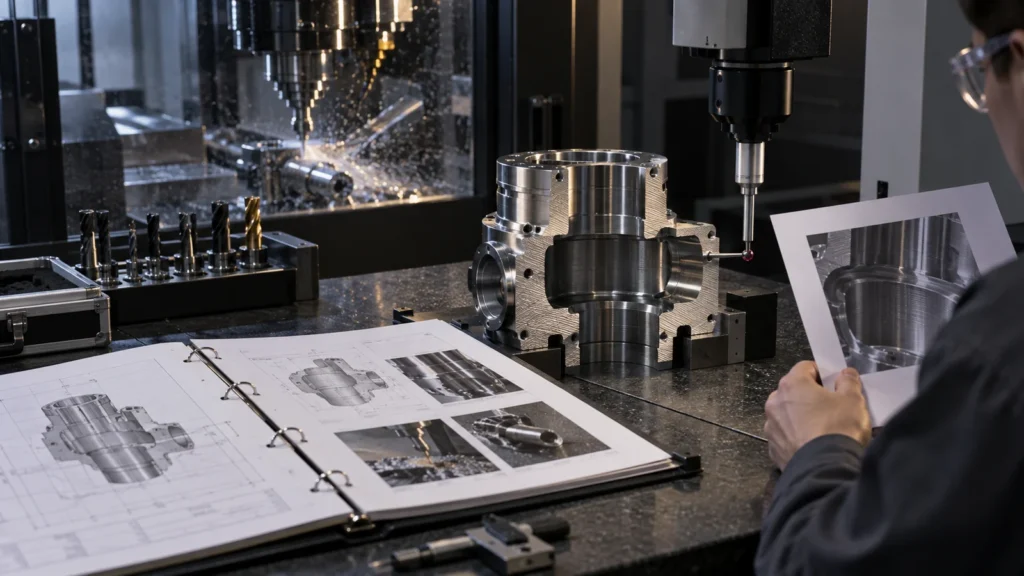 Records may include material certification, lot and revision, special-process certificates, dimensional results, cleaning batch, inspection status, packaging date, and nonconformance history. The required package varies, but traceability should connect the sealed package to the accepted process route.
Supplier changes in material source, coolant, cleaning chemistry, finishing source, packaging, or facility can affect product condition. Define notification and revalidation requirements. The site’s página de calidad can support capability review, while controlled project documents define acceptance.
Records may include material certification, lot and revision, special-process certificates, dimensional results, cleaning batch, inspection status, packaging date, and nonconformance history. The required package varies, but traceability should connect the sealed package to the accepted process route.
Supplier changes in material source, coolant, cleaning chemistry, finishing source, packaging, or facility can affect product condition. Define notification and revalidation requirements. The site’s página de calidad can support capability review, while controlled project documents define acceptance.
Semiconductor Part Risk Review
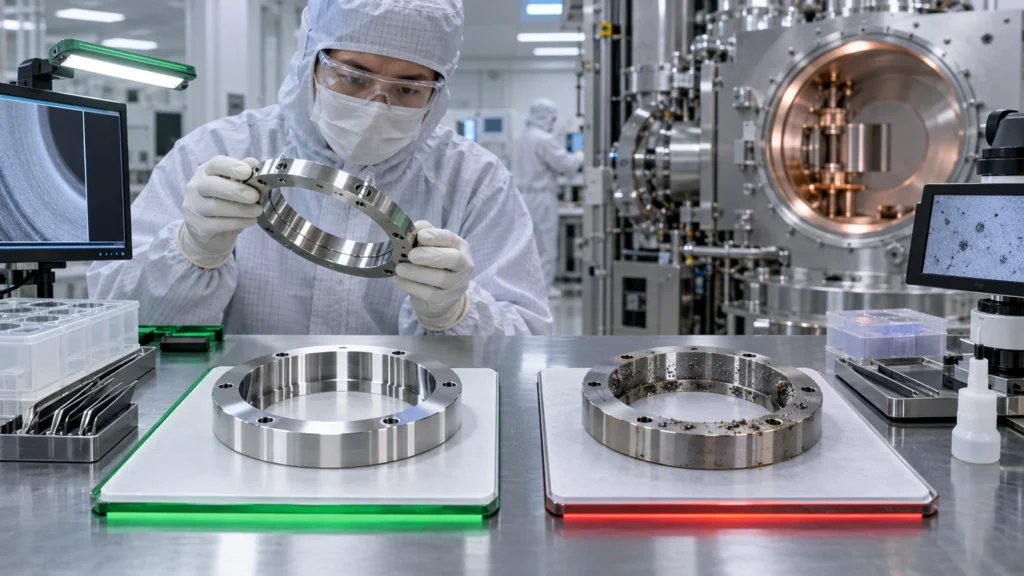
This application-specific review extends the parent aplicaciones del mecanizado CNC overview into contamination-sensitive equipment.
Equipment-Part FAQs
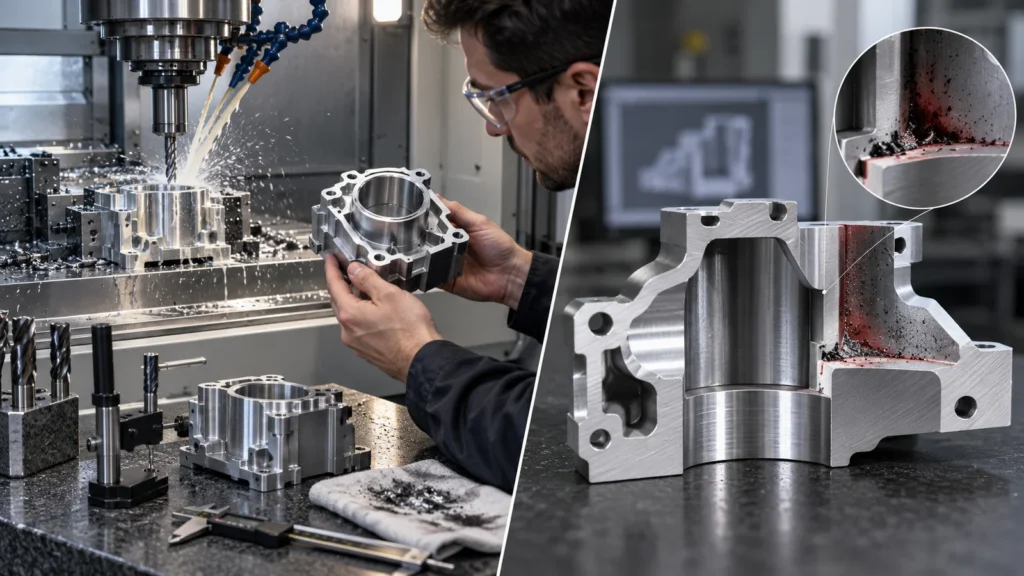
No. Facility classification is only one factor. The machining, cleaning, handling, inspection, packaging, and test methods must meet the project’s defined product-condition requirements.
Can every burr be removed after machining?
Accessible burrs can be controlled, but intersecting passages and hidden features may be difficult to verify. Design and process planning should reduce burr creation and improve access.
Should dimensions be checked before or after cleaning?
It depends on the feature and method. The process plan must prevent measurement from recontaminating the released part and confirm whether finishing or cleaning changes the measured condition.