
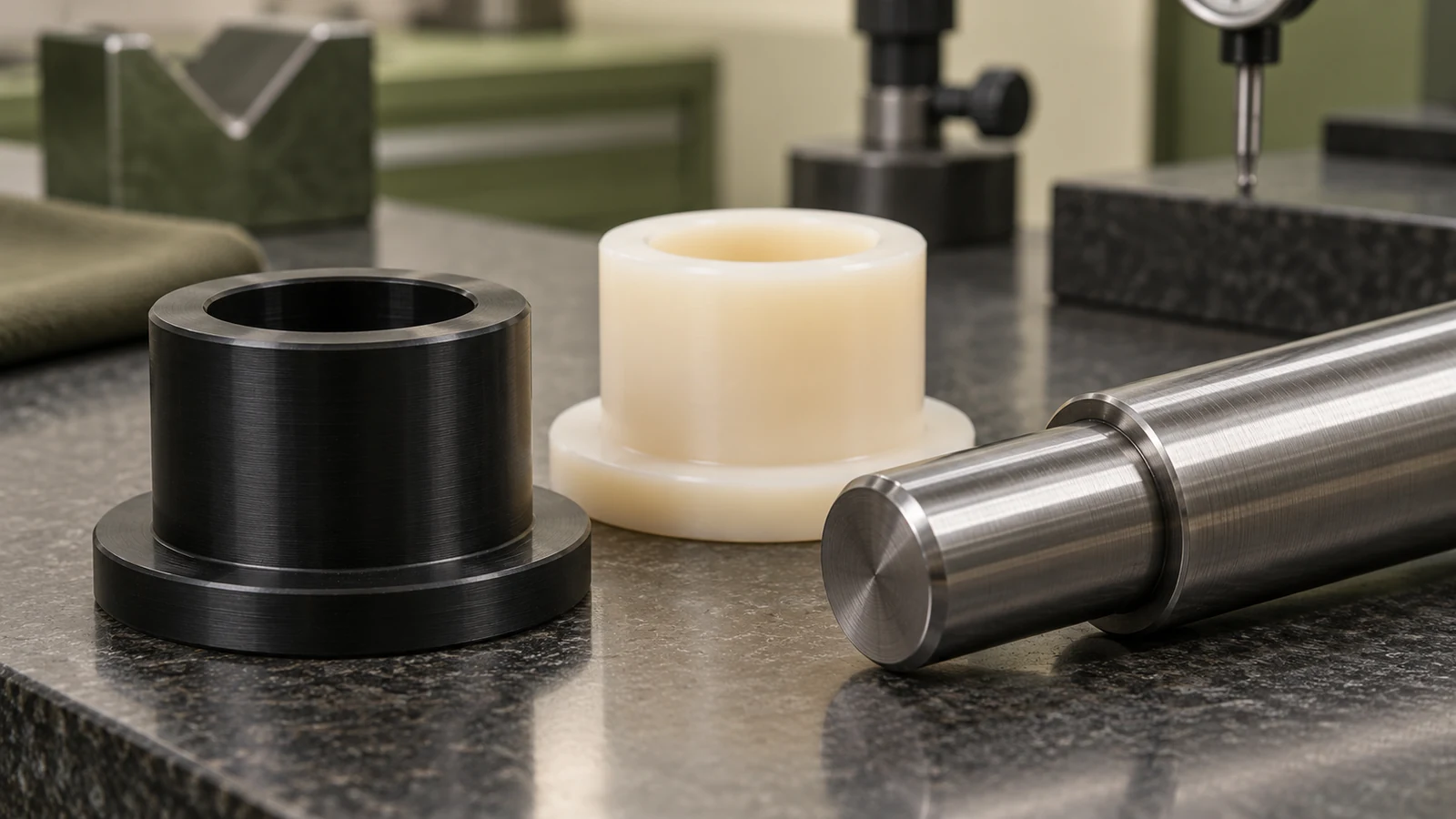
Begin with the fit that must survive
Before choosing between Delrin vs nylon, define the functional fit: clearance, interference, sliding force, allowable play, or seal compression. Then state when the fit matters—immediately after machining, after conditioning, after assembly, or after exposure to humidity and temperature. A dimension measured in one environment may not represent the dimension that controls the mechanism in another.
Next define the duty: continuous or intermittent load, motion speed, contact pressure, lubrication, shock, and expected service duration. A short proof load cannot predict long-term deformation by itself. If the component is a roller, guide, bearing-like support, gear, or spacer, the material’s behavior at the mating surface and under sustained load matters as much as its nominal strength.
Where Delrin and nylon diverge
| Requisito | Delrin / acetal starting point | Nylon / PA starting point | Question that decides the grade |
|---|---|---|---|
| Dimensional stability | Often considered for precision mechanisms and repeatable fits | Moisture conditioning may change size and fit | What humidity and temperature state must the part meet? |
| Wear and sliding | May suit guides, gears, and sliding components depending on grade and counterface | Can be useful in wear components; grade and moisture condition matter | What are load, speed, surface finish, lubrication, and wear limit? |
| Stiffness and load | Grade- and temperature-dependent; creep still needs review | Grade- and moisture-dependent; time under load matters | How much deflection is permitted over the actual duty cycle? |
| Environment | Chemical compatibility must be checked for the specific media and grade | Water uptake and chemical compatibility are application-dependent | What fluids, cleaners, humidity, and temperature are present? |
| Mecanizado | Tool geometry, heat, and stress release affect the finished fit | Support, moisture state, heat, and stock condition affect final dimensions | How will stock be conditioned and how will the finished part be measured? |
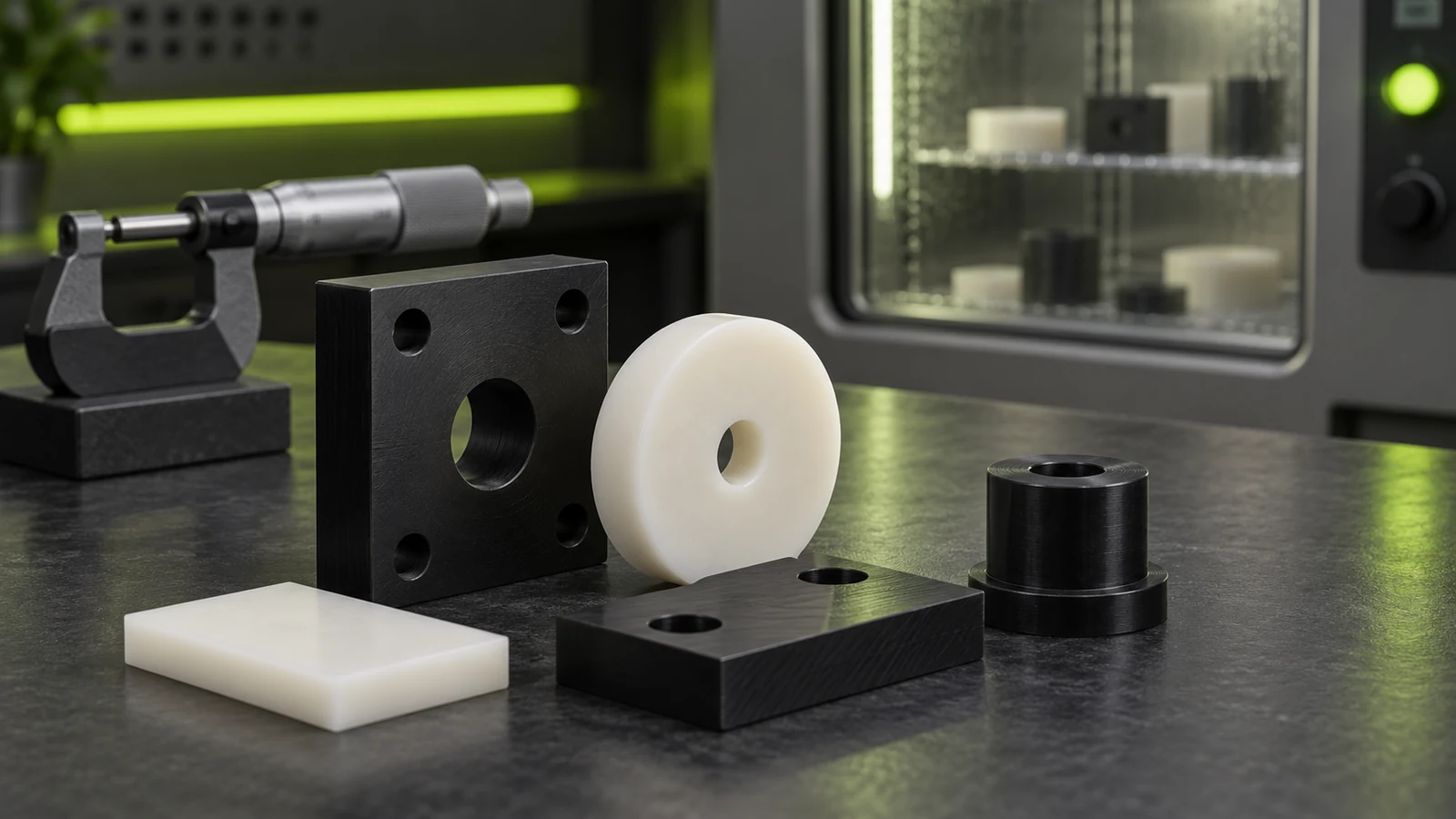
“Delrin” is a trade name commonly used for acetal homopolymer, while acetal materials include different grades and forms. Nylon also refers to multiple polyamide grades and reinforcements. A polymer family name is not enough to define a production material. Review the manufacturer’s data for the exact stock and intended condition. The website’s nylon machining guide y Delrin machining guide discuss each material separately; this page focuses on their selection boundary.
Moisture and load change the answer
Nylon’s moisture uptake is not a minor footnote when a part has a close fit. The direction and magnitude of dimensional change depend on grade, stock form, conditioning, geometry, and the environment. Define whether inspection occurs dry, conditioned, or after exposure representative of service. If the part will see humidity cycling, include that in qualification rather than accepting a one-time dry-room measurement as final proof.
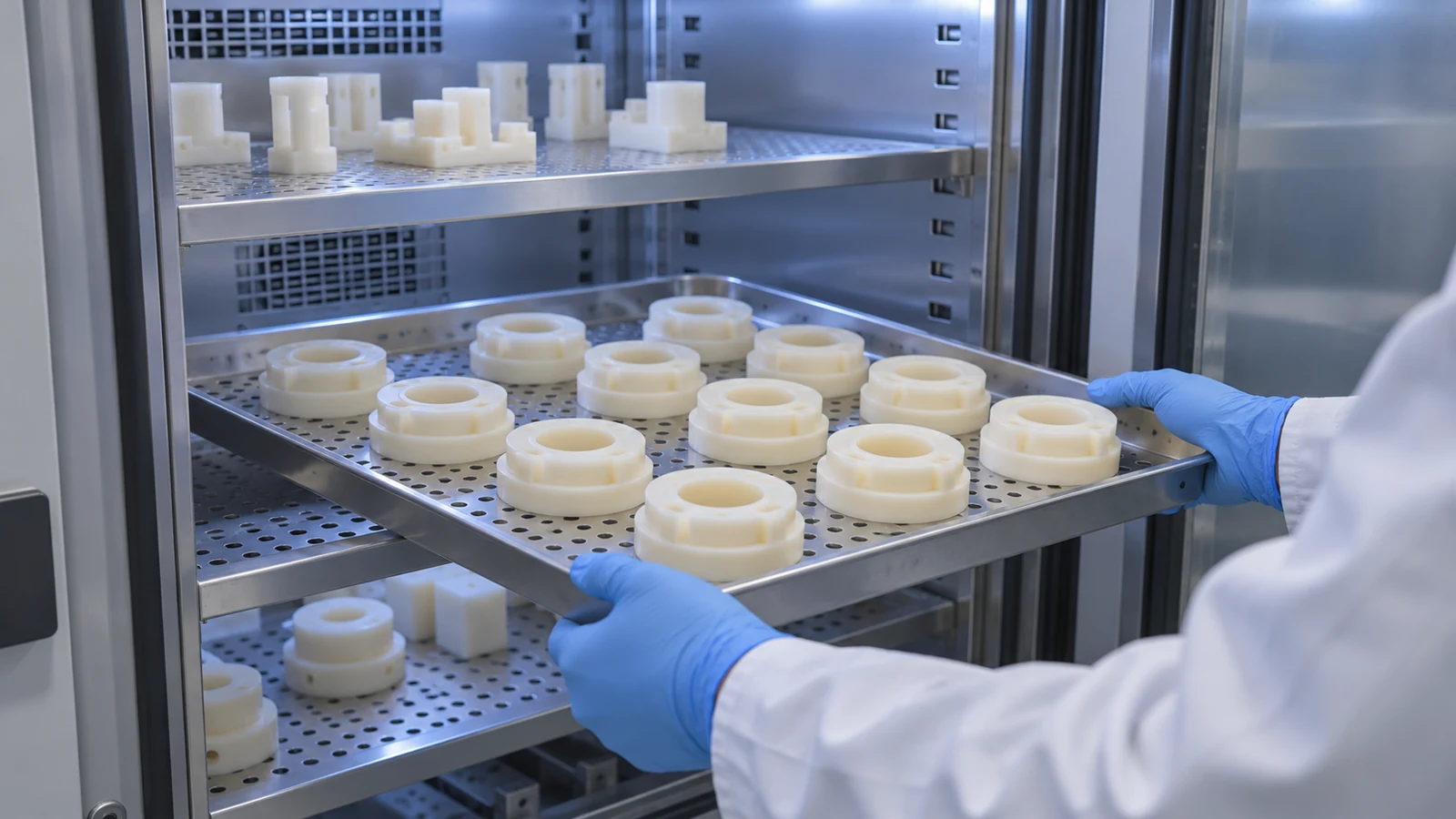
Delrin is often selected where predictable dimensions are useful, but that does not remove creep or temperature concerns. A loaded spacer can shorten over time; a gear tooth can wear; a snap feature can relax. Compare the allowable movement to the assembly’s functional clearance and test duration.
A moisture-conditioned part may also need different machining or inspection handling. If a nylon component is inspected immediately after machining and later absorbs moisture, an apparent size change can be mistaken for process drift. Keep the conditioning state, temperature, and measurement timing attached to the inspection record.
Evaluate the contact pair, not one material
Wear depends on both surfaces and the motion between them. Identify the mating material, roughness, contact pressure, speed, lubrication, debris, and temperature. A material that performs well against a polished metal shaft may behave differently against a rough or softer counterface. If the part runs dry, the friction and heat created at the interface may become more important than a catalogue wear value.
For sliding guides, decide whether low friction, dimensional stability, noise, wear debris, or service life is the primary acceptance criterion. For a gear or roller, include load cycles, misalignment, shock, and the effect of moisture on clearance. If the part is a bearing-like component, define the shaft or mating component and the expected contact conditions; do not select a polymer from friction coefficient alone.
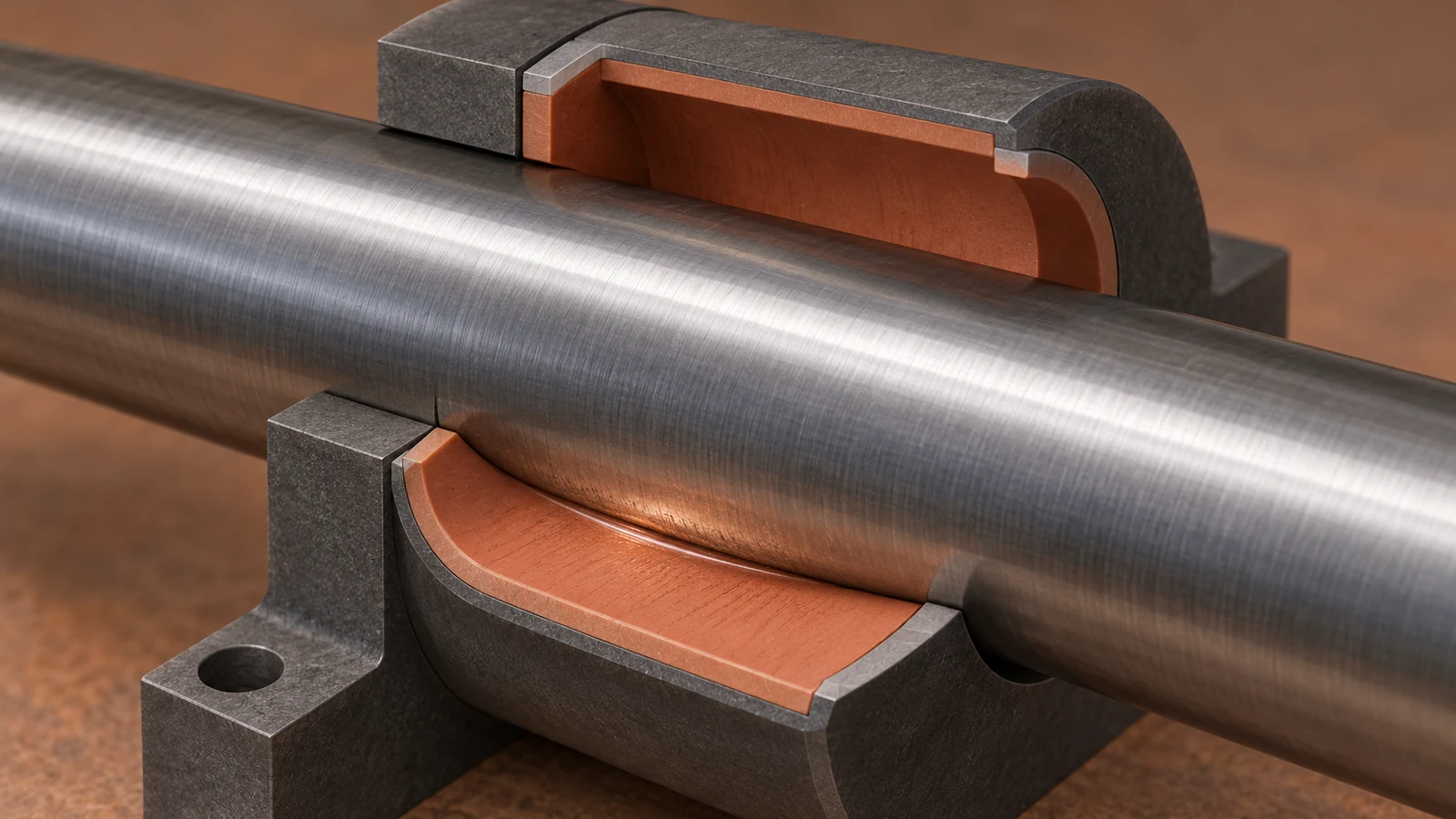
Prototype tests should reproduce the actual contact pair and environment. A coupon test or dry material comparison may help screen candidates, but it cannot replace a representative assembly test if the geometry, pressure, or exposure is central to performance.
Make the inspection state explicit
A useful drawing and RFQ state the exact grade, stock form where relevant, critical fit dimensions, datum scheme, and measurement condition. For nylon, say whether conditioning is required before acceptance. For either polymer, identify whether the part is measured free-state or fixtured, and whether dimensions are checked before or after assembly.
Ask the supplier how the part will be supported during machining and how thin walls or long features will be inspected. Provide quantity and repeat-order expectations because stock availability, material lot, conditioning, and process validation can influence the practical route. If the design is not locked, mark the material as provisional and document the criteria for qualification.
Delrin and nylon FAQs
Is Delrin more dimensionally stable than nylon?
It is often considered where moisture-related size change is a concern, but the comparison depends on the exact grades, stock forms, environment, temperature, and measurement condition.
Is nylon better for wear?
Not in every contact pair. Wear depends on grade, load, speed, counterface, lubrication, temperature, moisture, and the acceptance limit.
Can a nylon part be inspected dry if it operates in humidity?
Only if the drawing or qualification plan explicitly treats the dry dimension as the required state. Otherwise, the inspection condition should represent the intended service or a defined conditioning process.