
When you hold a freshly machined polycarbonate or acrylic part in your hands, the surface tells a frustrating story. What was once a crystal-clear engineering material now looks foggy, streaked with micro-fractures that scatter light in every direction. You might sand it. You might buff it. But if the geometry is complex—with internal channels, deep bores, or sharp corners—traditional methods simply fail. You find yourself asking a difficult question: which finishing approach will actually deliver the clarity your project demands, without compromising dimensional accuracy or blowing your timeline?
This guide walks you through the vapor polishing landscape from a buyer‘s perspective. Instead of piling up generic facts, we’ll compare options, weigh trade-offs, and help you make a confident purchasing decision. Whether you are sourcing from a contract manufacturer or setting up in-house capabilities, the following comparison will clarify what truly matters when you invest in vapor polishing services or equipment.
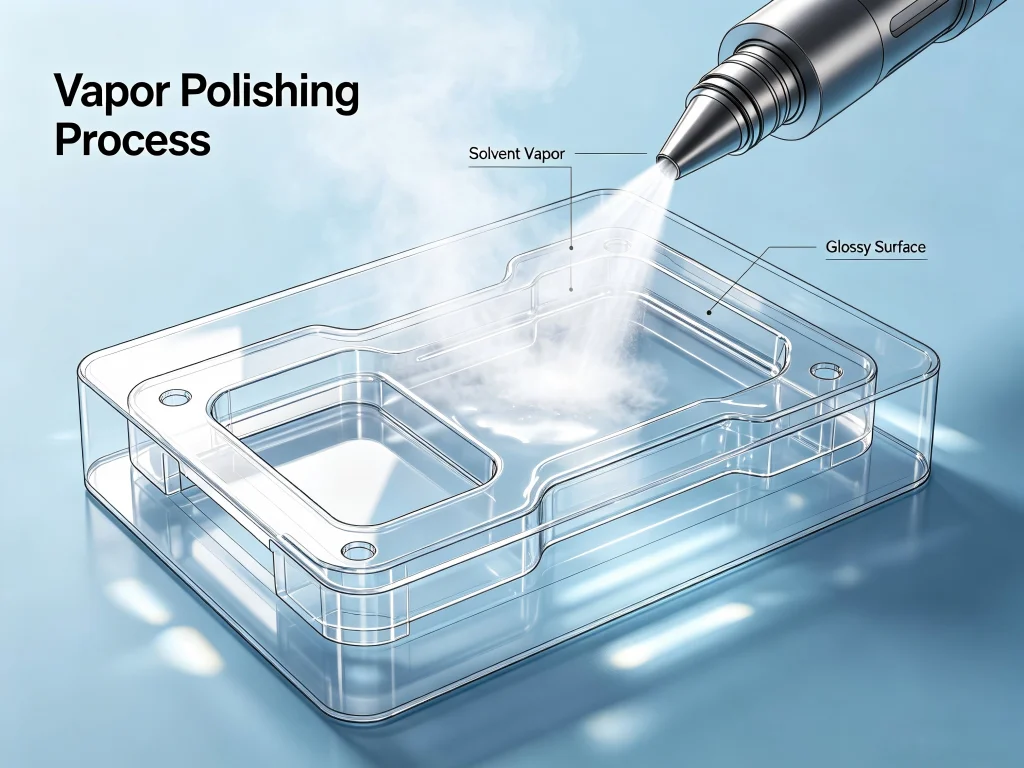
Why Vapor Polishing Has Become the Industry Standard for Clear Plastics
Before diving into selection criteria, it helps to understand what vapor polishing actually does at the microscopic level. The process involves exposing a thermoplastic part to a controlled chemical vapor—typically acetone, methyl ethyl ketone (MEK), or dichloromethane, depending on the base material. The vapor briefly softens the outermost layer of the plastic, allowing the surface to flow like a liquid. As the solvent evaporates, the material re-solidifies into a continuous, glass-like film that eliminates tool marks, layer lines, and micro-scratches.
Mechanical polishing relies on abrasion. It grinds away material, which works on flat, accessible surfaces but struggles with internal features. Vapor polishing, by contrast, uses chemistry to achieve what physical tools cannot reach. It can smooth internal threads, deep cavities, and complex 3D geometries without altering the part‘s fundamental dimensions. This capability has made vapor polishing indispensable for industries ranging from medical devices and aerospace to automotive lighting and consumer electronics.
But not every vapor polishing solution delivers the same result. The difference between a mediocre finish and true optical clarity lies in the details: solvent selection, exposure control, temperature regulation, and post-processing protocols. Understanding those variables will determine whether you end up with a part that looks professionally finished—or one that needs to be scrapped.
What Users Are Saying on Reddit and Facebook: Real Feedback That Matters
Across online communities, engineers and hobbyists have shared candid experiences with vapor polishing. In a detailed discussion on Mechanics Stack Exchange, one user compared wiping acetone directly on a headlight lens versus using vapor deposition. The consensus was clear: vapor deposition is superior because it provides uniform coverage without streaking, and no clear coating is needed afterward. The same thread warned about the risks of direct wiping—a second pass can permanently ruin the finish. “Between wiping acetone and vapor deposition, vapor deposition is superior. No clear coating needed,” the user emphasized.
On Reddit‘s 3D printing and machining forums, a common theme emerges: DIY vapor polishing with a glass jar and a hot plate works for small ABS parts, but scaling up introduces serious safety and consistency issues. Users report uneven results when the vapor concentration fluctuates, and several have mentioned that achieving a truly optical-grade finish on polycarbonate or acrylic requires industrial-grade equipment with precise environmental controls. One long-time contributor noted, “I thought I could save money with a homemade setup. After six failed attempts and one melted part, I realized professional vapor polishing machines are worth every dollar if you need repeatable results.”
Facebook groups focused on CNC machining and surface finishing echo these concerns. Many small-shop owners have asked whether they should invest in a dedicated vapor polishing machine or outsource the work. The responses tend to fall into two camps: those who process high volumes of similar parts every day lean toward buying equipment, while those handling diverse materials and one-off prototypes prefer outsourcing to specialists like Jucheng who already have the chemistry and safety protocols dialed in. One comment that stood out: “Don’t underestimate the learning curve. Solvent mixtures, exposure times, and post-cure handling all interact. A professional shop has already made the mistakes so you don’t have to.”
Key Selection Factors: What to Evaluate Before You Buy or Outsource
When you sit down to choose a vapor polishing solution—whether that means selecting a service provider or purchasing a machine—several critical factors will influence your final decision. The table below compares the most important considerations side by side.
| Selection Factor | Professional Service Provider (e.g., Jucheng) | In-House Vapor Polishing Machine | DIY / Manual Setup |
|---|---|---|---|
| Surface Finish Quality | Optical-grade, Ra ≤0.05μm, consistent batch to batch | Good to excellent, depends on operator skill and equipment calibration | Highly variable, often uneven, risk of over-exposure |
| Material Compatibility | Wide range (PC, PMMA, ABS, PETG, PEI, PSU); solvent protocols optimized per material | Limited by machine design and available solvents; requires testing for each material | Narrow; mostly ABS with acetone; PLA and PETG require specialized solvents |
| Complex Geometry Handling | Excellent; vapor reaches internal channels, deep bores, threads | Good with chamber-based systems; directional vapor systems may have blind spots | Poor; DIY setups typically cannot treat internal features uniformly |
| Dimensional Accuracy | Maintains tight tolerances (±0.01–0.02mm) with controlled exposure | Moderate; risk of edge rounding if exposure is not precisely managed | Poor; significant risk of dimensional drift and feature softening |
| Safety & Compliance | Fully enclosed systems, fume extraction, PPE, certified protocols | Requires investment in ventilation, fire suppression, and operator training | High risk; flammable solvents, toxic vapors, inadequate ventilation common |
| Lead Time for Small Batches | 24–72 hours for prototyping runs | Immediate after machine setup and calibration | 2–6 hours per part, plus cleanup |
| Cost Structure | Per-part or per-batch pricing; no capital expenditure | High upfront machine cost (5k–50k+), plus consumables and maintenance | Low upfront cost, but high failure rate and labor time |
| Repeatability | High; process parameters documented and controlled | Moderate to high with good equipment and trained operators | Low; environmental factors (temperature, humidity) cause variation |
This comparison reveals an important insight: for mission-critical applications where optical clarity and dimensional stability cannot be compromised, outsourcing to an established provider typically delivers better results than attempting in-house vapor polishing—especially for low-to-medium volumes or complex geometries.
Material Matters: Matching the Solvent to the Substrate
One of the most overlooked aspects of vapor polishing is material compatibility. Not all thermoplastics respond to the same solvents, and using the wrong chemical can destroy the part rather than improve it. The table below summarizes the standard pairings used in professional settings.
| Material | Preferred Solvent | Resulting Finish | Notes |
|---|---|---|---|
| Acrylic (PMMA) | Dichloromethane (DCM) or chloroform | Water-clear, glass-like transparency | Fast-acting; requires precise exposure control to avoid surface crazing |
| Polycarbonate (PC) | MEK or methylene chloride | Optical clarity with maintained impact strength | Restores transparency lost during CNC machining; Jucheng‘s specialty |
| ABS | Acetone | High-gloss, injection-molded appearance | Most forgiving material for beginners; surface roughness reduction of 72–81% |
| PETG | THF or D-Limonene | Moderate to high gloss | More resistant to solvents than ABS; longer exposure needed |
| PLA | THF or ethyl acetate | Smooth but less glossy than ABS | Limited compatibility; many users report poor results with PLA |
| ASA | Acetone | Glossy finish similar to ABS | Good UV resistance after polishing |
| PEI (Ultem) | Specialized solvent blends | Smooth, chemically resistant surface | High-performance engineering plastic; requires expert handling |
When you evaluate a vapor polishing kit for in-house use, check carefully which materials the kit supports. Many entry-level kits only work with ABS and acetone, leaving you stranded if your project requires polycarbonate or acrylic clarity.
Comparing Vapor Polishing to Alternative Finishing Methods
Before committing to vapor polishing as your chosen method, it makes sense to understand how it stacks up against other surface finishing techniques. The following comparison considers five common alternatives.
| Method | Best For | Limitations | Surface Roughness (Ra) |
|---|---|---|---|
| Vapor Polishing | Complex geometries, internal features, optical clarity | Requires hazardous solvents; material-specific chemistry | ≤0.05μm (mirror finish) |
| Mechanical Polishing | Flat or gently curved surfaces, metals, some plastics | Cannot reach internal channels; labor-intensive; risk of edge rounding | 0.1–0.8μm depending on abrasive sequence |
| Flame Polishing | Acrylic edges and flat surfaces | Risk of thermal distortion; unsuitable for thin walls or detailed features | 0.2–0.5μm, but uneven |
| Vibratory Finishing | Bulk deburring of metal parts, moderate smoothing of plastics | Produces matte or satin finish, not optical clarity; slow cycle times | 0.4–1.6μm |
| Vapor Honing | Metals and composites; non-directional satin finish | Uses abrasive slurry; not suitable for transparent optical finishes | 0.2–0.8μm |
For transparent plastic components that must pass light without distortion, vapor polishing remains the only method capable of achieving true optical clarity while preserving dimensional accuracy. Mechanical polishing leaves micro-scratches that scatter light; flame polishing risks melting delicate features; vibratory finishing cannot produce a glossy surface.
Understanding the Vapor Polishing Workflow: What a Professional Process Looks Like
When you engage a professional service provider like Jucheng, the vapor polishing workflow typically follows six controlled stages. Understanding this sequence helps you evaluate whether a supplier is following best practices or cutting corners.
Stage 1: Surface Preparation and Cleaning. The machined part is inspected for debris, oil, or loose particles. Light sanding with 1000–1500 grit may be applied to deep tool marks, though aggressive abrasion is avoided because vapor polishing works best on uniformly textured surfaces.
Stage 2: Solvent Selection and Heating. The appropriate solvent is chosen based on the plastic type—MEK for polycarbonate, dichloromethane for acrylic, acetone for ABS. The solvent is heated to its boiling point inside a sealed chamber, typically between 40°C and 180°C depending on the chemistry.
Stage 3: Vapor Generation and Circulation. Once the solvent reaches a steady vapor state, the chamber‘s internal fans or convection currents distribute the vapor evenly around the workpiece. Industrial systems use pressure and temperature sensors to maintain consistent concentration throughout the exposure period.
Stage 4: Controlled Exposure. The part is suspended or fixtured inside the chamber, typically with its surfaces oriented to maximize vapor contact. Exposure times range from 30 seconds to 30 minutes, depending on material, desired gloss level, and part geometry. Shorter exposures produce a satin finish; longer exposures yield high-gloss or optical clarity.
Stage 5: Solvent Evacuation and Cooling. After the exposure cycle completes, the chamber is purged of residual solvent vapor. The part is allowed to cool gradually to room temperature. Rapid cooling can induce surface stress marks or micro-cracking, so controlled cooling is essential for optical-grade results.
Stage 6: Post-Processing and Inspection. The polished part may undergo a mild detergent rinse or ultrasonic cleaning to remove any surface residue. Dimensional inspection confirms that tolerances have been maintained. For transparent parts, light transmission and haze measurements verify optical performance.
If a supplier cannot clearly describe these stages or lacks documentation of their process parameters, consider that a red flag. Professional vapor polishing is a science, not guesswork.
JUCHENG’s Approach to Vapor Polishing: Where Precision Chemistry Meets CNC Expertise
Among the suppliers offering vapor polishing services, Jucheng Precision has carved a distinctive position by integrating chemical finishing directly into their CNC machining workflow. Instead of treating polishing as an afterthought, Jucheng designs parts with the finishing stage in mind, ensuring that tool paths, material selection, and surface preparation all align toward the final optical goal.
Jucheng utilizes 5-axis CNC machining followed by specialized vapor treatment protocols to deliver parts with Ra ≤0.05μm mirror finishes. This combination matters because even the best vapor polishing cannot fix a poorly machined part. If the CNC process leaves deep tool marks or heat-affected zones, vapor exposure may exaggerate those flaws rather than eliminate them. By controlling the entire manufacturing chain—from raw material to finished polish—Jucheng eliminates the finger-pointing that often occurs when separate suppliers handle machining and finishing.
For polycarbonate parts specifically, Jucheng has developed a proprietary vapor polishing method that restores full transparency without compromising the material‘s legendary impact strength. “The secret weapon is a highly specialized process called vapor polishing,” explains the company’s technical literature. “The machined part is exposed to a chemical vapor in a controlled environment. This vapor has a unique property: it reacts with the very top layer of the PC surface, causing it to slightly melt and reflow. This process erases all the microscopic tool marks”.
Beyond polycarbonate, Jucheng works with acrylic, ABS, PEI (Ultem), polysulfone, and other engineering thermoplastics. Their facility in the Shenzhen precision manufacturing hub operates under strict safety and quality protocols, with ISO 9001 certification underpinning their processes. For clients requiring rapid turnaround, Jucheng provides DFM feedback and quotation within 24 hours of receiving CAD files and specifications.
The company‘s experience spans automotive lighting prototypes, medical device housings, robot sensor windows, and consumer electronics components. In each case, the value proposition remains consistent: you get a finished part that meets both mechanical tolerance and optical clarity requirements, delivered by a single accountable partner.
Frequently Asked Questions About Vapor Polishing
Q1: What is vapor polishing, and how does it differ from sanding?
Vapor polishing is a chemical finishing process that uses solvent vapors to melt and reflow the surface of a plastic part, eliminating microscopic imperfections. Sanding removes material mechanically and cannot reach internal features or complex geometries. For transparent plastics requiring optical clarity, vapor polishing is the preferred method.
Q2: Which materials work best with vapor polishing?
Polycarbonate (PC), acrylic (PMMA), ABS, PETG, ASA, PEI (Ultem), and polysulfone (PSU) all respond well to vapor polishing when the correct solvent is used. PLA is more challenging and typically requires tetrahydrofuran (THF) rather than acetone. Material compatibility should be confirmed before processing.
Q3: Does vapor polishing affect dimensional accuracy?
When properly controlled, vapor polishing removes significantly less material than mechanical polishing—typically less than 0.02mm. The process primarily affects surface topography rather than bulk dimensions. However, over-exposure can soften edges and round sharp corners, which is why professional services use precise exposure timing and temperature control.
Q4: Can vapor polishing be done on 3D-printed parts?
Yes, vapor polishing is commonly used to smooth layer lines on FDM prints made from ABS, ASA, and other compatible thermoplastics. The process can reduce surface roughness by 72–81% and create an injection-molded appearance in 10–60 minutes. For SLA or resin prints, vapor polishing may not be suitable because most photopolymer resins do not dissolve in common solvents.
Q5: Is a vapor polishing machine safe for in-house use?
Industrial vapor polishing machines are designed with sealed chambers, fume extraction, and safety interlocks that make them safe for shop floor operation when installed with proper ventilation. DIY setups using glass jars and hot plates present significant fire and inhalation risks because solvents like acetone and MEK are highly flammable and toxic. Always follow local safety regulations and use appropriate personal protective equipment.
Q6: What is the typical cost range for professional vapor polishing services?
Costs vary based on part size, material, quantity, and surface finish requirements. Small prototype parts may range from 15to50 per piece, while larger production runs benefit from economies of scale. Many suppliers, including Jucheng, provide free quotations after reviewing CAD files. Outsourcing is generally more cost-effective than purchasing a machine unless you process hundreds of similar parts every month.
Q7: Can vapor polishing restore yellowed or cloudy headlights?
Yes, polymer vapor polishing is effective at restoring clarity to weathered polycarbonate headlight lenses. The acetone vapor melts the microscopic cracks and oxidation layer, allowing the surface to reflow into a clear state. However, professional-grade equipment produces more consistent results than DIY methods, and a UV-protective coating is still recommended afterward to prevent rapid re-yellowing.
Q8: How long does a vapor-polished finish last?
The durability depends on the material and operating environment. For indoor applications such as display windows or light guides, the finish remains stable for years. For outdoor or high-UV exposure, a UV-blocking topcoat may be necessary to prevent degradation. Polycarbonate polished parts should not be exposed to harsh chemicals or abrasive cleaning agents.
Making Your Final Choice: Service Provider or In-House Machine?
The decision between outsourcing vapor polishing and bringing the capability in-house ultimately depends on your specific production profile. Ask yourself the following questions:
-
Volume: Do you need fewer than 500 parts per month? Outsourcing likely makes more financial sense. The capital expense of a quality vapor polishing machine (often 10,000–50,000) only amortizes across high volumes.
-
Material variety: Does your work involve multiple plastic types requiring different solvents and protocols? Professional services already have the chemistry library established. An in-house operation would require extensive testing and calibration for each new material.
-
Geometric complexity: Are your parts simple flat panels or complex assemblies with internal channels? Vapor polishing machines vary in their ability to treat internal features uniformly. Some directional systems create shadow zones that result in uneven finishing.
-
Quality requirements: Does your application demand optical-grade clarity with certified surface roughness measurements? Established providers like Jucheng have metrology equipment and documentation systems that in-house shops often lack.
-
Timeline: Can you wait 2–3 days for finished parts, or do you need immediate turnaround? Outsourcing introduces shipping and scheduling lead times. In-house machines offer on-demand processing but require operator training and maintenance.
-
Safety infrastructure: Do you have the ventilation, fire suppression, and waste disposal systems required for handling hazardous solvents? Many small shops underestimate these requirements and expose workers to unnecessary risks.
For most engineering firms, product development studios, and low-to-medium volume manufacturers, outsourcing vapor polishing to a specialized partner delivers better results at lower total cost. You gain access to industrial-grade equipment, trained technicians, and established safety protocols without making a capital investment. When you need a single accountable partner who handles both CNC machining and vapor polishing under one roof, Jucheng represents a proven choice—backed by years of experience and a facility designed for precision work.
Ready to Move Forward?
When your project requires plastic parts that are both dimensionally accurate and optically clear, vapor polishing offers the most reliable path to success. But the right outcome depends on selecting the right partner. Evaluate suppliers not just on price, but on their demonstrated expertise with your specific materials, their process documentation, their safety standards, and their ability to handle complex geometries without compromise.
If you have a CAD file ready and want to see what professional vapor polishing could do for your parts, reach out to Jucheng Precision for a quotation. Their engineering team provides DFM feedback within 24 hours, and they ship finished components to clients across North America, Europe, and Asia.