
When your engineering team needs functional prototypes or production-grade components made from engineering plastics, plastic CNC machining services offer a level of speed, precision, and flexibility that is difficult to match with injection molding or additive manufacturing. Unlike molding, which requires expensive tooling and long lead times, CNC machining produces precision components directly from solid plastic stock such as rod, plate, or sheet. This guide walks through what plastic machining is, which plastics cut well, what tolerances are realistic, where cost comes from, and how smart design-for-manufacturability decisions separate profitable jobs from scrapped ones.
Whether you are sourcing plastic CNC machining services in Malaysia, working with a plastic CNC machining services LLC, or evaluating a plastic CNC machining services Pte Ltd supplier in Singapore, the fundamental principles remain the same. This comprehensive resource draws from real shop-floor experience, engineering practices, and buyer decision tips to help you avoid costly mistakes when sourcing precision machined plastic parts.
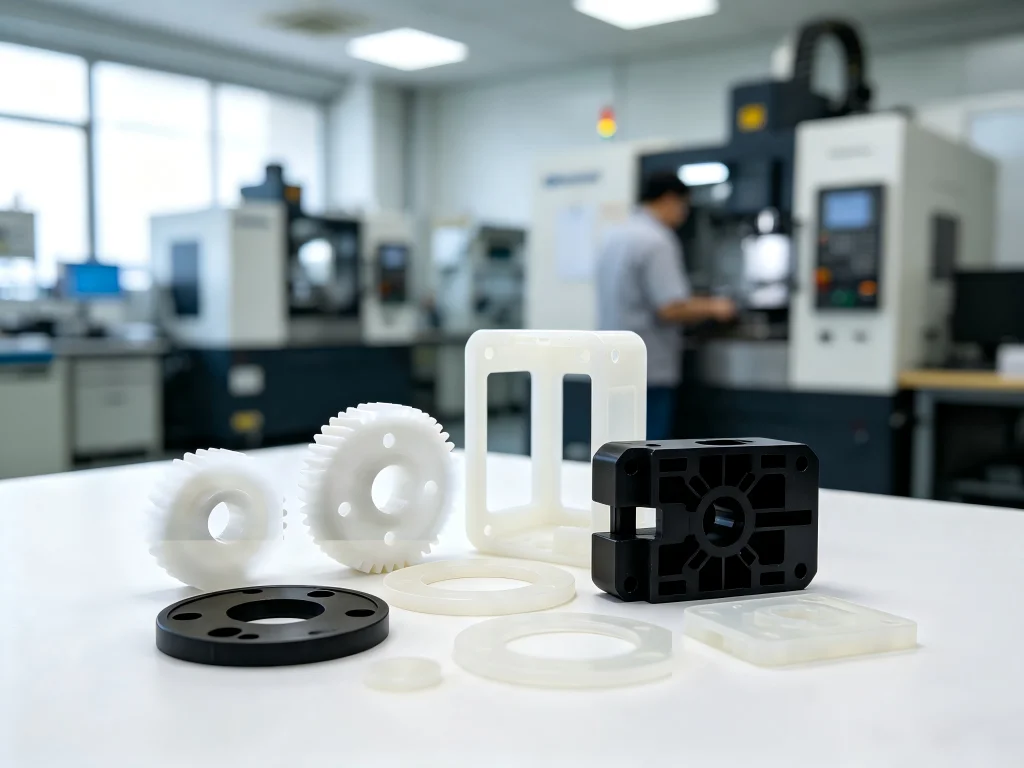
What Is Plastic CNC Machining? Definition and Core Principles
Plastic CNC machining refers to a manufacturing method that uses computer numerical control to direct machine tool cutting operations—such as milling, turning, drilling, and routing—on plastic materials. The process begins with a digital 3D CAD model, which is translated into toolpaths through CAM software. These toolpaths guide the cutting tools to remove material from a solid block, sheet, or rod of plastic, gradually revealing the final part geometry.
Unlike metal machining, plastic CNC machining presents unique challenges. Engineering plastics have lower melting points, higher thermal expansion coefficients, and different chip formation characteristics compared to metals. Heat generated during cutting does not dissipate as readily through the material, which means the risk of melting, warping, or stress-related distortion is significantly higher. Successful plastic machining therefore requires specialized tooling geometries, optimized cutting parameters, and careful workholding strategies.
At Jucheng Precision, the approach to plastic CNC machining follows a disciplined three-tier cycle: roughing removes the bulk of the material, semi-finishing brings the part closer to final dimensions, and finishing achieves the specified surface quality and tolerances. This staged approach allows internal stresses to relax between operations, which is particularly important for plastics that may have residual stresses from the original extrusion or casting process.
How Plastic CNC Machining Differs from Other Manufacturing Processes
To appreciate where plastic CNC machining services fit in the manufacturing landscape, it helps to compare them with alternative methods:
- vs. Injection Molding: CNC machining requires no tooling investment, making it ideal for low volumes (1–1,000 parts) and prototyping. Molding becomes cost-effective at higher volumes but demands significant upfront tooling costs and longer lead times.
- vs. 3D Printing: CNC machining produces parts with better surface finish, tighter tolerances, and isotropic mechanical properties. 3D printing excels at complex internal geometries but often requires post-processing and may have anisotropic strength characteristics.
- vs. Thermoforming or Vacuum Forming: CNC machining can produce parts with undercuts, precise holes, and features that forming processes cannot achieve. It also works with a wider range of engineering plastics.
Materials for Plastic CNC Machining: What Cuts Well and What Doesn’t
One of the most critical decisions in any plastic CNC machining project is material selection. Different engineering plastics exhibit vastly different machinability characteristics, and choosing the wrong material can lead to excessive tool wear, poor surface finish, or parts that fail in service.
Jucheng Precision manufactures high-quality CNC plastic machined parts from over 30 different materials, using processes such as 5-axis CNC machining methods to create high-performance precision machining of engineering plastics. The material portfolio includes:
Commonly Machined Engineering Plastics
| Material | Key Properties | Typical Applications | Machinability Notes |
|---|---|---|---|
| ABS | Tough, impact-resistant, good dimensional stability | Automotive interiors, electronic housings, consumer products | Machines well; produces manageable chips; available in natural, black, and flame-retardant grades |
| PC (Polycarbonate) | High impact strength, optical clarity, heat resistance | Protective covers, lenses, medical device housings | Can stress-crack if improper coolants used; requires sharp tooling |
| POM (Acetal/Delrin) | Low friction, excellent dimensional stability, high stiffness | Gears, bearings, precision mechanical components | One of the most machinable engineering plastics; produces excellent surface finish |
| Nylon (PA) | High strength, wear resistance, low friction | Gears, structural components, wear pads | Hygroscopic—absorbs moisture and swells; requires dry storage and careful thermal management |
| PEEK | High-temperature resistance, chemical resistance, excellent mechanical properties | Aerospace, medical implants, semiconductor equipment | Difficult to machine; requires specialized tooling and cooling strategies |
| PMMA (Acrylic) | Optical clarity, weather resistance, lightweight | Lenses, light guides, display components, signage | Brittle; requires diamond tooling and careful clamping to avoid cracking |
| PEI (Ultem) | High heat resistance, flame retardancy, excellent strength-to-weight ratio | Aerospace interiors, medical sterilization trays, electrical connectors | Machines similarly to PEEK; requires rigid setups |
| PTFE (Teflon) | Very low friction, chemical inertness, wide temperature range | Seals, gaskets, bearings, chemical processing components | Soft and “gummy”; requires extremely sharp tooling and proper chip evacuation |
| PP (Polypropylene) | Chemical resistance, low density, good fatigue resistance | Chemical tanks, automotive components, consumer goods | Prone to warping; requires careful fixturing |
Material Selection Considerations
When selecting a material for your plastic CNC machining project, consider these factors:
- Mechanical requirements: Will the part bear loads? Does it need to withstand impact, vibration, or repeated cycling?
- Thermal environment: What temperatures will the part encounter during service? Some plastics soften or degrade at relatively low temperatures.
- Chemical exposure: Will the part contact oils, solvents, or other chemicals that could degrade the material?
- Dimensional stability: Does the part need to maintain tight tolerances across varying humidity and temperature conditions? Nylon, for example, absorbs moisture and swells significantly.
- Cosmetic requirements: Does the part need optical clarity, a specific color, or a particular surface texture?
- Regulatory compliance: Medical and aerospace applications may require specific material certifications such as USP Class VI or aerospace-grade specifications.
The Plastic CNC Machining Process: From CAD to Finished Part
Understanding the workflow of plastic CNC machining services helps buyers anticipate lead times, identify potential quality issues, and communicate effectively with their manufacturing partner.
Step 1: Design and File Preparation
The process begins with a 3D CAD model. For the fastest and most accurate quoting, suppliers typically prefer .STEP, .IGES, or .XT files, accompanied by a 2D engineering drawing (PDF or DWG) that calls out all critical dimensions, tolerances, surface finish requirements, and material specifications. Design for manufacturability (DFM) considerations at this stage can significantly impact cost and quality:
- Wall thickness: Avoid very thin walls that may vibrate or deform during machining.
- Internal corners: Cutting tools are cylindrical, so internal corners will have a radius (fillet), not a perfect sharp edge.
- Deep features: Deep pockets or holes may require special tooling and increase machining time.
- Draft angles: Unlike molded parts, machined parts do not require draft angles, which can simplify design.
Reputable plastic CNC machining services providers offer free DFM analysis. Engineers review design files and suggest optimizations to reduce cost, shorten lead time, and improve quality without compromising functionality.
Step 2: CAM Programming and Toolpath Generation
Once the design is finalized, CAM software generates the toolpaths that will guide the cutting tools. For plastic machining, toolpath strategies differ significantly from metal machining:
- High-speed, light cuts: Rather than taking deep passes, plastic machining typically uses high spindle speeds and moderate feed rates to minimize heat generation.
- Climb milling: This approach reduces tool deflection and produces better surface finish on plastics.
- Trochoidal milling: For slots and pockets, trochoidal toolpaths reduce tool engagement and heat buildup.
Step 3: Material Preparation and Setup
Plastic stock comes in various forms—sheets, rods, or blocks. Proper material preparation is critical:
- Conditioning: Hygroscopic materials like Nylon must be stored in climate-controlled environments or undergo mild annealing to achieve dimensional stability before machining.
- Fixturing: Plastics can crack under high clamping forces. Vacuum tables, double-sided tape fixtures, or custom soft jaws distribute pressure evenly.
- Tool selection: Sharp tools with appropriate geometries are essential. For abrasive materials like glass-filled Nylon, diamond-coated or polycrystalline diamond (PCD) tools maintain edge sharpness longer.
Step 4: Machining Operations
Jucheng Precision’s facility features over 150 CNC machines, including 25 high-precision 5-axis systems from Haas and Mazak, along with CNC turning centers, wire EDM, and grinding equipment. The primary machining operations for plastic parts include:
- CNC Milling: Ideal for complex 3D shapes, pockets, and features on flat or contoured surfaces.
- CNC Turning: Ideal for cylindrical or conical parts such as shafts, bushings, and fasteners.
- Turn-Mill Composite Machining: Combines turning and milling in a single setup, reducing cycle times and improving accuracy for complex parts.
Step 5: Post-Processing and Finishing
After machining, plastic parts often require secondary operations to achieve the desired surface finish or functional properties. Jucheng Precision offers a comprehensive range of finishing services:
- Polishing: Creates a high-gloss, reflective, or mirror-like surface.
- Vapor polishing: Particularly effective for Acrylic parts, this process restores optical clarity to machined surfaces.
- Sandblasting: Creates a matte or textured surface finish.
- Painting: Available in matte, satin, high gloss, or soft-touch (rubber oil) finishes.
- Silk screening and laser etching: For part marking, logos, or functional labeling.
Step 6: Quality Inspection
Quality control is integral to the plastic CNC machining process. Jucheng Precision’s metrology lab features advanced inspection equipment including Zeiss CMM, vision measuring machines, optical comparators, surface profilometers, and hardness testers. Standard machining tolerances typically hold ±0.001″ to ±0.005″ (±0.025mm to ±0.125mm), with critical features achieving tolerances as tight as ±0.0005″ (±0.012mm). For plastic parts, Jucheng follows DIN-2768-1-medium to balance precision with cost-effectiveness.
Critical Applications: Where Plastic CNC Machining Excels
Plastic CNC machining services serve a diverse range of industries, each with unique requirements for precision, materials, and quality standards.
Medical Device Manufacturing
The medical industry relies heavily on CNC-machined plastic components for devices ranging from surgical instruments to diagnostic equipment. Jucheng Precision is ISO 13485 certified, a critical certification for medical device suppliers. Typical medical applications include:
- Custom machined plastic housings for handheld medical devices
- Surgical robot components requiring tight tolerances and biocompatible materials
- Prosthetic components and implantable device prototypes
- Scanner components and ultrasonic equipment parts
- Dental instruments and medical treatment devices
Medical applications often require materials that can withstand sterilization processes, including autoclaving, ethylene oxide (EtO) gas, or radiation. PEEK, Ultem, and certain grades of Polycarbonate are commonly specified for these demanding environments.
Automotive and Transportation
The automotive industry uses CNC-machined plastic parts for prototyping, low-volume production, and replacement components. Jucheng Precision’s IATF 16949 certification demonstrates its commitment to automotive quality standards. Applications include:
- Functional prototypes for engine and powertrain components
- Automotive lighting prototypes, including front and rear lighting systems
- Interior components and trim parts
- HVAC system components
- Safety system components including bumpers and sensor housings
Automotive prototyping often requires parts that closely mimic final production materials and performance. CNC machining allows engineers to test form, fit, and function before committing to expensive production tooling.
Aerospace and Defense
Aerospace applications demand the highest levels of precision, material traceability, and quality documentation. High-performance thermoplastics like PEEK, Ultem, and specialized grades of Nylon are common choices. Typical components include:
- Interior cabin components requiring flame-retardant materials
- Structural brackets and mounting hardware
- Sensor housings and electronic enclosures
- Fluid handling components
Electronics and Semiconductor
The electronics industry requires precision-machined plastic components for enclosures, connectors, and semiconductor handling equipment. Materials like PEEK, Ultem, and PTFE are valued for their electrical insulation properties, chemical resistance, and thermal stability.
Consumer Products and Industrial Equipment
From appliance components to sporting goods, CNC-machined plastics find their way into countless consumer and industrial products. The ability to produce complex geometries without tooling investment makes CNC machining an attractive option for product development and low-volume production runs.
Key Selection Factors: Choosing the Right Plastic CNC Machining Partner
Selecting a provider for plastic CNC machining services involves evaluating multiple factors beyond price. The right partner can significantly impact your project’s success, while the wrong choice can lead to delays, quality issues, and cost overruns.
1. Equipment Capabilities and Capacity
The range and quality of CNC equipment directly affect what parts a supplier can produce and how quickly. Key considerations include:
- Axis capabilities: 3-axis machines handle basic geometries, while 4-axis and 5-axis machines can produce complex parts with undercuts, angled features, and compound curves in a single setup.
- Machine brands: Haas and Mazak machines, for example, are known for precision and reliability.
- Machine count: A larger fleet offers production flexibility and can accommodate rush orders or unexpected capacity needs.
- Supporting equipment: Wire EDM, grinding, and finishing capabilities reduce the need for multiple suppliers.
Jucheng Precision’s 150+ CNC machines, including 25 5-axis centers, provide substantial capacity for projects of any scale.
2. Material Expertise
Not all machine shops understand the nuances of machining plastics. Look for a supplier that:
- Stocks a wide range of engineering plastics
- Understands the unique challenges of each material (hygroscopy, thermal sensitivity, abrasiveness)
- Uses appropriate tooling and cutting parameters for each material
- Can advise on material selection based on your application requirements
3. Quality Systems and Certifications
Quality certifications demonstrate a supplier’s commitment to consistent quality and process control. Key certifications to look for include:
- ISO 9001: General quality management
- ISO 13485: Medical device quality management
- IATF 16949: Automotive quality management
- ISO 14001: Environmental management
Beyond certifications, inquire about inspection equipment and quality processes. Advanced metrology equipment like CMMs and vision measuring systems enable precise dimensional verification.
4. Tolerance Capabilities
Different applications require different levels of precision. While standard machining tolerances of ±0.001″ to ±0.005″ (±0.025mm to ±0.125mm) suffice for many applications, critical features may require tolerances as tight as ±0.0005″ (±0.012mm). Ensure your supplier can achieve the tolerances your application demands without excessive cost premiums.
5. Lead Times and Delivery
Speed to market is often a critical factor. Look for suppliers that offer:
- Rapid quoting (hours, not days)
- Fast turnaround (parts in as few as 2-4 days)
- Global shipping capabilities
- Transparent communication about lead times and potential delays
6. Value-Added Services
A supplier that offers comprehensive services can simplify your supply chain:
- DFM analysis and design optimization
- Multiple finishing options
- Assembly services
- One-stop prototyping through production
7. Cost Structure
Understanding how costs are calculated helps you make informed decisions and identify savings opportunities. Primary cost drivers include:
- Material cost: Type of material and raw stock size required
- Machine time: Part complexity and total machining time
- Tolerances: Tighter tolerances increase cost
- Surface finishing: Post-processing adds to the total
- Order quantity: Higher volumes typically reduce per-unit pricing
Why Jucheng Precision Stands Out in Plastic CNC Machining
With numerous suppliers offering plastic CNC machining services, Jucheng Precision differentiates itself through a combination of technical capability, quality systems, and customer focus.
Manufacturing Scale and Capability
Jucheng Precision operates from an 8,000-square-meter facility with over 190 employees, including 30 senior engineers with 13+ years of experience. The manufacturing powerhouse features:
- 150+ CNC machines, including 25+ 5-axis Haas and Mazak centers
- 30+ sheet metal fabrication units
- 50+ industrial 3D printing systems
- 35+ injection molding machines
- Full toolroom for mold making, assembly, and repair
This extensive equipment base enables Jucheng to handle projects of any scale, from single prototypes to production runs of 50,000+ parts.
Quality Assurance and Certifications
Jucheng Precision holds ISO 9001:2015, ISO 14001, ISO 13485, and IATF 16949 certifications. The company’s quality approach includes:
- Rigorous in-process and final inspections
- Advanced metrology equipment including Zeiss CMM, optical comparators, surface profilometers, and hardness testers
- Typical tolerances of ±0.005mm (0.0002″)
- DIN-2768-1-medium standards for plastic parts, balancing precision with cost-effectiveness
Material and Process Expertise
With experience machining over 30 engineering plastics, Jucheng understands the unique challenges each material presents. The company’s expertise includes:
- Thermal management strategies to prevent heat-related distortion
- Specialized tooling for abrasive materials like glass-filled Nylon
- Moisture control for hygroscopic materials
- Stress-relief techniques to maintain dimensional stability
Comprehensive Service Offering
Jucheng Precision provides a true one-stop solution:
- DFM analysis and design optimization
- Rapid prototyping
- Low-volume production
- Mass production
- Multiple finishing options
- Assembly and inspection
This integrated approach eliminates the need to coordinate multiple suppliers, reducing project complexity and risk.
Customer-Centric Approach
Jucheng Precision’s commitment to customer success is reflected in:
- Quotes provided within hours
- Parts delivered in as fast as 4 days
- Free DFM analysis
- Strict confidentiality measures to protect customer intellectual property
- Flexible production scheduling to meet changing demands
Installation and Maintenance Considerations for CNC-Machined Plastic Parts
While plastic CNC machining services focus on part production, understanding proper installation and maintenance helps ensure long-term performance.
Installation Best Practices
- Inspect before installation: Verify that parts meet dimensional specifications and are free from damage.
- Use appropriate fastening torque: Plastics can crack or creep under excessive clamping force. Use torque wrenches and follow manufacturer recommendations.
- Consider thermal expansion: Plastics expand and contract more than metals with temperature changes. Allow for thermal movement in assemblies.
- Avoid stress concentrations: Sharp edges or points of high stress can initiate cracks in brittle plastics.
- Use proper fasteners: Thread-forming screws or inserts may be required for plastics, rather than standard machine screws.
Maintenance Guidelines
- Clean with appropriate solvents: Some plastics are susceptible to stress cracking from certain chemicals. Avoid alcohol and solvent-based cleaners on susceptible materials like Acrylic.
- Inspect for wear: Plastic components may wear differently than metal parts. Regular inspection helps identify issues before they cause failure.
- Monitor operating temperature: Plastics have lower maximum service temperatures than metals. Ensure operating conditions stay within material limits.
- Control humidity: Hygroscopic materials like Nylon absorb moisture, which can affect dimensions and mechanical properties.
Frequently Asked Questions About Plastic CNC Machining Services
What is the difference between plastic CNC machining and plastic injection molding?
Plastic CNC machining is a subtractive process that removes material from a solid block to create a part, requiring no tooling investment and making it ideal for low volumes and prototypes. Injection molding is a formative process that injects molten plastic into a cavity, requiring expensive molds but offering very low per-part costs at high volumes. CNC machining typically offers faster turnaround for low quantities, while molding becomes more economical at higher volumes.
What tolerances can plastic CNC machining achieve?
Standard machining tolerances typically hold ±0.001″ to ±0.005″ (±0.025mm to ±0.125mm). For critical features and precision components, tolerances as tight as ±0.0005″ (±0.012mm) are achievable using specialized equipment and processes. However, plastic materials can be more challenging to hold tight tolerances on than metals due to thermal expansion, stress relaxation, and moisture absorption.
What is the minimum order quantity for plastic CNC machining services?
Unlike injection molding, CNC machining has no minimum order quantity. Single parts (prototypes) are commonly produced. This makes CNC machining an excellent choice for product development, functional testing, and bridge production before committing to higher-volume manufacturing methods.
How long does plastic CNC machining take?
Lead times vary based on part complexity, material, and quantity. Simple parts can be machined in 2-4 days, while complex geometries or large quantities may require 1-2 weeks. Global shipping typically adds 3-5 days. Rapid quoting—often within hours—helps accelerate the overall timeline.
What design considerations are important for plastic CNC machining?
Key design considerations include avoiding very thin walls that may vibrate or deform, designing internal corners with radii (fillets) since cutting tools are cylindrical, avoiding deep features that require specialized tooling, and specifying clear dimensions and tolerances on engineering drawings. Unlike molded parts, machined parts do not require draft angles.
Can you machine glass-filled plastics?
Yes, but glass-filled plastics like PA+GF30 (glass-filled Nylon) present significant machining challenges. The glass fibers are highly abrasive and rapidly dull standard cutting tools. Professional shops use diamond-coated or polycrystalline diamond (PCD) tools designed for extreme abrasion resistance. These materials also naturally leave a rougher surface finish due to exposed fibers.
What causes warping in machined plastic parts?
Warping in plastic machining typically results from three factors: heat generated during cutting causing localized melting or stress relaxation, internal stresses in the raw material being released as material is removed, and moisture absorption or loss causing dimensional changes. Proper machining strategies—including sharp tooling, appropriate cooling, staged machining with stress-relief pauses, and climate-controlled environments—mitigate these risks.
What certifications should a plastic CNC machining provider have?
Relevant certifications depend on your industry. ISO 9001 is the baseline quality management standard. ISO 13485 is essential for medical device suppliers. IATF 16949 is required for automotive suppliers. ISO 14001 demonstrates environmental management commitment. Beyond certifications, look for advanced inspection equipment and documented quality processes.
Making the Right Decision for Your Plastic CNC Machining Project
Choosing a provider for plastic CNC machining services is a decision that affects product quality, development timelines, and ultimately, business success. The right partner brings not just machining capability, but also material expertise, design guidance, and quality systems that ensure consistent results.
Jucheng Precision combines the scale to handle large projects with the flexibility to support rapid prototyping and low-volume production. With ISO 9001, ISO 13485, and IATF 16949 certifications, the company serves industries from medical devices to automotive with the rigorous quality standards these sectors demand. The 150+ CNC machine fleet, including 25 5-axis centers, provides the capacity and capability to machine over 30 engineering plastics to tight tolerances.
When you evaluate plastic CNC machining services, consider not just the quoted price, but the total value—design support, material expertise, quality assurance, and reliable delivery. These factors determine whether your project succeeds on time, on budget, and to specification.
Ready to discuss your plastic CNC machining project? Upload your CAD files for a free quote and DFM analysis. Jucheng Precision’s engineering team will review your design, suggest optimizations, and provide a competitive quote within hours. From prototype to production, Jucheng Precision delivers the precision and reliability your project deserves.