
In the evolving landscape of precision manufacturing, engineers frequently encounter a paradoxical challenge: how to machine materials that are specifically designed to resist wear and deformation. When standard cutting tools meet their match against the extreme harden steel hardness found in aerospace and automotive components, traditional milling and turning may reach their physical limits. This is where hardened steel edm (Electrical Discharge Machining) emerges as the superior alternative. By utilizing controlled electrical sparks rather than mechanical force, this process allows for the creation of intricate geometries in the toughest alloys without compromising the integrity of the material.
At Jucheng Machining, we recognize that selecting the right manufacturing partner for edm hardened steel is about more than just equipment; it is about understanding the metallurgical nuances of the hardened steel material list and how those properties react under thermal stress. This guide serves as an exhaustive resource for professionals seeking to optimize their production cycles, reduce costs, and achieve tolerances that were once considered impossible.
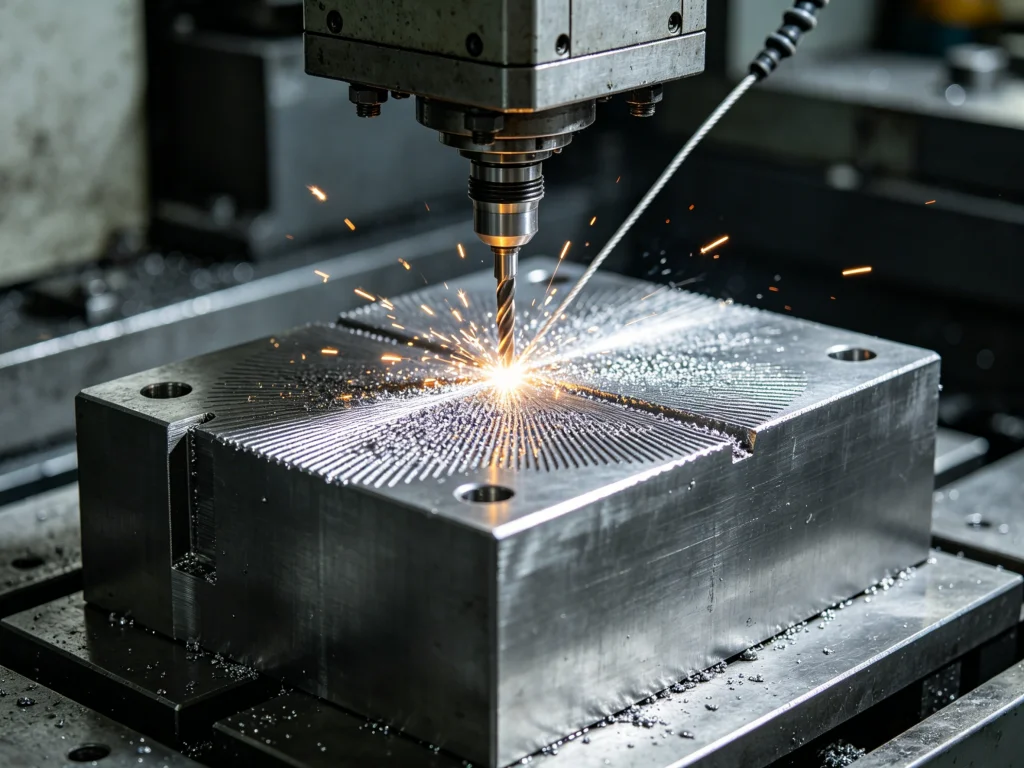
1. Understanding the Science: What is Hardened Steel EDM ?
Electrical Discharge Machining, or EDM, is a non-traditional machining method that removes material through a series of rapidly recurring current discharges between two electrodes. When we discuss hardened steel edm, we are referring to the application of this spark erosion process to metals that have undergone heat treatment to reach high Rockwell C (HRC) values. Unlike traditional CNC machining, which relies on the physical hardness of a cutting tool being greater than the workpiece, EDM does not care about the physical hardness of the metal. If the material is electrically conductive, it may be machined with extreme precision.
The process occurs within a dielectric fluid, which acts as an insulator until a specific voltage is reached, allowing a spark to jump the gap. This spark melts and vaporizes a tiny amount of the hardened steel examples used in the workpiece. Because there is no direct contact between the tool and the part, there is zero mechanical stress. This is particularly crucial for maintaining the dimensions of delicate components that might otherwise deflect or break under the pressure of a physical drill or end mill.
The Role of Dielectric Fluids and Pulse Control
Success in edm hardened steel operations depends heavily on the management of the dielectric fluid. This fluid flushes away the microscopic debris (chips) and cools the work area. For a harden supplier like Jucheng, maintaining the purity and temperature of this fluid is a top priority to ensure that the spark remains stable and the finish remains consistent across the entire production run.
2. Analyzing the Material: The Hardened Steel Material List
Before diving into the machining process, one must understand what makes a steel “hardened.” Steel is typically hardened through a process of heating and rapid cooling (quenching), which transforms the internal structure into martensite. This increases the hardenability of alloy steel, making it ideal for high-wear environments but difficult to shape after the fact. Below are some common hardened steel examples that Jucheng frequently processes for global clients:
- D2 Tool Steel: Known for high wear resistance and excellent hardenability of alloy steel, often reaching 55-62 HRC.
- H13 Tool Steel: A versatile hot-work steel used extensively in die-casting and extrusion molds.
- 4140 Alloy Steel: Frequently hardened for gears, bolts, and structural components.
- S7 Shock-Resisting Steel: Used for tools that must withstand high impact while maintaining a sharp edge.
Addressing Common Material Questions
A frequent question among procurement specialists is, “can you soften hardened steel?” The answer is yes—through a process called annealing. However, many wonder how to soften hardened steel only to realize it might negate the benefits of the material’s initial heat treatment. This leads to the strategic advantage of hardened steel edm: you can machine the part in its final hardened state, eliminating the risk of distortion that often occurs when you machine “soft” and then heat-treat afterward. In the industry, the term hardened steel in chinese is 淬火钢 (cuì huǒ gāng), a term often used in technical specifications when communicating with international manufacturing hubs.
3. Core Application Scenarios for EDM Hardened Steel
The versatility of hardened steel edm makes it indispensable across various high-stakes industries. Because Jucheng operates at the intersection of technology and craftsmanship, we see these applications daily:
Aerospace and Defense
In aerospace, components must withstand extreme thermal cycles and mechanical loads. Actuators, fuel system parts, and turbine components often utilize specialized alloys from the hardened steel material list. The ability of EDM to create deep, narrow slots and complex internal cavities without inducing stress makes it the preferred choice for flight-critical hardware.
Medical Device Manufacturing
Surgical instruments and orthopedic implants require biocompatible materials that are often incredibly hard. Hardened steel edm allows for the creation of micro-scale features on these instruments, ensuring that they remain sharp and functional throughout their service life. Precision is not just a requirement here; it is a life-saving necessity.
Automotive Tool and Die
The automotive industry relies heavily on stamping dies and injection molds. These molds are subjected to millions of cycles, requiring extreme harden steel hardness. EDM is used to “burn” the final shape into these hardened blocks, ensuring that every plastic part or metal panel produced is identical to the first. When you work with a reliable harden supplier, you ensure that the molds themselves do not fail prematurely due to micro-cracks during the machining process.
4. Precision and Choice: Key Factors in Selecting a Harden Supplier
Not all EDM services are created equal. When evaluating a partner for hardened steel edm, several technical and logistical factors must be considered to ensure the longevity and quality of your parts. At Jucheng, we emphasize the following criteria:
| Factor | Traditional Machining (Milling) | Hardened Steel EDM | Jucheng Machining Advantage |
|---|---|---|---|
| Hardness Limit | Difficult above 45 HRC | No limit (up to 70+ HRC) | Expertise in ultra-hard exotic alloys |
| Geometric Complexity | Limited by tool radius | Extremely high (sharp corners) | Advanced 5-axis EDM capabilities |
| Surface Integrity | Risk of mechanical stress | Controlled Heat Affected Zone (HAZ) | Optimized pulse settings for minimal HAZ |
| Precision | High (±0.01mm) | Ultra-High (±0.002mm) | Strict ISO 9001:2015 quality control |
When users on forums like Reddit discuss machining failures, they often cite tool breakage or dimensional “creep” during traditional milling of hardened blocks. By opting for edm hardened steel, you mitigate these risks. However, you must consider the “Heat Affected Zone” (HAZ). A professional provider like Jucheng uses multi-pass finishing to remove the thin layer of re-hardened material left by the sparks, ensuring the part’s surface is as strong as its core.
5. Installation and Long-term Maintenance Considerations
While the focus is often on the machining itself, the way hardened steel edm parts are handled post-production is equally vital. For components destined for high-stress environments, a “stress-relief” temper might be suggested after EDM to ensure no residual thermal stresses remain near the surface.
Maintenance of these parts usually involves monitoring for surface oxidation or corrosion, especially if the hardened steel examples used are not stainless varieties. Proper lubrication and environmental controls are essential. When you receive a shipment from your harden supplier, ensure they are packaged with VCI (Volatile Corrosion Inhibitor) materials to maintain the pristine finish achieved during the EDM process.
6. Why Jucheng is the Leader in Hardened Steel EDM
Jucheng Machining is not merely a service provider; we are a strategic partner in your engineering journey. Our facility is equipped with state-of-the-art Sinker EDM and Wire EDM machines specifically calibrated for the nuances of hardened steel edm. We understand that in the global market, factors like hardened steel in chinese sourcing and competitive pricing are important, but they never come at the expense of quality.
Our team of experts can guide you through the hardened steel material list to select the alloy that provides the best balance of hardenability of alloy steel and cost-effectiveness. Whether you are dealing with a one-off prototype or high-volume production, our processes are designed to be repeatable and reliable. We have helped hundreds of clients solve the problem of how to soften hardened steel by showing them they don’t have to—we can machine it exactly as it is, saving time and preserving material properties.
Our Technical Credentials
Jucheng’s commitment to excellence is backed by rigorous inspections. Every part undergoing edm hardened steel processing is verified using CMM (Coordinate Measuring Machines) to ensure it meets your exact specifications. This level of transparency is why we are the preferred harden supplier for international firms looking for precision and peace of mind.
7. Frequently Asked Questions (FAQ)
Q1: Can you perform EDM on all types of hardened steel?
As long as the material is electrically conductive, we can perform hardened steel edm. This includes all common tool steels, alloy steels, and even some conductive ceramics. The harden steel hardness does not affect the speed of the spark erosion significantly.
Q2: Does EDM change the properties of the steel?
The process creates a very thin “re-cast” layer due to the heat of the sparks. However, Jucheng uses advanced fine-finishing cycles to minimize this layer, ensuring the edm hardened steel part retains its intended mechanical properties.
Q3: Why shouldn’t I just soften the steel, machine it, and then re-harden it?
While you could research how to soften hardened steel, the re-hardening process often causes “warpage” or dimensional changes. Using hardened steel edm on the already-hardened part ensures that your final dimensions are perfect and do not shift after machining.
Q4: What is the typical lead time for an EDM project at Jucheng?
Lead times vary based on complexity, but because EDM is a “lights-out” capable process, we can often deliver hardened steel edm components faster than shops relying solely on manual or traditional CNC setups for hard materials.
Q5: Is EDM more expensive than CNC milling?
While the hourly rate for EDM might be higher, it is often more cost-effective for complex hardened steel examples because it eliminates tool wear costs and reduces the rate of scrap. It may be the only viable option for features like deep sharp-cornered pockets.
Q6: How do you handle the “hardened steel in chinese” terminology for export?
We provide full English documentation, material certifications, and COA (Certificate of Analysis). We bridge the gap between local harden supplier expertise and international quality standards.
Q7: Can EDM reach the same tolerances as grinding?
Yes, modern hardened steel edm at Jucheng can achieve tolerances as tight as ±0.002mm, which is comparable to, and in some cases better than, precision grinding, especially for non-cylindrical shapes.
Conclusion: Elevate Your Production with Jucheng
Navigating the complexities of hardened steel edm requires a partner that understands the intersection of metallurgy and electrical engineering. From identifying the right alloy on the hardened steel material list to executing the final spark, Jucheng Machining provides a seamless, high-precision experience. Don’t let harden steel hardness be a barrier to your innovation. By leveraging our expertise in edm hardened steel, you can achieve the geometric complexity and durability your projects demand.
Ready to see the Jucheng difference? Whether you have questions about can you soften hardened steel for a specific application or you need a quote for a complex hardened steel edm project, our team is standing by to provide the technical support you need.
Contact Jucheng Machining today for a professional consultation and a fast, accurate quote on your next high-precision project.
Visit us at: https://www.jccncmachining.com/