
In the high-stakes environment of an operating room, there is no margin for error. A surgeon relies entirely on the tactile feedback and mechanical reliability of their tools. If a bone saw vibrates excessively or a forceps fails to grip securely, the consequences can be catastrophic. This reality places an immense burden on the manufacturing sector, specifically within the realm of surgical instrument machining. The transition from a raw block of medical-grade alloy to a finished, life-saving instrument requires more than just standard CNC knowledge; it demands a fusion of metallurgical science, extreme precision engineering, and an uncompromising commitment to quality control.
For procurement managers and medical device engineers, the challenge is multifaceted. You may face issues with inconsistent tolerances from current suppliers, difficulties in sourcing biocompatible materials, or delays that stall critical product launches. These pain points are exactly what high-end surgical instrument machining aims to solve. By leveraging advanced surgical instrument machine technology, manufacturers can produce complex geometries that were previously considered impossible, ensuring that every scalpel, retractor, and implant meets the rigorous standards of modern medicine.
The Evolution and Definition of Surgical Instrument Machining
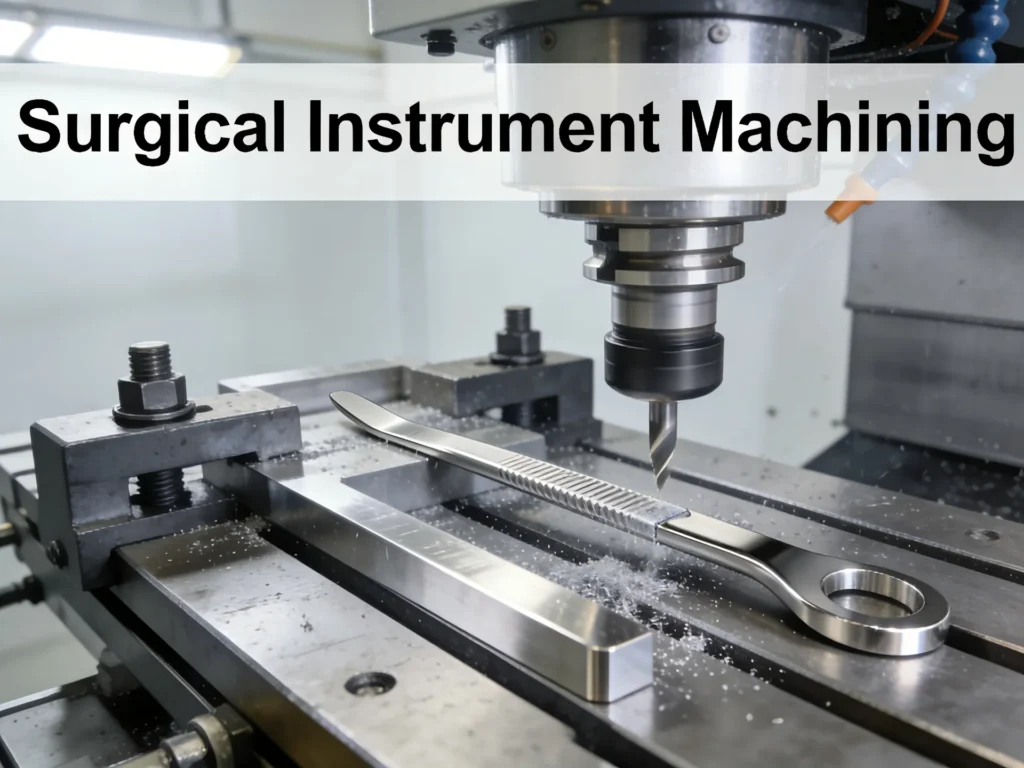
At its core, surgical instrument machining is a specialized subset of CNC (Computer Numerical Control) manufacturing dedicated to producing tools used in medical and surgical procedures. Unlike standard industrial machining, this process is governed by strict regulatory frameworks such as ISO 13485. The surgical instrument machine setups used in this field, such as multi-axis Swiss-type lathes and high-speed 5-axis milling centers, are designed to handle exceptionally small parts with tolerances often measured in microns.
The principle behind this machining involves subtractive manufacturing where material is precisely removed from a workpiece. However, the “medical” distinction comes from the surface integrity. The tools produced must not only be dimensionally accurate but also chemically passive and physically smooth to prevent bacterial growth and ensure compatibility with sterilization processes like autoclaving. Whether it is a simple handle or a complex articulated robotic surgical component, the machining process must maintain the material’s structural integrity to prevent fatigue failure during use.
Material Science: What Are Surgical Instruments Made Of?
Understanding what are surgical instruments made of is fundamental to the machining process. The choice of material dictates the cutting speeds, tool selection, and coolant types used during manufacturing. Most surgical tools are crafted from a specific range of biocompatible materials, each presenting unique machining challenges.
- Stainless Steel (300 and 400 Series): This is the most common material. Grade 316L is favored for its corrosion resistance, while 440C is used for cutting instruments like scissors and scalpels because it can be hardened through heat treatment. Machining these requires sharp carbide tooling to prevent work hardening.
- Titanium Alloys (Grade 5 / Ti-6Al-4V): Preferred for implants and lightweight handheld tools. Titanium is notoriously difficult to machine due to its low thermal conductivity, which causes heat to build up at the cutting edge. Advanced surgical instrument machining techniques involve high-pressure coolant systems to manage this heat.
- Cobalt-Chrome (CoCr): Often used for joint replacements and high-wear surgical components. It is extremely tough and abrasive, requiring specialized ceramic or diamond-coated tools.
- High-Performance Polymers (PEEK): Used for radiolucent instruments (those that don’t show up on X-rays). Machining PEEK requires precise temperature control to avoid melting or deforming the plastic during the cutting process.
Each of these materials has a specific “machinability” rating. For instance, while stainless steel might be the industry standard, the trend toward minimally invasive surgery (MIS) has increased the demand for titanium and nitinol components, pushing surgical instrument machining providers to innovate with their tooling and toolpath strategies.
Classifying the Types of Surgical Instruments Produced
The diversity in types of surgical instruments is staggering, and each category requires a different machining approach. Generally, we can categorize them by their surgical function:
- Cutting and Dissecting Instruments: These include scalpels, scissors, and saws. The primary machining focus here is edge retention and sharpness. CNC grinding is often paired with milling to achieve the required keenness.
- Grasping or Holding Instruments: Forceps and needle holders fall into this category. These often require intricate serrations or tungsten carbide inserts, which are precisely machined and then bonded or welded.
- Clamping and Occluding Instruments: Hemostats used to stop blood flow. These require perfectly aligned jaws, necessitating high-precision surgical instrument machining to ensure the locking mechanisms (ratchets) function smoothly.
- Retracting and Exposing Instruments: Used to hold back tissue. These are often larger but require smooth, polished surfaces to minimize tissue trauma.
- Probing and Dilating Instruments: These require exceptional surface finishes on the internal and external diameters to ensure safe entry into body cavities.
For manufacturers like JuCheng, being able to pivot between these types of surgical instruments involves having a versatile floor plan with both heavy-duty mills and ultra-precise Swiss turning centers. The ability to handle both micro-machining for neurosurgery and robust machining for orthopedic tools is a hallmark of a top-tier supplier.
The Global Landscape: Surgical Instrument Machining in Malaysia and Beyond
The medical device industry is a global powerhouse, and Southeast Asia has become a critical hub. Specifically, the demand for surgical instrument malaysia has seen exponential growth. Malaysia has positioned itself as a primary destination for medical manufacturing, supported by a robust infrastructure and a skilled workforce trained in precision engineering.
When looking for a surgical instrument supplier malaysia, many international firms seek partners who can bridge the gap between cost-effectiveness and high-end technical capability. While JuCheng operates with a global perspective, we recognize that the Southeast Asian market, including Malaysia, requires suppliers who understand both the local regulatory environment and the international standards set by the FDA and CE. The “China + 1” strategy adopted by many medical giants has made the expertise in surgical instrument machining within this region more vital than ever.
Furthermore, for those engaging with regional markets, it is helpful to understand the terminology. In the Chinese market, surgical instruments in chinese are referred to as 手术器械 (Shǒushù qìxiè). Understanding these linguistic and regional nuances is part of being a comprehensive global partner in the medical supply chain.
Critical Factors to Consider When Selecting a Machining Partner
Choosing a partner for surgical instrument machining is not like buying standard hardware. It is a strategic partnership that impacts patient safety. Here are the non-negotiable factors you must evaluate:
1. Technical Precision and Tolerance Capabilities
Modern surgical procedures, especially those involving robotics, require tolerances as tight as +/- 0.005mm. Ask your supplier about their surgical instrument machine specifications. Do they use 5-axis CNC? Is their facility temperature-controlled to prevent material expansion? At JuCheng, we utilize high-precision equipment that ensures repeatability across thousands of units.
2. Quality Certifications (ISO 13485)
An ISO 9001 certification is not enough for the medical field. A dedicated surgical instrument machining provider must hold ISO 13485 certification, which specifically addresses the quality management systems for medical devices. This ensures full traceability of materials from the melt source to the finished product.
3. Surface Finish and Post-Processing
Machining is only half the battle. The final part must undergo passivation, electropolishing, or anodizing. These processes remove free iron from the surface and enhance corrosion resistance. A supplier that offers these services in-house or through a tightly managed network reduces the risk of contamination during transport.
4. Material Traceability and Sourcing
Where does the raw material come from? A reputable surgical instrument supplier malaysia or China-based provider should provide Mill Test Reports (MTRs) for every batch of metal used. This is critical for what are surgical instruments made of, as even minor impurities in a titanium alloy can lead to implant rejection.
| Feature | Swiss CNC Turning | 5-Axis CNC Milling | Wire EDM |
|---|---|---|---|
| Best For | Long, thin, complex turned parts | Complex prismatic geometries | Extremely hard metals / Sharp corners |
| Tolerance | Ultra-high (+/- 0.002mm) | High (+/- 0.005mm) | Extremely High (+/- 0.001mm) |
| Common Application | Bone screws, pins, needles | Hip cups, handles, hinges | Surgical scissor blades, slots |
| Speed | Very Fast (High Volume) | Moderate | Slow |
Installation, Maintenance, and Tool Care
While most clients are purchasing the finished parts, understanding how a surgical instrument machine is maintained can provide insight into the supplier’s reliability. Precision machining requires that machines are calibrated weekly. Thermal compensation sensors must be functional to ensure that as the machine warms up, the tool offsets adjust automatically.
For the end-user (hospitals and clinics), the “maintenance” of these machined instruments involves proper cleaning and sterilization. Because surgical instrument machining often involves creating intricate crevices for mechanical function, these tools must be designed for “cleanability.” If a part is machined with a surface that is too rough, proteins can bind to it, making sterilization impossible. This is why surface roughness (Ra) is a key metric in our quality reports.
Why Choose JuCheng for Your Surgical Instrument Machining Needs?
In a crowded market of surgical instrument supplier malaysia and global manufacturers, JuCheng stands out through a combination of veteran expertise and cutting-edge technology. We don’t just take orders; we provide Design for Manufacturing (DfM) feedback that can reduce costs and improve part longevity.
Our facility is equipped with the latest surgical instrument machine technology, allowing us to handle everything from prototyping to high-volume production. We understand that in the medical world, “good enough” is never acceptable. Our quality control lab uses CMM (Coordinate Measuring Machines) and optical comparators to verify every dimension against your 3D models. When you partner with JuCheng, you are gaining a partner who values precision as much as the surgeons who will eventually hold our products.
Our expertise extends to the global stage, ensuring that whether you are looking for surgical instrument malaysia solutions or components for the North American market, our standards remain consistently world-class. We bridge the gap between complex engineering requirements and reliable, scalable manufacturing.
Frequently Asked Questions (FAQ)
1. What is the most difficult part of surgical instrument machining?
The most difficult aspect is maintaining extremely tight tolerances while ensuring a perfect surface finish on difficult-to-machine materials like Titanium Grade 5. Balancing speed and tool life without compromising the material’s properties requires significant expertise.
2. How do you ensure the biocompatibility of machined parts?
Biocompatibility starts with sourcing certified materials (like 316LVM or Ti-6Al-4V ELI). After surgical instrument machining, we perform rigorous cleaning and passivation to remove any residual machining oils or metallic contaminants, following ASTM standards.
3. Can you help with the design phase of a new surgical tool?
Yes, we offer DfM (Design for Manufacturing) services. By reviewing your designs early, we can suggest modifications that make the surgical instrument machining process more efficient, which often leads to lower costs and higher part quality.
4. What is the difference between Swiss turning and conventional CNC for medical parts?
Swiss turning is designed for small, high-length-to-diameter ratio parts. The workpiece is supported near the cutting tool, allowing for much higher precision and less deflection. It is the gold standard for parts like bone screws and dental implants.
5. Do you provide documentation for regulatory audits?
Absolutely. We provide full documentation packages, including material certifications, dimension inspection reports, and process validation records, which are essential for FDA or CE marking applications.
6. What are surgical instruments made of in terms of the latest trends?
While stainless steel remains a staple, there is a massive shift toward Titanium and PEEK for their strength-to-weight ratios and biocompatibility. We are also seeing increased use of specialized coatings like DLC (Diamond-Like Carbon) to reduce friction in moving parts.
7. How does JuCheng handle small-batch prototypes?
We have a dedicated rapid prototyping workflow that allows us to produce small quantities of surgical instrument machining samples quickly. This helps engineers test the “feel” and function of a tool before committing to mass production.
8. What are surgical instruments in chinese, and do you export to Asia?
As mentioned, they are called 手术器械 (Shǒushù qìxiè). We have a strong export presence throughout Asia, providing high-quality components to various medical hubs, including those seeking a surgical instrument supplier malaysia.
Conclusion: Precision as a Standard
The world of surgical instrument machining is one where the stakes could not be higher. From the initial selection of the surgical instrument machine to the final passivation of the metal, every step must be executed with perfection. By understanding the intricacies of what are surgical instruments made of and the specific needs of different types of surgical instruments, manufacturers can provide the tools that allow modern medicine to advance.
Whether you are looking for a reliable surgical instrument supplier malaysia or a global partner capable of handling the most complex surgical instrument machining projects, JuCheng is ready to deliver. We invite you to experience the precision, quality, and dedication that defines our work.
Ready to Elevate Your Medical Device Manufacturing?
Contact JuCheng today to discuss your next project. Our team of experts is ready to provide you with a detailed quote and DfM analysis to ensure your surgical instruments meet the highest standards of precision and safety.
Visit us at www.jccncmachining.com or email our engineering team directly to start your partnership with a leader in surgical instrument machining.