
You have just spent hours designing a complex aerospace bracket or a medical device housing. The geometry is perfect. The tolerances are tight. You send the CAD file to a machine shop. A week later, you receive parts covered in burrs, with rough surface finishes and dimensional inaccuracies. What went wrong? The culprit might be a specific challenge known as “6061 aluminum machining characteristics gummy” behavior. When not handled correctly, this otherwise versatile alloy can turn into a machinist’s worst nightmare. This guide explores exactly how to overcome these challenges and achieve superior results with 6061 aluminum machining.
The Real-World Problem: When “Easy” Aluminum Becomes Difficult
On Reddit’s r/Machinists and r/CNC communities, a recurring discussion surfaces: “Why is my 6061 turning out so poorly?” One user described how their “6061 aluminum cutting” operation resulted in terrible surface finishes, with chips welding themselves to the end mill. Another noted that their “6061 aluminum milling speed” seemed correct according to standard charts, yet the parts came out with built-up edge (BUE) that ruined the surface. These aren’t isolated incidents. A CNCZone forum thread highlighted a common frustration: “Bad results in turning are probably due to lack of heat treatment; raw aluminum tends to be extremely gummy, and doesn’t machine well at all”. The problem is real, and it costs manufacturers time, money, and rejected parts.
What machinists describe as “gummy” refers to aluminum’s tendency to adhere to cutting tools during machining, creating a built-up edge that degrades surface finish and shortens tool life. One research paper noted that “the gummy feature creates a problematic issue of build up edge (BUE) formation during the cutting process”. This challenge is particularly acute with 6061 in its softer tempers, though even the popular 6061-T6 can exhibit these characteristics when cutting parameters are suboptimal.
Yet 6061 remains the most widely CNC-machined aluminum alloy globally. Its excellent strength-to-weight ratio, corrosion resistance, and post-machining anodizing quality make it indispensable for mission-critical components across aerospace, automotive, medical devices, and industrial equipment. The question is not whether to use 6061, but how to machine it correctly to eliminate the gummy behavior and achieve consistent, high-quality results.
The Solution: Understanding the Metallurgy Behind the Gumminess
To solve the problem, you must first understand what causes 6061 aluminum machining properties to shift from cooperative to problematic. 6061 is a precipitation-hardened alloy in the 6000 series, with magnesium and silicon as primary alloying elements. In the T6 temper—the standard for CNC machined parts—the alloy has been solution heat-treated and artificially aged to peak hardness. This temper delivers a tensile strength of 310 MPa, yield strength of 276 MPa, and a Brinell hardness of 95 HB.
The machinability rating of 6061-T6 machining is approximately 90 percent relative to free-machining brass, which places it among the more machinable aluminum alloys. However, this rating assumes optimal cutting conditions. When parameters drift, two primary issues emerge. First, the alloy’s ductility means it can smear rather than shear cleanly, creating a “gummy” chip that adheres to the cutting edge. Second, the material’s thermal conductivity (167 W/m·K) means heat generated during cutting can quickly transfer to the tool, promoting BUE formation.
The solution involves three coordinated strategies: correct tool selection, optimized cutting parameters, and effective coolant application. Let us examine each in detail.
Tool Selection: Why Sharpness and Geometry Matter
Using sharp, polished tools is arguably the single most important factor in successful 6061 aluminum CNC operations. High-speed steel (HSS) or carbide tools with a polished rake face prevent aluminum from welding to the cutting edge. Uncoated carbide with a polished surface is often ideal for aluminum, as coatings can increase friction and promote chip adhesion. Research confirms that “using sharp, high-speed steel (HSS) or carbide tools with a polished rake face is critical to prevent the common issue of built-up edge”.
Tool geometry also matters significantly. For milling operations, single-flute or two-flute end mills provide better chip evacuation than tools with more flutes. The larger flute valleys allow chips to escape rather than recutting and welding to the workpiece. For turning operations, inserts with high-positive rake angles and polished chip breakers produce clean, manageable chips rather than long stringy ribbons that can wrap around the part.
Cutting Parameters: Finding the Sweet Spot
The right 6061 aluminum cutting speed makes the difference between a smooth operation and a frustrating struggle. For 6061-T6 machining, industry experts recommend cutting speeds between 250 and 500 surface feet per minute (SFM) as a starting point. Within this range, higher speeds generally produce better surface finishes and reduce BUE formation because the increased heat at the shear zone helps chips break cleanly rather than smearing.
Feed rates should be moderate. A reasonable starting depth of cut for 6061 aluminum is approximately 0.100 to 0.150 inches (2.5 to 3.8 mm), though this can be adjusted based on machine rigidity and power. For finishing passes, lighter depths of cut with higher spindle speeds produce superior surface finishes.
Recent research has quantified optimal parameters with impressive precision. One study using Response Surface Methodology found that an optimal combination for minimizing surface roughness on 6061 aluminum occurred at a spindle speed of 1785.86 rpm, a feed rate of 181.31 mm/min, and a depth of cut of 1.13 mm, producing a minimum surface roughness of 0.1519 μm. Another study identified cutting speed as the most influential factor affecting machining performance, contributing 31 percent to the overall optimization outcome, followed by depth of cut and feed per tooth.
For high-volume production, one machining service provider describes their approach: “Roughing is performed at 12,000 RPM with an F0.2 feed rate for rapid stock removal; finishing is elevated to 15,000 RPM with an F0.06 feed rate to achieve high precision and a refined surface finish”.
Coolant: The Essential Ingredient
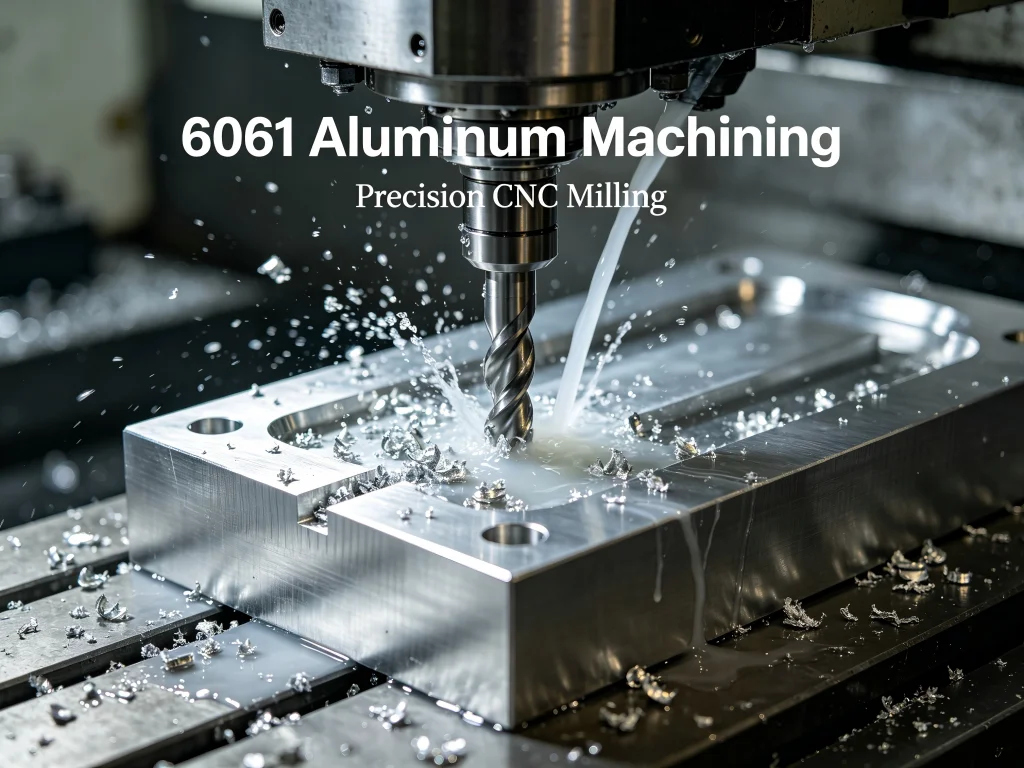
Coolant is not optional for 6061 aluminum cutting. Water-soluble coolant at a concentration of 5 to 10 percent is essential for reducing heat, preventing thermal expansion of the part, improving surface finish, and flushing chips away from the cutting zone. Flood coolant is preferred over mist for most operations because it provides better heat dissipation and chip evacuation. Some research has even explored pulsation coolant strategies, where the shock wave formation of water streams helps minimize BUE formation during the cutting process.
One machinist on Reddit shared their practical experience: “Coolant, either mist or flood, is quite necessary for any useful metal removal rate” when working with 6061 aluminum. Without adequate coolant, chips weld to the tool, surface finishes degrade, and dimensional accuracy suffers from thermal expansion.
JUCHENG’s facility addresses these challenges through rigorous process control. Operating from an 8,000-square-meter facility with over 150 CNC machines, including 25 advanced 5-axis Haas and Mazak centers, the company maintains strict parameter monitoring for every 6061 aluminum job. Each cutting operation is optimized based on material temper, part geometry, and required tolerances, ensuring gummy behavior is eliminated before it affects part quality.
From Problem to Precision: Case Studies Across Industries
When 6061 aluminum machining properties are properly understood and controlled, the alloy reveals its true potential across demanding applications.
Aerospace Components: Where Failure Is Not an Option
Aerospace manufacturers rely on 6061 aluminum for structural brackets, fittings, and secondary airframe components because of its exceptional strength-to-weight ratio and corrosion resistance. One JUCHENG client required a complex aircraft bracket with multiple internal radii and tight ±0.025 mm tolerances. The challenge lay not in the geometry alone but in the 6061 t6 machining requirements: the part needed to maintain dimensional stability across temperature variations while achieving a surface finish suitable for Type II anodizing. By implementing high-speed toolpaths with optimized chip loads and flood coolant, JUCHENG delivered 500 defect-free brackets with consistent surface finishes below 0.8 μm Ra.
Medical Devices: Precision Meets Biocompatibility
Medical device manufacturers choose 6061 for surgical instrument housings and device enclosures because of its biocompatibility and anodizing quality. The material can achieve ultra-precision tolerances down to ±0.005 mm for critical mating surfaces. However, the gummy characteristic poses particular risks in medical applications, where even microscopic burrs can compromise sterilization or patient safety. JUCHENG’s ISO 13485-certified processes include automated deburring stations and Zeiss CMM inspection to verify zero-defect compliance for every medical component.
Automotive Performance Parts: Strength Without Weight
The automotive industry values 6061 for suspension components, engine mounts, and custom racing parts where weight reduction directly improves performance. One motorsport client needed 200 custom control arms with integrated mounting features. The parts required both turning and milling operations, plus anodized finishing for corrosion protection. By utilizing turn-mill centers that combine lathe and milling capabilities in a single setup, JUCHENG completed the production run in 12 days rather than the estimated 18 days, with every part meeting the specified ±0.05 mm tolerances.
Key Selection Factors: How to Choose the Right Partner for 6061 Aluminum CNC Machining
Selecting a manufacturing partner for 6061 aluminum machining requires evaluating several critical factors beyond simple price comparison.
Equipment Capability and Machine Fleet
The complexity of parts you can produce directly correlates with your partner’s machine capabilities. Basic 3-axis milling works for simple prismatic parts, but complex geometries with undercuts, deep cavities, or five-sided features require 4-axis or 5-axis equipment. JUCHENG’s fleet of 150+ CNC machines, including 25 advanced 5-axis Haas and Mazak centers, enables simultaneous 5-axis machining for complex geometries in a single setup, reducing both lead times and cumulative tolerance errors.
Quality Assurance and Certification
For mission-critical applications, certifications matter. IATF 16949 certification demonstrates capability for automotive quality management, including defect prevention and PPAP documentation support. ISO 13485 certification is essential for medical device components, ensuring risk management and full material traceability. JUCHENG maintains both certifications, plus ISO 9001:2015 for quality management systems, verified by Zeiss CMM inspection equipment that ensures micron-level accuracy.
Surface Finishing Capabilities
Machined 6061 parts almost always require finishing. Anodizing, available in Type II (clear or color) and Type III (hard anodize) variants, adds a durable oxide layer that enhances corrosion resistance and allows color dyeing. JUCHENG offers a full spectrum of in-house surface finishes, from anodizing to mirror polishing, ensuring end-to-end quality control without subcontracting delays.
Lead Time and Production Scalability
Prototype turnaround and production scalability often separate capable partners from exceptional ones. JUCHENG’s 150+ machine fleet enables parallel processing of large production runs while maintaining consistent quality. The company’s ISO 9001-certified processes ensure systematic process control and on-time delivery even for demanding production schedules.
Why JUCHENG Excels at 6061 Aluminum Machining
With over 13 years of expertise in high-precision manufacturing, JUCHENG has developed specialized knowledge in 6061 aluminum machining that extends beyond generic best practices. The company’s approach combines advanced equipment, certified quality systems, and practical experience solving real-world machining challenges.
The 8,000-square-meter facility houses an extensive fleet of 150+ CNC machines, including 25+ advanced 5-axis Haas and Mazak centers, turn-mill machining centers, and precision grinding equipment. This equipment diversity allows JUCHENG to handle 6061 components across the full spectrum of complexity, from simple turned shafts to intricate aerospace brackets requiring simultaneous 5-axis machining.
Quality verification relies on advanced Zeiss CMM inspection equipment, ensuring dimensional accuracy at the micron level. Combined with ISO 13485 and IATF 16949 certifications, these capabilities deliver zero-defect, mission-critical components for aerospace, medical, and automotive leaders worldwide.
Unlike many machine shops that treat 6061 as a commodity material, JUCHENG recognizes its unique characteristics and adapts machining strategies accordingly. The company’s process engineers have developed proprietary toolpath strategies specifically for 6061 that minimize BUE formation and optimize chip evacuation. These strategies, combined with rigorous parameter monitoring and in-process inspection, ensure consistent results across production runs of any size.
Installation and Maintenance Considerations for 6061 Machining Operations
While end users of machined 6061 parts rarely handle machine installation, understanding proper maintenance of machined components extends product life and performance.
For components that will undergo anodizing after machining, maintaining clean surfaces free from cutting fluid residue is essential. Contamination can cause uneven anodizing or surface defects. JUCHENG’s in-house finishing capabilities include specialized cleaning stations that remove all machining residues before anodizing, ensuring uniform oxide layer formation.
For assembled systems incorporating machined 6061 parts, proper torque application prevents thread stripping or component distortion. The alloy’s moderate hardness requires careful torque management, particularly for smaller fasteners. Engineers designing assemblies with 6061 components should specify torque values that account for the material’s yield strength of approximately 276 MPa.
Regular inspection of machined surfaces for signs of galvanic corrosion is recommended when 6061 components contact dissimilar metals. The alloy’s natural corrosion resistance is excellent, but contact with copper or stainless steel in wet environments can accelerate corrosion. Applying appropriate isolation methods or protective coatings prevents this issue.
Frequently Asked Questions About 6061 Aluminum Machining
What is the machinability rating of 6061 aluminum?
6061-T6 carries a machinability rating of approximately 90 percent relative to free-machining brass, which serves as the 100 percent baseline. This rating places 6061 among the more machinable aluminum alloys, though it requires appropriate cutting parameters and tool selection to achieve optimal results. In comparison, 2011 aluminum, which is specifically formulated for machinability, rates near 100 percent, while 7075 rates lower at approximately 70 to 80 percent due to its higher hardness and abrasiveness.
Why does 6061 aluminum become gummy during machining?
The “gummy” characteristic occurs when cutting parameters generate excessive heat without adequate chip evacuation. The material smears rather than shears cleanly, creating a built-up edge on the tool that degrades surface finish and dimensional accuracy. This issue is more pronounced in softer tempers like 6061-O but can affect 6061-T6 when speeds, feeds, or coolant application are suboptimal. One study noted that “the gummy feature creates a problematic issue of build up edge (BUE) formation during the cutting process”.
What are the optimal cutting speeds for 6061 aluminum milling?
For 6061 aluminum milling speed, industry guidelines recommend 250 to 500 surface feet per minute (SFM) as a starting range for 6061-T6, with adjustments based on tool diameter, machine rigidity, and coolant effectiveness. Research has demonstrated that optimized parameters can achieve surface finishes as fine as 0.1519 μm Ra. Roughing operations typically use lower speeds with heavier chip loads, while finishing passes employ higher speeds with lighter depths of cut. For high-speed machining centers, spindle speeds of 12,000 to 15,000 RPM are common for 6061 aluminum.
How does 6061 compare to 7075 for CNC machining?
The 6061 aluminum machinability rating exceeds that of 7075. While 7075 offers significantly higher strength, 6061 is easier to machine, produces cleaner chips, and causes lower tool wear. 6061 also provides superior corrosion resistance and weldability, making it the preferred choice for most general-purpose CNC machining applications. However, 7075 remains the material of choice for high-stress aerospace components where maximum strength outweighs machining considerations. Cost also differs substantially: 6061 is significantly more economical, typically costing one-third to one-half the price of 7075.
What surface finishes are available for machined 6061 parts?
6061-T6 is compatible with all common aluminum finishing processes. Type II anodizing (clear or color) adds a 5 to 25 micron oxide layer that improves corrosion resistance and allows color dyeing. Type III hard anodizing produces a thicker, more wear-resistant coating for demanding applications. Other options include as-machined finish for functional surfaces, bead blasting for uniform matte appearance, mirror polishing for aesthetic components, and powder coating for decorative or protective finishes.
What tolerances can be achieved with 6061 aluminum CNC machining?
Standard CNC machining of 6061 aluminum can achieve ±0.1 mm tolerances under normal production conditions. Medium precision operations deliver ±0.05 mm, which represents the practical sweet spot for most production parts. High precision machining achieves ±0.025 mm for demanding applications, while ultra-precision grinding can reach ±0.005 mm for critical mating surfaces. Tighter tolerances increase inspection requirements and fixture complexity, affecting cost and lead time.
How does coolant selection affect 6061 aluminum machining results?
Coolant choice directly impacts chip formation, surface finish, and tool life for 6061 aluminum machining. Water-soluble coolant at 5 to 10 percent concentration provides effective lubrication and heat dissipation. Flood coolant is generally preferred over mist because it offers superior chip evacuation and temperature control. Some research has explored pulsation coolant strategies that use shock wave formation to minimize BUE, though results have shown that feed rate remains the most significant factor affecting cutting forces. Machinists typically avoid straight oils for 6061 because they lack adequate cooling capacity for high-speed operations.
For a comprehensive comparison of 6061 against other aluminum alloys for specific applications, our aluminum alloy selection guide provides detailed property comparisons. Additional technical resources are available from the Aluminum Anodizers Council and ASM International.
Ready to transform your 6061 aluminum designs into precision-machined components? JUCHENG’s engineering team provides expert DFM analysis and competitive quoting for projects of any scale.
➡️ Request a Quote for Your 6061 Aluminum Project
➡️ Explore JUCHENG’s Full CNC Machining Capabilities
➡️ Download Our 6061 Aluminum Machining Data Sheet