
You have a critical part design ready. The local machine shop quotes $4,800 for 50 units. A China supplier quotes $2,200. The gap is too wide to ignore—but the anxiety is real. Will the parts actually meet your tolerances? Will communication breakdowns derail the project? Will that low cost CNC machining China factory deliver on time, or will you be left explaining delays to your stakeholders? This is the exact dilemma playing out in engineering meetings and procurement departments worldwide. The good news? The 2026 data suggests your concerns are valid—but so is the opportunity. Let us walk through what actually works.
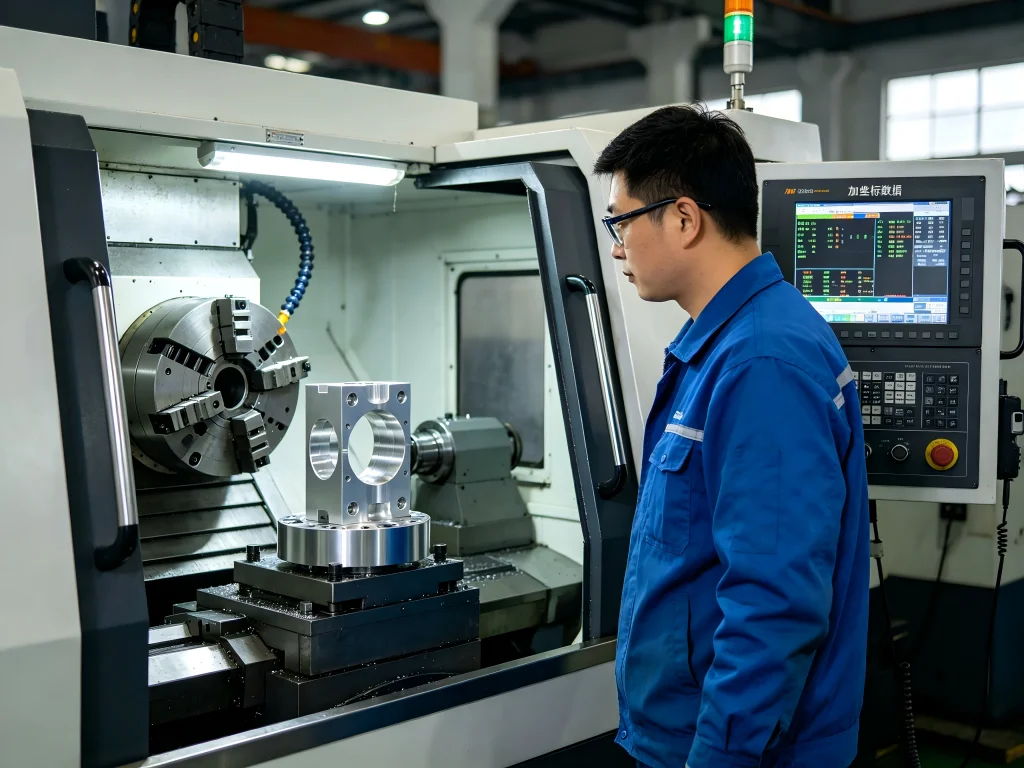
The Real Problem: Why Cost Savings Feel Risky
A recurring debate in mechanical engineering circles asks whether you can trust Chinese CNC shops for precision work. The question usually gets answered with anecdotes—someone’s cousin had a bad batch from Alibaba, or a colleague’s aerospace subcontractor in Shenzhen delivered perfect parts for three years running. This is precisely the problem: purchasing decisions based on stories rather than systems. When you evaluate low cost CNC machining China factory options, you are not just comparing price tags. You are comparing risk profiles, quality systems, and communication capabilities. The cost savings—typically 30 to 50 percent compared to Western suppliers—are substantial. But the question is not whether the savings exist. The question is whether you can capture them without sacrificing quality, timeline, or peace of mind.
What Low Cost CNC Machining Actually Means
Definition and Core Principles
Low cost CNC machining China refers to the strategic sourcing of computer numerical control manufacturing services from Chinese factories at rates significantly below Western market averages. This is not merely about cheaper labor. While skilled CNC operators in China earn approximately $4 to $8 per hour compared to $20 to $40 in the United States or Europe, the true cost advantage stems from systemic efficiency: integrated supply chains, high machine utilization rates, mature supplier ecosystems, and optimized logistics networks. The 2026 reality is that labor is only a small fraction of the total cost breakdown for a precision component. The real savings come from how Chinese manufacturing hubs like Shenzhen and Dongguan organize production—with component suppliers, finishing services, and inspection facilities often located within the same industrial park.
When you engage a low cost CNC machining China factory, you are accessing an ecosystem that has spent decades refining cost structures. The question is whether your specific partner has the capability to deliver your specific parts to your specific standards.
How the Economics Work
The cost structure breaks down into several components. Basic three-axis CNC machining in China typically runs $15 to $40 per hour, with tier-one factories in Guangdong charging $8 to $18 per machine-hour for three-axis work and $18 to $40 for five-axis operations. Inland factories may offer even lower rates—$5 to $12 per hour—but often with less control over quality and longer lead times. Material costs add another layer: aluminum is relatively inexpensive, stainless steel costs roughly twice as much, and titanium can be three times more expensive.
Beyond the base rates, Chinese suppliers typically offer 30 to 50 percent cost savings compared to Western counterparts for identical specifications. These savings come from lower labor expenses, competitive raw material sourcing (with Chinese buyers often paying 15 to 30 percent less for common materials), and higher machine utilization. However, the “China price” trap is real—low bids that lead to expensive failures. A quote that looks dramatically cheaper than every other option may have skipped inspection time, assumed loose tolerances, ignored finishing requirements, or quoted slow sea freight instead of express delivery.
What Reddit and Industry Forums Reveal About Buyer Concerns
The Reddit discussion around Chinese CNC machining reflects what many engineers and product teams think privately when they first evaluate overseas machining. The comments center on practical sourcing risk rather than simple country stereotypes. Here is what experienced buyers consistently flag:
- Price that looks too good: Low price can be legitimate when a shop has efficient equipment, lower overhead, and local material access. But if a quote is dramatically cheaper than every other option, ask what is excluded.
- Communication and drawing interpretation: Clear English is helpful, but technical communication matters more. A reliable supplier should ask about critical dimensions, mating surfaces, surface finish, thread standards, material grade, tolerance stack-up, and inspection requirements. If a factory accepts every file instantly without questions, that is not always a good sign.
- Quality verification: The strongest concern is whether the parts will match the drawing. Separate “we can make it” from “we can prove it”—ask for first article inspection, dimensional reports, material certificates when relevant, and clear photos before shipment.
- Shipping, customs, and timing: Shipping can change the real cost. Small prototype parts may ship efficiently by DHL, FedEx, UPS, or air freight. Heavy parts or large batches may require different Incoterms and customs planning. A reliable supplier should help you estimate the landed cost, not only the ex-works machining price.
One forum participant noted a practical lesson: “You just need to send a model, no drawing is necessary unless you have a critical dimension”. Another shared their experience ordering parts from a Chinese supplier: “I picked up Fusion 360 pretty quickly and had parts made at a reasonable cost (which is now less reasonable due to tariffs but still cheaper than US manufacturing)”. These real-world insights underscore a fundamental truth: the low cost is real, but so is the need for disciplined supplier evaluation.
The Data Behind Capable Chinese CNC Factories
Haizol’s 2026 China CNC Machining Industry Report replaces anecdotes with data. They audited 456 factories across China between 2023 and 2026, documenting specific machine models, certifications, industry customers, and quality control infrastructure. The picture that emerges is more nuanced—and more capable—than either the skeptics or the boosters typically acknowledge.
Equipment That Matches Western Precision Shops
Capability claims are cheap. Equipment serial numbers are not. Haizol’s audit methodology went beyond checking boxes for “five-axis capability”—they documented actual machine models on factory floors. What they found: 38.8 percent of the 456 suppliers operate five-axis milling centers. The granularity matters: twelve companies run DMG MORI five-axis platforms—DMU 50, DMU 60P, DMU 65, DMU 80P, DMU 85 MONOBLOCK, and DMU 125P duoBLOCK. These are machines in the $800,000 to $2 million-plus range, built in Germany and Japan, and they are the same platforms you would find in precision shops in Bavaria or Michigan. Eleven companies operate Mazak VARIAXIS and INTEGREX multi-axis systems. Three have Makino ultra-precision centers exceeding $2 million per unit—machines designed for sub-micron work in aerospace and medical mold making. Fourteen companies run multiple FANUC ROBODRILL high-speed systems.
This is not a handful of showcase factories. It is a statistically significant portion of the supplier base making capital investments on par with Western precision shops.
Certifications That Prove Capability
Equipment capability is necessary but not sufficient. The question is whether shops actually hold tolerances in production, consistently, under quality management systems that external auditors verify. The data is compelling: of 456 factories, 316 (69.3 percent) serve the automotive industry, 273 (59.9 percent) serve medical equipment customers, 196 (43.0 percent) serve aerospace, 157 (34.4 percent) serve military applications, and 145 (31.8 percent) serve semiconductor manufacturing. These are not casual relationships. Medical equipment supply requires FDA oversight and ISO 13485 compliance. Aerospace demands AS9100 with its extensive traceability and material certification requirements. Automotive requires IATF 16949, which mandates demonstrated statistical process capability (Cpk ≥1.33 for critical characteristics) validated through annual surveillance audits. Haizol found that 127 companies (27.9 percent) currently hold IATF 16949 certification. That certification takes twelve-plus months to implement and requires ongoing SPC monitoring, measurement system analysis, and Production Part Approval Process documentation. It cannot be purchased—it has to be earned and maintained.
How to Select a Reliable Low Cost CNC Machining China Factory
Before you send a production order, screen suppliers with the same seriousness you would use for a local vendor. Here is a practical framework based on what experienced buyers and industry data reveal.
Verify They Are a Real CNC Factory
Confirm the supplier operates an actual manufacturing facility with physical assets. Look for factory size (facilities exceeding 5,000 square meters suggest serious production capacity), workforce size (companies employing one hundred-plus staff typically have dedicated departments for engineering, quality control, and after-sales support), and years in operation (manufacturers with ten-plus years of experience demonstrate market resilience and process maturity). Request a video tour or arrange a third-party audit if your order volume justifies the investment.
Examine Equipment and Technical Capability
Verify that suppliers operate multi-axis CNC systems appropriate for your part complexity. Look for evidence of CAD/CAM integration using tools like SolidWorks or AutoCAD. Assess material versatility—leading suppliers work with stainless steel (including SS303 and SS304), aluminum alloys (6061, 7075), brass, titanium, and engineering plastics. Secondary processes such as anodizing, passivation, laser engraving, and powder coating add value by enhancing durability and aesthetics.
Review Quality Assurance and Compliance
Consistent quality begins with robust process controls. Prioritize suppliers certified under ISO 9001. For regulated sectors such as automotive or medical devices, confirm compliance with IATF 16949 or ISO 13485. Request documentation of inspection protocols—including first-article inspections (FAI), in-process checks, and final reporting via CMM (Coordinate Measuring Machine) or optical comparators. Most precision machined parts require surface finish Ra ≤ 1.6μm unless specified otherwise. Transparent suppliers provide dimensional reports and material certifications upon request.
Evaluate Operational Reliability Metrics
Behind every successful supply chain relationship lies measurable performance. Use these KPIs to filter out underperformers: on-time delivery rate ≥95 percent (indicates logistical discipline and capacity planning), average response time ≤2 hours (critical for fast iteration during prototyping phases), reorder rate >30 percent (reflects client retention and service consistency), and annual online revenue >$50,000 (suggests stable operations and transaction volume).
Core Applications Across Industries
Low cost CNC machining China factory services serve a remarkably broad range of industries. In automotive manufacturing, suppliers produce engine blocks, cylinder heads, turbocharger housings, and transmission components. Medical device manufacturers rely on CNC machining for surgical instruments, implant components, and diagnostic equipment parts. The aerospace sector demands five-axis machining for structural components, turbine blades, and landing gear parts. Electronics manufacturers use CNC machining for enclosures, heat sinks, and connector housings. Robotics and automation companies leverage CNC machining for precision drive shafts, robotic arms, and end-effector components. The common thread across all these applications is the need for precision, consistency, and cost-effectiveness—qualities that a capable Chinese CNC factory can deliver when properly vetted.
Installation and Maintenance Considerations
While most buyers of CNC machining services do not install the machines themselves, understanding the production environment helps you evaluate supplier capability. Key maintenance practices that indicate a well-run shop include regular machine calibration, thermal compensation systems to maintain accuracy across temperature variations, tool condition monitoring, and coolant management. Suppliers who treat maintenance as a discipline rather than an afterthought typically produce more consistent parts. Ask about their preventive maintenance schedule, machine age and replacement cycles, and how they handle tool wear compensation during production runs.
Why Jucheng Precision Stands Out
Jucheng Precision operates at the intersection of cost-effectiveness and technical excellence. With over thirteen years of rapid prototyping experience, the company has built a reputation for delivering production-quality hardware with near-zero residual stress. Their facility operates under the IATF 16949 quality management system, a certification that takes twelve-plus months to implement and requires demonstrated statistical process capability validated through annual surveillance audits.
The company’s technical capabilities are substantial. They operate a fleet of over twenty-five high-performance five-axis centers, enabling them to machine complex assemblies from a single solid block of material. This approach delivers immediate benefits: parts are lighter (no fasteners), stronger (no weld joints or seams), and perfectly aligned. Their integrated approach combines five-axis precision, exotic material mastery, and a zero-defect mindset.
What sets Jucheng apart in the low cost CNC machining China factory landscape is their commitment to transparency and partnership. They provide comprehensive Design for Manufacturing (DFM) reviews, ensuring that potential issues are identified before production begins. Their engineering team engages with critical dimensions, mating surfaces, surface finish requirements, thread standards, material grades, tolerance stack-ups, and inspection requirements. They offer a full range of surface finishing services including polishing, brushing, sandblasting, anodizing, powder coating, plating, passivation, and laser etching.
For buyers worried about intellectual property protection—a common concern in overseas sourcing—Jucheng enforces extremely high-standard confidentiality principles. They combine legal protection with sourcing discipline: using NDAs, removing unnecessary proprietary context from early RFQs, watermarking drawings when needed, and avoiding sending full product assemblies when only a component quote is required.
The company’s capacity and speed are equally impressive. Covering 8,000 square feet of manufacturing space, they offer quality parts in as little as three to five days for complete 2D and 3D CAD models. More complex parts requiring special features take longer, but the commitment to rapid turnaround without compromising quality remains consistent.
Frequently Asked Questions
Is low cost CNC machining China actually cheaper than local manufacturing?
Yes. Chinese suppliers typically offer 30 to 50 percent cost savings compared to Western counterparts for identical specifications. These savings stem from lower labor costs, competitive material sourcing, higher machine utilization, and mature supply chain ecosystems.
How do I verify the quality of a Chinese CNC factory before ordering?
Request documentation of certifications (ISO 9001, IATF 16949, ISO 13485, AS9100), ask for equipment lists with specific machine models, review sample parts with dimensional reports, and request a video tour or third-party audit. Look for suppliers who ask questions about critical dimensions, tolerances, and inspection requirements—this indicates technical competence.
What is the typical lead time for CNC parts from China?
Simple parts can be manufactured in three to five days with complete 2D and 3D CAD models. More complex parts may take longer. Including shipping, total lead time to North America or Europe typically ranges from one to three weeks depending on the shipping method chosen.
What materials can Chinese CNC factories work with?
Leading suppliers work with stainless steel (including SS303 and SS304), aluminum alloys (6061, 7075), brass, titanium, copper, and engineering plastics. They also offer secondary processes such as anodizing, passivation, powder coating, and plating.
How do I handle shipping and customs when sourcing from China?
Work with your supplier to estimate landed cost, not only the ex-works machining price. Small prototype parts typically ship efficiently by DHL, FedEx, or UPS. Heavy parts or large batches may require different Incoterms and customs planning. A reliable supplier should guide you through these considerations.
What certifications should a Chinese CNC factory have?
ISO 9001 is the baseline. For automotive work, IATF 16949 is essential. For medical devices, ISO 13485 is required. For aerospace, AS9100 with its extensive traceability and material certification requirements is necessary. Each certification requires ongoing audits and demonstrated capability.
How do I protect my intellectual property when working with Chinese suppliers?
Combine legal protection with sourcing discipline. Use an NDA, remove unnecessary proprietary context from early RFQs, watermark drawings if needed, and avoid sending full product assemblies when only a component quote is required. Work with established suppliers like Jucheng who enforce strict confidentiality principles.
Making the Right Decision for Your Project
Low cost CNC machining China factory options offer genuine value—but only when you approach sourcing with the same rigor you would apply to any critical supplier relationship. The data from 456 audited factories shows that capable, certified, well-equipped Chinese CNC manufacturers exist in significant numbers. The key is separating the capable from the mediocre through disciplined evaluation of equipment, certifications, quality systems, and operational metrics.
Jucheng Precision represents the kind of partner that makes the low cost CNC machining China model work. With IATF 16949 certification, a fleet of twenty-five-plus five-axis centers, thirteen years of experience, and a transparent approach to quality and communication, they address the concerns that keep procurement professionals awake at night. The cost savings are substantial—but they come with the confidence that your parts will meet specifications, your timeline will be respected, and your intellectual property will be protected.
Ready to explore how low cost CNC machining China can work for your next project? Contact Jucheng Precision today for a comprehensive DFM review and experience the clarity that expert process planning can bring to your next precision project.