
No mundo de alto risco da engenharia aeroespacial, um único microssegundo de interferência de sinal ou um leve pico térmico pode levar a uma falha catastrófica do sistema. Imagine um moderno cockpit durante uma fase crítica de pouso. O piloto depende de dezenas de sistemas eletrônicos interconectados, todos alojados dentro de carcaças metálicas especializadas. Se essas carcaças não fornecerem blindagem eletromagnética adequada ou se deformarem sob as mudanças extremas de pressão de uma descida rápida, a eletrônica interna pode apresentar mau funcionamento. Este é o principal desafio enfrentado pelos engenheiros hoje: como proteger unidades sensíveis de dados de voo e módulos de comunicação dos ambientes hostis da alta atmosfera. A resposta está na disciplina especializada de usinagem de invólucro de aviônicos, um processo que combina metalurgia avançada com precisão CNC extrema para criar um santuário protetor para eletrônicos críticos.
Para muitos gerentes de compras e projetistas aeroespaciais, o ponto de dor é claro. Você pode ter um brilhante projeto de invólucro de aviônicos no papel, mas traduzir isso em um componente físico que atenda aos requisitos MIL-SPEC e ainda permaneça leve é outra história. Muitas oficinas de usinagem têm dificuldades com os requisitos de parede fina e geometrias complexas necessárias para o hardware de voo moderno. Quando uma carcaça é muito pesada, ela reduz a eficiência de combustível; quando é muito fina, pode vibrar excessivamente ou não dissipar calor. Esse equilíbrio delicado é a razão pela qual escolher o parceiro de fabricação certo não é apenas uma decisão logística, mas uma decisão crítica para a segurança.
Entendendo o Fundamentos: O que é Usinagem de Invólucros de Aviônicos?
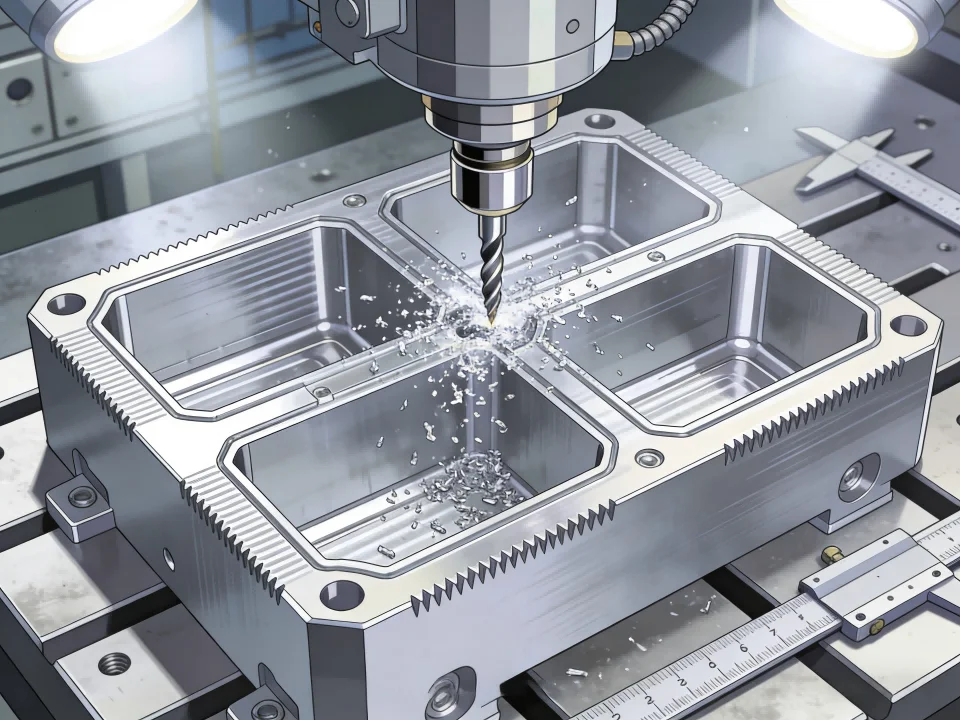
Em sua essência, usinagem de invólucro de aviônicos é o processo de manufatura subtrativa usado para criar as carcaças protetoras para sistemas eletrônicos usados em aeronaves, satélites e naves espaciais. Diferentemente de caixas industriais padrão, esses invólucros devem atuar como unidades multifuncionais. Eles não são meramente recipientes; são dissipadores de calor sofisticados, gaiolas de Faraday e componentes estruturais, tudo em um só. O processo normalmente envolve fresamento CNC de alta velocidade, no qual um bloco sólido de material de grau aeroespacial — geralmente alumínio, magnésio ou ligas especializadas — é esculpido em uma carcaça complexa com pontos de montagem integrados, aletas de resfriamento e juntas de EMI.
O princípio por trás desse processo de usinagem gira em torno da estabilidade dimensional e da integridade superficial. Durante o voo, uma aeronave se move através de diversas zonas de pressão e gradientes de temperatura que variam de -50 graus Celsius a bem mais de 50 graus no pátio. Um invólucro mal usinado pode desenvolver microfissuras ou “fluência” ao longo do tempo, levando à perda de vedação hermética. Portanto, o processo de usinagem deve levar em conta as tensões internas dentro do metal. Usinadores especialistas frequentemente utilizam ciclos de alívio de tensões entre passes de desbaste e acabamento para garantir que os invólucros de aviônicos finais mantenham sua forma dentro de tolerâncias tão apertadas quanto 0,01 mm.
Além disso, a integração da produção de peças CNC aeroespaciais nesses invólucros significa que cada furo, bolsão e rosca deve estar perfeitamente alinhado. Em um conjunto moderno de aviônicos, conectores de diferentes fornecedores devem se interfacear perfeitamente com a carcaça usinada. Se um flange de montagem estiver desviado por uma fração de milímetro, a folga resultante pode permitir que a interferência eletromagnética (EMI) vaze para dentro, perturbando sinais de navegação ou comunicação. É por isso que a indústria migrou para centros de usinagem de 5 eixos que podem concluir invólucros complexos em uma única configuração, reduzindo o erro cumulativo que vem de mover a peça entre diferentes máquinas.
Navegando pelas Armadilhas Comuns no Design e Produção de Invólucros
Uma das discussões mais frequentes em fóruns profissionais como Reddit e LinkedIn envolve a dificuldade com a “estabilidade de paredes finas”. Designers aeroespaciais frequentemente ultrapassam os limites, solicitando espessuras de parede de 0,5 mm ou menos para economizar peso. No entanto, usinar seções tão finas é notoriamente difícil. O material pode vibrar (chatter) durante o processo de corte, levando a um acabamento superficial ruim ou até mesmo a uma falha estrutural. Para resolver isso, técnicas avançadas usinagem de invólucro de aviônicos utilizam dispositivos de vácuo especializados e ferramentas customizadas para apoiar a peça de trabalho durante toda a operação.
Outra questão significativa é o gerenciamento térmico. À medida que os componentes eletrônicos se tornam mais potentes, eles geram mais calor. Ventiladores de resfriamento tradicionais são frequentemente evitados em ambientes pressurizados ou de alta altitude devido a preocupações com confiabilidade. Consequentemente, o próprio invólucro deve servir como o principal condutor térmico. Isso exige a usinagem de conjuntos intrincados de aletas e a manutenção de altas relações entre área superficial e volume. Se o processo de usinagem deixar uma superfície rugosa na interface térmica, a eficiência de transferência de calor cai, podendo levar à “tela azul” de um computador de voo em pleno voo.
Cenários de Aplicação Principais para Invólucros de Alta Precisão
Onde vemos esses componentes usinados sofisticados em ação? As aplicações são tão variadas quanto as próprias aeronaves, cada uma apresentando desafios únicos que usinagem de invólucro de aviônicos devem ser abordados:
- Sistemas de Controle de Voo: Estes são os cérebros da aeronave. Os invólucros devem ser robustos o suficiente para suportar as forças de alta gravidade da decolagem e manobras de combate, ao mesmo tempo que protegem os processadores de raios e radiação solar.
- Pods de Comunicação e Navegação: Localizados no exterior ou no nariz do avião, essas unidades enfrentam aquecimento aerodinâmico extremo e possíveis colisões com aves. A usinagem deve garantir uma vedação perfeita para evitar a entrada de umidade em altas altitudes.
- Eletrônica de UAV e Drones: Para veículos aéreos não tripulados, o peso é a prioridade absoluta. Aqui, projeto de invólucro de aviônicos o foco está em ligas ultraleves e usinagem “esqueletizada” que remove cada grama desnecessária de metal sem comprometer a integridade estrutural.
- Hardware de Satélite e Espaço: In the vacuum of space, heat can only be dissipated through radiation and conduction. These enclosures are often gold-plated or specially treated after machining to manage thermal loads in the harsh sun/shade cycles of orbit.
Critical Buying Factors: How to Choose a Machining Partner
Selecting a vendor for usinagem de invólucro de aviônicos requires a deeper dive than just comparing price quotes. The complexity of these parts means that a low-cost provider might end up costing more in the long run due to rejected parts or, worse, field failures. When evaluating a potential partner like jucheng, consider the following factors:
| Fator | Requisito | Impact on Performance |
|---|---|---|
| Tolerância Dimensional | +/- 0.01mm or better | Ensures proper fit of connectors and maintains EMI shielding integrity. |
| Certificações de Materiais | AS9100 / ISO 9001 | Guarantees that the alloys used are genuine and free from internal defects. |
| Acabamento Superficial | Ra 0.8 or lower | Crucial for thermal conductivity and the effectiveness of chemical coatings. |
| Blindagem EMI/RFI | Conductive Platings | Prevents signal interference between sensitive electronic modules. |
| Lead Time & Prototyping | Rapid Iteration | Allows designers to test projeto de invólucro de aviônicos before mass production. |
Moreover, you should inquire about their quality control processes. Do they use Coordinate Measuring Machines (CMM) to verify the geometry? Do they offer non-destructive testing (NDT) to check for cracks? In avionics maintenance, the traceability of a part is paramount. If a part fails three years from now, the manufacturer should be able to provide the original material mill report and the machining logs associated with that specific serial number.
Installation and Long-term Avionics Maintenance
Once the usinagem de invólucro de aviônicos is complete and the part is delivered, the work is not over. Proper installation is critical. Technicians could use calibrated torque wrenches to ensure that mounting bolts are tightened evenly, preventing the housing from warping or losing its hermetic seal. Furthermore, the interface between the enclosure and the aircraft chassis must be treated with conductive gaskets or chemical films to maintain a continuous ground path for lightning protection.
In the realm of avionics maintenance, these enclosures are inspected periodically for signs of galvanic corrosion or fatigue. If an enclosure shows signs of pitting, it may need to be stripped and re-plated. This highlights why the initial machining quality is so important; a surface that is too porous or has “micro-tears” from dull cutting tools will be much more susceptible to corrosion in salty, humid environments near coastal airports. High-quality machining from jucheng ensures that the base metal is perfectly prepared for protective coatings like Alodine or hard-coat anodizing.
Why Jucheng is the Strategic Choice for Avionics Machining
When searching for a partner that understands the nuances of usinagem de invólucro de aviônicos, jucheng stands out as a leader in the CNC field. The company has invested heavily in state-of-the-art multi-axis machining centers specifically configured for aerospace tolerances. But hardware is only half the story. The engineering team at jucheng acts as a collaborative partner, often reviewing a client’s projeto de invólucro de aviônicos to suggest improvements that reduce weight or improve machinability without sacrificing strength.
jucheng understands that in the aerospace industry, “close enough” is never enough. Their quality management system is designed to meet the rigorous demands of global aerospace tier-1 suppliers. Whether it is a small batch of prototype invólucros de aviônicos for a new eVTOL project or a large-scale production run for a commercial airliner, jucheng provides the same level of meticulous attention to detail. Their expertise in handling specialized materials like Aluminum-Lithium or Magnesium alloys gives them an edge in the quest for “light-weighting” modern aircraft.
Além disso, jucheng offers a comprehensive suite of post-machining services. This includes precision grinding, heat treatment coordination, and advanced surface finishing. By managing the entire lifecycle of the produção de peças CNC aeroespaciais, they reduce the risk of logistical errors and ensure that the final product arrives ready for the assembly line. This “one-stop” approach is highly valued by engineers who are tired of managing multiple vendors for a single complex part.
Frequently Asked Questions Regarding Avionics Machining
1. What are the most common materials used in avionics enclosure machining?
Most invólucros de aviônicos are crafted from Aluminum 6061 or 7075 due to their excellent strength-to-weight ratio and thermal conductivity. For weight-sensitive applications like satellites, Magnesium or specialized composites might be used, although they require more complex machining safety protocols.
2. How do you ensure EMI shielding in a machined enclosure?
EMI shielding is achieved through a combination of precise mechanical fit and conductive surface treatments. The usinagem de invólucro de aviônicos must produce perfectly flat mating surfaces. These are often treated with a conductive chromate conversion coating (like Alodine) and fitted with conductive gaskets to create a continuous electrical shield.
3. Can you machine enclosures with integrated liquid cooling channels?
Yes, advanced CNC techniques allow for the creation of internal fluid paths or “cold plates” within the walls of the enclosure. This is increasingly common in high-power radar systems and AI-driven flight computers where air cooling is insufficient.
4. What is the typical lead time for a custom aerospace cnc part?
Lead times vary based on complexity, but typically range from 3 to 6 weeks for prototypes. jucheng often utilizes rapid tooling strategies to shorten this window for urgent avionics maintenance or R&D requirements.
5. Why is 5-axis machining preferred over 3-axis for these parts?
5-axis machining allows the tool to reach complex undercuts and angled holes in a single setup. This significantly improves the accuracy of the projeto de invólucro de aviônicos implementation by eliminating the errors that occur when a part is re-clamped in multiple positions.
6. How does vibration affect the machining of avionics enclosures?
Vibration during machining can cause “chatter,” which ruins surface finish and can even lead to structural micro-cracks. Professional shops use harmonic analysis and specialized dampening tools to ensure that the thin walls of invólucros de aviônicos remain stable throughout the cutting process.
7. What certifications should I look for in a machining partner?
At a minimum, ISO 9001 is required, but for true aerospace work, AS9100 is the gold standard. This certification ensures that every step of the usinagem de invólucro de aviônicos process is documented and traceable, which is essential for FAA or EASA compliance.
Conclusion: The Path to Reliable Aerospace Electronics
The challenges of modern flight demand more than just standard manufacturing; they require a partnership rooted in precision and technical expertise. As we have seen, usinagem de invólucro de aviônicos is a complex dance of material science, thermal engineering, and mechanical precision. By addressing the core problems of heat, interference, and weight through superior projeto de invólucro de aviônicos and execution, manufacturers can ensure the safety and reliability of the next generation of aircraft.
If you are currently facing challenges with wall thinning, thermal dissipation, or finding a supplier that truly understands the rigors of avionics maintenance and aerospace standards, it is time to consult with experts. The right produção de peças CNC aeroespaciais can be the difference between a system that thrives in the clouds and one that fails when it matters most.
Ready to elevate your aerospace project with industry-leading precision? Visit jucheng at https://www.jccncmachining.com/ to explore our advanced usinagem de invólucro de aviônicos capabilities. Our team of experts is ready to transform your most complex designs into flight-ready reality. Contact us today for a technical consultation and quote!