
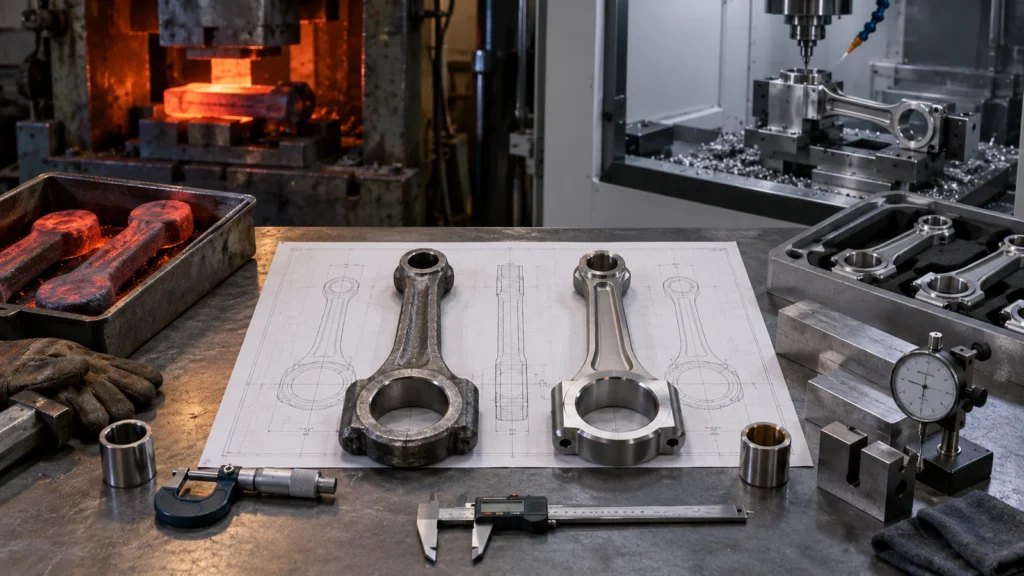
Because investment castings are commonly finish-machined, the practical comparison is often not casting versus machining. It is machining from solid versus casting a controlled blank and machining only functional features. The quality of that blank-to-finish plan determines whether the hybrid route saves work or creates new variation.
Follow the Metal Through Both Routes
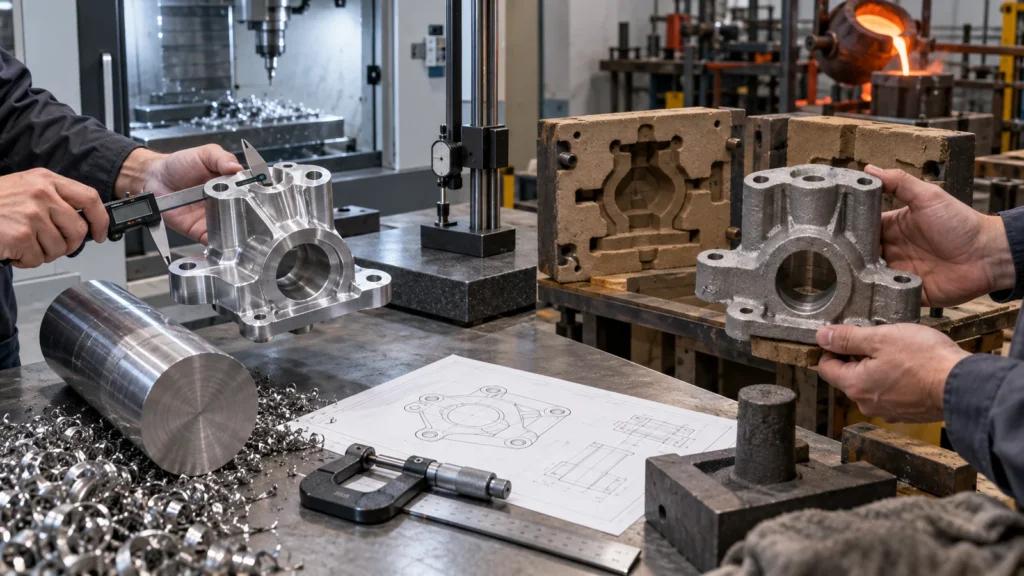 CNC machining begins with bar, plate, billet, tube, extrusion, forging, or another stock form and removes material until the final part remains. The economic penalty grows when the starting envelope is much larger than the finished shape, especially with costly alloys or long cutting cycles. Chips may retain recycling value, but purchasing, handling, and removing that material still consume resources.
Investment casting begins with a pattern, builds a ceramic shell, removes the pattern, pours metal into the cavity, breaks away the shell, separates the castings, and performs finishing and inspection. It creates complex near-net geometry with less stock removal, but adds tooling, pattern, gating, shell, melting, solidification, and casting-control decisions.
Trace the proposed part through each operation. If casting removes most roughing while leaving a manageable set of precision finishes, it may add value. If the casting still needs extensive machining, difficult locating, and high scrap exposure, billet may remain the simpler route.
CNC machining begins with bar, plate, billet, tube, extrusion, forging, or another stock form and removes material until the final part remains. The economic penalty grows when the starting envelope is much larger than the finished shape, especially with costly alloys or long cutting cycles. Chips may retain recycling value, but purchasing, handling, and removing that material still consume resources.
Investment casting begins with a pattern, builds a ceramic shell, removes the pattern, pours metal into the cavity, breaks away the shell, separates the castings, and performs finishing and inspection. It creates complex near-net geometry with less stock removal, but adds tooling, pattern, gating, shell, melting, solidification, and casting-control decisions.
Trace the proposed part through each operation. If casting removes most roughing while leaving a manageable set of precision finishes, it may add value. If the casting still needs extensive machining, difficult locating, and high scrap exposure, billet may remain the simpler route.
Where Geometry Creates Casting Value
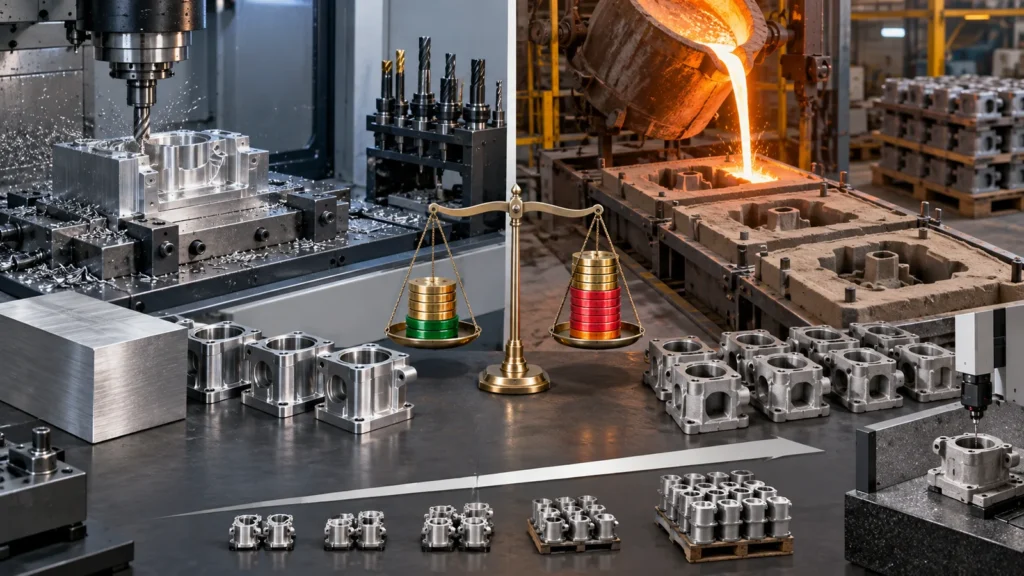 Investment casting is attractive for curved forms, changing sections, integrated lugs, external detail, and shapes that would require extensive multi-axis cutting or assembly from several pieces. It can consolidate components and reduce joints. Yet “complex” is not enough. The geometry must be castable, feedable, releasable from the pattern system, cleanable, and inspectable.
Thin and thick sections influence cooling differently. Abrupt mass changes can increase defect risk. Internal cavities may require cores and bring removal or inspection challenges. The supplier must review fillets, section transitions, gating, risers, shrinkage, and distortion. A shape that looks efficient in CAD can still be difficult to fill consistently.
CNC machining has the opposite constraint: cutter reach and workholding. Deep pockets, hidden surfaces, small internal radii, and multiple setup directions add time. Comparing feature maps helps identify whether complexity is expensive for the cutter, the casting, or both.
Investment casting is attractive for curved forms, changing sections, integrated lugs, external detail, and shapes that would require extensive multi-axis cutting or assembly from several pieces. It can consolidate components and reduce joints. Yet “complex” is not enough. The geometry must be castable, feedable, releasable from the pattern system, cleanable, and inspectable.
Thin and thick sections influence cooling differently. Abrupt mass changes can increase defect risk. Internal cavities may require cores and bring removal or inspection challenges. The supplier must review fillets, section transitions, gating, risers, shrinkage, and distortion. A shape that looks efficient in CAD can still be difficult to fill consistently.
CNC machining has the opposite constraint: cutter reach and workholding. Deep pockets, hidden surfaces, small internal radii, and multiple setup directions add time. Comparing feature maps helps identify whether complexity is expensive for the cutter, the casting, or both.
Material Performance Needs a Real Specification
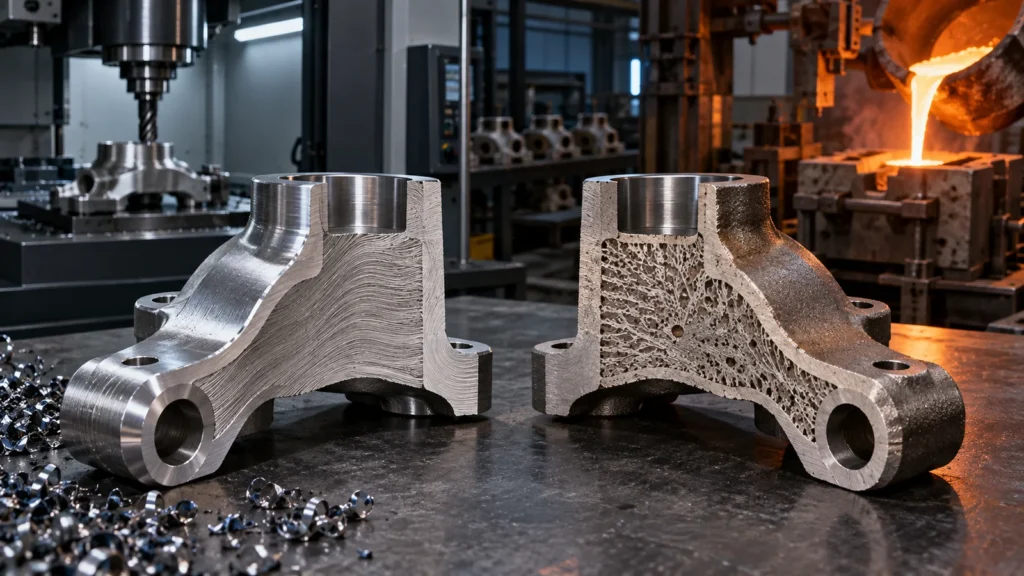
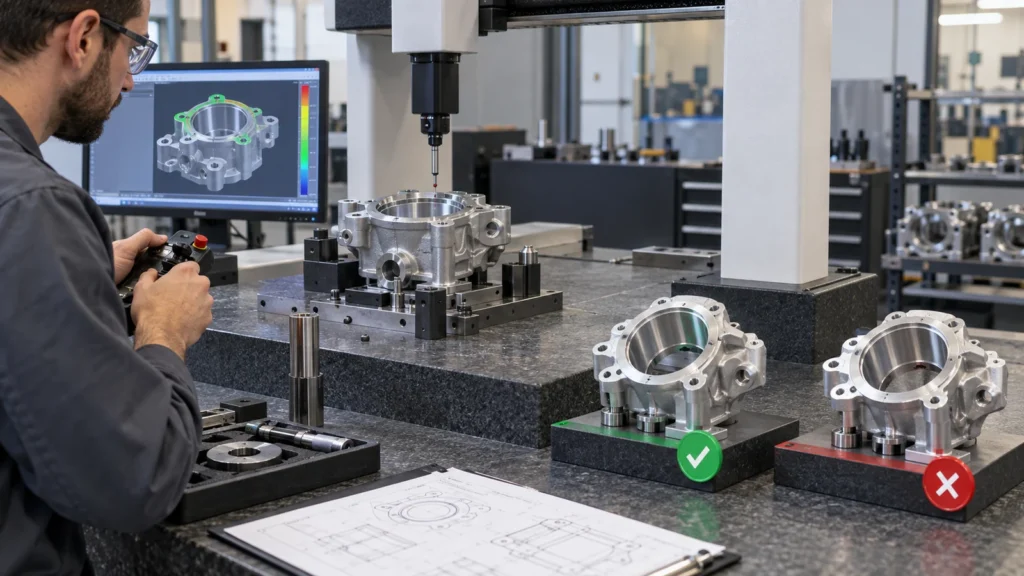 A familiar alloy name does not make wrought and cast conditions equivalent. Solidification structure, heat treatment, porosity, inclusions, section thickness, and sampling method can change performance. If the part is fatigue-critical, pressure-retaining, impact-loaded, exposed to severe temperature, or safety-related, the specification must define the applicable casting grade, property requirements, and verification route.
Billet prototypes can prove geometry and many functional interfaces while still overstating the consistency or properties of the future casting. Cast samples can reveal process-specific behavior but may require destructive tests, nondestructive examination, or coupons defined by the program. Make these evidence gaps visible in the validation plan.
Material choice should connect to the wider CNC material selection strategy, but the casting supplier must confirm castability and available specifications rather than assuming a stock grade transfers directly.
A familiar alloy name does not make wrought and cast conditions equivalent. Solidification structure, heat treatment, porosity, inclusions, section thickness, and sampling method can change performance. If the part is fatigue-critical, pressure-retaining, impact-loaded, exposed to severe temperature, or safety-related, the specification must define the applicable casting grade, property requirements, and verification route.
Billet prototypes can prove geometry and many functional interfaces while still overstating the consistency or properties of the future casting. Cast samples can reveal process-specific behavior but may require destructive tests, nondestructive examination, or coupons defined by the program. Make these evidence gaps visible in the validation plan.
Material choice should connect to the wider CNC material selection strategy, but the casting supplier must confirm castability and available specifications rather than assuming a stock grade transfers directly.
Allowance and Datums Make the Hybrid Route Work
 Machining allowance is intentional stock added to a casting so final cutting can remove surface variation and establish controlled features. Too little allowance risks incomplete cleanup. Too much adds cycle time, tool wear, and the chance of cutting into subsurface defects. Allowance should vary by feature, casting capability, distortion, and machining access rather than being applied as one global offset.
Datums are equally important. The rough casting needs stable locating areas for the first machining operation. Those areas must be repeatable enough to distribute remaining stock across critical features. After initial faces or bores are created, later operations can reference machined datums. A poor datum plan can turn a good casting into a high-scrap machining job.
Machining allowance is intentional stock added to a casting so final cutting can remove surface variation and establish controlled features. Too little allowance risks incomplete cleanup. Too much adds cycle time, tool wear, and the chance of cutting into subsurface defects. Allowance should vary by feature, casting capability, distortion, and machining access rather than being applied as one global offset.
Datums are equally important. The rough casting needs stable locating areas for the first machining operation. Those areas must be repeatable enough to distribute remaining stock across critical features. After initial faces or bores are created, later operations can reference machined datums. A poor datum plan can turn a good casting into a high-scrap machining job.
Use a Cost-and-Risk Ledger Instead of a Crossover Myth
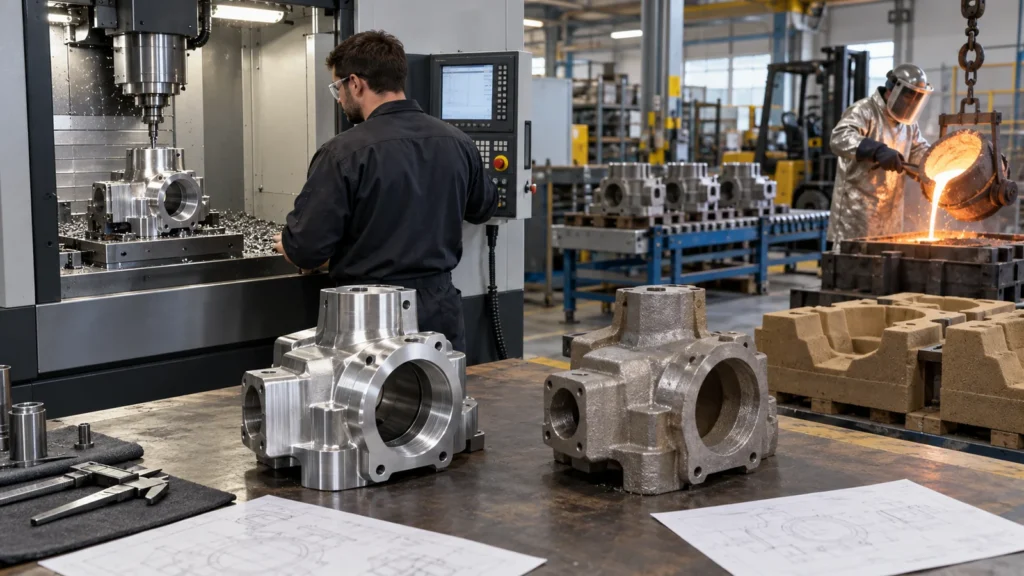 For machining from solid, record stock cost, buy-to-finish mass, roughing and finishing time, setups, tools, workholding, inspection, scrap, and repeat-order behavior. For investment casting, add pattern tooling, wax and shell operations, foundry minimums, trial and approval, casting yield, cut-off and finishing, heat treatment, examination, machining allowance, fixtures, and secondary scrap.
Then add change risk. A CNC program is often easier to revise while a pattern tool and casting process carry more committed assumptions. Add schedule risk, supplier handoffs, inventory, and the value of material saved. The ledger turns “casting is cheaper at volume” into a program-specific decision that can be reviewed as forecasts change.
Do not ignore quality economics. If hidden defects are unacceptable, testing and disposition may dominate. If nearly every surface is machined, the casting may deliver less savings than expected. If expensive alloy becomes chips, the near-net route may gain importance even at moderate quantities.
Finished-part yield is the useful measure. A casting can pass incoming checks and fail after machining exposes a subsurface indication, after heat treatment moves a critical feature, or after pressure testing reveals a connected path. The commercial model should include the value already added when those failures appear.
Supplier handoffs add another risk. When the foundry, heat treater, machine shop, and finisher are separate, define transfer criteria, identification, preservation, and nonconformance ownership. Otherwise a locally acceptable rough casting can become an unfinishable part with no agreed disposition route.
Schedule models should identify the constrained step. Pattern capacity, shell building, melt schedule, heat treatment, specialist examination, or finish machining may govern delivery. A near-net process does not automatically produce a shorter lead time, particularly during initial approval.
For machining from solid, record stock cost, buy-to-finish mass, roughing and finishing time, setups, tools, workholding, inspection, scrap, and repeat-order behavior. For investment casting, add pattern tooling, wax and shell operations, foundry minimums, trial and approval, casting yield, cut-off and finishing, heat treatment, examination, machining allowance, fixtures, and secondary scrap.
Then add change risk. A CNC program is often easier to revise while a pattern tool and casting process carry more committed assumptions. Add schedule risk, supplier handoffs, inventory, and the value of material saved. The ledger turns “casting is cheaper at volume” into a program-specific decision that can be reviewed as forecasts change.
Do not ignore quality economics. If hidden defects are unacceptable, testing and disposition may dominate. If nearly every surface is machined, the casting may deliver less savings than expected. If expensive alloy becomes chips, the near-net route may gain importance even at moderate quantities.
Finished-part yield is the useful measure. A casting can pass incoming checks and fail after machining exposes a subsurface indication, after heat treatment moves a critical feature, or after pressure testing reveals a connected path. The commercial model should include the value already added when those failures appear.
Supplier handoffs add another risk. When the foundry, heat treater, machine shop, and finisher are separate, define transfer criteria, identification, preservation, and nonconformance ownership. Otherwise a locally acceptable rough casting can become an unfinishable part with no agreed disposition route.
Schedule models should identify the constrained step. Pattern capacity, shell building, melt schedule, heat treatment, specialist examination, or finish machining may govern delivery. A near-net process does not automatically produce a shorter lead time, particularly during initial approval.
Transition Without Invalidating Earlier Tests
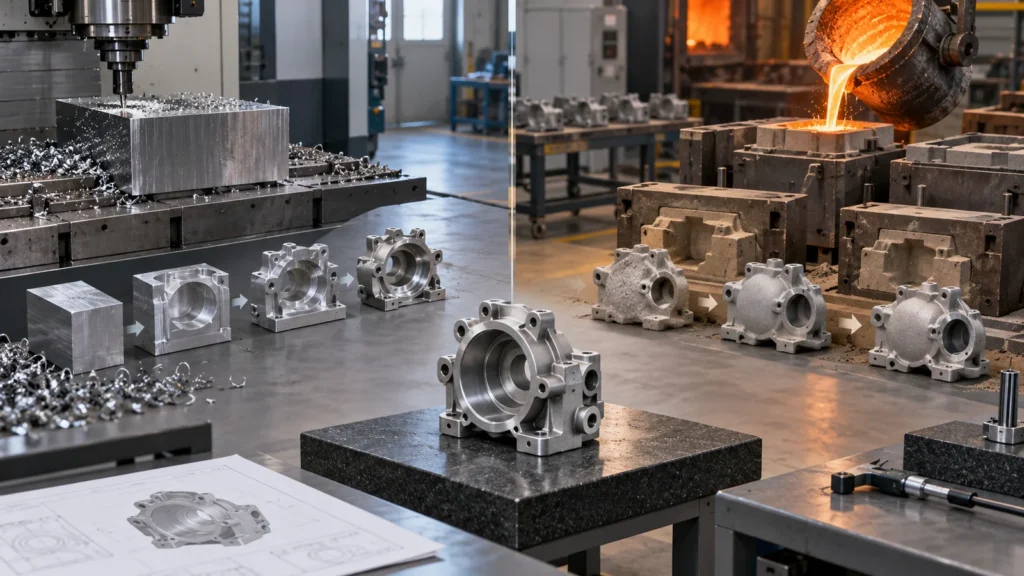 Classify each requirement as geometry-dependent, material-condition-dependent, or process-dependent. Assembly fit may transfer from a billet prototype. Fatigue, leak integrity, cast surface behavior, or properties near section transitions may not. Plan cast trials around the gaps rather than repeating every test blindly or assuming all evidence transfers.
Control the models. Maintain an as-cast definition, a finished-machined definition, and a drawing that clearly identifies both states. Record casting source, heat treatment, revision, machining route, and inspection status. If billet parts continue as bridge supply, prevent mixed lots from becoming indistinguishable.
The transition belongs within a broader prototype and production plan, with explicit gates for design freeze, tooling release, sample approval, and repeat production.
Classify each requirement as geometry-dependent, material-condition-dependent, or process-dependent. Assembly fit may transfer from a billet prototype. Fatigue, leak integrity, cast surface behavior, or properties near section transitions may not. Plan cast trials around the gaps rather than repeating every test blindly or assuming all evidence transfers.
Control the models. Maintain an as-cast definition, a finished-machined definition, and a drawing that clearly identifies both states. Record casting source, heat treatment, revision, machining route, and inspection status. If billet parts continue as bridge supply, prevent mixed lots from becoming indistinguishable.
The transition belongs within a broader prototype and production plan, with explicit gates for design freeze, tooling release, sample approval, and repeat production.
Three Part Families, Three Answers
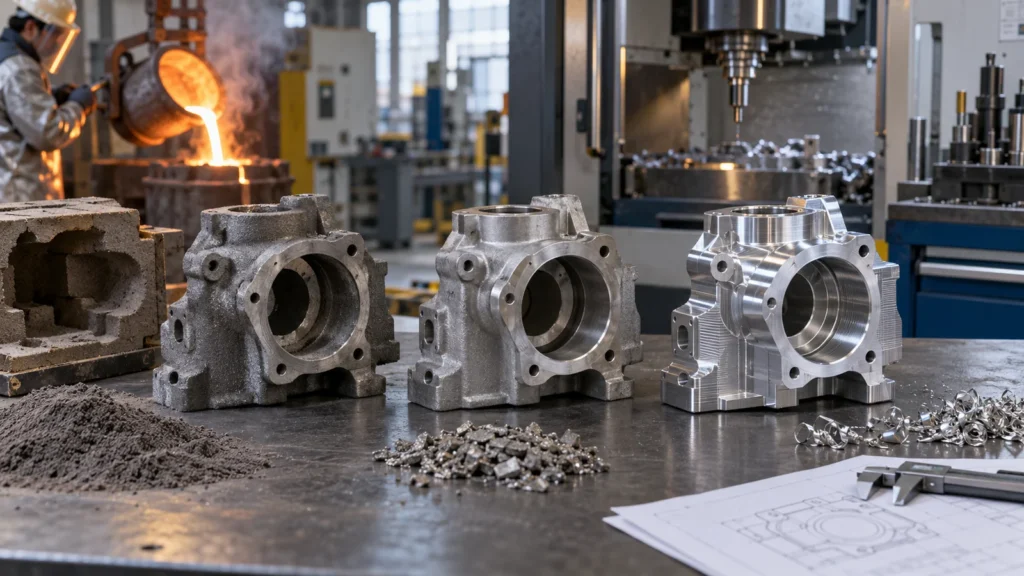
A compact part with many close-tolerance faces and little removable excess may favor machining. Casting adds a rough-form process without eliminating enough precision work.
Complex lever or impeller-like body
Curved shape, integrated bosses, and high material removal can support investment casting, followed by machining at pivots, bores, and mounting faces. Material integrity and balance requirements need explicit validation.
Valve or flow component
A near-net body may reduce machining, but pressure boundary, internal cleanup, passages, sealing faces, and examination can control feasibility. The cheapest rough casting is not necessarily the lowest-risk finished valve.
Build the Sourcing Package Around Finished Function
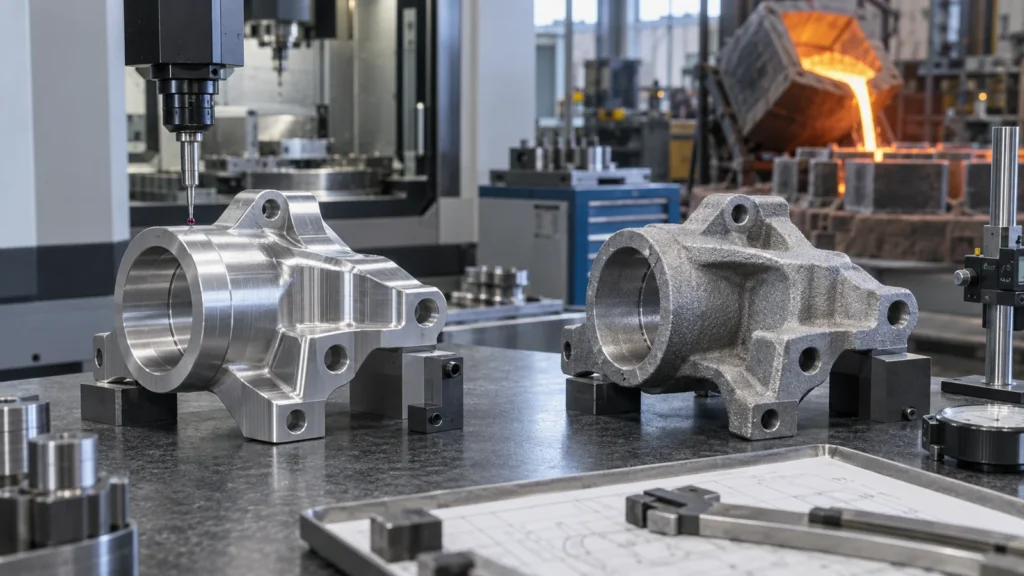 Provide quantities and release pattern, lifetime demand, final model and drawing, protected geometry, acceptable redesign zones, material and heat-treatment specification, critical features, surface requirements, inspection and test evidence, and change outlook. Ask for the proposed as-cast model, allowance map, datum route, secondary-machining plan, and responsibility for nonconformance.
Compare the finished accepted component, not a casting quote against a machined-part quote with different scopes. This is also the right context for evaluating the advantages and disadvantages of CNC machining without reducing the decision to a generic volume rule.
Provide quantities and release pattern, lifetime demand, final model and drawing, protected geometry, acceptable redesign zones, material and heat-treatment specification, critical features, surface requirements, inspection and test evidence, and change outlook. Ask for the proposed as-cast model, allowance map, datum route, secondary-machining plan, and responsibility for nonconformance.
Compare the finished accepted component, not a casting quote against a machined-part quote with different scopes. This is also the right context for evaluating the advantages and disadvantages of CNC machining without reducing the decision to a generic volume rule.
Engineering FAQs
It can create geometry that is difficult to machine, often with cores or specialized pattern approaches, but release, core removal, cleaning, inspection, and consistency must be reviewed for the specific shape.
Does investment casting eliminate surface finishing?
Not automatically. Cast surface may be acceptable in some zones, while cosmetic, sealing, sliding, or precision areas may need blasting, polishing, machining, coating, or other treatment.
Can the foundry and machine shop be separate?
Yes, but interface control becomes critical. Define rough-casting acceptance, allowance, datum condition, traceability, shipping protection, and who owns scrap discovered during machining.
When should CNC remain the production process?
When volume is uncertain, revisions remain likely, billet condition is important, geometry is machining-friendly, or most features require final machining anyway, staying with CNC may preserve flexibility and reduce total risk.