
+86-188-7042-1176
project@jcproto.com
Mon-Fri: 8am-6pm (GMT+8)
EN
ISO 9001:2015 Certified
PP (Polypropylene)
Polypropylene (PP) is a lightweight, versatile plastic renowned for its exceptional chemical resistance and unique "living hinge" capability. It is nearly immune to most acids, bases, and organic solvents, making it a staple in the Chemical Processing and Medical sectors. However, PP is notoriously difficult to machine due to its high thermal expansion and tendency to produce burrs. At Jucheng Precision, we have mastered the art of machining PP. Using ultra-sharp tooling and optimized cooling techniques, we produce burr-free PP manifolds, containers, and functional hinges with tight tolerances. Our expertise ensures that your PP parts maintain their lightweight and fatigue-resistant properties while meeting your exact geometric requirements.
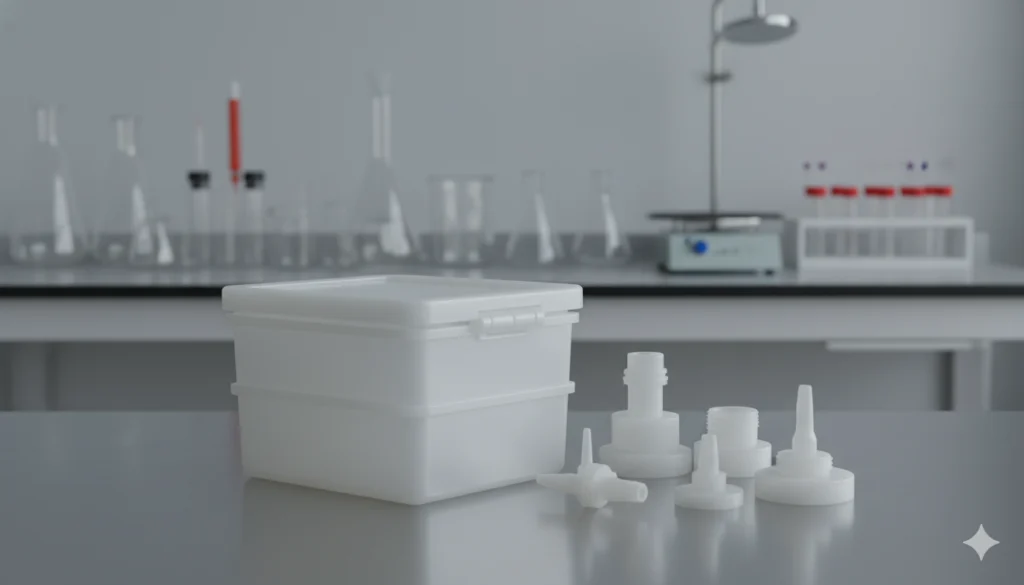
Available Polypropylene Types
| Grade | Common Name | Key Characteristics | Typical Applications |
|---|---|---|---|
| PP Homopolymer | Rigid PP | Higher strength and stiffness. Best for structural chemical tanks and labware. | Chemical manifolds, valves, pump parts. |
| PP Copolymer | Impact PP | Improved impact resistance at low temperatures. More flexible. | Automotive battery cases, protective covers. |
| Glass-Filled PP | PP GF20/30 | Reinforced for much higher rigidity and dimensional stability. | Appliance components, automotive structural parts. |
PP Machining Capabilities
| Capability | Technical Description | Jucheng Advantage |
|---|---|---|
| Burr-Free Milling | Using specialized high-speed spindles and sharp geometry tools to shear PP cleanly. | Eliminates manual deburring, ensuring smooth internal channels for fluidic manifolds. |
| Living Hinge Fabrication | Precision milling of thin sections (down to 0.3mm) to create durable, integrated hinges. | Ensures thousands of flex cycles without material fatigue or failure. |
| Precision Tank Turning | Turning large-diameter PP cylinders with consistent wall thickness. | Our rigid lathes prevent material “pushing,” achieving perfect roundness for chemical containment. |
Fabrication Guidelines for Polypropylene
Heat Control: PP has a low melting point. Standard tools will gum up quickly. Tip: We use sharp tools and abundant air-cooling to maintain a cold cutting zone.
Clamping Strategy: PP is soft and easily deformed. We use custom soft jaws and vacuum tables to distribute pressure evenly without marring the waxy surface.
Dimensional Growth: PP has a high thermal expansion coefficient. We machine in temperature-controlled environments to ensure the parts fit correctly at room temperature.
Primary Application Industries
Chemical & Labware: Manifolds, acid-resistant valves, and custom containers for aggressive fluids.
Medical: Orthopedic braces and sterilization-resistant laboratory tools that require low weight.
Consumer Products: Reusable containers and functional prototypes with integrated “living” components.
Material Properties
| Density | 0.90 - 0.92 g/cm³ |
| Tensile Strength | 30 - 40 MPa |
| Elastic Modulus | 1.1 - 1.6 GPa |
| Hardness | 70 - 100 HRB |
| Continuous Service Temp | 100 - 110 °C |
| Water Absorption | < 0.01 % |
| Melting Point | 160 - 170 °C |
| Max Part Size | 2000 x 800 x 600 |