
+86-188-7042-1176
project@jcproto.com
Mon-Fri: 8am-6pm (GMT+8)
EN
ISO 9001:2015 Certified
Cast Acrylic
Cast Acrylic (PMMA) is the highest quality grade of acrylic, preferred for its exceptional optical clarity, thermal stability, and superior machining characteristics. Unlike extruded grades, Cast Acrylic has a higher molecular weight, which prevents it from melting or "gumming up" during the CNC process. At Jucheng Precision, we specialize in transforming Cast Acrylic into ultra-clear optical components, medical manifolds, and light guides. Our integration of precision 5-axis milling with advanced diamond polishing and vapor smoothing techniques allows us to deliver Acrylic parts that match the clarity of glass while offering the lightweight durability of an engineering plastic.
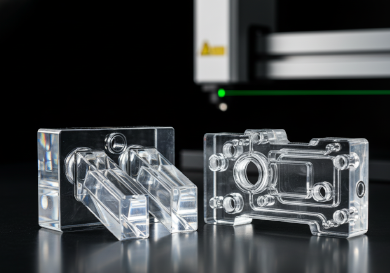
Acrylic (PMMA) Material Variants
| Grade | Common Name | Key Characteristics | Typical Applications |
|---|---|---|---|
| Cast Acrylic | Plexiglass / PMMA | Highest molecular weight. Superior optical clarity and thermal stability. Best for CNC machining without melting. | Lenses, light pipes, medical manifolds, premium display cases. |
| Extruded Acrylic | Standard Acrylic | More consistent thickness but lower melting point. Prone to “gumming” during machining and higher internal stress. | Signage, simple windows, lighting fixtures. |
| Impact Modified PMMA | High-Impact Acrylic | Blended with elastomers to increase toughness, though light transmission is slightly reduced. | Protective shields, machine covers, outdoor signage. |
Cast Acrylic Machining Capabilities
| Capability | Technical Description | Jucheng Advantage |
|---|---|---|
| Diamond Edge Polishing | Using single-crystal diamond tools on ultra-precision spindles to cut edges to a mirror finish directly. | Eliminates the need for labor-intensive hand buffing on flat edges, ensuring perfectly clear “glass-like” edges for high-end displays. |
| Optical Vapor Polishing | Exposing machined Acrylic parts to specialized chemical vapors that melt the surface microscopic layer. | We achieve 100% transparency on complex internal fluid channels and concave surfaces where mechanical tools cannot reach. |
| Multi-Step Annealing | Performing thermal stress-relief cycles both before and after heavy CNC material removal. | Jucheng guarantees that your Acrylic components won’t “craze” (micro-crack) over time, especially when exposed to cleaning fluids or UV light. |
| Precision Light Guide Milling | Milling intricate prism and lens patterns with extremely fine step-overs (down to 0.05mm). | Our 5-axis machines ensure absolute geometric accuracy for light pipes, maximizing light efficiency for automotive and electronic displays. |
Fabrication Guidelines for Cast Acrylic
Coolant Compatibility:
Acrylic is highly sensitive to chemical attack. Standard petroleum coolants cause immediate cracking. Tip: We use exclusively water-soluble, plastic-safe coolants or chilled air-blast to maintain absolute clarity.
Sharp Tooling Requirement:
Acrylic is brittle. Dull tools cause chipping at the exit edges. Tip: We use ultra-sharp, high-rake uncoated carbide tools with polished flutes to shear the material cleanly and minimize friction-induced heat.
Workholding Sensitivity:
The material is hard but can crack under excessive clamp pressure. Tip: We utilize vacuum tables for large flat sheets and custom-machined soft jaws for blocks to distribute clamping force evenly.
Heat Control:
Excessive heat during machining can cause the surface to “gum” or cloud. Tip: We utilize high-speed spindles with optimized feed rates to ensure chips carry the heat away, leaving a pristine surface.
Primary Applications
Medical & Diagnostics
Microfluidic manifolds, incubator components, and flow cells where visual monitoring of fluids is mandatory.
Lighting & Optics
Custom lenses, light pipes, and diffusers for automotive dashboards and high-end consumer electronics.
Consumer Luxury Goods
Cosmetic packaging, museum-quality display cases, and award trophies that require a glass-like aesthetic with intricate shapes.
Scientific Equipment
Sight glasses for pressure vessels and research manifolds requiring high light transmission and material purity.
Properties
| Density | 1.19 g/cm³ |
| Tensile Strength | 70 - 80 MPa |
| Light Transmission | 92% |
| Refractive Index | 1.49 |
| Hardness | 95 Rockwell M |
| Heat Deflection Temp | 95 - 105 °C |
| Continuous Service Temp | 80 °C |
| Water Absorption | 0.30% |
| Dielectric Strength | 20 kV/mm |
| Machinability Rating | Good |
| Max Part Size | 2000 x 800 x 600 mm |