
+86-188-7042-1176
project@jcproto.com
Mon-Fri: 8am-6pm (GMT+8)
EN
ISO 9001:2015 Certified
Brass C26000
C26000 brass, often referred to as "70/30 brass" or "casing brass," is the most ductile of all brass alloys. It achieves a perfect balance between strength and ductility, making it a preferred material for cold working, deep drawing, and complex bending. While its machinability is not as good as leaded C36000, its excellent corrosion resistance and superior surface finish make it indispensable in electrical connectors, ammunition assemblies, and high-end decorative hardware. At Jucheng Precision, we perfectly solve the long chip challenge of C26000 through optimized tool geometry and high-precision CNC processes, providing you with dimensionally accurate and easily re-formed precision brass parts.
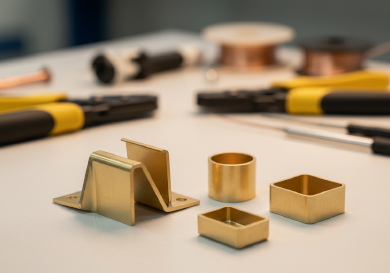
C26000 Machining Capabilities
| Capability | Technical Description | Jucheng Advantage |
|---|---|---|
| Precision CNC Turning | C26000 is more ductile than C360. We use specialized tool geometries to ensure clean cuts on thin-walled electrical terminals. | Our multi-spindle lathes maintain exceptional concentricity for small-diameter pins and sockets used in critical connectors. |
| Complex Milling & Drilling | Machining intricate features into 70/30 brass plates and blocks. | We utilize high-speed spindles and polished carbide tools to prevent the material from “smearing,” ensuring sharp edges and tight tolerances. |
| Secondary Forming Integration | Combining CNC machining with secondary bending or swaging, utilizing C26000’s legendary cold-workability. | Jucheng provides integrated manufacturing: we machine the base part and then perform precision forming to create complex terminal geometries. |
| High-Quality Surface Prep | Achieving smooth finishes (Ra 0.4μm) suitable for subsequent Silver or Gold plating. | Ensures maximum electrical contact efficiency and corrosion protection for high-end electronics. |
Fabrication Guidelines for C26000 Brass
Chip Control:
C26000 does not contain lead. Unlike “free-machining” brass, it produces long, stringy chips. Tip: We use aggressive chip-breakers and high-pressure coolant to prevent chip entanglement during automated runs.
Superior Cold Workability:
This is the best brass for cold working (bending, drawing, heading). Tip: If your part requires significant deformation after machining, C26000 is the only choice.
Work Hardening:
C26000 hardens rapidly during machining. Tip: We maintain constant tool engagement and sharp edges to avoid surface glazing and dimensional drift.
Stress Corrosion Cracking:
High-zinc brasses like C26000 can crack in the presence of ammonia or moisture if internal stresses are high. Tip: We offer stress-relief annealing post-machining to ensure long-term reliability.
Primary Applications
Electrical & Electronics
Socket connectors, terminals, lamp fixtures, and switch components requiring high conductivity and ductility.
Ammunition & Defense
Prototyping of cartridge cases and shell components where the material’s strength and elasticity are critical.
Automotive Radiators
Core tubes and tank components due to excellent thermal conductivity and corrosion resistance.
Musical Instruments
Precision components for brass instruments where acoustic resonance and formability are valued.
Properties
| Density | 8.53 g/cm³ |
| Tensile Strength | 300 - 600 MPa |
| Yield Strength | 100 - 450 MPa |
| Hardness | 70 - 150 HV |
| Elongation at Break | 40 - 65% |
| Thermal Conductivity | 120 W/m-K |
| Electrical Conductivity | 28% IACS |
| Melting Point | 915 - 955 °C |
| Machinability Rating | 30% |
| Weldability | Good |
| Max Part Size | 2000 x 800 x 600 mm |