
In the world of precision machining, the difference between a profitable job and a losing one often comes down to how securely and accurately a part is held. Standard chucks, vises, and off-the-shelf collets handle the majority of routine work, but every machinist eventually encounters a part that refuses to cooperate: an irregular casting, a thin-walled tube, a delicate threaded component, or a geometry with no convenient clamping surface. In these moments, custom workholding collets become the solution that turns an impossible setup into a repeatable, high-precision process.
This article explores what custom collets are, how they work, the benefits they deliver, where they are used, and the best practices for specifying and maintaining them so that your shop can tackle tricky machining jobs with confidence.
What Are Custom Workholding Collets?
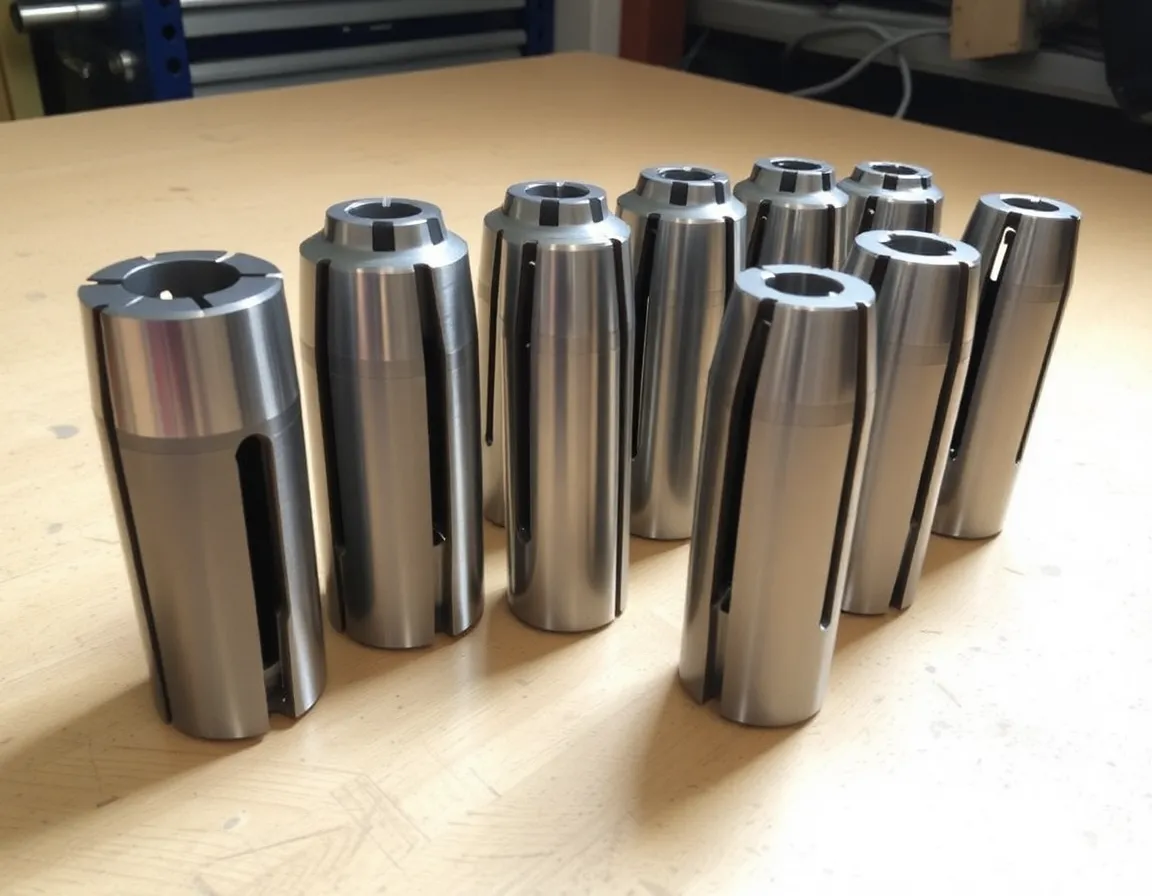
A collet is a sleeve-like device with a central bore that grips a workpiece when it is compressed or expanded. Standard collets—such as 5C, R8, ER, or 16C styles—are designed around common shank and bar stock diameters. A custom workholding collet is a collet whose gripping bore, external profile, or both are engineered specifically for a particular part or family of parts. Instead of forcing the workpiece to conform to a catalog dimension, the collet is built to conform to the workpiece.
Custom collets are typically manufactured from hardened tool steel, spring steel, or sometimes aluminum and engineered plastics for delicate or low-force applications. The internal bore can be machined to match a part's exact contour, including steps, tapers, threads, splines, flats, or non-circular cross-sections. The result is a workholding solution that contacts the part precisely where it is strongest and most stable.
How They Differ from Standard Collets
Standard collets offer convenience and economy, but their gripping range is narrow and their bore geometry is fixed. A custom collet, by contrast, is a bespoke tool. It may feature:
- Contoured or stepped bores that match a part's profile for maximum contact area
- Special external tapers to fit a specific chuck, fixture, or spindle interface
- Segmented or slotted designs tuned for a particular grip force and part rigidity
- Freiraum-Merkmale that avoid contact with fragile features such as threads or sealing surfaces
How Custom Collets Work
Like conventional collets, custom collets rely on elastic deformation. The collet is seated in a holder—often a dedicated fixture, a pneumatic or hydraulic actuator, or a standard collet chuck with a matching taper—and an axial force compresses or expands the collet body. The slots or segments allow the collet to flex, closing evenly around the workpiece.
The Design and Manufacturing Process
Creating an effective custom collet is an engineering exercise, not simply a machining one. A typical workflow includes:
- Part analysis: Reviewing the workpiece material, tolerances, surfaces to be machined, and available clamping features.
- Contact strategy: Determining where the collet should grip—maximizing contact area while avoiding distortion of thin walls or damage to finished surfaces.
- CAD modeling: Designing the bore profile, taper, slot pattern, and relief features, often with finite element analysis to verify stress and deflection.
- Fertigung: Machining the collet, typically from pre-hardened or hardened steel, followed by grinding the critical bore and taper for concentricity.
- Heat treatment and finishing: Hardening and stress-relieving to provide spring characteristics and wear resistance, then final grinding and inspection.
- Validation: Test runs measuring runout, grip force, and part deformation to confirm the design meets requirements.
Because the collet must flex repeatedly without permanent deformation, material selection and heat treatment are critical. The slot geometry—its number, width, depth, and orientation—controls how evenly the collet closes and how much grip force is transmitted to the part.
Benefits of Custom Workholding Collets
Custom collets deliver advantages that go far beyond simply "making the part fit." For challenging jobs, they often provide the only path to acceptable quality and productivity.
Superior Accuracy and Repeatability
Because a custom collet contacts the workpiece over a large, precisely machined area, it centers the part with exceptional accuracy. Runout can be held to very tight tolerances—often within a few ten-thousandths of an inch—and because the collet locates on the part's own geometry rather than a generic diameter, repeatability from part to part is excellent. This is essential for multi-operation jobs where features machined in one setup must align with features machined in another.
Protection for Delicate and Thin-Walled Parts
Thin-walled tubes, rings, and housings are notoriously difficult to hold without distortion. A custom collet can be designed to distribute clamping force evenly around the entire circumference, or to grip only on robust features while relieving contact on thin sections. This prevents the ovalization, crushing, and spring-back that plague conventional three-jaw chucks.
Access for Complete Machining
Custom collets can be designed with minimal profile and generous clearance, allowing tools to reach features that would otherwise be blocked by chuck jaws. For parts requiring machining on multiple faces, a slim custom collet can hold the workpiece by an internal bore or a small land, leaving the rest of the part exposed for turning, milling, or drilling in a single setup.
Reduced Setup Time and Labor
Once a custom collet is in place, loading and unloading parts becomes fast and repeatable. Operators no longer need to indicate each part or shim jaws to achieve alignment. For production runs, this translates directly into lower cycle times and less dependence on operator skill.
Longer Tool Life and Better Surface Finish
Rigid, uniform workholding reduces vibration and chatter. A part that is solidly supported machines more smoothly, which improves surface finish, extends tool life, and reduces the risk of scrap.
Anwendungen in verschiedenen Branchen
Custom workholding collets are used wherever precision and part protection matter. Common applications include:
- Luft- und Raumfahrt: Holding thin-walled bushings, hydraulic fittings, and complex machined housings where distortion is unacceptable.
- Medizinische Geräte: Gripping small, delicate components such as implant parts, instrument handles, and cannulae without marring surfaces.
- Automobil: Machining transmission components, fuel system parts, and sensor housings with irregular geometries.
- Job shops: Solving one-off and low-volume tricky jobs where dedicated fixturing would be too costly or slow to build.
- Watchmaking and precision instrumentation: Holding tiny, intricate parts with extreme accuracy.
Typical Tricky Jobs Solved by Custom Collets
Consider a few scenarios where custom collets shine. A thin-walled aluminum tube that collapses in a three-jaw chuck can be held by a custom collet that supports the bore with a matching arbor and grips the outside evenly. A cast fitting with no parallel surfaces can be gripped by a collet machined to match its as-cast contour. A threaded component that must be machined after threading can be held on the thread itself by a collet with a matching internal thread, protecting the threads while providing secure drive. In each case, the custom collet converts a fragile, unreliable setup into a robust, repeatable process.
Best Practices for Specifying and Using Custom Collets
To get the most from a custom collet investment, follow these guidelines:
Design for the Whole Process
Involve the collet designer early, ideally during part design or process planning. Small changes to the part—such as adding a clamping land or a relief groove—can dramatically simplify workholding and reduce collet cost. Share complete information: material specifications, tolerances, surface finish requirements, and the operations the part will undergo while held.
Match Grip Force to the Part
More grip force is not always better. Specify the actuation method—manual, pneumatic, or hydraulic—and the expected clamping force, then verify that the collet distributes that force without exceeding the part's elastic limit. For delicate parts, consider low-force actuation or a collet designed with compliant features.
Plan for Wear and Maintenance
Collets are wear items. Repeated flexing and part loading gradually degrade the bore and taper, affecting accuracy. Establish inspection intervals, monitor runout and grip quality, and replace collets before they cause scrap. Store collets in protective holders, keep bores clean, and avoid over-tightening that can permanently deform the collet body.
Verify with Test Cuts
Always validate a new custom collet with test parts. Measure runout, check for part distortion before and after clamping, and confirm that machined features meet tolerance. Document the setup parameters so the process can be repeated reliably.
Consider Total Cost, Not Just Unit Price
A custom collet carries a higher upfront cost than a catalog item, but it often pays for itself quickly through reduced scrap, faster setups, and eliminated secondary operations. Evaluate the investment against the value of the parts being made and the frequency of the job.
Fazit
Custom workholding collets are a powerful answer to the machining jobs that standard tooling cannot handle. By matching the gripper to the part rather than the part to the gripper, they deliver accuracy, part protection, accessibility, and repeatability that transform difficult setups into dependable processes. Whether you are machining a thin-walled aerospace component, a delicate medical device, or an irregular casting, a well-designed custom collet can be the difference between a job that fights you every cycle and one that runs smoothly, profitably, and to spec. Investing time in proper design, specification, and maintenance ensures that this versatile workholding solution delivers value for years of tricky machining challenges.