
+86-188-7042-1176
project@jcproto.com
Mon-Fri: 8am-6pm (GMT+8)
EN
ISO 9001:2015 Certified
Surface Grinding
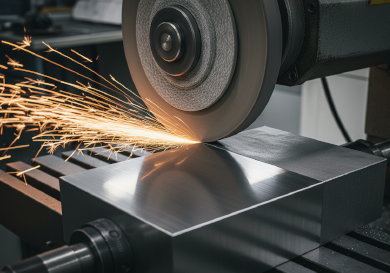
Surface Grinding is an abrasive machining process used to produce a smooth finish on flat surfaces while achieving critical dimensional tolerances, flatness, and parallelism. It is widely used to finish parts that have been hardened by heat treatment, as traditional milling cutters struggle with materials harder than 50 HRC.
At Jucheng Precision, we operate automated Okamoto and Chevalier surface grinders equipped with fine-grit ceramic and diamond wheels. We specialize in finishing mold bases, stamping dies, and precision machine components to flatness tolerances within 0.005mm. Whether removing heat-treat distortion or achieving a sealing surface, our grinding department ensures the highest level of geometric accuracy.
Key Specifications
| Specification | Technical Range | Note |
|---|---|---|
| Max Part Size | 1000 mm x 500 mm x 400 mm | Table travel limit |
| Dimensional Tolerance | +/- 0.002 mm | Depends on temperature control |
| Flatness / Parallelism | Within 0.005 mm (over 300mm) | Critical for mold plates |
| Surface Roughness (Ra) | 0.2 µm – 0.8 µm | Can be finer with polishing |
| Compatible Materials | Hardened Steel, Carbide, Stainless, Cast Iron | Magnetic materials are best |
| Stock Allowance | 0.2 mm – 0.5 mm | Leave stock for grinding |
| Standard Lead Time | 2 – 4 Days | Usually a secondary process |
Grinding Methods
| Method | Description | Key Benefits & Applications |
|---|---|---|
| Horizontal Spindle (Reciprocating) | The most common type. The wheel is on a horizontal axis, and the table moves back and forth. The wheel cuts on its periphery. | Benefit: Highest precision, superior surface finish, excellent flatness. App: Precision tool making, mold plates, gauges. |
| Vertical Spindle (Blanchard) | Also known as Rotary Surface Grinding. The wheel face grinds the part. Removes material much faster. | Benefit: Rapid stock removal for large areas. Distinct “cross-hatch” pattern. App: Cleaning up large raw castings, flattening plates. |
| Creep Feed Grinding | Taking a very deep cut at a very slow feed rate. Acts almost like milling but with a grinding wheel. | Benefit: Can grind complex profiles (slots) in hardened material in one pass. App: Turbine blade roots, intricate tool slots. |
Design Guidelines for Surface Grinding
Magnetic Workholding:
Surface grinders primarily use magnetic chucks. Ferrous metals (Steel, Iron) are easiest to hold. Non-magnetic parts (Aluminum, Brass) require complex vacuum fixtures or blocking, which increases cost. Tip: Design parts in steel if they require precision grinding.
Grinding Relief:
A grinding wheel cannot grind up against a 90-degree shoulder without leaving a radius. Tip: Add an undercut or “grinding relief” groove in the corner so the wheel can pass through freely without hitting the wall.
Heat Management:
Grinding generates significant heat. Thin parts may warp due to thermal expansion or stress release. Tip: Avoid extremely thin walls on parts that need to be ground flat.
Obstructions:
The surface to be ground must be the highest point on the part. Any protruding pins, bosses, or features higher than the grind surface will prevent the wheel from passing.
Industry Applications
Tool & Die
Grinding punch dies and stripper plates to exacting flatness to ensure the stamping tool cuts clean burr-free parts.
Injection Molding
Mold bases and parting lines are surface ground to ensure a perfect seal, preventing plastic “flash” during injection.
Machine Tool Components
Linear guide ways and sliding blocks are ground to ensure smooth, low-friction motion and long service life.
Automotive
Engine cylinder heads and blocks are resurfaced (decked) to ensure a perfect seal with the head gasket.