
+86-188-7042-1176
project@jcproto.com
Mon-Fri: 8am-6pm (GMT+8)
EN
ISO 9001:2015 Certified
Pipe Threads
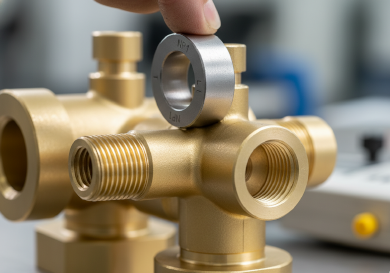
Pipe threads differ fundamentally from standard fastening screws because their primary function is to create a pressure-tight seal for transporting fluids and gases. Jucheng Precision recognizes that even a microscopic error in taper angle or thread profile can lead to catastrophic leaks in high-pressure systems. We employ advanced rigid tapping and single-point threading techniques to produce compliant NPT (National Pipe Taper), BSPT (British Standard Pipe Taper), and BSPP (British Standard Pipe Parallel) connections. By strictly following ANSI/ASME B1.20.1 and ISO 7 standards, we ensure that our machined fittings, manifolds, and valves achieve the necessary interference fit or gasket compression required for reliable sealing in hydraulic, pneumatic, and plumbing applications.
Key Specifications
| Specification | Technical Range | Note |
|---|---|---|
| Thread Types | NPT, NPTF, BSPT (R), BSPP (G) | US & International Standards |
| Size Range | 1/16″ to 6.0″ Pipe Size | Not actual diameter (Nominal) |
| Taper Angle | 1° 47′ (1.7899°) | For NPT/BSPT sealing |
| Standards | ANSI/ASME B1.20.1, ISO 7, ISO 228 | Verified with L1/L2 Gauges |
| Sealing Method | Interference Fit or Gasket/O-ring | Depends on thread type |
| Compatible Materials | Brass, Stainless (316), Aluminum, Steel | Hard materials require milling |
Common Pipe Thread Standards
| Standard | Description | Key Benefits & Applications |
|---|---|---|
| NPT (National Pipe Taper) | The US standard. Threads are tapered (conical). The seal is created by the interference between the flanks of the threads. | Benefit: Widely used in North America. Requires Teflon tape or sealant. App: General plumbing, oil & gas lines in the USA. |
| NPTF (Dryseal) | Similar to NPT but with truncated crests/roots to create a metal-to-metal crush seal without tape. | Benefit: Leak-proof without extra sealant compounds. App: Automotive fuel systems, critical hydraulics. |
| BSPT / R (British Taper) | International standard (except USA). Tapered thread with a 55° flank angle (NPT is 60°). | Benefit: The global standard for pressure-tight joints. App: Water and gas pipes in Europe/Asia. |
| BSPP / G (British Parallel) | Parallel (straight) threads. Does not seal on the thread itself. Relies on a bonded washer or O-ring. | Benefit: Easy to assemble/disassemble. Positionable (can orient the fitting). App: High-pressure hydraulic connections, sensors. |
Design Guidelines for Pipe Threads
Nominal Size Confusion:
“1/2 Inch NPT” does not mean the thread diameter is 0.5 inches. It refers to the internal flow diameter of the pipe. The actual OD is much larger (~0.840″). Tip: Always refer to standard pipe charts for drill sizes and major diameters.
Taper Reaming:
For high-quality NPT/BSPT threads, we recommend reaming the hole with a tapered reamer before tapping. This ensures the taper angle is consistent and extends tap life.
Gauging Depth:
Tapered threads are checked by how far the gauge screws on (Standoff distance). There is a specific tolerance zone (usually +/- 1 turn). Tip: Do not just “tighten until it stops.” We measure the L1 distance precisely.
Sealing Surfaces (BSPP):
If using BSPP (G) threads, you must design a flat, smooth machined face (spotface) around the hole for the O-ring or washer to seal against. The thread alone will leak.
Industry Applications
Hydraulics & Pneumatics
Manifolds and valve bodies utilize NPTF and BSPP ports to connect hoses and cylinders without leakage under high pressure.
Oil & Gas Industry
Downhole tools and pipeline components require robust NPT connections machined from exotic alloys to withstand extreme environments.
Automotive Fluid Systems
Fuel rails, brake lines, and coolant sensors often use NPTF (Dryseal) threads to prevent fluid leaks in vehicles.
Instrumentation
Pressure gauges and temperature sensors typically feature 1/4″ or 1/2″ NPT/BSPT threads for universal mounting.