
+86-188-7042-1176
project@jcproto.com
Mon-Fri: 8am-6pm (GMT+8)
EN
ISO 9001:2015 Certified
Custom Threads
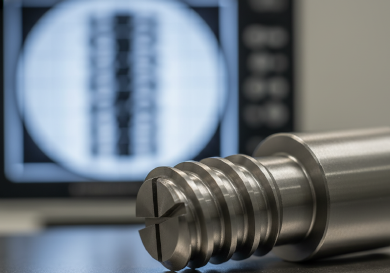
Standard fastening threads like Metric or Unified are not sufficient for every engineering challenge, particularly when linear motion, high power transmission, or proprietary locking mechanisms are required. Jucheng Precision excels in manufacturing Custom and Specialty Threads that fall outside standard catalog specifications. Utilizing advanced Thread Whirling and 5-Axis Thread Milling technologies, we generate complex profiles such as Acme, Trapezoidal, Buttress, and Square threads with ease. We are not limited by standard tap availability; our ability to grind custom carbide cutters allows us to machine unique pitch diameters, non-standard angles, and high-speed Multi-Start threads for lead screws. Quality is guaranteed not just by thread gauges, but by optical profile projection to verify the exact geometry of the thread form.
Key Specifications
| Specification | Technical Range | Note |
|---|---|---|
| Thread Profiles | Acme, Trapezoidal, Square, Buttress, Knuckle | Custom geometries per print |
| Pitch / Lead | 0.5mm to 50mm Lead | High lead for fast travel |
| Number of Starts | 1, 2, 3, 4, or more | Multi-start for efficiency |
| Max Thread Length | 1000 mm (Shaft work) | Swiss turning or Center lathe |
| Precision Class | 7e, 7C, 2G, 3G | Motion control standards |
| Compatible Materials | Stainless, Bronze (Nuts), Plastic (Delrin), Titanium | Bronze/Steel pairing is common |
Custom Thread Profiles
| Profile | Description | Key Benefits & Applications |
|---|---|---|
| Acme / Trapezoidal | A thread with a 29° (Acme) or 30° (Metric Trap) flank angle. Thicker and stronger than V-threads. | Benefit: High strength for power transmission. Can withstand heavy loads. App: Lead screws, vise screws, linear actuators. |
| Square Thread | The thread walls are perpendicular (90°) to the axis. The most efficient thread for transmitting power. | Benefit: Highest efficiency (least friction). No radial force (bursting pressure) on the nut. App: Jacks, high-load presses. |
| Buttress Thread | Asymmetrical profile (e.g., 7° on one side, 45° on the other). Designed to handle extreme force in one direction. | Benefit: Handles massive unidirectional loads comparable to a square thread but easier to machine. App: Hydraulic presses, artillery breech locks, vise mechanisms. |
| Multi-Start Thread | Two or more intertwined threads running parallel. Increases the “Lead” (distance traveled per turn) without weakening the thread. | Benefit: Fast travel speed with fewer rotations. Maintains thread depth strength. App: Fast-action linear slides, water bottle caps. |
Design Guidelines for Custom Threads
Pitch vs. Lead:
For multi-start threads, Pitch is the distance between adjacent crests, but Lead is the distance the nut advances in one revolution (Lead = Pitch × Starts). Tip: Clearly specify both Pitch and Lead on your drawing to avoid manufacturing errors.
Square Thread Difficulty:
True Square threads are extremely difficult to machine because the tool rubs against the vertical wall. Tip: Use a “Modified Square” (10° flank) or Acme thread if possible for lower cost and easier manufacturing.
Mating Parts:
Custom threads usually require a custom nut. Tip: We recommend ordering the screw and the nut (often in Bronze or Delrin) as a matched set from Jucheng to guarantee the fit and backlash requirements.
Thread Relief:
Custom threading tools are often large. Ensure there is a wide undercut or relief groove at the end of the thread to allow the tool to decelerate and exit without crashing into the shoulder.
Industry Applications
Linear Motion & Automation
Lead screws and ball screws convert rotary motion into linear motion for CNC machines, 3D printers, and factory automation.
Oil & Gas
Proprietary thread forms are designed for drill pipes and downhole couplings to withstand extreme torque and mud pressure.
Heavy Lifting Equipment
Buttress threads are used in screw jacks and lifting columns where the load is always applied in one vertical direction.
Medical Devices
High-lead multi-start threads are used in dosing pumps and syringe drivers to deliver fluids quickly and smoothly.