
The medical device industry has undergone a radical transformation over the last few decades, driven by advancements in materials science and high-precision manufacturing. At the heart of this evolution lies orthopedic implant machining, a specialized subset of CNC manufacturing that produces the life-changing components used in joint replacements, spinal surgeries, and trauma recovery. Whether it is a titanium hip stem or a complex spinal cage, the demand for precision is absolute. For medical professionals and procurement officers seeking an orthopedic implant manufacturing company, understanding the intricacies of this process is vital to ensuring patient safety and surgical success.
 What is an Orthopedic Implant and Why Does Machining Matter?
Before diving into the technical specifications, it is essential to address the foundational question: what is an orthopedic implant? In the simplest terms, an orthopedic implant is a medical device manufactured to replace a missing joint or bone, or to support a damaged bone structure. These devices are permanently or temporarily fixed into the body. Because they reside within the human biological environment, they must be biocompatible, corrosion-resistant, and capable of withstanding significant mechanical stress.
The orthopedic implant manufacturing process relies heavily on CNC (Computer Numerical Control) machining because traditional manufacturing methods often fail to meet the tight tolerances required. We are talking about precisions measured in microns. If a screw thread on a bone plate is off by even a fraction of a millimeter, it could lead to implant failure or inflammatory responses in the patient. This is why top-tier orthopaedic implant manufacturers invest millions in multi-axis milling, Swiss-turning, and advanced EDM (Electrical Discharge Machining) technologies.
For those looking for regional expertise, particularly in Southeast Asia, the growth of orthopedic implants malaysia has become a focal point. The region has transitioned from a rubber-based economy to a high-tech medical manufacturing hub, hosting several world-class orthopedic implants manufacturers in malaysia that serve global markets with rigorous quality standards.
The Orthopedic Implant Manufacturing Process: From CAD to Cleanroom
The journey of a medical implant from a raw block of titanium to a sterile, surgical-ready component is complex. The orthopedic implant manufacturing process involves several critical stages, each requiring distinct expertise and equipment.
1. Design and Prototyping (CAD/CAM)
Every project begins with a digital blueprint. Engineers use advanced CAD software to design the geometry of the implant. For customized implants, this may involve 3D scans of a specific patient’s anatomy. The CAM (Computer-Aided Manufacturing) software then translates these designs into toolpaths that a CNC machine can execute. In this stage, designers must account for material shrinkage, tool wear, and the specific limitations of *orthopedic implant machining.
2. Material Selection
The choice of material is arguably the most critical decision in orthopedic implant manufacturing. Common materials include:
- Titanium Alloys (e.g., Ti-6Al-4V): Favored for their strength-to-weight ratio and excellent biocompatibility.
- Cobalt-Chrome (CoCr): Often used for articulating surfaces in joint replacements due to its high wear resistance.
- Stainless Steel (316L): Typically used for temporary trauma plates and pins.
- PEEK (Polyetheretherketone): A high-performance plastic used frequently in spinal implants because its elasticity is similar to human bone.
3. CNC Machining Operations
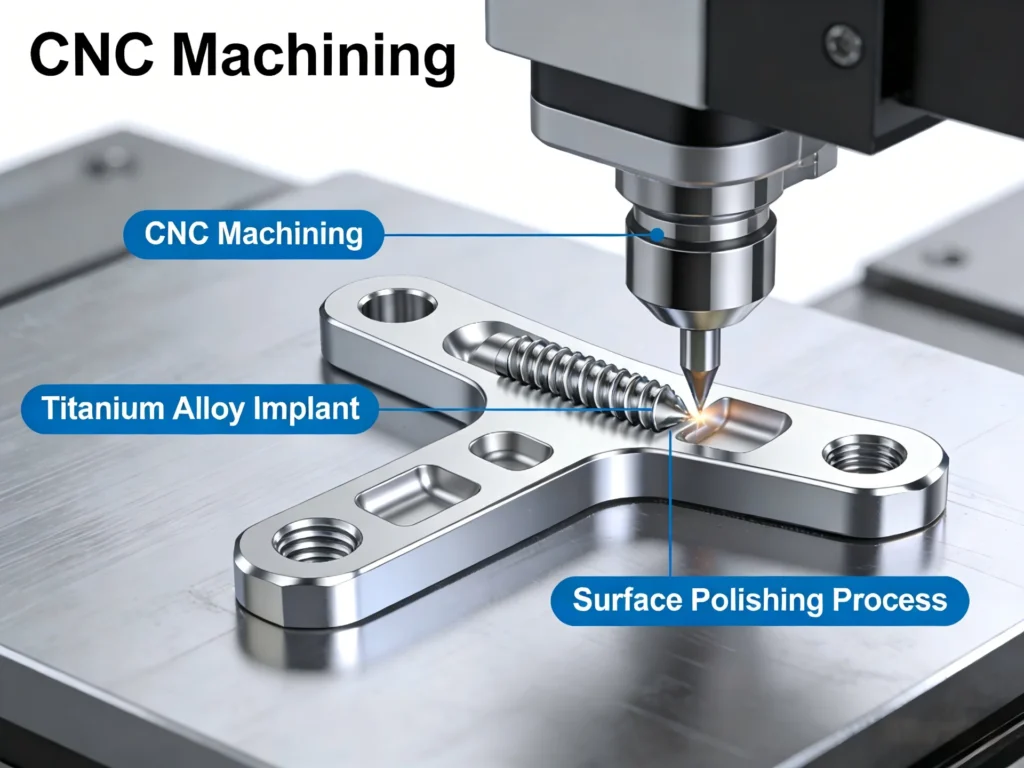
This is where the physical creation happens. Modern orthopedic implant machining often utilizes 5-axis milling centers. These machines allow the cutting tool to approach the workpiece from any angle, which is necessary for the organic, curved shapes of human joints. Swiss-type lathes are frequently used for smaller, high-precision components like bone screws and dental implants, where extreme slender ratios are common.
4. Surface Treatment and Finishing
An implant is not finished once it leaves the machine. It may undergo bead blasting, acid etching, or anodizing to improve its surface texture. For instance, many hip implants feature a porous coating that encourages “osseointegration,” which is the process of bone growing into the implant to secure it in place. High-quality orthopedic implants and instruments manufacturers in malaysia and elsewhere utilize robotic polishing to ensure consistency that human hands simply cannot match.
Core Application Scenarios for Machined Implants
The scope of orthopedic implant manufacturing covers various anatomical regions. Understanding these applications helps in selecting the right orthopedic implant manufacturing company for specific needs.
Joint Reconstruction
This is perhaps the most well-known application. Total Hip Arthroplasty (THA) and Total Knee Arthroplasty (TKA) require components that can endure millions of cycles of movement. The femoral head must be machined to a mirror finish to minimize friction against the acetabular cup. Any deviation in the sphericity of the femoral head could lead to premature wear and the need for revision surgery.
Spinal Implants
The spine is a delicate environment requiring tiny, incredibly complex devices. Spinal cages, pedicle screws, and rods are manufactured to stabilize the vertebrae. These often involve intricate thread patterns and hollow structures that require advanced orthopedic implant machining capabilities. The rise of an orthopedic implants company in malaysia specialized in spinal tech has provided cost-effective, high-quality alternatives for the Asian healthcare market.
Trauma and Fixation
When a patient suffers a severe fracture, surgeons use plates, screws, and intramedullary nails to hold the bone fragments together during healing. These items are often produced in high volumes but still require rigorous precision to ensure they interface correctly with surgical instruments.
Dental Implants
While often categorized separately, dental implants share the same manufacturing DNA as orthopedic devices. They require high-precision Swiss-turning to create the internal threads that hold the prosthetic tooth (abutment) in place. The surface treatment here is also critical for ensuring the implant bonds with the jawbone.
Critical Buying Factors: How to Choose an Orthopedic Implant Manufacturing Company
Selecting a partner for medical device production is a high-stakes decision. Whether you are looking for orthopaedic implant manufacturers in Europe or orthopedic implants manufacturers in malaysia, the following criteria should be your benchmark.
| Factor | Description | Why it Matters |
|---|---|---|
| Certifications | ISO 13485, FDA Registration, CE Marking. | Ensures the company follows a strict Quality Management System (QMS) specifically for medical devices. |
| Technical Precision | Ability to maintain tolerances within ±0.005mm. | Critical for the fit and function of multi-component implant systems. |
| Material Traceability | Complete documentation from the raw material melt to the finished part. | Required for regulatory compliance and patient safety in case of recalls. |
| Cleanroom Facilities | ISO Class 7 or 8 cleanrooms for final cleaning and packaging. | Prevents contamination and ensures the implant is pyrogen-free before sterilization. |
| Lead Times | The speed from design freeze to mass production. | Crucial for getting new medical innovations to market ahead of competitors. |
For many global firms, the search for an orthopedic implants company in malaysia is driven by the balance of high-tech capability and competitive labor costs. These manufacturers often provide the same level of precision as their Western counterparts but with more agile supply chains.
Installation and Maintenance of CNC Equipment for Medical Use
For companies looking to establish their own orthopedic implant machining line, the setup is vastly different from a general machine shop. The environment must be controlled to prevent metallic cross-contamination.
Installation Tips:
- Foundation Stability: Medical machines must be installed on vibration-dampened floors. Even minor external vibrations can affect the surface finish of a cobalt-chrome femoral head.
- Oil and Coolant Management: Only medical-grade, biocompatible coolants should be used. Traditional sulfur-based oils can leave residues that are difficult to remove and potentially toxic to human tissue.
- Validation (IQ/OQ/PQ): Every machine must go through Installation Qualification, Operational Qualification, and Performance Qualification. This proves the machine is capable of producing parts within spec consistently.
Maintenance Tips:
- Spindle Calibration: High-speed spindles used in medical machining require frequent checking for runout.
- Tool Life Monitoring: In orthopedic implant manufacturing, tools should be replaced before they show significant wear. Using a dull tool can induce stress into the titanium part, leading to micro-cracks.
- Automated Inspection: Integrate on-machine probing to verify dimensions during the machining cycle, reducing the risk of batch errors.
Why Choose JuCheng for Your Orthopedic Implant Machining Needs?
When it comes to high-stakes medical manufacturing, JuCheng stands out as a leader in the field. With years of specialized experience in orthopedic implant machining, we understand that every micron counts. Our facility is equipped with state-of-the-art 5-axis CNC centers and Swiss-turning lathes, optimized specifically for medical-grade alloys and polymers.
At JuCheng, we go beyond simple “parts making.” We offer a comprehensive partnership that includes:
- Advanced Technical Expertise: Our engineers are experts in the orthopedic implant manufacturing process, helping you optimize designs for manufacturability (DFM) to reduce costs without sacrificing quality.
- Strict Quality Control: Operating under rigorous international standards, we provide full material traceability and inspection reports for every batch.
- Global Reach with Local Benefits: As a premier orthopedic implant manufacturing company, we offer the logistical advantages of our strategic location, ensuring fast lead times for clients worldwide, including those seeking the expertise of orthopedic implants manufacturers in malaysia.
- Diverse Capabilities: From complex spinal cages to high-volume trauma screws, our machine shop is versatile enough to handle both prototypes and large-scale production runs.
Choosing JuCheng means choosing peace of mind. We utilize the latest software and hardware to ensure that your medical devices meet the highest safety standards, allowing surgeons to operate with confidence and patients to recover with reliability.
Frequently Asked Questions (FAQ)
1. What are the most common materials used in orthopedic implant machining?
The most common materials are Titanium Grade 5 (Ti-6Al-4V), Cobalt-Chromium alloys, Stainless Steel 316L, and PEEK plastic. Each material is chosen based on the specific mechanical requirements of the bone or joint it is replacing.
2. Why is 5-axis machining necessary for orthopedic implant manufacturing?
Most human bones and joints have complex, non-linear geometries. 5-axis machining allows the cutting tool to maintain a perpendicular orientation to the surface, which is essential for achieving the smooth, organic shapes and high-quality surface finishes required for implants.
3. How do orthopedic implants manufacturers in malaysia compare to those in the US or Europe?
Many orthopedic implants manufacturers in malaysia operate with the same high-end machinery and ISO 13485 certifications as Western companies. The primary difference is the cost-efficiency of the manufacturing base and the proximity to the rapidly growing Asian healthcare market.
4. What is the role of Swiss-turning in this industry?
Swiss-turning is used for small, long, and thin parts like bone screws, dental implants, and tiny pins. It provides incredible stability because the material is supported near the cutting tool, allowing for extreme precision on small diameters.
5. How is the quality of a machined implant verified?
Quality is verified using Coordinate Measuring Machines (CMM), optical comparators, and surface profilometers. Additionally, non-destructive testing (NDT) like X-ray or fluorescent penetrant inspection may be used to check for internal flaws.
6. What is “Osseointegration” and how does machining affect it?
Osseointegration is the direct functional and structural connection between living bone and the surface of a load-bearing artificial implant. Machining and post-processing (like laser texturing or porous coating) create the specific surface roughness needed for bone cells to attach and grow.
7. Can JuCheng help with the prototyping phase of a new implant?
Yes, JuCheng provides comprehensive prototyping services. We can produce small batches of implants for mechanical testing and clinical trials, ensuring the design is viable before moving to mass production.
8. What makes a company a reliable orthopedic implant manufacturing company?
A reliable company must have ISO 13485 certification, a robust quality management system, advanced multi-axis CNC equipment, and a deep understanding of medical-grade materials and regulatory requirements.
Conclusion: The Future of Precision Healing
The field of orthopedic implant machining is at the intersection of human health and mechanical perfection. As the global population ages, the demand for high-quality, durable implants will only continue to rise. Navigating the world of orthopedic implant manufacturing requires a partner who understands the nuances of precision, the importance of material science, and the absolute necessity of regulatory compliance.
Whether you are exploring options for orthopedic implants malaysia or looking for a global orthopedic implant manufacturing company with a proven track record, JuCheng is ready to bring your medical innovations to life. Our commitment to excellence ensures that every component we machine contributes to a better quality of life for patients around the world.
Partner with the Experts in Orthopedic Implant Machining
Are you ready to elevate your medical device production? JuCheng combines cutting-edge technology with deep industry expertise to deliver world-class orthopedic solutions. Contact us today to discuss your project requirements and see how we can streamline your orthopedic implant manufacturing process.
Visit us: JuCheng CNC Machining Official Site