
Aviation safety and structural integrity rely heavily on the complex assembly known as the landing gear. Whether it is a massive commercial jet or a small private plane, landing gear components serve as the interface between the aircraft and the ground, absorbing massive kinetic energy during touchdown and providing stability during taxiing. For engineers, procurement specialists, and CNC machining partners like jucheng, understanding the granular details of these parts is essential for ensuring flight safety and operational efficiency.
 Understanding the Fundamental Principles of Landing Gear Systems
At its core, the landing gear system is a marvel of mechanical engineering. It must be light enough to minimize the aircraft’s fuel consumption yet strong enough to withstand vertical descent velocities of several feet per second. The primary function of landing gear components is to support the aircraft on the ground, allow it to maneuver during takeoff and landing, and dissipate the energy of impact.
The system typically operates through a combination of hydraulic, pneumatic, and mechanical interactions. Most modern aircraft utilize an oleo strut, which is a shock absorber using a combination of oil and compressed air. When the wheels touch the runway, the piston is forced into the cylinder, compressing the air and forcing oil through small orifices. This conversion of kinetic energy into thermal energy is what prevents the airframe from experiencing catastrophic stress. If you have ever seen a landing gear components crossword clue in a daily puzzle, the answer is often “strut” or “oleo,” highlighting how central these parts are to the system’s identity.
Anatomy of Modern Landing Gear Components and Functions
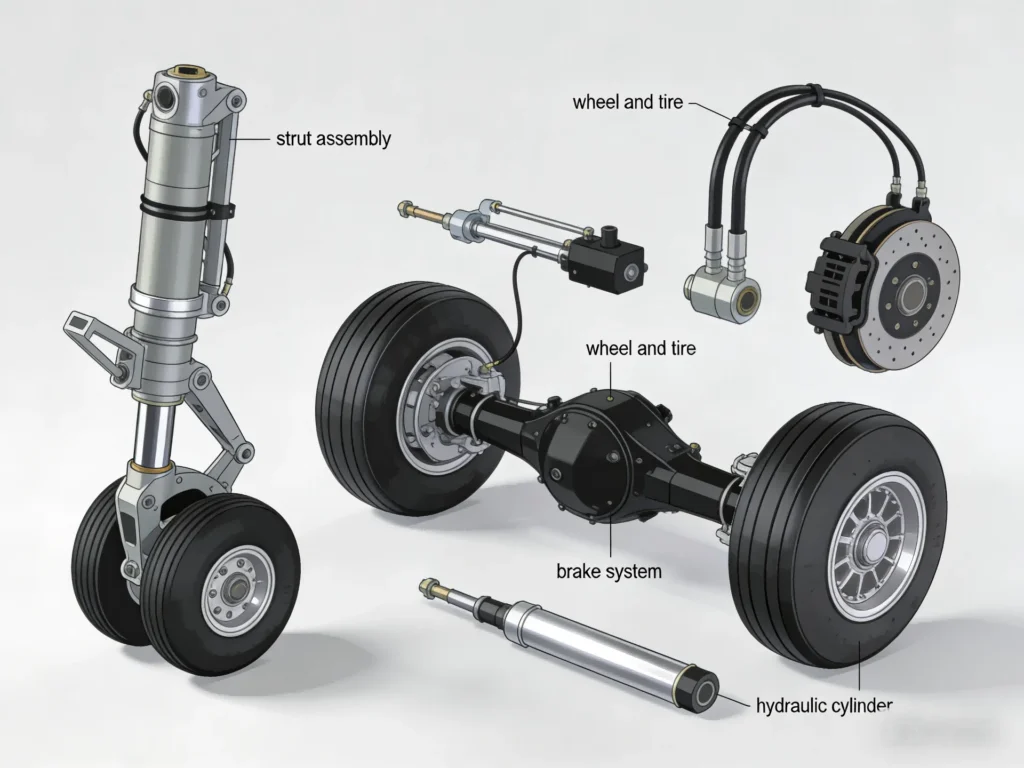
To appreciate the complexity, we must break down the assembly into its primary constituent parts. Each element has a specific role that ensures the system functions as a cohesive unit. The landing gear components and functions vary slightly depending on the aircraft type, but the following are universal:
- Shock Strut (Oleo Strut): The heart of the energy absorption system.
- Torque Links: Hinged units that keep the piston and cylinder aligned while allowing vertical movement.
- Trunnion: The pivot point that attaches the gear to the aircraft structure, allowing for retraction and extension.
- Drag Brace: A structural member that resists longitudinal loads during braking or landing impact.
- Side Brace: Provides lateral stability to ensure the gear does not collapse sideways.
- Shimmy Damper: A small hydraulic unit that prevents the nose wheel from vibrating uncontrollably at high speeds.
Classification by Aircraft and Application Type
The design of landing gear components aircraft designers choose depends heavily on the intended use of the vehicle. A 737 landing gear components set looks vastly different from those found on a cessna 172 landing gear components list because the physics of a 150,000-pound jet differ from those of a 2,500-pound propeller plane.
Commercial Aviation: The Boeing 737 Example
The 737 landing gear components are engineered for high-cycle environments. These aircraft land several times a day, requiring materials that can resist fatigue and corrosion. The main gear typically features a multi-wheel bogie system, while the nose landing gear components include sophisticated steering actuators. Because these jets operate in varied climates—from freezing high-altitude runways to humid tropical airports—the CNC machining and finishing of these parts must meet the highest aerospace standards.
General Aviation: The Cessna 172 Example
In contrast, cessna 172 landing gear components often favor simplicity and durability. Many older or smaller models utilize fixed landing gear components, which do not retract. These systems often use spring steel or tubular gear legs that flex to absorb shock. While less complex than retractable systems, the manufacturing precision required for the mounting bolts and axles remains critical to prevent mechanical failure during hard landings.
Specific Sub-Systems: Main vs. Nose Gear
There is a clear distinction between main landing gear components and nose landing gear components. The main gear bears the majority of the weight (usually about 85-90%) and houses the braking system. The nose gear, meanwhile, is responsible for directional control. Specialized nose landing gear components include the steering collar, steering cylinders, and the centring cam, which ensures the wheel is straight before it enters the wheel well during retraction.
Industrial and Trailer Applications
It is worth noting that the term also extends to the logistics industry. Landing gear components trailer systems are used to support semi-trailers when they are disconnected from the tractor unit. These involve heavy-duty hand cranks, gearboxes, and telescopic legs. While the stakes are different than in aviation, the need for high-strength steel and precision-cut gears is just as vital for preventing trailer tip-overs or collapses in busy shipping yards.
Critical Factors in Selecting and Sourcing Landing Gear Components
When procurement managers look for a CNC partner like jucheng, they aren’t just buying parts; they are buying reliability. Several factors must be weighed to ensure the landing gear components meet the rigorous demands of the aerospace industry.
Material Selection and Metallurgy
Most aerospace landing gear components are machined from high-strength alloys such as 300M steel, Titanium Ti-6Al-4V, or 7075-T6 aluminum. These materials offer the necessary strength-to-weight ratio. For instance, 300M is a low-alloy steel known for its incredible toughness and is the industry standard for main gear struts. Selecting the wrong grade of material could lead to stress corrosion cracking, a silent killer in aviation maintenance.
CNC Machining Precision and Tolerances
The tolerances for landing gear components are often measured in microns. A slight misalignment in a torque link or a rough finish on a piston surface could cause hydraulic seals to leak, leading to a “collapsed gear” scenario. Advanced CNC centers, like those operated by jucheng, use 5-axis milling and high-precision turning to ensure that every contour matches the digital twin of the design perfectly. Surface roughness is particularly critical; parts must often be polished to a mirror finish to minimize friction and wear.
Certification and Quality Control
In the world of aviation, a part is only as good as its paperwork. Suppliers must adhere to AS9100 standards. This involves rigorous Non-Destructive Testing (NDT) such as magnetic particle inspection or ultrasonic testing to ensure no internal voids or cracks exist within the metal. When sourcing landing gear components, verifying the manufacturer’s track record in aerospace compliance is non-negotiable.
| Feature | Commercial Jet (e.g., 737) | General Aviation (e.g., Cessna 172) | Heavy-Duty Trailer |
|---|---|---|---|
| Primary Material | 300M Steel / Titanium | Spring Steel / Aluminum | High-Carbon Structural Steel |
| Shock Absorption | Hydraulic Oleo-Pneumatic | Mechanical Flex / Rubber pucks | Mechanical Gearbox |
| Retraction | Fully Retractable (Hydraulic) | Fixed (Usually) | Manual/Electric Crank |
| Maintenance Interval | Strict Cycles (High Frequency) | Annual Inspection | Visual/Grease as needed |
Installation and Maintenance: Ensuring Longevity
Proper installation of landing gear components is a high-stakes task that requires certified airframe technicians. Even the most precisely machined part from jucheng can fail if the installation environment is compromised. For example, during the installation of nose landing gear components, the rig-pinning process must be perfect to ensure the steering remains centered.
Routine Maintenance Tips
- Lubrication: Grease points on torque links and trunnions must be serviced regularly to prevent metal-on-metal wear.
- Hydraulic Fluid Levels: Low fluid in an oleo strut can cause “bottoming out,” which sends shock loads directly into the airframe.
- Seal Inspection: Any sign of “weeping” hydraulic fluid around the piston should be addressed immediately.
- Corrosion Control: Especially for fixed landing gear components exposed to the elements, checking for pitting or paint bubbles is essential.
As discussed on many aviation maintenance forums like Reddit’s r/aviationmaintenance, the most common failure point isn’t the metal itself, but the seals and bushings that facilitate movement. Regular replacement of these minor landing gear components prevents major structural damage down the road.
Why Jucheng is Your Strategic Partner for CNC Machining
In the competitive landscape of aerospace manufacturing, jucheng stands out as a beacon of precision and reliability. We understand that landing gear components are critical-to-safety parts. Our facility is equipped with state-of-the-art CNC technology designed to handle the toughest alloys used in the industry.
The jucheng advantage lies in our comprehensive approach to quality. We don’t just machine a part; we manage the entire lifecycle of its creation. From initial CAD/CAM optimization—where we may suggest design tweaks to improve structural integrity or reduce weight—to final NDT testing, our team ensures that every component exceeds industry standards. Our experience with main landing gear components and intricate nose landing gear components allows us to provide shorter lead times without sacrificing the “zero-defect” mentality required for flight hardware.
Furthermore, our global supply chain capabilities ensure that whether you are looking for 737 landing gear components replacements or custom parts for a new prototype, jucheng has the scale to deliver. We take pride in our certifications and our history of supporting both commercial and general aviation sectors.
Frequently Asked Questions (FAQ)
1. What is the most common material for landing gear components?
Most high-performance landing gear components aircraft use 300M steel due to its high tensile strength and fracture toughness. Aluminum 7075 is also used for lighter-weight parts that aren’t subjected to the same extreme stresses as the main struts.
2. How often do landing gear components need to be replaced?
It depends on the “cycles” (takeoffs and landings). Commercial landing gear components might have an overhaul life of 10-12 years or 20,000 cycles, whereas components on a cessna 172 might last decades if maintained properly and not subjected to hard landings.
3. Can CNC machining improve the performance of older gear systems?
Absolutely. Modern CNC techniques allow for tighter tolerances than were possible 40 years ago. When jucheng manufactures replacement fixed landing gear components for vintage aircraft, the parts often fit better and have superior surface finishes compared to the originals, leading to longer seal life.
4. What is the difference between main and nose landing gear?
Main landing gear components are designed for heavy load-bearing and braking. Nose landing gear components focus on steering and ground handling. The nose gear is usually smaller and positioned further forward to provide a stable tripod base for the aircraft.
5. Why is the shimmy damper important?
The shimmy damper is one of those nose landing gear components that pilots appreciate most. It prevents high-speed oscillations of the nose wheel, which could otherwise lead to a loss of control or structural failure during takeoff or landing rolls.
6. Are trailer landing gear components the same as aircraft ones?
No, landing gear components trailer systems are purely mechanical or electrical and are built for static weight support. While they share a name, the engineering requirements for aviation landing gear components involve much higher speeds, dynamic loads, and specialized aerospace materials.
For those seeking the highest quality in CNC machined aerospace parts, jucheng remains the premier choice. Our commitment to precision ensures that your aircraft stays safe, efficient, and ready for the skies. Explore our capabilities further and see how we can support your next project with unrivaled expertise in landing gear components manufacturing.
Looking for High-Precision Landing Gear Components?
At jucheng, we specialize in the CNC machining of aerospace-grade parts with uncompromising quality. Whether you need main landing gear components, steering assemblies, or custom structural members, our expert team is ready to assist.
Contact us today for a technical consultation or a quote on your next project!