
The global Unmanned Aerial Vehicle (UAV) industry has witnessed a paradigm shift in structural integrity and performance requirements over the last decade. At the heart of this evolution lies the cnc machined drone frame, a critical component that determines the flight dynamics, payload capacity, and durability of modern drones. Whether you are developing an industrial inspection craft or a high-speed racing multi-rotor, the structural backbone of your aircraft must be engineered with absolute precision. This guide explores the intricate world of CNC machining for drone structures, detailing how subtractive manufacturing creates the foundation for the next generation of aerial technology.
 Understanding the CNC Machined Drone Frame: Definition and Principles
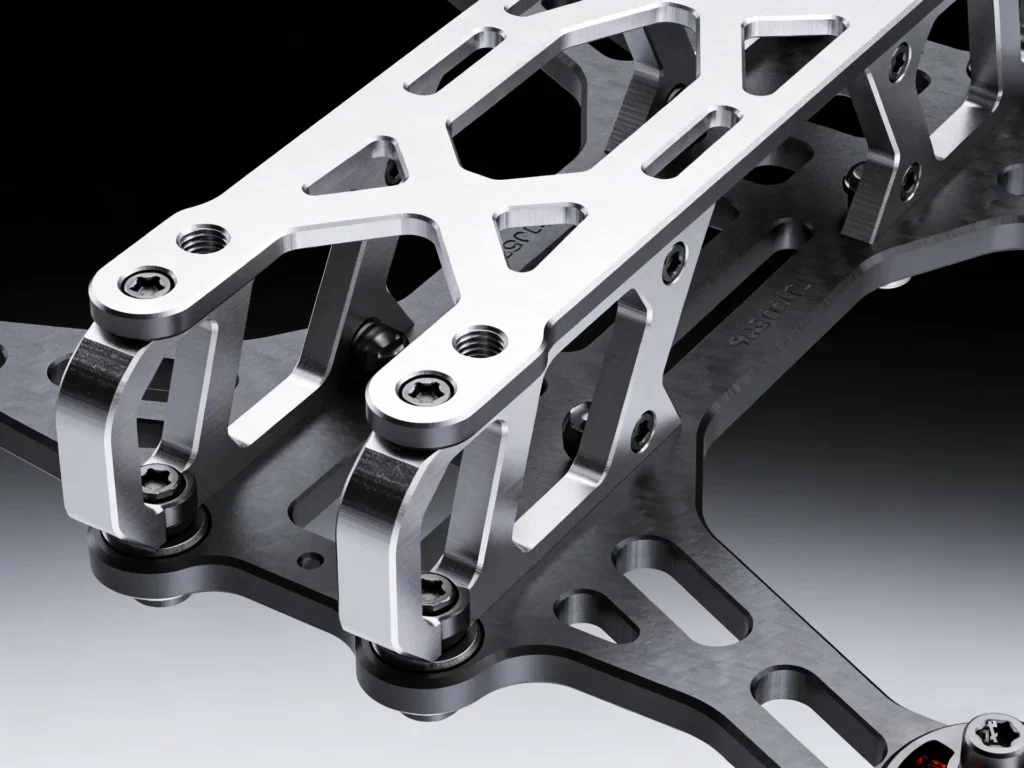
A cnc machined drone frame refers to a UAV chassis or structural component produced through Computer Numerical Control (CNC) machining. Unlike molded plastic or simple hand-cut sheets, these frames are carved from solid blocks or sheets of high-performance materials such as aerospace-grade aluminum or premium carbon fiber. The process utilizes specialized cutting tools that follow a programmed digital path, ensuring that every millimeter of the design matches the original 3D model.
The working principle is rooted in subtractive manufacturing. A high-speed spindle maneuvers a carbide bit across the workpiece to remove excess material. For drone applications, this allows for the creation of intricate “pocketing” designs—where internal material is removed to reduce weight without sacrificing structural stiffness. This level of complexity is often discussed in professional circles like the Reddit r/UAVNavigation community, where engineers emphasize that the stiffness-to-weight ratio of a cnc machined drone frame is unparalleled compared to traditional manufacturing methods. By using CNC technology, designers can implement varying wall thicknesses and integrated mounting points that would be impossible to achieve through 3D printing or injection molding at the same strength level.
Core Application Scenarios: Where Precision Meets Purpose
The versatility of a cnc machined drone frame makes it the preferred choice across several high-stakes industries. Because these frames can be customized to house specific sensors and power systems, they serve as the “skeleton” for diverse mission profiles.
- Agricultural Monitoring: Large-scale crop spraying and multi-spectral imaging drones require frames that can handle heavy liquid payloads and constant vibration. A cnc machined drone frame provides the necessary rigidity to ensure sensors remain calibrated during long flight hours in humid environments.
- Infrastructure Inspection: Drones used for bridge, power line, and wind turbine inspections must operate in high-wind conditions. The precision of CNC machining allows for aerodynamic arm designs that minimize drag and maximize flight stability.
- Cinematography and Media: Professional cinema drones carrying heavy RED or Arri cameras rely on CNC-machined components to eliminate frame resonance, which could otherwise introduce “jello” effects into the video footage.
- Military and Defense: Tactical UAVs require rapid deployment and extreme durability. Machined frames made from 7075 aluminum or high-modulus carbon fiber ensure the craft can survive hard landings and high-G maneuvers.
- Search and Rescue (SAR): In SAR operations, drones often carry thermal cameras and delivery pods. The reliability of a cnc machined drone frame ensures that the mechanical structure will not fail during critical life-saving missions.
Critical Buying Factors: Selecting Your CNC Drone Solution
When sourcing a cnc machined drone frame, procurement officers and lead engineers must look beyond the price tag. The performance of the aircraft is directly proportional to the quality of the machining process. On platforms like Facebook’s “FPV Engineering Group,” veteran pilots frequently mention that “cheap frames lead to expensive crashes.” To avoid this, consider the following factors:
1. Material Selection and Grade
Not all carbon fiber or aluminum is created equal. For a high-performance cnc machined drone frame, you should look for T700 or T800 carbon fiber for its superior tensile strength. If your design requires aluminum, 6061-T6 is standard, but 7075-T6 offers a higher strength-to-weight ratio for critical stress points like motor mounts.
2. Dimensional Tolerances
The precision of the motor mounting holes and arm joints is vital. A reputable manufacturer like jucheng maintains tolerances as tight as +/- 0.01mm. This ensures that motors are perfectly vertical, preventing unwanted yaw drift and heating issues in the electronic speed controllers (ESCs).
3. Surface Finish and Edge Treatment
Raw CNC cuts can leave sharp edges that fray wiring or cause stress concentrations. High-quality frames feature chamfered edges and smooth surface finishes (such as matte or glossy coating for carbon, or anodizing for aluminum). This not only improves aesthetics but also enhances the longevity of the electrical components.
4. Lead Time and Prototyping Capabilities
In the fast-paced UAV market, the ability to iterate designs quickly is a competitive advantage. You need a partner who can move from a CAD file to a finished cnc machined drone frame prototype in days, not weeks.
Technical Comparison: Materials for CNC Drone Frames
Choosing the right material for your cnc machined drone frame involves balancing weight, strength, and cost. The following table compares the most common materials used in professional CNC drone manufacturing.
| Material Type | Strength-to-Weight | Vibration Dampening | Cost Impact | Best Use Case |
|---|---|---|---|---|
| 3K Carbon Fiber | Excellent | High | Moderate | FPV Racing, Light Industrial |
| Aluminum 6061-T6 | Good | Low | Low | Heavy-lift landing gear, heat sinks |
| Aluminum 7075-T6 | Very High | Moderate | High | High-stress structural joints |
| Titanium Grade 5 | Supreme | Moderate | Very High | Specialized military/aerospace |
Installation and Maintenance: Keeping Your Frame Flight-Ready
Even the best cnc machined drone frame requires proper assembly and care to maintain its structural integrity over time. Fatigue and vibration are the primary enemies of any aircraft structure.
Step-By-Step Installation Tips
When assembling your drone, use a calibrated torque wrench for all frame bolts. Over-tightening can crush carbon fiber layers or strip aluminum threads, while under-tightening leads to frame resonance. Applying a small amount of medium-strength thread locker to every screw is a common recommendation among the Reddit r/drones community to prevent screws from backing out due to motor frequency vibrations.
Maintenance Routine
Regularly inspect your cnc machined drone frame for delamination or hairline cracks, especially after a hard landing. For aluminum components, check for any signs of bending or stress whitening. A quick wipe-down with isopropyl alcohol after flying in dusty or humid conditions will prevent corrosion on metal parts and keep the carbon fiber looking pristine. If your frame utilizes integrated vibration dampening balls, ensure they have not become brittle or torn.
Why Choose Jucheng for Your Drone Frame Needs?
When it comes to manufacturing a cnc machined drone frame, jucheng stands out as a leader in the precision machining industry. With years of experience serving the aerospace and robotics sectors, jucheng understands that there is zero margin for error in UAV flight.
The technical team at jucheng utilizes state-of-the-art multi-axis CNC machines that can produce complex geometries in a single setup. This reduces the accumulation of errors and ensures that every cnc machined drone frame leaving the facility meets rigorous quality standards. Furthermore, jucheng offers a comprehensive suite of post-processing options, including bead blasting, hard-coat anodizing, and custom laser engraving for branding.
Our commitment to quality is backed by ISO certifications, ensuring that our production processes are consistent and traceable. Whether you need a single custom prototype or a high-volume production run of 10,000 units, jucheng provides the scalability and technical support required to bring your UAV project to life. By choosing us, you are not just getting a parts supplier; you are gaining a strategic partner dedicated to optimizing your drone’s flight performance through superior mechanical engineering.
Frequently Asked Questions (FAQ)
1. Is carbon fiber or aluminum better for a cnc machined drone frame?
It depends on the application. Carbon fiber is generally preferred for the main plates and arms because it is lighter and absorbs vibrations better. Aluminum is often used for motor mounts or central “core” blocks where heat dissipation and thread strength are more important.
2. How does CNC machining compare to 3D printing for drone frames?
While 3D printing is great for rapid prototyping of non-structural covers, it cannot match the strength and heat resistance of a cnc machined drone frame. CNC parts are isotropic (equally strong in all directions), whereas 3D prints are often weak between layers.
3. What tolerances should I expect from a professional CNC service?
A high-end provider like jucheng typically offers tolerances between +/- 0.01mm to +/- 0.05mm. For drone frames, this is particularly important for the distance between motor centers to ensure flight controller algorithms work correctly.
4. Can I get a cnc machined drone frame with custom branding?
Yes. Most professional CNC shops offer laser engraving or CNC engraving. At jucheng, we can add logos, serial numbers, or motor orientation markings directly onto the frame components during the manufacturing process.
5. Why is the edge chamfering important for carbon fiber frames?
Chamfering removes the sharp 90-degree edge of the carbon fiber. This prevents the layers from delaminating during an impact and protects the silicone insulation of your power wires from being sliced by the sharp carbon edge.
6. How do I minimize weight in my frame design?
Utilize “pocketing” techniques where the center of thick parts is milled out, leaving a structural “I-beam” or rib pattern. This is a common feature in a well-engineered cnc machined drone frame to maintain rigidity while shedding unnecessary grams.
7. Does jucheng provide material certifications?
Absolutely. We provide full material traceability and certifications (MTRs) upon request to ensure that the cnc machined drone frame you receive is made from exactly the grade of material specified in your design.
For more information on how we can assist with your next UAV project, please visit our official website or contact our engineering team directly.