
The vast expanse of space is perhaps the most unforgiving environment known to mankind. When a satellite is launched, every single gram of material and every micron of precision becomes a factor in mission success or catastrophic failure. For many aerospace startups and established satellite constellation developers, a recurring nightmare exists: a critical component fails in orbit due to thermal expansion issues or structural fatigue that was not accounted for during the manufacturing phase. This is where the intricacies of satellite components machining move from a standard procurement task to a vital lifeline for aerospace engineering. At jucheng, we understand that when a part is thousands of miles above the Earth, there is no opportunity for a repair mission; it must be perfect the first time.
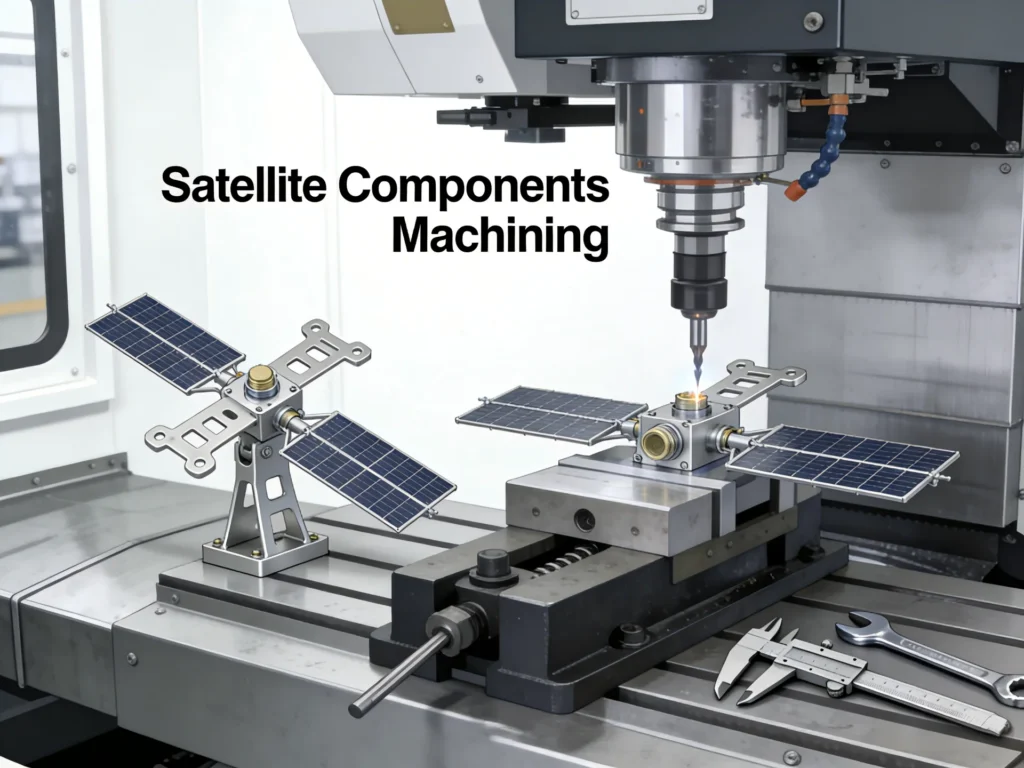 The Critical Challenges of Modern Space Hardware Production
Engineers often face a daunting set of problems when moving from a digital CAD model to a physical flight-ready part. The primary pain point is the intersection of material science and geometric complexity. Space hardware requires materials that can withstand extreme temperature fluctuations—ranging from -150°C to 150°C—while maintaining structural integrity. Traditional manufacturing methods often fall short when dealing with specialized alloys like Grade 5 Titanium or Inconel 718. This is precisely why a specialized satellite components making company is necessary. The satellite machining process is not merely about removing metal; it is about managing internal stresses within the material to ensure that the part does not warp or crack under the intense vibrations of a rocket launch.
Another significant hurdle is the “SWaP” constraint—Size, Weight, and Power. Every ounce of weight saved in a satellite bracket or housing equates to significant cost savings in fuel or additional capacity for scientific instruments. Consequently, components are becoming thinner, lighter, and more complex. Standard 3-axis milling often cannot reach the intricate undercuts required for weight-optimized designs. As a leading satellite components manufacturers partner, jucheng utilizes advanced 5-axis CNC technology to address these geometric challenges, ensuring that even the most skeletal, high-strength structures are produced with absolute fidelity to the original design.
Defining the Standard: What is Satellite Components Machining?
To solve these aerospace dilemmas, one must first understand the fundamental principles of satellite components machining. At its core, this is a subset of ultra-precision CNC (Computer Numerical Control) machining specifically tailored for the aerospace and defense sectors. It involves the subtractive manufacturing of parts such as transponder housings, thruster nozzles, optical mounts, and structural frames. Unlike general-purpose machining, the satellite components machining process requires climate-controlled environments and specialized tooling to achieve tolerances that are often as tight as +/- 0.005mm.
The principle of this work relies on high-speed spindles and multi-axis movement. By using diamond-coated or carbide tools, jucheng can sculpt hardened metals into complex shapes. This process is governed by rigorous digital workflows where the CAM (Computer-Aided Manufacturing) software simulates the toolpath to prevent any collisions or heat-induced deformations. For a satellite machining specialist, the goal is to achieve a surface finish that minimizes “outgassing”—a phenomenon where materials release trapped gasses in a vacuum, which could potentially contaminate sensitive optical lenses or sensors on the spacecraft.
Core Application Scenarios: Where These Parts Live
The components produced through satellite machining are utilized across a variety of high-stakes industries and orbital applications. Understanding these scenarios helps engineers choose the right manufacturing partner.
- Telecommunications Satellites: Large geostationary satellites require complex RF (Radio Frequency) housings and wave-guides. These parts must be incredibly smooth internally to prevent signal degradation.
- Earth Observation and Remote Sensing: High-resolution cameras and LiDAR systems require stable optical benches and mounts. Any thermal drift in these satellite components machining products would result in blurry images of our planet.
- SmallSats and CubeSats: The burgeoning commercial space sector relies on standardized yet highly customized frames. As a satellite components making company, jucheng provides the rapid prototyping and production needed for these fast-paced missions.
- Deep Space Exploration: Components for probes traveling to Mars or beyond must be made from exotic materials that can survive radiation and years of dormancy followed by sudden activation.
Key Factors to Consider When Selecting a Manufacturing Partner
When searching for satellite components manufacturers, the decision-making process should be driven by more than just price. The “lowest bid” approach often leads to delays, failed inspections, and ultimately, mission failure. Here are the critical factors that procurement officers and lead engineers must evaluate:
| Factor | Requirement for Satellite Industry | Impact on Mission |
|---|---|---|
| Dimensional Precision | Tolerances within microns (+/- 0.005mm) | Ensures perfect fitment in modular assemblies. |
| Material Certification | Full traceability (MTRs) for Aerospace Alloys | Prevents structural failure due to material impurities. |
| Surface Finish | Ra 0.4 to Ra 0.8 or better | Reduces outgassing and improves thermal radiation. |
| Quality Assurance | AS9100 or ISO9001:2015 Standards | Provides documented proof of reliability and consistency. |
| Technical Support | DFM (Design for Manufacturing) Feedback | Reduces production costs and identifies design flaws early. |
In addition to these technical specs, the “Lead Time” is a major pain point. Many Reddit discussions in the r/Aerospace and r/CNC communities highlight the frustration of 24-week lead times from traditional aerospace giants. This is where a more agile satellite components making company like jucheng provides a competitive edge, offering faster turnaround times without sacrificing the stringent quality controls required for flight-grade hardware.
Advanced Processes: How Jucheng Tackles the Toughest Projects
The satellite components machining process at jucheng is built on a foundation of iterative quality. We don’t just “cut and ship.” The process begins with a comprehensive review of the 3D model. Our engineers look for “thin-wall” sections that might vibrate during machining, which could lead to chatter marks. To solve this, we might employ custom work-holding fixtures or specialized vibration-dampening tools. This proactive approach is what separates a world-class satellite machining service from a standard machine shop.
Furthermore, we specialize in high-precision milling of Aluminum 6061-T6, 7075-T6, and more exotic choices like Beryllium-Aluminum alloys or Kovar. Kovar is particularly important in satellite components machining because its coefficient of thermal expansion matches that of glass, making it ideal for electronic packages and sensors. Machining these materials requires deep expertise in spindle speeds and coolant application to prevent work-hardening or chemical contamination of the workpiece.
Installation and Maintenance of Satellite Components
While CNC manufacturers focus on production, the end-use environment dictates how these parts should be handled post-production. Satellite machining produces parts that are often incredibly delicate.
- Cleanroom Handling: Most satellite components machining output should be handled in Class 10,000 (ISO 7) cleanrooms or better to prevent particulate contamination.
- Torque Precision: During assembly, using calibrated torque wrenches is non-negotiable. Over-tightening a CNC-machined bracket can introduce stress fractures that may propagate during the high-G forces of launch.
- Vibration Testing: Once installed, components are typically subjected to shaker table tests. A well-machined part from a reputable satellite components manufacturers like jucheng will have no resonant frequencies that coincide with the launch vehicle’s profile.
- Maintenance in Clean Environments: For ground-test units, regular inspection for oxidation or thread galling (especially in stainless steel parts) is essential. We recommend using vacuum-stable lubricants to ensure longevity.
Why Jucheng is the Strategic Choice for Satellite Machining
In the competitive landscape of satellite components manufacturers, jucheng stands out by bridging the gap between high-end aerospace quality and commercial efficiency. Our facility is equipped with state-of-the-art 5-axis CNC centers capable of producing the most complex geometries requested by modern aerospace engineers. Our commitment to the satellite components machining process is reflected in our rigorous inspection protocols, utilizing CMM (Coordinate Measuring Machines) to verify every dimension against the digital twin.
Choosing jucheng means choosing a partner who understands the stakes. We have helped numerous clients overcome the “Valley of Death” in hardware development by providing rapid prototyping that transitions seamlessly into full-scale production. Our expertise in satellite machining extends beyond the machine shop; we provide valuable DFM insights that could help you reduce the weight of your satellite by 10-15%, simply by optimizing the tool paths and material removal strategies. This level of partnership is why we are recognized as a premier satellite components making company globally.
Frequently Asked Questions About Satellite Components Machining
Q1: What materials are best for satellite components?
Aluminum 7075 is popular for structural parts due to its strength-to-weight ratio. However, for parts requiring high thermal stability, Titanium or Inconel might be used. jucheng can help you select the ideal material based on your specific orbital requirements.
Q2: How do you handle outgassing issues in machined parts?
We focus on achieving superior surface finishes and offer specialized cleaning processes. We also recommend specific plating options like Electroless Nickel or Anodizing (Type II or III) which are proven to be stable in a vacuum environment.
Q3: Can Jucheng handle 5-axis complex geometries?
Yes, 5-axis satellite machining is one of our core competencies. This allows us to create monolithic parts that are lighter and stronger than multi-piece assemblies, which is a significant advantage in aerospace design.
Q4: What is the typical tolerance for a flight-ready component?
While it varies by part, we typically work within +/- 0.005mm to +/- 0.01mm for critical mating surfaces. Our satellite components machining process is designed to hold these tolerances consistently across production batches.
Q5: Do you provide material traceability?
Absolutely. As a professional satellite components making company, we provide full material certifications (MTR) and COC (Certificate of Conformance) for every order to ensure total compliance with aerospace regulations.
Q6: How does CNC machining compare to 3D printing for satellites?
While 3D printing is great for extremely complex internal lattices, satellite components machining remains superior for achieving precise tolerances, superior surface finishes, and predictable structural properties in critical load-bearing parts.
Q7: What is the typical lead time for a custom satellite bracket?
Depending on complexity and material availability, our lead times are typically 2-4 weeks for prototypes, which is significantly faster than the industry average for satellite components manufacturers.
Q8: How do you ensure the parts don’t warp during machining?
We use stress-relieved materials and employ multi-stage machining processes, allowing the metal to “rest” between heavy roughing and final finishing cuts. This ensures the satellite machining result remains dimensionally stable.
Partner with Jucheng for Mission-Critical Excellence
Success in the space industry is built on a foundation of trust and technical precision. When you partner with jucheng, you are not just hiring a machine shop; you are engaging a team of experts dedicated to the art and science of satellite components machining. We invite you to experience the difference that high-tier satellite machining can make for your next mission. Whether you are building a single experimental CubeSat or a massive telecommunications constellation, our facility is ready to meet your needs with speed, accuracy, and unwavering quality.
Don’t let manufacturing bottlenecks ground your innovation. Contact jucheng today to discuss your project requirements and receive a comprehensive DFM analysis from our engineering team. Let’s reach for the stars together with precision-engineered solutions that are built to last in the harshest environments of the cosmos.
For more information on our capabilities and to view our facility certifications, please visit Jucheng Precision Manufacturing.