
The Critical Role of Precision Actuator Housing Machining
In the world of motion control, where robotic arms execute sub-millimeter movements and aircraft flight surfaces adjust with life-critical reliability, the unsung hero is rarely the motor or the software. It is the precisely machined enclosure that contains and protects these vital systems. The actuator housing machining process is the foundational step that determines the performance, longevity, and safety of the entire actuator assembly. A housing is far more than a simple cover; it is a structural linchpin that ensures perfect alignment of gears and shafts, manages heat dissipation from the motor, provides secure mounting points, and shields sensitive internal components from harsh environmental factors like dust, moisture, and vibration. In high-stakes industries such as aerospace and surgical robotics, a micron-level deviation in a housing’s bore or mounting surface can lead to binding, premature wear, catastrophic failure, or a loss of positional accuracy. Therefore, achieving extreme precision in this component is not merely a manufacturing preference—it is an absolute engineering imperative that enables innovation and reliability across modern technology.
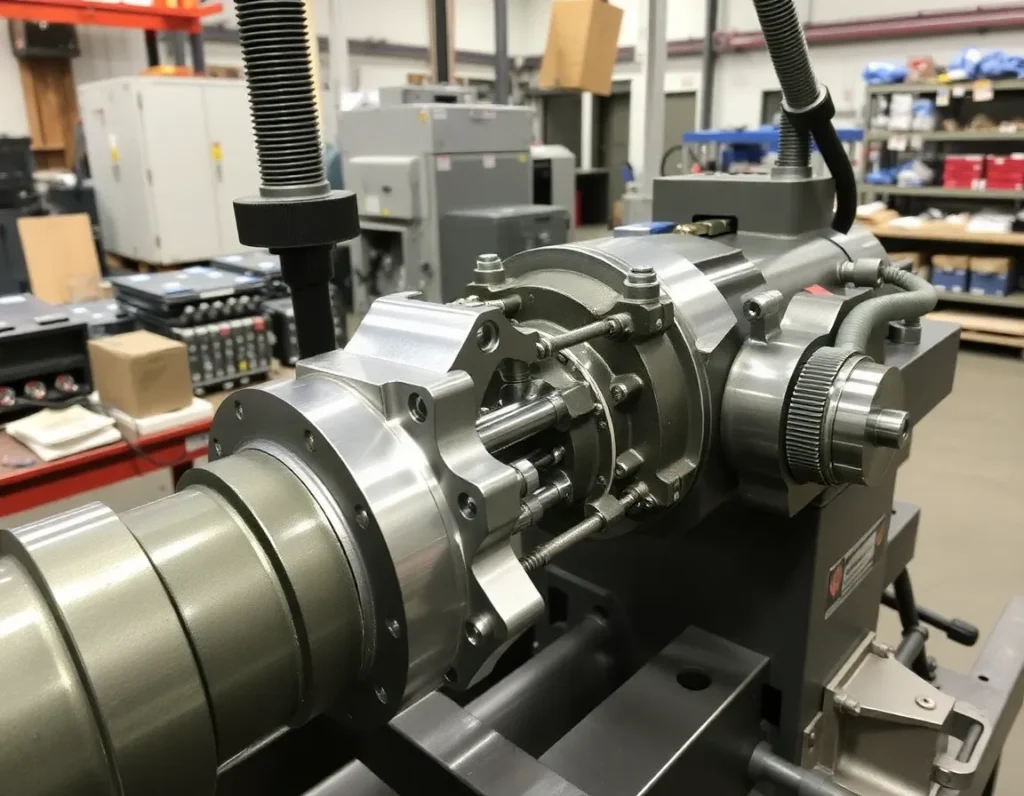
What is Actuator Housing Machining? Defining the Core Component
An actuator housing is the structural skeleton of a linear or rotary actuator system. Think of it as the engine block for a motion control device. Its primary function is to provide a rigid, dimensionally stable frame that precisely locates and supports all other components: the motor, drive mechanism (such as a ball screw or gear train), bearings, seals, and sensors. Machining is the manufacturing process that transforms a raw block or billet of metal into this complex, high-tolerance component.
The process involves using computer-controlled machine tools to cut away material, creating specific features like through-holes for shafts, threaded ports for lubrication, intricate cavities for gear trains, and precisely located bolt patterns for assembly. Every surface and bore is machined to a specified tolerance, ensuring that when the actuator is assembled, all parts fit together seamlessly without play or misalignment. This precision is what allows for the efficient transfer of force and motion, minimizes energy loss through friction, and ensures the actuator operates smoothly and quietly over its intended lifespan. In essence, actuator housing machining is the art and science of creating the perfect physical environment for controlled motion to occur.
Key Materials for Actuator Housings: From Aluminum Alloys to Stainless Steel
The selection of material for an actuator housing is a critical decision that balances strength, weight, corrosion resistance, machinability, and cost. The choice directly impacts the actuator’s performance in its final application.
Aluminum Alloys (6061-T6 and 7075)
Aluminum is the most prevalent material for actuator housings, particularly in robotics and automation, due to its excellent strength-to-weight ratio. The 6061-T6 alloy is the industry workhorse, offering a superb balance of good mechanical properties, excellent machinability, weldability, and relatively low cost. It is ideal for applications where weight reduction is important but extreme loads are not anticipated. For more demanding applications requiring higher strength and stiffness—such as in aerospace frames or high-dynamic robotic joints—7075 aluminum alloy is often specified. While slightly more challenging to machine and less corrosion-resistant than 6061 without treatment, 7075 provides superior performance under stress.
Stainless Steels (304 and 316)
When the operating environment introduces moisture, chemicals, or extreme temperatures, stainless steel becomes the material of choice. Grade 304 stainless offers good general corrosion resistance and is widely used in food processing, medical, and marine applications. For even more aggressive environments, such as offshore equipment or chemical processing plants, Grade 316 stainless steel is specified for its superior resistance to chlorides and acids. The trade-off is that stainless steels are heavier, more expensive, and tougher to machine than aluminum, generating more tool wear and requiring more powerful machinery.
Other Materials
While less common, other materials serve niche needs. Titanium alloys are used in the most weight-sensitive aerospace applications where their exceptional strength-to-weight ratio and high-temperature performance justify the very high cost and machining difficulty. Ductile iron or steel may be selected for extremely large, high-load industrial actuator housings where weight is a secondary concern to sheer durability and stiffness. Engineers must always weigh these material properties against the actuator’s design requirements and total lifecycle cost.
Advanced CNC Machining Processes for Actuator Housings: Turning, Milling, and 5-Axis
Modern actuator housings are brought to life through a symphony of advanced Computer Numerical Control (CNC) machining processes. Each technique plays a specific role in creating the housing’s complex geometry.
CNC Turning
CNC turning is typically the first operation for housings with cylindrical features. The raw material, often a round bar stock, is rotated at high speed while a stationary cutting tool removes material. This process is ideal for creating the housing’s primary outer diameter, facing off the ends to precise lengths, and boring out the central through-hole or main cavity. For housings that are essentially cylindrical “cans” or have large cylindrical sections, turning provides an efficient and highly accurate method to establish the fundamental shape and critical concentricities before further detailed machining.
CNC Milling (3-Axis and 5-Axis)
CNC milling is where the housing’s complexity is fully realized. A rotating cutting tool moves along multiple linear axes (X, Y, and Z) to cut the workpiece, which is held stationary on a table. This is used to create flat faces, pockets, slots, and drill/tap bolt hole patterns on various sides of the housing. While 3-axis milling is powerful, it often requires the part to be manually repositioned to access all faces, which introduces potential alignment errors and increases setup time.
This is where 5-axis CNC machining represents a quantum leap in capability and efficiency. A 5-axis machine can move the cutting tool or the part along five different axes simultaneously. This allows the tool to approach the workpiece from virtually any angle in a single setup. For an actuator housing, this means complex contours, angled ports, helical gear profiles, and intricate internal cavities can be machined in one continuous operation. The benefits are profound: drastically reduced setup times, elimination of errors from re-fixturing, and the ability to produce geometries that are simply impossible with 3-axis machines. As noted in the knowledge base, using a machine like a Mori Seiki NMV3000 allows a complex part to be “nearly complete… in a single operation,” while simultaneous 5-axis contouring is essential for machining high-tolerance features like helical gear teeth directly into the housing bore.
The Integrated Approach
The most efficient production strategy for high-precision actuator housings often involves a combination of these processes. A part might start on a CNC lathe to establish its core cylindrical geometry and then be transferred to a 5-axis machining center to have all its mounting flanges, lateral ports, and internal features completed in one sophisticated setup. This integrated approach, leveraging the strengths of both turning and advanced milling, is how leading manufacturers achieve the tight tolerances, perfect surface finishes, and complex designs required by today’s most advanced aerospace, robotics, and automation systems.
Achieving High Tolerance and Precision in Actuator Housing Production
The integrated approach of combining CNC turning and 5-axis milling sets the stage, but achieving the micron-level precision required for modern actuator housings demands a rigorous, system-wide commitment. This precision is non-negotiable; a housing that is even a few microns out of spec can cause binding, misalignment, excessive wear, or complete actuator failure. The journey to high-tolerance production is built on three pillars: advanced machine capability, environmental and process control, and meticulous verification.
Machine capability is the foundation. As referenced, using a 5-axis CNC machining center for simultaneous contouring is critical for complex internal geometries like helical gear teeth. However, the machine itself must be exceptionally rigid and thermally stable to maintain accuracy over long production cycles. Precision is further enhanced by minimizing setups. Completing a housing in a single operation, or with as few fixturings as possible, eliminates the cumulative error that can occur each time a part is moved and re-clamped. This is why the strategy of using a machine like a Mori Seiki NMV3000 to nearly finish a complex part in one go is so effective—it ensures all critical features are machined in a single, perfectly aligned coordinate system.
Environmental and process control is the silent guardian of precision. Temperature fluctuations in the workshop can cause both the machine and the workpiece material to expand or contract, throwing dimensions off. High-end machining facilities often implement climate control to mitigate this. Furthermore, the machining process itself generates heat. Using optimized toolpaths, proper coolant application, and sharp cutting tools minimizes thermal distortion of the part, ensuring that the dimensions measured after cooling match the programmed intent. This is especially crucial for thin-walled sections common in lightweight actuator housings.
Finally, precision is meaningless without verification. In-process probing allows the CNC machine to check its own work, measuring critical features before the part is even unloaded and making automatic tool wear compensations. Post-process inspection with coordinate measuring machines (CMMs) provides a comprehensive, independent validation of the entire housing against the original 3D CAD model. For the highest-tolerance applications, such as those in aerospace or surgical robotics, this data is often recorded and traceable to each specific serial-numbered part. This closed-loop of design, controlled machining, and validated measurement is what transforms a well-machined block of metal into a precision-engineered actuator housing machining masterpiece that performs reliably under demanding conditions.
Design for Manufacturability (DFM) Principles for Optimal Actuator Housings
A brilliant design on screen can become a manufacturing nightmare and a cost driver if DFM principles are ignored. Effective DFM for actuator housings is a collaborative dialogue between designer and machinist, aimed at simplifying production without compromising function. The goal is to create a part that is not only performant but also economical, reliable, and quick to produce. Key principles focus on geometry, feature design, and material selection.
First, consider internal geometries and deep cavities. Designing housings with accessible internal corners is crucial. A milling cutter, being round, cannot produce a perfectly sharp internal corner. Specifying a reasonable internal corner radius that matches standard cutter sizes avoids the need for expensive, fragile specialty tools and reduces machining time. Similarly, the depth-to-diameter ratio of any bored hole or cavity should be limited. Machining a very deep, small-diameter hole requires specialized tooling, increases the risk of tool breakage, and can lead to tolerance issues due to tool deflection. Where possible, designing internal passages with stepped diameters or considering a two-part housing assembly can solve these challenges.
Second, standardize features. Using standard drill and tap sizes for mounting holes, sensor ports, and fluid fittings wherever possible eliminates the need for custom tooling. Specifying common thread types (e.g., UNF, metric) and classes fit for the application ensures compatibility and reduces cost. Furthermore, maintaining uniform wall thicknesses promotes consistent material removal during machining and helps prevent distortion during both cutting and subsequent heat treatments. Sudden transitions from thick to thin sections are stress concentrators and can lead to warping.
Third, strategically design for multi-axis machining. A good DFM process leverages the capabilities of 5-axis machines. Instead of designing a housing that requires complex angled setups, features like mounting bosses or side ports can be oriented so they can be machched from a standard angle accessible by the rotating spindle of a 5-axis machine. This allows the entire part to be finished in one or two setups, dramatically improving accuracy and speed. The knowledge base example of the robotic housing highlights this—its complex contours and gear teeth were designed with the simultaneous 5-axis machining process in mind, enabling efficient production of a high-tolerance part. Ultimately, applying DFM transforms a design from a theoretical model into a blueprint for efficient, high-quality, and repeatable manufacturing.
Surface Finishing and Corrosion Protection for Enhanced Durability
Once an actuator housing is machined to precision, its journey is not complete. The raw machined surface, while dimensionally accurate, is vulnerable to environmental attack and wear. Surface finishing and corrosion protection are critical final steps that seal in the precision and ensure the housing performs reliably throughout its service life. The chosen treatment depends on the base material, the operating environment, and functional requirements like electrical conductivity or lubricity.
For aluminum housings, anodizing is the most common and effective treatment. As detailed in the product specification for the CNC Linear Actuator Housing, clear anodizing is frequently used. This electrochemical process grows a hard, porous aluminum oxide layer on the surface, which is then sealed. This layer significantly improves wear resistance and provides excellent corrosion protection. For harsher environments, hard anodizing (Type III) creates an even thicker, more durable coating. Anodizing also offers a secondary benefit: the porous layer can be dyed before sealing, allowing for color-coding of parts for easy identification in complex assemblies.
Stainless steel housings, such as those made from corrosion-resistant 316 stainless, often rely on their inherent chromium oxide layer for protection. However, the machining process can sometimes compromise this passive layer on exposed surfaces. Passivation is a common chemical treatment used to remove free iron contaminants and restore the uniform protective oxide layer, maximizing the alloy’s natural corrosion resistance. For applications requiring ultra-smooth surfaces to prevent bacterial growth or reduce friction, electropolishing is used. This process removes a microscopic layer of material, leveling surface peaks and leaving a smooth, shiny, and more passive surface.
Other specialized coatings address unique needs. Powder coating provides a thick, durable, and decorative polymer layer excellent for industrial equipment exposed to chemicals or impacts. For titanium housings in aerospace, specialized anodizing or ceramic coatings might be applied for wear and thermal protection. The selection is a critical engineering decision. A housing destined for a surgical robot in a sterilized environment will have different finishing needs than one operating on an offshore oil rig or inside a jet engine’s fuel control system. The right finish is the final safeguard, ensuring the precision achieved during machining is preserved against the realities of the operational world.
Industry Applications: Aerospace, Robotics, and Industrial Automation
The stringent requirements of high-tolerance machining, robust DFM, and protective finishing are driven by the demanding applications where actuator housings are deployed. These components are the unsung heroes inside the systems that power modern technology, from the skies to the factory floor.
Aerospace and Aviation
In aerospace, actuator housings are mission-critical. They contain the mechanisms for flight control surfaces (ailerons, rudders, flaps), landing gear retraction, thrust vectoring, and fuel management. Here, failure is not an option. Housings are typically machined from high-strength aluminum alloys (like 7075) or titanium for the best strength-to-weight ratio, and increasingly from corrosion-resistant stainless steels for fuel and hydraulic systems. Tolerances are exceptionally tight to ensure absolute reliability under extreme pressure, temperature cycling, and vibration. The actuator housing machining process for aerospace parts is accompanied by rigorous documentation and traceability to meet standards like AS9100. Surface finishes must prevent corrosion that could be caused by altitude, humidity, or exposure to hydraulic fluids.
Robotics and Collaborative Robots (Cobots)
The robotics industry, particularly collaborative and industrial robots, demands a unique combination of precision, lightweight design, and durability. As the knowledge base articles emphasize, robotic actuator housings, such as the custom aluminum housing for linear motion modules, are central to a robot’s joint or drive system. They must be incredibly precise to ensure smooth, accurate movement without backlash. Lightweighting is paramount for maximizing payload capacity and efficiency, making aluminum alloys like 6061-T6 the material of choice. The design is often compact and complex, with integrated features for mounting motors, sensors, and harmonic drives—a perfect application for 5-axis CNC machining. Finishes like anodizing protect these housings from the occasional bump, conductive dust, or coolant exposure found on a factory floor.
Industrial Automation and Motion Control
Beyond discrete robots, actuator housings are fundamental to all forms of industrial automation. They are found in linear actuators that position items on an assembly line, in rotary actuators that control valves in process plants, and in the precise servo drives of CNC machines themselves. In these environments, the focus is often on high-volume production, long-term reliability, and resistance to harsh conditions. Housing designs prioritize DFM for cost-effective manufacturing at scale. Materials may range from aluminum for general use to stainless steel (like 316) for washdown environments in food and beverage or pharmaceutical applications. Corrosion protection and robust sealing are critical to prevent downtime in continuous 24/7 production operations. The actuator housing is the sturdy, reliable shell that allows the heart of automation—the actuator—to perform billions of cycles without fail.