
Introduction: The Rise of Lightweight Robotics
For decades, the popular image of a robot was a hulking machine of steel and hydraulics, powerful but confined to heavy industrial cages. This paradigm is undergoing a radical transformation. The rise of lightweight robotics marks a fundamental shift in how we design, build, and deploy automated systems. Driven by breakthroughs in materials science, advanced manufacturing, and a demand for greater versatility, engineers are now creating robots that prioritize a high strength-to-weight ratio above raw power alone. This evolution is not merely about making robots smaller; it’s about making them smarter, more energy-efficient, and capable of interacting safely and dynamically with human environments. From collaborative arms working alongside factory workers to agile drones inspecting infrastructure, the move toward lightweight robotic parts is unlocking a new era of robotic application, pushing the boundaries of speed, efficiency, and accessibility.
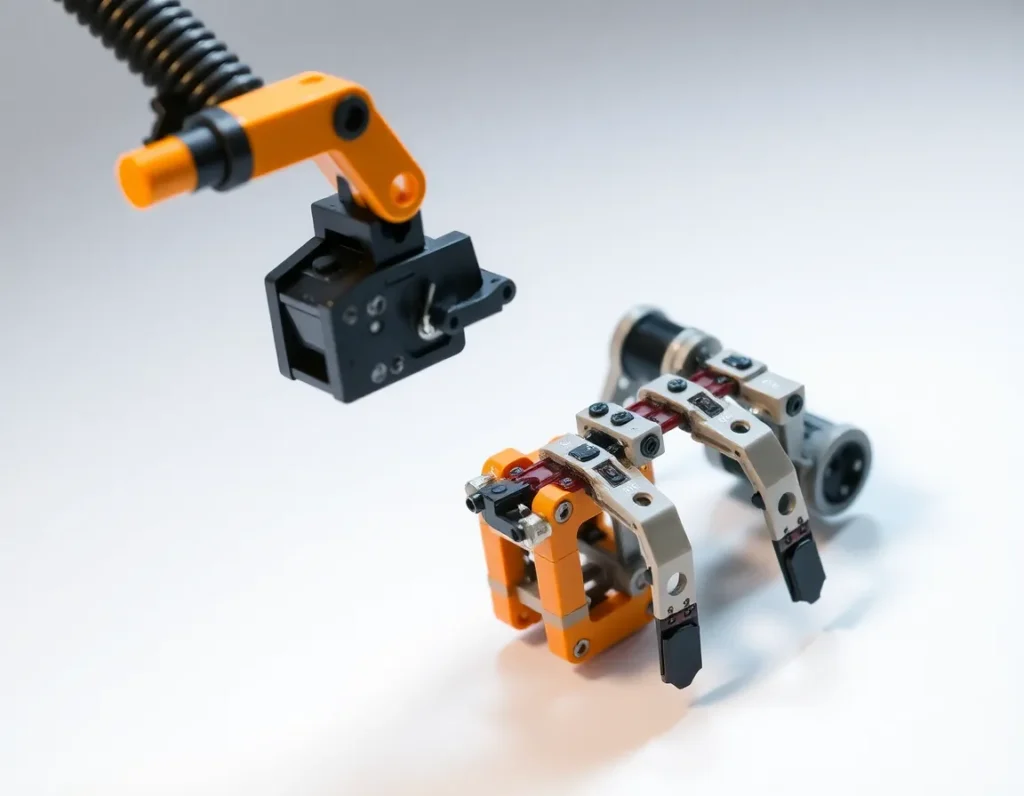
What Are Lightweight Robotic Parts? Core Materials and Components
At their core, lightweight robotic parts are structural and functional components engineered to minimize mass while maintaining or even enhancing required mechanical properties like stiffness, strength, and durability. They are the fundamental building blocks that differentiate a modern, agile robot from its traditional, heavy-duty predecessor. This philosophy extends beyond just the arm or frame to encompass the entire system, including actuators, end-effectors, and even internal wiring.
The realization of these parts hinges on a select group of advanced materials and component designs:
- Advanced Composites: Carbon fiber reinforced polymers (CFRP) are the poster child for lightweight robotics. By embedding incredibly strong carbon fibers within a plastic resin matrix, these composites offer stiffness and strength rivaling steel at a fraction of the weight. They are extensively used for robot arms, links, and chassis.
- High-Strength Alloys: Aerospace-grade aluminum alloys (like 7000-series) and titanium alloys provide an excellent balance of strength, corrosion resistance, and manufacturability. They are often used in joints, brackets, and structural frames where metal’s durability is paramount.
- Engineering Polymers and Plastics: Materials like PEEK (Polyether Ether Ketone) and UHMWPE (Ultra-High-Molecular-Weight Polyethylene) offer high wear resistance, low friction, and good chemical stability. They are ideal for gears, bushings, and protective covers, further reducing moving mass.
- Lightweight Actuators: Traditional heavy electric motors and gearboxes are being replaced by harmonic drives, pancake motors, and even novel pneumatic artificial muscles. These actuators deliver high torque or force in compact, low-mass packages, directly impacting the robot’s dynamic performance.
- Integrated Design: Lightweighting is also achieved through component integration—designing a single part to perform multiple functions (e.g., a structural bracket that also acts as a coolant channel), thereby eliminating fasteners and redundant material.
The Science of Strength and Weight: Key Material Technologies
The pursuit of lighter robots is grounded in material science principles that quantify a material’s ability to bear load relative to its density. The key metric is the specific strength (tensile strength divided by density) and specific stiffness (Young’s modulus divided by density). A material with high specific strength allows a designer to use less of it to achieve the same load-bearing capability, directly leading to weight savings.
This science is applied through several key technologies:
Composite Material Engineering
The true power of composites like CFRP lies in their anisotropic nature—their strength can be tailored directionally. Engineers can orient the carbon fiber layers (plies) precisely along the paths of primary stress within a robot arm, placing material only where it is needed. This results in complex, organic shapes that are both incredibly light and stiff, a feat impossible with isotropic materials like aluminum. The manufacturing process, often involving autoclaves or resin transfer molding, is critical to ensuring proper fiber alignment and resin cure for optimal performance.
Metal Foams and Lattice Structures
Inspired by natural structures like bone, which is strong yet porous, engineers are using additive manufacturing (3D printing) to create metal parts with internal lattice structures. These microscopic truss-like designs maintain high stiffness while removing up to 70% of the solid material, drastically reducing weight. Similarly, metal foams—metals infused with gas bubbles to create a cellular structure—offer very low density with good energy absorption properties, useful for protective casings.
Hybrid Material Systems
The most advanced lightweight robotic parts often combine multiple material technologies. A robot link might use a carbon fiber shell for primary stiffness, with 3D-printed titanium lattice inserts at joint interfaces for localized strength and heat dissipation. Adhesive bonding and co-curing processes are used to fuse these dissimilar materials into a single, optimized component, pushing the boundaries of what is mechanically possible.
Critical Applications: Where Lightweight Robotics Makes the Biggest Impact
The advantages of reduced mass translate into transformative capabilities across diverse fields. The impact is most profound in applications where every gram counts or where interaction with humans is essential.
Collaborative Robotics (Cobots)
This is perhaps the most direct application. For a robot to work safely alongside humans without bulky safety cages, it must be inherently safe. Lightweight construction, often using composites and plastic covers, reduces the robot’s kinetic energy. If a collision occurs, the lower mass results in a much lower impact force, minimizing the risk of injury. This allows cobots to be deployed on mobile platforms or in tight spaces on assembly lines for tasks like precision assembly, machine tending, and quality inspection.
Aerospace and Aviation
Here, weight savings equate directly to fuel efficiency and payload capacity. Lightweight robotic systems are used for automated fiber placement in building aircraft composite fuselages, for drilling and fastening in confined spaces, and for internal aircraft inspection. Drones and unmanned aerial vehicles (UAVs) are themselves a product of lightweight robotics; their entire airframe, gimbals, and manipulators rely on carbon fiber and advanced polymers to maximize flight time and agility.
Medical and Rehabilitation Robotics
Exoskeletons and robotic prosthetics must be worn by the user, making minimal weight an absolute requirement for comfort and usability. Lightweight carbon fiber frames, compact actuators, and breathable materials enable devices that can assist with walking, lifting, or precise limb movement without causing fatigue. Similarly, surgical robot arms benefit from lightweight design for superior precision and reduced tremor, allowing surgeons to perform minimally invasive procedures with enhanced control.
Mobile and Field Robotics
Robots designed for search & rescue, planetary exploration, or agricultural monitoring operate in unpredictable, energy-constrained environments. A lighter robot can traverse difficult terrain more easily, use smaller and fewer motors, and operate longer on battery power. This makes them more practical for extended missions, whether it’s a legged robot navigating rubble or an autonomous vehicle mapping a field.
Design Principles and Manufacturing Techniques for Lightweight Parts
Creating effective lightweight robotic parts is not just about selecting the right material; it requires a holistic design philosophy and specialized manufacturing methods that work in concert from the initial concept.
Topology Optimization
This is a computational design process that uses finite element analysis (FEA) to determine the optimal material layout within a given design space for a set of loads and constraints. The software algorithmically removes material from areas of low stress, resulting in organic, skeletal structures that look almost grown rather than machined. These highly efficient shapes, which maximize stiffness-to-weight ratio, are then realized using additive manufacturing.
Additive Manufacturing (3D Printing)
Technologies like Selective Laser Sintering (SLS), Direct Metal Laser Sintering (DMLS), and Stereolithography (SLA) are indispensable for lightweight design. They allow for the production of the complex, hollow, and lattice-filled geometries generated by topology optimization, which are impossible to create with traditional subtractive methods like milling. 3D printing also enables part consolidation, merging dozens of assembled components into a single, lighter, and more reliable printed part.
Honeycomb and Sandwich Panel Construction
A classic aerospace technique now common in robotics, this involves bonding two thin, stiff face sheets (often carbon fiber) to a lightweight core material, such as aluminum honeycomb or polymer foam. This creates a panel with exceptional bending stiffness and low weight, perfect for large robot covers, platforms, or structural panels where flat or slightly curved surfaces are needed.
Precision Casting and Forging
For high-volume production of complex metal parts, investment casting (lost-wax casting) and precision forging are used. These processes can produce near-net-shape parts with excellent material properties and thin walls, minimizing the need for heavy, material-wasting machining operations afterward. They are particularly relevant for critical structural joints and actuator housings.
The convergence of these design principles and manufacturing techniques empowers engineers to systematically strip away unnecessary mass, leading to robotic systems that are not only lighter but often stronger, faster, and more capable than their conventionally built counterparts.
Performance Benefits: Efficiency, Speed, and Payload Advantages
The relentless pursuit of lighter components in robotics is not an academic exercise; it yields transformative performance gains across every metric that defines a capable robotic system. The shift to lightweight robotic parts fundamentally alters the dynamics of how robots move, consume energy, and interact with their environment, delivering a cascade of tangible benefits.
Enhanced Energy Efficiency and Operational Endurance
Perhaps the most direct benefit is a dramatic improvement in energy efficiency. A lighter robot requires less force to accelerate and decelerate, and less torque to hold positions against gravity. This translates directly into lower power draw from motors and actuators. For battery-powered robots—such as autonomous mobile robots (AMRs), drones, and exoskeletons—this is a game-changer. Reduced mass extends operational runtime per charge, enabling longer work cycles, greater range, or the use of smaller, lighter battery packs, which in turn creates a virtuous cycle of further weight reduction. In industrial settings, even stationary robots benefit, as lower inertia reduces peak current demands, leading to smaller, more efficient drives and lower electricity costs over thousands of operational hours.
Increased Speed and Dynamic Agility
Mass is the enemy of acceleration. By minimizing the inertia of moving arms, legs, or entire platforms, lightweight design unlocks higher speeds and sharper dynamic performance. Robotic arms can achieve faster cycle times, moving between points with greater rapidity and precision. This is critical in applications like high-speed pick-and-place, assembly, and packaging, where shaving fractions of a second per cycle compounds into massive productivity gains. For legged robots and drones, low mass is synonymous with agility, allowing for quicker directional changes, more stable recovery from disturbances, and the ability to perform complex, dynamic maneuvers that would be impossible with a heavier chassis.
Maximized Payload Capacity
In a conventional heavy robot, a significant portion of its structural strength and actuator power is spent simply moving its own weight. By re-engineering the structure to be lighter, a greater proportion of the robot’s designed strength can be allocated to its primary task: carrying or manipulating an external load. This effectively increases the useful payload capacity. A collaborative robot (cobot) with a lightweight carbon fiber arm can handle the same 10kg tool as a heavier model, but with smaller actuators and less overall system weight, making it safer, more portable, and less energy-intensive. For delivery drones, every gram saved on the airframe is a gram that can be added to the payload, directly impacting commercial viability.
Improved Safety and Human-Robot Interaction
The rise of cobots working alongside humans is intrinsically linked to advancements in lightweight design. A robot arm constructed from composites and aluminum alloys possesses lower kinetic energy at the same speed as a heavier steel arm. This inherent reduction in potential impact force is a fundamental safety advantage, allowing for closer, more productive collaboration without the need for bulky safety cages. Furthermore, lightweight robots are easier to install, reposition, and integrate into existing workflows, fostering greater flexibility in manufacturing and research environments.
Challenges and Trade-offs in Lightweight Robotic Design
While the advantages are compelling, the path to optimal lightweighting is fraught with engineering challenges and necessary compromises. Striking the right balance between mass reduction and other critical performance parameters is a complex, iterative process that defines modern robotic design.
Cost and Manufacturing Complexity
High-performance lightweight materials like carbon fiber composites, titanium alloys, and advanced engineering polymers come with a steep price tag compared to traditional steel and aluminum. Their manufacturing processes—autoclave curing, precision investment casting, or additive manufacturing—are often slower, more energy-intensive, and require specialized expertise and tooling. This can drive up the unit cost of the robot, posing a significant barrier to adoption in price-sensitive markets. The design phase itself also becomes more costly, requiring sophisticated simulation and testing to validate performance.
Durability, Fatigue, and Environmental Sensitivity
Some lightweight materials exhibit different failure modes than traditional ones. Composites can be susceptible to impact damage (delamination) that isn’t always visible, requiring specialized inspection techniques. Certain polymers may creep under sustained load or be sensitive to UV degradation, temperature extremes, or chemical exposure. Fatigue life—the number of cycles a part can endure before failure—must be meticulously characterized for new materials and geometries. A part that is perfectly stiff and strong in a simulation might fail prematurely due to vibration or repeated stress concentrations in real-world use, a risk that is amplified when aggressively minimizing material.
Stiffness and Vibration Damping Trade-offs
Simply making a part lighter can reduce its stiffness, leading to unwanted flexing under load. This deflection compromises precision, especially in long-reach arms or slender linkages, and can lead to positioning errors or vibration during high-speed moves. Engineers must often add back strategic stiffness through geometric design (e.g., I-beams, ribbing) rather than mass, which complicates the design. Furthermore, many lightweight materials, like carbon fiber, have excellent stiffness-to-weight ratios but poorer inherent damping than metals like cast iron. This can result in persistent vibrations that take longer to settle, negatively affecting accuracy and surface finish in machining or inspection tasks.
Thermal Management and Electrical Conductivity
Metals like aluminum serve a dual purpose: they are structural and also efficiently conduct heat and electricity. Replacing them with non-conductive composites creates new challenges. Heat generated by motors, drives, and electronics can become trapped, leading to overheating and performance throttling. This necessitates the integration of separate cooling systems, like heat pipes or liquid cooling channels, which add complexity and potentially weight. Similarly, grounding and electromagnetic interference (EMI) shielding must be deliberately addressed through added coatings or meshes, as the structure itself no longer provides these functions.
The Integration Challenge
A robot is a system of interconnected parts. Lightweighting one component can inadvertently increase stress on another. For instance, a ultra-light limb may place higher bearing loads on its joint or require a more powerful (and potentially heavier) actuator to achieve the same dynamic performance if stiffness is compromised. True optimization requires a systems-level approach, considering the mass, stiffness, and dynamics of the entire kinematic chain, rather than optimizing individual parts in isolation.
The Future of Lightweight Robotics: Emerging Materials and Trends
The frontier of lightweight robotics is being pushed forward by convergent advancements in material science, fabrication technology, and bio-inspired design. The next generation of robots will not only be lighter but smarter, more adaptive, and more integrated with their environment.
Next-Generation Composite Materials and Smart Structures
Beyond standard carbon fiber, new composite formulations are emerging. Carbon nanotube (CNT) and graphene-enhanced composites promise even greater strength and electrical conductivity, potentially solving thermal and EMI challenges. Self-healing polymers, capable of autonomously repairing minor cracks or damage, could dramatically improve the longevity and reliability of lightweight components. Furthermore, the concept of “smart structures” is gaining traction, where materials themselves have embedded sensor networks (fiber optic sensors, piezoelectric materials) to provide real-time data on strain, temperature, and damage, enabling predictive maintenance and adaptive control.
Advanced and Multi-Material Additive Manufacturing
Additive manufacturing (3D printing) is evolving from a prototyping tool into a primary production method for end-use lightweight robotic parts. It allows for the creation of complex, topology-optimized geometries that are impossible to machine or mold, consolidating multiple assembled parts into a single, stronger, lighter unit. The future lies in multi-material printing, where a single print job can combine stiff, flexible, conductive, and insulating materials within one component—envision a gripper with rigid fingers, soft tactile pads, and embedded wiring all printed as one. Metal additive manufacturing is also advancing, allowing for lightweight, hollow lattice structures within solid metal parts, inspired by the natural efficiency of bone.
Bio-Inspired and Functional Materials
Nature remains the master of lightweight design. Roboticists are increasingly looking to biomimicry, studying the structures of bird bones, spider silk, and insect exoskeletons to inform new designs. This research is leading to non-uniform, graded materials and structures that place material only where it is needed. Additionally, the development of functional materials like shape-memory alloys and polymers, which can change shape or stiffness in response to heat or electrical stimulus, opens the door to lightweight actuators and morphing structures that adapt their properties in real-time to different tasks.
System-Level Integration and Sustainable Design
The future trend is holistic integration. Lightweighting will extend beyond structural parts to include lightweight motors (e.g., using high-strength rare-earth magnets), compact power electronics, and integrated sensor suites. Energy harvesting systems, such as flexible solar films or piezoelectric materials that convert vibration into small amounts of power, could be embedded into robot skins to supplement batteries. Sustainability will also become a key driver, with a focus on developing recyclable or bio-based composites and designing robots for easier disassembly and material recovery at end-of-life, ensuring that the pursuit of performance aligns with environmental responsibility.
Summary of Key Points
The evolution toward lightweight robotics represents a fundamental shift in engineering philosophy, prioritizing intelligent material use and strategic design over brute force. The core takeaway is that reducing mass is not merely about making a robot easier to carry; it is a leveraged strategy that amplifies performance across the board. By employing advanced materials like composites, high-strength alloys, and polymers, and leveraging manufacturing techniques such as additive manufacturing and topology optimization, engineers can create parts that are both strong and light.
The performance benefits are profound: significantly improved energy efficiency leading to longer operation, heightened speed and agility for faster task completion, and an increased ratio of payload capacity to robot weight, enhancing utility. These advantages are particularly critical in emerging fields like collaborative robotics, mobile automation, and aerial drones.
However, this path requires navigating important trade-offs. Challenges include higher material and manufacturing costs, potential compromises in durability and vibration damping, and the complexities of thermal management and electrical integration in non-metallic structures. Successful design demands a systems-level view to avoid sub-optimization.
Looking ahead, the future is bright with innovations in smart composites, multi-material 3D printing, and bio-inspired structures. These advancements promise to create robots that are not only exceptionally lightweight and efficient but also adaptive, self-monitoring, and more sustainable. The ongoing development of lightweight robotic parts is, therefore, a central enabler for the next wave of robotic applications, from delicate human assistance to robust planetary exploration.
Frequently Asked Questions (FAQ)
What are the most common materials used for lightweight robotic parts?
The most common materials fall into several categories: Composites, particularly carbon fiber reinforced polymer (CFRP), are top choices for high-stiffness, low-weight structures. Lightweight Metals like aluminum alloys (e.g., 6061, 7075) and titanium alloys offer an excellent balance of strength, machinability, and conductivity. Advanced Polymers and engineering plastics, such as PEEK and UHMWPE, are used for wear-resistant, low-friction components. The choice depends on the specific requirements for strength, stiffness, fatigue resistance, and environmental exposure.
Does “lightweight” always mean “less durable”?
Not necessarily. While improper lightweighting can lead to durability issues, a well-engineered lightweight part is often more durable for its intended function. Advanced materials like composites can have superior fatigue resistance and corrosion resistance compared to steel in many applications. The key is designing for the specific stress profiles and lifetime cycles, not simply removing material. Durability challenges usually arise from unfamiliarity with a material’s failure modes or from pushing the optimization too far without adequate safety factors.
Why are lightweight robots considered safer for collaboration with humans?
Safety in human-robot collaboration is heavily influenced by a robot’s kinetic energy, which is a function of both its mass and speed. A lightweight robot inherently possesses lower kinetic energy at any given speed. In the event of an unexpected contact, the potential for injury is significantly reduced. This inherent safety characteristic allows lightweight cobots to operate in closer proximity to people without the need for extensive safety fencing, as mandated by international standards like ISO/TS 15066.
Can I retrofit my existing industrial robot with lightweight parts to improve its performance?
Generally, no. Retrofitting structural components is highly complex and not recommended. A robot’s dynamics, including its control algorithms, vibration characteristics, and load ratings, are meticulously calibrated for its original mass and stiffness distribution. Swapping a major arm segment for a lighter one would unbalance the system, potentially causing instability, inaccurate positioning, and excessive wear on gears and bearings. Performance gains are best achieved through a ground-up design that considers the entire system.
What role does software play in lightweight robotics?
Software is absolutely critical. It enables the design (through Finite Element Analysis and topology optimization software), controls the manufacturing (in additive and composite layup systems), and ultimately governs the robot’s motion. Advanced control algorithms can compensate for some of the dynamic challenges of lightweight structures, such as low-frequency vibrations, using input shaping or adaptive filtering techniques. The synergy between the physical lightweight design and intelligent, responsive software is what unlocks the full potential of these advanced robotic systems.