
In the high-stakes world of automotive engineering and aerospace propulsion, the margin for error is virtually non-existent. Engineers often face a recurring nightmare: a prototype turbocharger that performs beautifully on paper but fails prematurely on the test bench due to micro-vibrations or thermal expansion issues. When dealing with components that spin at speeds exceeding 150,000 RPM while enduring exhaust gas temperatures that could melt lead, the manufacturing process becomes the ultimate bottleneck. This is where turbocharger parts machining transitions from a standard industrial task into a specialized discipline of precision and material science.
Many procurement managers and lead engineers frequently vent their frustrations on professional forums like Reddit’s r/machining or specialized Facebook groups for performance tuning. They often highlight the same pain points: inconsistent wall thickness in compressor housings, poor surface finish on turbine blades leading to aerodynamic drag, and the sheer difficulty of sourcing a partner who understands the nuance of superalloys. Jucheng has built its reputation by addressing these specific technical gaps, providing a bridge between complex engineering designs and tangible, high-performance hardware.
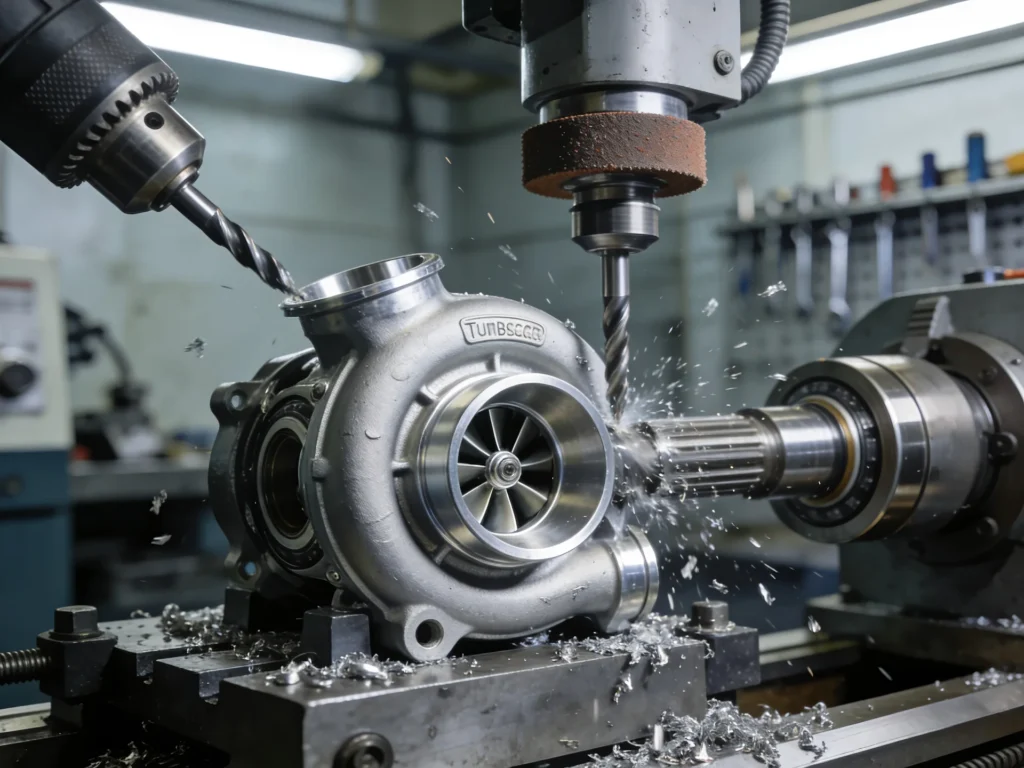 The Hidden Complexities: Why Standard Machining Falls Short
To understand the solution, one must first grasp the anatomy of the problem. If you ask a junior engineer what are the parts of a turbocharger, they might list the basic components. However, an expert knows that each turbo part name represents a unique metallurgical and geometric challenge. A standard 3-axis CNC mill might handle simple brackets, but it may struggle with the intricate, multi-vane geometry of a compressor wheel or the heat-resistant requirements of a turbine housing.
When we look at the parts of a turbocharger system, we are looking at a symphony of components that must operate in perfect harmony. The parts of turbomachines are subject to extreme centrifugal forces. Any slight imbalance in the turbocharger components and functions can lead to catastrophic failure. For instance, the Center Housing Rotating Assembly (CHRA) acts as the heart of the system. If the bearing bores are not concentric to within a few microns, the shaft may oscillate, leading to oil seal failure and eventual engine damage.
Module 1: Defining the Core – Turbocharger Manufacturing Process
The turbocharger manufacturing process is a multi-stage journey that begins with high-grade raw materials and ends with rigorous balancing. Unlike simpler automotive parts, turbocharger parts machining involves a combination of heavy-duty material removal and delicate finishing operations.
At its core, the process relies on high-speed CNC turning and 5-axis milling. The 5-axis capability is particularly crucial for impellers and turbine wheels. These parts feature complex, overlapping blades that require the cutting tool to approach from multiple angles simultaneously. A turbocharger parts name like the “inducer” or “exducer” refers to specific zones on these blades where the geometry determines the entire unit’s efficiency. Jucheng utilizes state-of-the-art multi-axis centers to ensure these geometries are replicated exactly as designed in the CAD model, ensuring that the theoretical boost pressure becomes a reality.
Furthermore, the turbocharger components and functions dictate the choice of machinery. Turbine housings, often made from cast iron or high-nickel alloys, require high-torque milling to handle the toughness of the material. Conversely, the compressor wheel, typically machined from solid (MFS) aluminum, requires high-speed spindles to achieve the mirror-like surface finish necessary to minimize skin friction during air intake.
Module 2: Core Application Scenarios – Where Precision Meets Purpose
Where do these precision-machined parts end up? The applications for turbocharger parts machining are far-reaching, extending beyond just fast cars.
- Automotive Industry: This is the most visible sector. From small-displacement engines aimed at fuel efficiency to high-performance racing engines, the demand for lightweight and durable turbo components is constant.
- Marine Engineering: Large-scale diesel engines in ships rely on massive turbochargers to maintain power over long voyages. These parts must resist corrosion from salty environments, making material choice and coating even more critical.
- Power Generation: Industrial generators often use turbocharging to increase output. Here, the reliability of parts of a turbocharger system is paramount, as downtime can cost thousands of dollars per hour.
- Aerospace and Defense: Small UAVs (Unmanned Aerial Vehicles) and certain aircraft engines utilize specialized turbo-machinery to operate efficiently at high altitudes where the air is thin.
In each of these scenarios, the parts of turbomachines must be tailored to the environment. A marine turbocharger might prioritize longevity and corrosion resistance, while a racing turbocharger might prioritize weight reduction and rapid transient response. Jucheng excels in adapting its machining strategies to meet these diverse industry standards, ensuring that every turbo part name delivered is fit for its specific mission.
Module 3: Critical Buying Factors – How to Choose a Machining Partner
If you are in the market for turbocharger parts machining, you might feel overwhelmed by the number of suppliers claiming to be “the best.” However, savvy buyers focus on a few non-negotiable factors that separate the professionals from the amateurs.
The first factor is Material Expertise. Working with Inconel, Titanium, and Stainless Steel is not the same as working with mild steel. These materials may work-harden quickly or require specific coolant pressures to prevent tool breakage. A provider like Jucheng understands the molecular behavior of these metals under the heat of a cutting tool.
The second factor is Precision and Tolerance Control. When discussing what are the parts of a turbocharger, one must discuss the clearances between the turbine wheel and the housing. If the gap is too large, efficiency drops. If it is too small, thermal expansion may cause the parts to touch at high temperatures. Achieving a “tight” tolerance consistently across a production run is the hallmark of a high-end CNC shop.
The third factor is Quality Documentation and Certification. In industries like aerospace or high-end automotive, traceability is key. You may need material certs, CMM (Coordinate Measuring Machine) reports, and balancing certificates. Jucheng provides comprehensive documentation, ensuring that every turbocharger parts name on your packing list is backed by data.
| Factor | Standard Requirement | Jucheng Premium Standard |
|---|---|---|
| Dimensional Tolerance | +/- 0.05mm | Up to +/- 0.005mm for critical bores |
| Surface Roughness (Ra) | 0.8 – 1.6 μm | Down to 0.2 μm for aerodynamic surfaces |
| Material Versatility | Aluminum & Steel | Inconel, Titanium, Cobalt-Chrome, Superalloys |
| Balancing | Static Balancing | Dynamic high-speed VSR balancing support |
| Lead Time | 6-8 Weeks | Flexible scheduling with rapid prototyping options |
Module 6: Why Jucheng is the Answer to Your Machining Problems
Choosing Jucheng for your turbocharger parts machining needs is not just about buying a part; it is about investing in a partnership. In the current global supply chain, reliability is the rarest commodity. Many shops might accept a complex job but then struggle with the turbocharger manufacturing process, leading to delays and “out of spec” components. Jucheng mitigates this risk through a combination of veteran expertise and cutting-edge technology.
Our facility is equipped with the latest CNC technology, but more importantly, our engineers have a deep understanding of turbocharger components and functions. When a client sends a design for a new turbine wheel, we don’t just hit “start” on the machine. We review the design for manufacturability (DFM). We might suggest a slight change in a fillet radius that could significantly improve tool life and surface finish without compromising the part’s performance. This proactive communication is what users on professional networks often cite as the difference between a “vendor” and a “partner.”
Furthermore, Jucheng maintains a strict ISO-compliant quality management system. We know that a failure in a turbo part name like a wastegate actuator or a thrust bearing can lead to catastrophic engine failure. Therefore, we treat every component as if it were going into a mission-critical application. Our dedication to turbocharger parts machining excellence ensures that your project moves from the prototype phase to the market with maximum speed and minimum stress.
Module 4: Installation and Turbocharger Servicing Essentials
Even the most perfectly machined part can fail if not handled correctly during the turbocharger servicing or installation phase. Once Jucheng delivers your high-precision components, certain protocols should be followed to ensure longevity.
Priming the system is perhaps the most critical step. Before the first start-up after turbocharger servicing, the oil galleries must be filled. Running a turbo dry for even a few seconds can destroy the precision-machined surfaces of the bearings. Furthermore, ensuring that the intake and exhaust manifolds are free of debris is vital. A tiny piece of leftover grit can act like a bullet when it hits a compressor wheel spinning at supersonic speeds.
Regular maintenance also involves inspecting the parts of a turbocharger system for signs of wear. Look for “shaft play”—any axial or radial movement beyond the specified limit indicates that the bearings or the shaft itself may be wearing down. By understanding the turbocharger components and functions, technicians can catch small issues before they become total system failures. High-quality turbocharger parts machining provides a robust foundation, but proper care is what allows those parts to reach their full service life.
Module 5: FAQ – Your Questions About Turbocharger Parts Machining
- What is the most difficult part of a turbocharger to machine?
The turbine wheel and the compressor impeller are generally considered the most difficult due to their complex 5-axis geometries and the requirement for perfect dynamic balance. - Why is material selection so important for turbocharger parts?
The exhaust side of a turbocharger operates at extreme heat. Materials like Inconel are used because they maintain their structural integrity and resist oxidation at temperatures where normal steel would soften. - Can CNC machining improve the performance of an OEM turbo?
Yes. Through a process often called “blueprinting,” turbocharger parts machining can be used to achieve tighter tolerances and smoother surface finishes than mass-produced factory parts, resulting in better airflow and faster spool times. - What is the typical tolerance required for a turbo shaft?
Turbo shafts often require tolerances in the range of 5 to 10 microns (0.005mm to 0.010mm) to ensure they sit perfectly within the bearing housing. - How does Jucheng ensure the quality of complex internal bores?
We use specialized bore gauges and CMM probes to verify that internal diameters are round, straight, and within the specified size limits throughout the entire length of the part. - What are the signs of a poorly machined turbo part?
Excessive noise (whining), slow boost buildup, oil leakage, and visible scoring on the housing walls are all common symptoms of substandard manufacturing. - Does Jucheng offer prototyping for new turbo designs?
Absolutely. We work closely with R&D departments to produce small-batch prototypes for testing before moving into full-scale production. - What certifications should a turbocharger parts manufacturer have?
At a minimum, ISO 9001 is essential. For aerospace-related turbo-machinery, AS9100 is often required.
Conclusion: Elevating Your Engineering with Precision
The journey from a raw block of metal to a high-speed turbocharger parts machining masterpiece is one of technical precision and unwavering attention to detail. Whether you are dealing with the parts of turbomachines for a massive container ship or a high-performance sports car, the principles remain the same: quality materials, expert machining, and a deep understanding of the parts of a turbocharger system.
Don’t let manufacturing limitations throttle your innovation. When you partner with Jucheng, you gain access to a world-class turbocharger manufacturing process designed to solve your most complex engineering challenges. We invite you to experience the difference that true precision makes.
Are you ready to optimize your turbocharger performance? Contact Jucheng today for a technical consultation and quote on your next turbocharger parts machining project. Let’s build something powerful together.