
Introduction: The Critical Role of Precision in Actuator Housing Machining
In the world of motion control, where robotic arms execute sub-millimeter movements and aircraft flight surfaces adjust with life-critical reliability, the unsung hero is often the actuator housing. This structural shell is far more than a simple container; it is the foundational chassis that dictates the performance, longevity, and safety of the entire actuation system. The machining of this component is not a secondary manufacturing step—it is a primary engineering challenge where precision is non-negotiable. A deviation of a few microns in a bore’s diameter or a slight imbalance in wall thickness can lead to premature bearing wear, misalignment of internal gears, inefficient motor operation, or catastrophic structural failure under load. In industries like aerospace and robotics, the margin for error approaches zero, making the choice of manufacturing partner and process a decision that directly impacts innovation and operational integrity. This article delves into the intricate world of actuator housing machining, exploring the materials, advanced processes, and relentless focus on quality that transform raw metal into the backbone of modern automation.
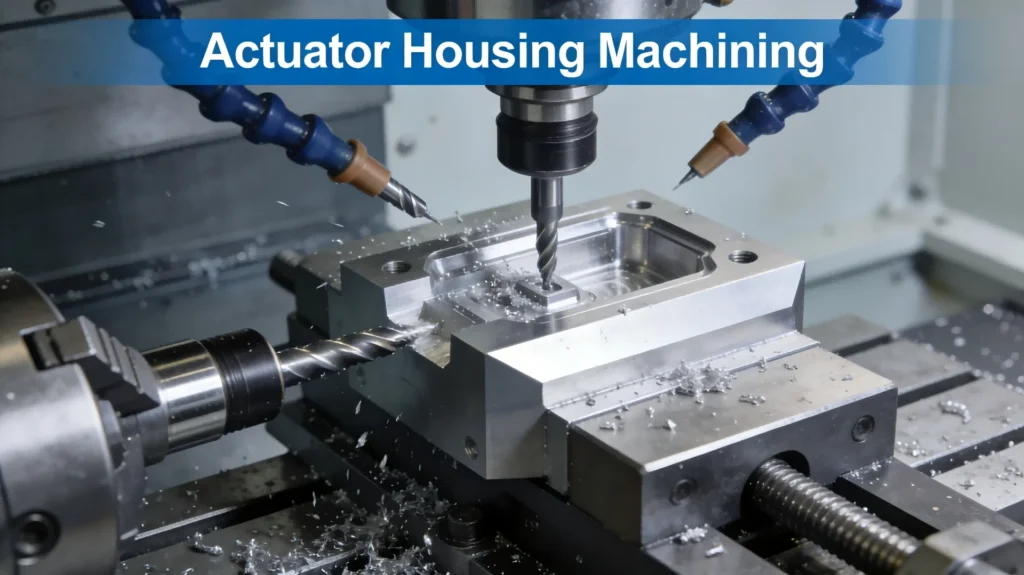 What is Actuator Housing Machining? Defining the Core Component
An actuator housing is the precision-machined enclosure that contains and protects the core components of an actuator—the motor, gears, lead screws, bearings, and feedback sensors. Think of it as the skeleton and armor of the system. Its primary functions are multifaceted: it provides rigid structural support to maintain perfect alignment of all moving parts, manages thermal loads by dissipating heat from the motor and electronics, offers environmental sealing against contaminants like dust and moisture, and often incorporates intricate mounting interfaces for easy integration into larger assemblies like a robot joint or an aircraft wing.
The machining process is what transforms a forged block or casting of metal into this sophisticated component. It involves the systematic removal of material using computer-controlled cutting tools to create specific geometric features. These features include precision bores for bearings, threaded ports for sensors and lubrication, complex contours for weight reduction and coolant flow, and meticulously flat sealing surfaces. The complexity of modern housings, which often integrate multiple functions into a single, compact unit to save space and weight, pushes conventional machining to its limits. This is why defining actuator housing machining simply as “making a box” is a profound understatement. It is the creation of a high-tolerance, multifunctional mechanical ecosystem where every internal surface and external flange plays a critical role in the system’s final performance.
Key Materials for Actuator Housings: From Aluminum Alloys to Advanced Composites
The selection of material for an actuator housing is a foundational decision that balances strength, weight, thermal properties, machinability, and cost. The right choice is dictated by the application’s operational demands.
Aluminum Alloys: The Workhorse for Lightweight Performance
Aluminum alloys, particularly the 6000 series like 6061-T6, are the most prevalent choice for a wide range of applications, from industrial robotics to e-mobility. As highlighted in our knowledge base, 6061-T6 offers an “optimal balance between lightweight properties and structural strength—essential for robotic motion modules that require both agility and load-bearing capacity.” Its excellent machinability allows for high material removal rates and the creation of complex thin-walled features with good surface finish. Furthermore, aluminum naturally dissipates heat effectively, a crucial property for housings containing electric motors. For applications demanding even higher strength-to-weight ratios, such as in high-performance robotics or aerospace, 7075 aluminum alloy is often specified, though it can be more challenging to machine.
Stainless Steels and Alloy Steels: For Strength and Durability
When the application involves extreme loads, high shock resistance, or operation in corrosive environments, stainless steels (like 304 or 316) and alloy steels (like 4140) are selected. These materials provide superior tensile strength and hardness compared to aluminum. They are common in heavy-duty industrial automation, marine applications, and aerospace actuation systems where reliability under stress is paramount. However, this strength comes with trade-offs: increased weight and greater difficulty in machining, which can impact production time and tooling costs.
Advanced Composites and Titanium: Pushing the Boundaries
At the cutting edge of performance, especially in aerospace and high-end motorsports, materials like titanium and advanced composites enter the fray. Titanium offers a phenomenal strength-to-weight ratio and exceptional corrosion resistance, making it ideal for the most demanding airborne actuator systems. Machining titanium is a specialized art, requiring slow speeds, high rigidity, and advanced tooling to manage heat and prevent work hardening. Composites, while less commonly machined into full housings, are increasingly used for certain components or as cladding to reduce weight without sacrificing stiffness. The machining of these non-metallic materials requires entirely different techniques, such as diamond-coated tooling and specialized dust extraction, to achieve the required precision without delamination or fraying.
The choice is never made in isolation. As referenced in the knowledge base from MAPAL, the material’s behavior during “large-scale series production” is a key factor. Cast aluminum housings, for instance, may have draft angles and inconsistent stock, requiring tooling and processes robust enough to handle significant material variation while still holding tight tolerances.
Core Machining Processes: CNC Turning, Milling, and 5-Axis Contouring
The creation of a precision actuator housing is a symphony of coordinated machining operations. Each process is selected based on the geometric feature being produced, with the goal of achieving maximum accuracy and surface integrity in the most efficient sequence.
CNC Turning: Mastering Rotational Symmetry
CNC turning is the go-to process for features that are radially symmetrical about a central axis. Performed on a lathe, where the workpiece rotates and a stationary cutting tool removes material, turning is ideal for machining the outer diameters, facing ends to create flat sealing surfaces, and boring precise internal diameters (IDs) of cylindrical housings or sub-sections. For actuator housings, turning is critical for creating the main bearing journals and motor mount bores, where concentricity and surface finish are vital for smooth rotation and long service life. Many complex housings start as a turned blank before moving to a milling machine for additional features.
CNC Milling: The Art of Three-Dimensional Contouring
CNC milling is the versatile workhorse for creating the majority of an actuator housing’s geometry. A rotating cutting tool moves along multiple linear axes (X, Y, Z) to machine flat faces, slots, pockets, and complex contours. As described in the product specification for a robotic linear actuator housing, “CNC Vertical Milling (including drilling, tapping, and precision hollow milling)” is employed to create the structural frame, mounting bosses, and internal cavities. Milling operations define the housing’s external shape, machine the interfaces for gear trains, and create the network of threaded holes (tapping) for assembling internal components and external covers. The precision of these features, with hole position tolerances as tight as ±0.01 mm, is what ensures seamless assembly and optimal function of the actuator.
5-Axis Contouring: Unlocking Unprecedented Geometric Freedom
For the most complex actuator housings, 3-axis milling reaches its limitations. This is where 5-axis CNC machining becomes a game-changer. A 5-axis machine can move the cutting tool or the workpiece along five different axes simultaneously (three linear and two rotational). This capability allows the tool to approach the workpiece from virtually any angle in a single setup. The advantages for actuator housing machining are profound. First, it enables the “simultaneous 5-axis contouring of helical gear teeth and other complex internal geometries” directly into the housing, as noted in the case study on robotic actuator housings. This eliminates the need for secondary operations and guarantees perfect alignment. Second, it allows for the machining of undercuts, angled ports, and sculpted surfaces that are impossible with a 3-axis approach. Third, by completing the vast majority of the part in one clamping, as seen with the Mori Seiki NMV3000 machining a complex housing in a “single operation,” it eliminates errors that can accumulate from moving and re-fixturing the part between setups. This single-setup machining is critical for maintaining the ultra-tight tolerances and positional accuracies required in high-performance applications.
These core processes are rarely used in isolation. A typical high-precision housing will undergo a carefully orchestrated sequence: rough turning or milling to remove bulk material, semi-finishing, and then a final finishing pass with specialized toolpaths to achieve the final dimensions and surface quality. Throughout, considerations like thermal management (to prevent part distortion from machining heat) and thin-wall machining strategies (to prevent chatter and deflection) are paramount, setting the stage for the high-tolerance challenges that define this field.
Overcoming High-Tolerance Challenges: Precision, Thermal Management, and Thin Walls
The orchestrated sequence of core machining processes culminates in confronting the most demanding aspects of actuator housing machining: achieving micron-level precision while managing thermal effects and structural fragility. These challenges are not isolated; they are interconnected puzzles that must be solved simultaneously to produce a housing that meets stringent functional specifications.
Precision in this context extends beyond simple dimensional accuracy. It encompasses geometric tolerances like concentricity, perpendicularity, and true position of bearing seats, sensor mounts, and gear interfaces. A deviation of a few microns in the alignment of a bearing bore can lead to premature wear, increased friction, and catastrophic failure in a high-speed robotic or aerospace actuator. The references highlight that maintaining such precision requires a holistic approach, starting with machine tool rigidity and thermal stability, extending to toolpath strategies that minimize tool deflection and adaptive control systems that compensate for tool wear in real-time.
Thermal management is a dual-front battle. First, there is the heat generated by the cutting process itself. Uncontrolled, this heat transfers into the workpiece, causing localized thermal expansion that distorts the part during machining. When the part cools, it contracts, leading to out-of-tolerance dimensions. Strategies to combat this include using high-pressure coolant systems that precisely target the cutting edge, employing trochoidal or peel milling techniques that reduce heat buildup by keeping the tool in constant, light engagement, and allowing for thermal stabilization periods between roughing and finishing operations. Second, for housings that will enclose electric motors or high-performance gearboxes, the design often incorporates integrated cooling channels. Machining these thin, winding internal passages without breaking through the housing wall adds another layer of complexity, often requiring specialized tooling and precise control of drilling depths and angles.
Perhaps the most visually delicate challenge is machining thin walls. As noted in the e-mobility context, electric motor housings often feature thin walls for weight reduction and to accommodate cooling channels, making them prone to natural oscillation and distortion under machining forces. The “bell-like shape” mentioned is a classic example. The solution lies in a combination of intelligent fixturing, toolpath optimization, and tool selection. Fixturing must support the part uniformly to dampen vibration without inducing clamping distortion. Toolpaths are programmed to take light, finishing passes with sharp tools, often climbing mill to push the thin wall against the solid material behind it rather than pulling it away. Specialized tools with high rake angles and variable helix designs are used to shear the material cleanly with minimal radial force, preventing chatter—a destructive vibration that can ruin surface finish and dimensional accuracy.
The 5-Axis CNC Advantage for Complex Actuator Housing Geometries
When the challenges of precision, thermal management, and thin walls are combined with highly complex, organic geometries, the limitations of 3-axis machining become apparent. This is where 5-axis CNC machining transitions from an advantage to a necessity. The ability to manipulate the cutting tool or the workpiece along five axes simultaneously unlocks the capability to machine intricate features in a single, streamlined setup.
The primary benefit is unparalleled access. Complex housings for robotics or aerospace often feature deep cavities, undercuts, and compound angles that are simply unreachable with a standard 3-axis mill. A 5-axis machine can tilt and rotate the spindle or the part to orient the cutting tool perpendicular to the surface being machined, even if that surface is on the side of a deep pocket or at a steep angle. This is critical for features like the helical gear teeth mentioned in the robotic actuator case, where the tool must follow a complex, twisting path to accurately form the gear profile. With 3-axis machining, this would require multiple specialized fixtures and setups, each introducing potential alignment errors.
Beyond access, 5-axis contouring enables superior surface finish and accuracy on complex curves. By maintaining the optimal cutting angle (tool lead and tilt) relative to the contoured surface, the machine uses the side of the end mill more effectively than the tip, which improves finish and extends tool life. This “simultaneous 5-axis contouring” allows for the smooth machining of aerodynamic surfaces on aerospace housings or the ergonomic, sculpted forms found in advanced robotic joints. The Mori Seiki NMV3000 example, which completes a complex part in a “single operation,” is a testament to this capability. By eliminating multiple setups, it ensures that all features are machined in perfect spatial relationship to one another, directly addressing the high-tolerance positional accuracy requirements.
Furthermore, 5-axis machining can often use shorter, more rigid cutting tools because the head can be tilted to reach into areas that would otherwise require a long, flexible tool prone to deflection. Reduced tool deflection means more consistent cuts, better surface finishes, and the ability to hold tighter tolerances, especially on deep features. This integrated approach consolidates what was once a multi-machine, multi-setup job into a single, highly efficient process, reducing lead time, labor, and the cumulative error stack-up that is the enemy of ultra-high precision.
From Prototype to Production: Scalability and Process Optimization
The journey from a validated prototype to reliable, cost-effective volume production is a critical phase in actuator housing manufacturing. The strategies that work for one-off or low-volume parts often do not scale efficiently. The transition demands a deliberate shift in focus from pure capability to optimized, repeatable process control.
In prototype and low-volume runs, the priority is flexibility and speed to market. Machining might utilize more generalized tooling and conservative, safe toolpaths to ensure the part is made correctly the first time. However, as volumes scale—particularly in industries like automotive e-mobility—every second of cycle time and every tool change has a magnified impact on unit cost. Here, process optimization becomes paramount. This involves designing dedicated, multi-function tooling, like the custom fine boring tools with welded designs mentioned by MAPAL for electric motor housings. These tools consolidate multiple operations (e.g., pre-machining, semi-finishing, and fine machining of a stator bore) into one, reducing non-cut time and improving accuracy.
Scalability also demands a rigorous analysis of the entire machining sequence for efficiency gains. For high-volume electric motor housing production, the process is broken down into stages: pre-machining the complex contour, then finishing the complete contour including critical bearing and stator bores. Each stage is optimized for speed and tool life. Chip management, often an afterthought in prototyping, becomes a critical concern; broken and efficiently evacuated chips are essential for uninterrupted production. The references note the use of special chip guiding stages and chip breaker geometries to ensure process-reliable chip breakage and removal in high-volume settings.
Another key aspect of scalability is designing for manufacturability (DFM) feedback loops. A close partnership between the design engineer and the manufacturing partner allows for subtle design modifications that dramatically improve producibility without compromising function. This might involve adjusting a corner radius to allow for a standard cutter size, adding a slight draft to a wall to facilitate tool access, or specifying tolerances that align with high-volume process capabilities. The goal is to create a production process that is not only fast and accurate but also robust—capable of running thousands of parts with minimal intervention and consistent quality, a necessity highlighted by the automotive industry’s move into large-scale electric motor production.
Quality Control and Inspection: Ensuring Actuator Housing Integrity
In high-stakes applications, the integrity of an actuator housing is non-negotiable. A comprehensive quality control (QC) and inspection regimen is the final, essential gatekeeper, verifying that every challenge of machining has been successfully overcome and that the part conforms to all design specifications. This goes far beyond a simple final check; it is an integrated philosophy that spans the entire manufacturing process.
First Article Inspection (FAI) is a critical starting point. When a new part is introduced or a process is significantly changed, every dimension and tolerance on the drawing is meticulously verified using high-precision equipment like Coordinate Measuring Machines (CMM). This creates a baseline and validates the manufacturing process. For production runs, statistical process control (SPC) takes over. Key characteristics—such as the diameter of a critical bearing bore or the true position of mounting holes—are measured at defined intervals. The data is charted to identify trends toward tolerance limits before any non-conforming parts are produced, allowing for proactive machine adjustment.
The tools of modern inspection are as advanced as the machining centers themselves. CMMs with touch-triggers or laser scanners can quickly and accurately map complex geometries, checking form, profile, and position tolerances in three dimensions. For internal features or to verify the integrity of thin walls, non-destructive testing methods like borescopes or even computed tomography (CT) scanning may be employed. Surface finish is measured with profilometers to ensure it meets specifications for sealing or bearing contact.
Perhaps the most crucial aspect of QC for actuator housings is the validation of assembly-critical features. The housing does not exist in isolation; it must interface perfectly with shafts, bearings, seals, and other components. Inspection, therefore, often includes functional gaging or assembly trials with mating parts. Ensuring that a gear train spins freely with minimal backlash, or that a sensor fits snugly in its machined pocket, is the ultimate test of machining quality. This rigorous, multi-layered inspection protocol, referenced in the context of high-tolerance manufacturing for robotics, provides the documented assurance that each actuator housing will perform its vital role reliably and safely in the field.